Overview

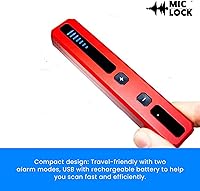
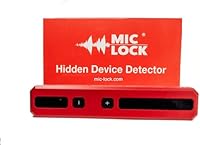
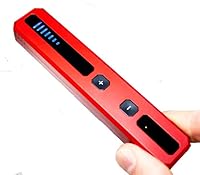
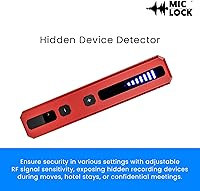
The Mic-Lock Frequency Detector RF Signal Finder is a compact, pen-sized device built for anyone who has ever walked into a hotel room or Airbnb and felt a nagging sense of unease. Privacy concerns around hidden cameras and listening devices have grown significantly in recent years, and this RF detector sits at an accessible price point that makes personal counter-surveillance practical for everyday people. Slim enough to toss in a jacket pocket, it targets travelers and renters who want a basic layer of reassurance without hiring a professional sweep team. It won't replace expert-grade equipment, but for casual personal use, that's not really the point.

Features & Benefits

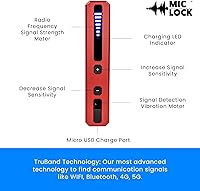
The signal finder uses what Mic-Lock calls TruBand technology to scan across a wide range of wireless signals — WiFi, Bluetooth, 4G, 5G, Z-Wave, Zigbee, and more. Sensitivity is adjustable, which matters in practice: start lower, then increase gradually as you move through a room. Three alert modes — LED flash, audible beep, and vibration — let you scan quietly when needed, a genuinely useful option in shared or public spaces. USB rechargeable and weighing just 4.6 ounces, it travels light. The IP54 rating adds a modest layer of durability against dust and the occasional splash. No complicated setup required; it's operational within seconds.

Best For

This bug detector makes the most sense for frequent travelers who regularly check into short-term rentals, boutique hotels, or other unfamiliar accommodations where privacy isn't guaranteed. It's also reasonable for homeowners or parents wanting a quick sweep when moving into a new space. The learning curve is essentially flat — hold two buttons, wait for power-on, scan one to two feet from surfaces. That said, keep expectations grounded: the device cannot detect cameras or recorders that aren't actively transmitting a signal. A powered-off device stays invisible to it. Anyone expecting professional sweep capability will likely come away disappointed.

User Feedback

Across more than 1,400 ratings, this RF detector holds a 3.6-star average — an honest score that reflects a product working well within a specific, limited context. Travelers frequently praise its portability and how little effort it takes to get up and running. The recurring criticism, though, is hard to ignore: false positives near household routers, smart TVs, and phones can make interpreting results genuinely confusing for first-time users. Some buyers also question whether every claimed frequency is reliably caught. On the positive side, the vibration alert mode earns consistent appreciation from reviewers scanning in quiet environments. For casual peace-of-mind use, many find it earns its spot in a travel bag.

Pros

  • Fits in a jacket pocket or toiletry bag — genuinely one of the most travel-friendly detectors in its category.
  • Zero setup required: charge it, power it on, and start scanning within seconds.
  • Vibration alert mode lets you sweep a hotel room quietly without alerting anyone nearby.
  • Detects a broad range of actively transmitting signals including WiFi, Bluetooth, 4G, and 5G.
  • Adjustable sensitivity helps reduce noise in lower-signal environments when tuned carefully.
  • USB rechargeable via any standard cable — no proprietary charger to lose while traveling.
  • IP54 rating adds a small but meaningful layer of resilience for dusty or humid spaces like bathrooms.
  • No app, no account, no pairing required — works completely standalone out of the box.
  • Three distinct alert modes accommodate different accessibility needs and scanning situations.

Cons

  • False positives from everyday devices like routers and smart TVs make results hard to interpret without prior experience.
  • Cannot detect any camera or recording device that is not actively broadcasting a wireless signal.
  • No guidance provided on how to distinguish a genuine threat from normal ambient RF activity.
  • Sensitivity dial lacks labeled thresholds, leaving most users guessing at the right setting for their space.
  • Plastic build feels lightweight in a way that raises durability questions after extended travel use.
  • Audible beep has no volume control, which is awkward in shared or thin-walled accommodations.
  • Long-term reliability is sparsely documented, with some reviewers reporting degraded performance after several months.
  • Detection consistency across less common protocols like Z-Wave and Zigbee is questionable based on user testing.

Ratings

The scores below for the Mic-Lock Frequency Detector RF Signal Finder were generated by our AI system after analyzing verified buyer reviews from across global markets, with spam, bot-submitted, and incentivized feedback actively filtered out. Each category reflects the real distribution of praise and frustration found in authentic user experiences — nothing is smoothed over or inflated. Where buyers consistently hit walls, the scores show it honestly.
Ease of Use
83%
Most buyers comment on how refreshingly straightforward this signal finder is to operate — hold two buttons, wait a moment, then slowly scan a room. No app pairing, no manual-reading required. Travelers especially appreciate being able to run a sweep right after checking into a rental without any setup friction.
A few users noted the sensitivity dial can feel ambiguous — there is no clear labeling to indicate what level is appropriate for a given space. First-timers sometimes scan at too high a sensitivity and end up confused by constant alerts from their own devices.
Detection Accuracy
58%
42%
For detecting actively transmitting consumer devices like WiFi routers, Bluetooth speakers, and cellular-enabled gadgets, the bug detector does respond reliably. Users who tested it against known signal sources confirmed it picks up common frequencies without issue, which provides a reasonable baseline for casual sweeps.
The accuracy picture gets murkier when users expect more nuanced detection. Several reviewers reported missing signals they expected to catch, and others flagged inconsistent responses when scanning the same area twice. The device cannot detect anything that is not actively broadcasting, a fundamental limitation this category of product shares broadly.
False Positive Rate
44%
56%
Some buyers have learned to work around the false positive issue by first calibrating in a known-clean area and establishing a baseline reading. In low-signal environments, like rural accommodations or older buildings with fewer connected devices, the signal finder performs more cleanly.
This is the most common complaint in the review pool. In a typical modern home or hotel room — surrounded by smart TVs, routers, phones, and IoT devices — the RF detector triggers frequently on completely ordinary electronics. Distinguishing a genuine threat from ambient RF noise requires more technical knowledge than most casual users have.
Portability & Form Factor
91%
At 4.6 ounces and roughly the size of a thick marker, this RF detector genuinely earns its travel-friendly claim. It slides into a jacket pocket, toiletry bag, or carry-on without any bulk. Travelers consistently call out the compact design as one of the main reasons they bought it over larger, bulkier alternatives.
The slim plastic body, while convenient, feels lightweight in a way that reads as fragile to some users. A few noted the build does not inspire confidence for frequent handling, and the charging port cover — if present — was flagged as flimsy on certain units.
Alert System
78%
22%
The three-mode alert system — LED flash, beep, and vibration — covers a wider range of real-world situations than most competing devices at this price tier. The vibration mode in particular earned repeat praise from users who want to scan a hotel room quietly without alerting anyone nearby.
The audible beep is described by some reviewers as quite loud with no volume adjustment available, which makes it awkward to use in shared spaces like hostels or thin-walled vacation rentals. A low-volume mode or tone adjustment would meaningfully improve the experience.
Build Quality
61%
39%
The plastic housing is lightweight and the overall assembly feels reasonably consistent across units. For an indoor-use consumer device, the build is functional and the IP54 rating does give it a small edge in dusty or lightly humid environments like bathrooms.
Reviewers who expected a more premium feel given the price point were let down. The plastic casing flexes slightly under pressure, and the buttons have been described as mushy rather than tactile. Several users reported durability concerns after a few months of regular travel use.
Battery Life
72%
28%
Once fully charged, most users report the battery holds up adequately for several scanning sessions across a multi-day trip. The USB recharging makes it compatible with any standard phone charger or power bank, which is a practical choice for travelers already carrying those accessories.
The initial two-hour charge requirement before first use caught some buyers off guard, particularly those who opened the box expecting to scan immediately. Battery longevity over many months of ownership is also sparsely documented in reviews, leaving long-term performance uncertain.
Signal Range Coverage
63%
37%
The advertised spectrum — covering WiFi, Bluetooth, 4G, 5G, Z-Wave, Zigbee, and cellular bands — is impressively broad on paper. For everyday consumer threats like hidden WiFi cameras or Bluetooth trackers, the coverage is relevant and practical.
Several technically informed reviewers questioned whether all listed frequencies are detected with equal sensitivity or merely acknowledged in the spec sheet. Real-world testing against less common protocols like Z-Wave and Zigbee produced inconsistent results in the review pool, suggesting broader frequency claims should be taken with some caution.
Value for Money
67%
33%
For a buyer who simply wants a pocket-sized tool to feel more secure in unfamiliar accommodations, the price is justifiable. The device fills a real psychological need and performs adequately in low-signal environments, which covers a meaningful portion of its target use cases.
Those who approach this bug detector expecting professional-grade reliability tend to feel the price is not well-earned. Given the false positive issues and detection limitations, buyers with higher expectations would likely need to spend considerably more to get a tool that meets them.
Setup & Onboarding
86%
Literally no software, no app, and no account required. Charge it, power it on, and you are scanning within seconds. For non-technical users — parents, older travelers, or anyone who just wants simplicity — this zero-friction onboarding is a genuine plus.
The included documentation is thin, and the lack of a clear guide on how to interpret results is a recurring frustration. Users who get an alert have no reliable way to know if they are looking at a real concern or a neighbor's WiFi bleed through a shared wall.
Sensitivity Adjustment
69%
31%
Having an adjustable sensitivity range gives users more control than fixed-threshold detectors. When tuned carefully, it allows the device to cut through some of the background RF noise that would otherwise produce constant alerts in device-dense environments.
The adjustment range is not well-calibrated for communicating meaningful thresholds to users. There are no preset modes or labeled zones — just a dial — which leaves most casual users guessing rather than making informed adjustments based on their environment.
Discreetness
77%
23%
The slim red form factor does not scream security device, and the vibration-only mode lets users sweep a room without drawing attention. Guests who want to check a rental without making a scene find this aspect genuinely useful compared to larger, more conspicuous detectors.
The color red, while distinctive, is not exactly subtle. A few users noted they would prefer a more neutral color option for situations where discretion really matters. The audible beep mode undermines discreetness in practice unless deliberately avoided.
Durability Over Time
55%
45%
Short-term, the device holds up fine for occasional travel use. Users who take one or two trips per month and store it carefully between uses report no functional degradation over the first few months of ownership.
Longer-term feedback is thin but leans negative. The plastic casing shows wear relatively quickly, and a handful of reviewers reported the device stopped responding accurately — or altogether — after six to twelve months of regular use, raising questions about longevity.

Suitable for:

The Mic-Lock Frequency Detector RF Signal Finder is a practical fit for frequent travelers who regularly book short-term rentals, Airbnbs, or budget hotels and want a quick, low-effort way to check their surroundings before settling in. It works well for people who are not technically trained — the learning curve is essentially zero, and the three alert modes mean you can scan a room silently without drawing attention. Parents moving into a new home or homeowners hosting strangers through rental platforms will also find it useful as a basic sweep tool that takes seconds to deploy. If your goal is general peace of mind rather than forensic-level detection, this bug detector fills that role at an accessible price point without requiring any setup, apps, or expertise.
Not suitable for:

Anyone expecting professional-grade counter-surveillance capability will likely walk away disappointed by this signal finder. The device cannot detect cameras or recording equipment that are powered off or not actively transmitting a wireless signal — a fundamental limitation that applies to this entire category of consumer RF detectors, but one that matters enormously if your threat model goes beyond basic hidden WiFi cameras. Security professionals, private investigators, or corporate users conducting serious sweep operations need dedicated, calibrated equipment that costs significantly more and interprets results with far greater precision. People living in device-dense urban apartments or modern smart homes will also find the false positive rate genuinely frustrating — nearly every router, smart TV, and connected appliance in range will trigger the detector, making it hard to interpret what, if anything, is actually concerning. If you need definitive answers rather than a general alert, this tool is not the right one.

Specifications

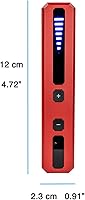
  • Dimensions: The device measures 4 x 1 x 1 inches, giving it a slim pen-style profile that fits easily in a pocket or small bag.
  • Weight: At 4.6 ounces (0.13 kg), the unit is light enough to carry daily without adding noticeable bulk to travel luggage.
  • Material: The outer housing is constructed from plastic, keeping the overall weight low while providing a basic level of structural protection.
  • IP Rating: The device carries an IP54 rating, indicating resistance to dust ingress and protection against water splashed from any direction.
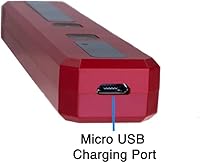
  • Power Source: The unit is powered by a built-in rechargeable battery that charges via an included USB cable.
  • Charge Time: Mic-Lock recommends a full 2-hour initial charge before the first use to ensure optimal battery performance.
  • Alert Modes: Three alert types are available: flashing LED indicator, audible beep, and physical vibration, which can be used independently or in combination.
  • Sensitivity: Sensitivity is user-adjustable, allowing the operator to dial down background RF noise or increase responsiveness depending on the environment.
  • Detected Signals: The device is designed to detect WiFi, Bluetooth, BLE, GSM, CDMA, 3G, 4G, 5G, Z-Wave, Zigbee, and general IoT wireless transmissions.
  • Detection Range: Mic-Lock recommends scanning at a distance of 1 to 2 feet from the surface or object being checked for reliable signal response.
  • Color: The device is available in red, making it visually easy to locate in a bag but not particularly discreet in appearance.
  • Included Items: Each unit ships with the RF device finder and one USB charging cable; no additional accessories are included in the box.
  • Recommended Use: The device is rated for indoor use and is intended for personal privacy sweeps rather than outdoor or professional field deployments.
  • Connectivity Tech: Detection is passive and wireless; the unit does not pair with any app, Bluetooth device, or external system to function.
  • BSR Ranking: As of the most recent data, the device holds the number 49 position in the Amazon Radio Scanners category.
  • First Available: The product was first listed for sale in July 2022, giving it a meaningful period of real-world buyer feedback to draw from.
  • Manufacturer: The device is designed and sold by Mic-Lock, a brand focused on personal privacy and anti-surveillance consumer tools.
  • UPC: The product UPC is 784718731868, which can be used to verify authenticity when purchasing from third-party sellers.

Related Reviews
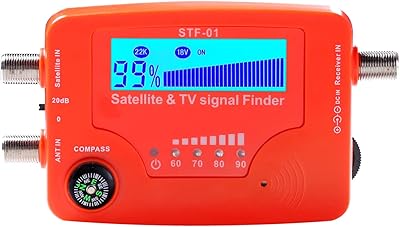
Weytoll STF-01 Digital Satellite and TV Signal Finder
84%
88%
Signal Accuracy
91%
Ease of Use
82%
Build Quality
93%
Portability
89%
Display Clarity
More
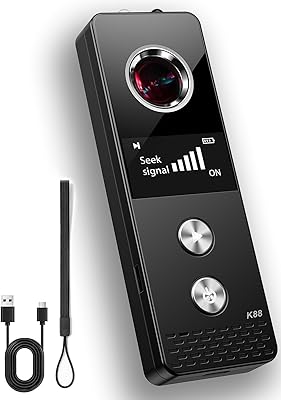
HUYNL K88 Hidden Camera and Bug Detector
75%
91%
Ease of Use
67%
Detection Performance
88%
Battery Life
93%
Portability
58%
False Positive Rate
More
Lixada Wired Fishing Finder Sonar Sensor
70%
88%
Ease of Setup
76%
Display Clarity
63%
Depth Detection Accuracy
72%
Bottom & Structure Detection
58%
Audible Fish Alarm
More
Venterior VT-FF005 Portable Castable Fish Finder
80%
91%
Ease of Setup
78%
Sonar Accuracy
84%
Display Readability
77%
Wireless Range & Connectivity
73%
Battery Life
More
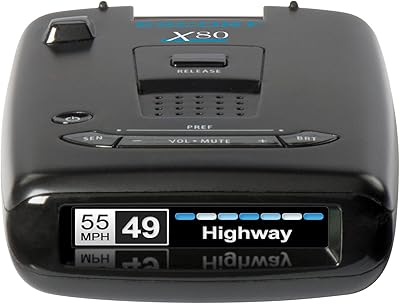
Escort X80 Radar Detector
84%
92%
Long-Range Detection
88%
Ease of Installation
84%
Voice Alert Customization
90%
App Integration (Escort Live)
80%
Accuracy of Alerts
More
Deeper START Castable Fish Finder
75%
88%
Ease of Setup
93%
Portability & Form Factor
67%
App Experience
71%
Sonar Accuracy & Fish Detection
76%
Battery Life
More
RICANK F12 Fish Finder
86%
89%
Ease of Use
92%
Portability
91%
Water Resistance
87%
Fish Location Accuracy
82%
Battery Life
More
XpacEbank Car Radar Detector
81%
85%
Detection Performance
90%
Ease of Setup
88%
Voice Alert Clarity
65%
False Alerts
89%
GPS Accuracy
More
MXL-603S Instrument Mic
84%
88%
Sound Quality
91%
Build Quality
82%
Ease of Setup
89%
Durability
86%
Value for Money
More
FYSCKEJI Smart Card Android Wallet Tracker
79%
91%
Ease of Setup
88%
Google Find Hub Integration
72%
Bluetooth Range
78%
Speaker Volume & Audibility
83%
Battery Life
More

FAQ

It detects the wireless signals that many hidden cameras transmit — things like WiFi or Bluetooth. If a camera is actively streaming or connected to a network, the signal finder will likely respond to it. However, if a camera is recording locally to a memory card and not broadcasting any signal, the device will not detect it. It is a wireless signal detector, not a camera detector specifically.

Honestly, yes — this is one of the most common frustrations buyers report. In any modern space loaded with routers, smart TVs, and phones, you will get alerts from perfectly innocent devices. The trick is to start with lower sensitivity and first scan an area you know is clean to establish a baseline, then methodically move toward objects you want to check. It takes a little patience to use effectively.

Press and hold both the plus and minus buttons simultaneously for about 2 seconds and it will power on. That is genuinely all there is to it. No pairing, no app, no menu navigation required.

The device is rated for indoor use, and its detection performance is optimized for enclosed spaces where signals are concentrated. In open outdoor environments, RF signals dissipate quickly and the detector may underperform. For vehicle sweeps, it can work in the cabin of a car since it is an enclosed space, but results will vary.

Mic-Lock does not publish a specific runtime figure, and buyer feedback on this point is mixed. Most users report it holds up across several scanning sessions during a multi-day trip, which is typically sufficient for the intended travel use case. Charging it overnight before a trip is a reasonable habit to build.

If you stay in short-term rentals or unfamiliar hotels even occasionally and the privacy concern is real to you, the cost is relatively easy to justify. It is compact enough to forget it is in your bag between trips. Just go in with realistic expectations about what it can and cannot detect.

It lets you scan a room completely silently, which is useful when you do not want anyone nearby to know you are running a sweep. Several reviewers specifically call this out as the most practical alert mode for real-world use in occupied or shared spaces.

No, and this applies to every consumer RF detector on the market. If a device is not transmitting a wireless signal, there is nothing for the bug detector to pick up. This is a fundamental limitation of the technology, not a flaw unique to this unit.

Yes — start by scanning a neutral area away from known devices and observe the baseline alert behavior at your chosen sensitivity level. Then lower the sensitivity dial until those ambient alerts quiet down, and use that as your working level. When something causes a noticeably stronger or more persistent response than your baseline, that is worth investigating further.

The device is designed to detect a broad spectrum of wireless communication protocols used globally, including GSM, CDMA, 3G, 4G, and 5G bands alongside WiFi and Bluetooth. There are no region-specific restrictions mentioned by the manufacturer, making it a reasonable travel companion for international trips.