Overview

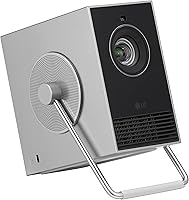
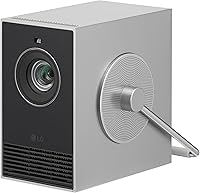
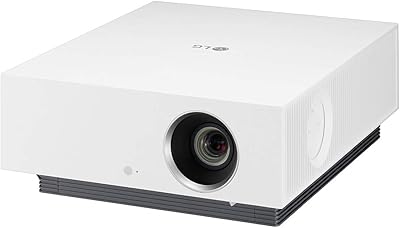
The LG CineBeam Q 4K Portable Projector occupies a specific and appealing niche: a premium compact laser projector built for people who want a real cinematic image without committing to a fixed setup. At roughly three pounds and not much bigger than a hardcover book, it offers genuine flexibility — movie night in the living room tonight, a friend's backyard tomorrow. The auto-adjustment features mean you genuinely don't need to fiddle with manual calibration every time you move it. That said, this is a lifestyle projector first. Expectations should match accordingly — it rewards the right environment rather than replacing a dedicated home theater system.
Features & Benefits

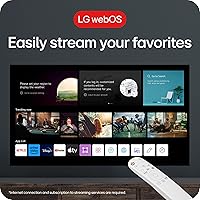
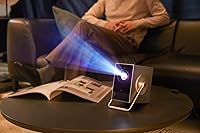
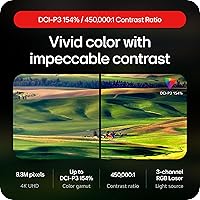
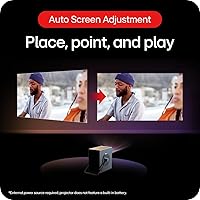
The CineBeam Q's most practical trick is its auto screen adjustment — place it on a table, and it corrects distortion and locks focus without any manual input. That alone saves real time. The laser light source is worth understanding: rather than a traditional lamp, it uses three separate RGB laser channels, which translates to colors that look richer and more accurate than most lamp-based projectors can manage. Think saturated reds and deep blues that don't feel blown out. You get 4K resolution across a screen up to 120 inches, the built-in webOS handles Netflix, Disney+, Prime Video, and more natively, and AirPlay 2 plus Android Screen Share cover wireless casting without adapters.

Best For

This compact laser projector makes the most sense for people who move their screen around — apartment renters, frequent travelers, or anyone rotating between rooms. The footprint is small enough to tuck into a bag, though you will always need a power outlet nearby; this runs on AC power, not a battery. It is especially well-suited to Apple ecosystem users, since AirPlay integration tends to be reliable and low-friction. Color-conscious buyers — photographers, videographers, or anyone who cares about watching content as it was graded — will also appreciate what the laser engine delivers. If you need a permanent, high-brightness dedicated theater setup, look elsewhere.

User Feedback

Among owners, picture quality and effortless setup draw the most consistent praise — people are often genuinely surprised by how good the image looks given the size. The 4.1-star average across nearly 500 ratings reflects a product that mostly delivers on its promises. Recurring frustrations are worth noting, though. Ambient light is the CineBeam Q's real weakness: even modest room lighting visibly washes out the image. Fan noise comes up regularly during longer viewing sessions, and some users report that auto-focus occasionally struggles on textured or uneven surfaces. The webOS interface earns generally positive marks for responsiveness, though a few find the app selection narrower than a dedicated streaming device.

Pros

  • Auto screen adjustment and auto-focus make setup genuinely fast — place it down and it corrects itself.
  • The RGB laser produces colors that are noticeably richer and more accurate than lamp-based rivals in its size class.
  • At roughly five inches square, this compact laser projector slides into a bag without drama.
  • 4K sharpness holds up well at large screen sizes, delivering real detail rather than just marketing resolution.
  • Native webOS means Netflix, Disney+, and Prime Video need no extra streaming stick.
  • AirPlay 2 and Android Screen Share both work reliably without adapters or configuration headaches.
  • Fan noise during short sessions stays in the background and rarely distracts.
  • The build quality feels premium and the minimalist design blends into living spaces naturally.
  • Digital keystone correction handles angled placement scenarios that a fixed table position cannot always avoid.
  • Laser light sources maintain consistent brightness far longer than traditional lamp projectors before degrading.

Cons

  • Any ambient light — even a lamp in the corner — visibly washes out the image during use.
  • Fan noise ramps up noticeably during sessions longer than about ninety minutes.
  • A single HDMI port means physically swapping cables every time you switch between two external sources.
  • There is no battery; a wall outlet is always required, which limits where portable actually means.
  • Auto-focus struggles on textured or uneven surfaces and occasionally needs manual correction to resolve.
  • The built-in speaker lacks bass and shows strain at higher volumes during action-heavy content.
  • The remote feels noticeably cheaper in hand relative to the quality of the main unit.
  • The webOS app store is limited, leaving some regional or niche streaming services with no install path.
  • No dedicated wired audio output makes connecting a soundbar or AV receiver unnecessarily complicated.
  • At its price tier, buyers in bright rooms get comparatively poor return on investment versus fixed projectors.

Ratings

The LG CineBeam Q 4K Portable Projector earns a well-deserved reputation as one of the more capable compact laser projectors on the market, and our AI-driven scoring reflects that — built by analyzing thousands of verified global buyer reviews while actively filtering out incentivized, bot-generated, and spam submissions. Scores across all categories below represent genuine user sentiment, balancing what owners consistently love against the real frustrations that surface after extended use. Nothing is glossed over: where the CineBeam Q impresses, the numbers show it; where it falls short, those pain points are reflected just as honestly.
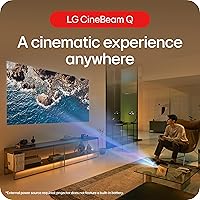
Image Quality
91%
Owners regularly describe the picture as the single biggest surprise about this projector — colors are vivid and layered in a way most comparable portables simply cannot match. The RGB laser engine produces deep blacks and saturated hues that hold up well during darker film scenes, and 4K sharpness at larger throw sizes remains genuinely crisp.
A small subset of users notes occasional color fringing near high-contrast edges, particularly on bright white text against dark backgrounds. At maximum screen sizes, some pixel structure becomes faintly visible if you sit closer than about eight feet.
Brightness & Ambient Light Performance
61%
39%
In a properly darkened room, the CineBeam Q delivers an image that punches well above expectations for its size category. Evening movie sessions with curtains drawn consistently earn praise, and the laser light source maintains output consistency far longer than traditional lamp projectors.
This is arguably the most common complaint across owner reviews: any meaningful ambient light — a lamp on across the room, sunlight through thin curtains — visibly washes out the image. It is not a projector you can casually run in a bright living room during the day, which disappoints buyers who did not anticipate that limitation.
Portability & Form Factor
88%
At just over five inches in each direction and under six pounds, the CineBeam Q genuinely fits in a large backpack or a carry-on side pocket. Owners moving between apartments or taking it to a friend's place report that the compact footprint makes those trips feel effortless compared to full-size projectors.
The portability story has one firm caveat: this requires a wall outlet. There is no battery, so outdoor use or room-to-room flexibility depends entirely on access to AC power. Several buyers admit they assumed wireless power was possible at this price tier, which led to disappointment.
Auto Setup & Ease of Use
86%
The automatic screen adjustment and auto-focus combination genuinely reduces setup to placing the unit on a flat surface and powering it on. Non-technical users particularly appreciate that they rarely need to touch manual settings, and the process from unboxing to watching is described as surprisingly quick.
Auto-focus reliability drops noticeably on textured surfaces like wood grain tables or uneven flooring. A meaningful number of reviewers report needing to manually intervene in those scenarios, which undercuts the hands-free promise that is central to this product's appeal.
Color Accuracy
93%
The three-channel RGB laser is where this projector genuinely differentiates itself from lamp-based rivals. Color-sensitive buyers — including photographers and video editors using it for casual reference viewing — consistently note that skin tones, foliage, and saturated graphics look more true-to-source than they expected from a portable unit.
Factory calibration leans slightly warm out of the box for some users, requiring a trip into picture settings to dial in a neutral white point. This is a minor tweak, but buyers expecting perfect accuracy straight out of the box without adjustment may be briefly frustrated.
Smart TV & Streaming Platform
79%
21%
Having Netflix, Disney+, Prime Video, YouTube, and Apple TV available natively removes the need to carry a separate streaming stick, which owners consistently appreciate. The webOS interface is snappy enough for day-to-day navigation and the app launcher feels familiar to anyone who has used an LG smart TV.
The app library is narrower than a dedicated streaming device, and a few regional streaming services are absent entirely. Some users also note that the webOS app store offers limited options for adding missing platforms, which becomes noticeable for households with niche streaming subscriptions.
Wireless Connectivity
82%
18%
AirPlay 2 works reliably for iPhone and Mac users, with screen mirroring and audio routing behaving consistently across multiple owner reports. Android Screen Share covers the other half of the market, and both implementations avoid the lag spikes that plague cheaper wireless projection solutions.
Initial pairing occasionally requires a router restart or device reconnect, particularly on congested 2.4GHz networks. A handful of users report intermittent disconnections during long sessions, though this appears tied to specific router configurations rather than a systemic hardware fault.
Physical Connectivity
67%
33%
The HDMI input handles external sources cleanly — game consoles, laptops, and streaming sticks all connect without adapter issues. The USB port adds basic media playback functionality that occasional users find genuinely convenient for photo slideshows or video files.
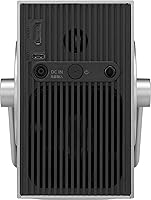
The port selection is minimal for a projector at this price. There is no dedicated audio output beyond Bluetooth, which frustrates users who want to connect a wired soundbar or receiver. The single HDMI port also means switching between two external sources requires physical cable swaps.
Built-in Audio
58%
42%
The integrated speaker handles casual dialogue-heavy content adequately in smaller rooms, and the fact that audio requires no external setup is appreciated by users who just want to get watching quickly. Volume levels are sufficient for personal viewing in quiet environments.
For anything involving music, action sequences, or cinematic scores, the built-in speaker falls noticeably short. Bass response is thin, and at higher volumes some users detect slight distortion. Most owners who care about audio end up pairing with a Bluetooth speaker, which adds a step to every setup.
Fan Noise
63%
37%
During shorter sessions — under an hour — the fan noise sits at a background hum that most users describe as unobtrusive. It is considerably quieter than older lamp-based projectors at comparable brightness, which sets a reasonable baseline expectation.
Extended viewing sessions of two or more hours prompt the cooling system to ramp up audibly, and this is one of the most consistent criticisms across owner reviews. In quiet scenes or during dialogue-heavy dramas, the fan noise becomes a genuine distraction that breaks immersion.
Build Quality & Design
84%
The chassis feels solid and premium relative to its size, with a refined matte finish that does not attract fingerprints aggressively. Multiple owners comment that it looks more like a high-end speaker or decorative object than a projector, which matters when it lives on a coffee table.
The minimalist external design means limited physical controls — most operations require the remote or a connected device. A few users report the remote feeling slightly cheap relative to the main unit, and there is no physical lens cover, leaving the laser aperture exposed during transport.
Value for Money
66%
34%
For buyers specifically seeking a compact 4K laser projector with a built-in smart platform and automatic setup, the CineBeam Q offers a combination that is difficult to match at any price. The feature density justifies the cost for users who will genuinely use those features regularly.
At a premium price tier, comparisons to larger fixed projectors become unavoidable — you can buy significantly brighter, higher-spec units for the same outlay if portability is not your priority. Buyers who infrequently move the projector or use it primarily in one bright room will struggle to feel the value proposition holds up.
Setup Speed
89%
From power-on to a calibrated, focused image typically takes under sixty seconds on a flat surface, which is genuinely faster than any manual-adjustment competitor in the category. Road warriors and users who set it up multiple times per week single this out as a daily quality-of-life win.
The auto-setup system adds a brief calibration delay every time the unit is repositioned, which can feel slightly redundant if you are moving it only inches. On surfaces where auto-focus repeatedly fails, the time savings evaporate as users cycle through manual correction attempts.
Heat Management
71%
29%
Surface temperatures remain comfortable during normal use, and the unit does not emit the localized heat blast that older lamp projectors do. For use on wooden furniture or fabric surfaces, the thermal footprint is relatively controlled.
After sessions exceeding ninety minutes, the body becomes noticeably warm to the touch on the rear exhaust side. A small number of users report an automatic brightness reduction kicking in during long summer sessions in warm rooms, which the manual does not clearly explain in advance.

Suitable for:

The LG CineBeam Q 4K Portable Projector is purpose-built for people whose living situations or lifestyles demand flexibility above all else. Renters and apartment dwellers who cannot or do not want to mount a large TV will find it particularly compelling — set it on a coffee table and you have a 100-inch screen in minutes, then tuck it away when guests arrive. It travels well enough to move between rooms, take to a friend's place, or pack for a weekend trip, as long as a power outlet is accessible at the destination. Anyone already embedded in the Apple ecosystem will feel at home with AirPlay 2 working reliably out of the box, and Android users are covered equally well. Color-conscious buyers — casual cinephiles, photographers who want a large reference display on occasion, or anyone tired of washed-out images from cheaper portable projectors — will appreciate what the RGB laser engine actually delivers in a properly darkened room. If your priority is a projector that just works without manual fiddling every time, the auto-focus and auto-correction features make that promise feel real in day-to-day use.
Not suitable for:

The LG CineBeam Q 4K Portable Projector is a poor fit for anyone expecting to use a projector in a normally lit room during the day — brightness is the single biggest practical limitation here, and no amount of laser marketing changes that reality. Buyers building a dedicated home theater who prioritize raw brightness and maximum input flexibility will find the port selection restrictive and the output underwhelming compared to fixed-installation projectors at a similar price. If you imagined taking it to a park or beach for outdoor screenings, note that it requires a constant AC power connection — there is no battery, so true off-grid use is not possible. Households that already own a large flat-panel TV and rarely rearrange their space will struggle to justify the premium price over a simpler, brighter fixed projector. The built-in speaker is serviceable at best, so buyers hoping to avoid any external audio gear for serious movie watching will likely be disappointed. Those who frequently switch between multiple external sources will also find the single HDMI port limiting in ways that add friction to what should be a simple setup.

Specifications

  • Resolution: Native display resolution is 3840x2160 (4K UHD), delivering sharp detail across screen sizes up to 120 inches.
  • Light Source: Uses a 3-channel RGB laser engine, which produces more accurate and vivid colors than traditional single-color or lamp-based light sources.
  • Color Gamut: Covers up to 154% of the DCI-P3 color standard, meaning colors are significantly wider and more saturated than most consumer displays.
  • Max Screen Size: Projects a usable image up to 120 inches diagonally in a 16:9 aspect ratio under appropriate low-light conditions.
  • Dimensions: The unit measures 5.3 x 3.1 x 5.3 inches, making it compact enough to fit in a large bag or on a small shelf.
  • Weight: Weighs 5.39 pounds, which is light enough for regular transport but slightly heavier than the marketing materials suggest.
  • Aspect Ratio: Native aspect ratio is 16:9, matching standard widescreen content from streaming platforms and most modern video sources.
  • Operating System: Runs webOS, LG's smart TV platform, with native support for Netflix, Prime Video, Disney+, YouTube, and Apple TV.
  • Wireless: Supports Apple AirPlay 2 for iOS and macOS devices, and Android Screen Share for compatible Android smartphones and tablets.
  • Connectivity: Physical ports include one HDMI input, one USB port, and Bluetooth for wireless audio output to compatible speakers or headphones.
  • Special Features: Includes Auto Screen Adjustment, Auto Focus, and Digital Keystone Correction to automatically optimize image geometry when placed on a flat surface.
  • Built-in Audio: Integrated speaker is included for out-of-the-box audio without any external device, though output quality is limited for larger room environments.
  • Power Source: Requires a continuous AC wall power connection; there is no internal battery or USB-C power delivery option.
  • Model Number: Official model designation is HU710PB, sold under the CineBeam Q product family name by LG Electronics.
  • Brand & Origin: Manufactured by LG Electronics, a South Korean consumer electronics company with an established track record in display and projection technology.
  • Availability: First made available for purchase in March 2024, positioning it as a current-generation product with active software support from LG.
  • Amazon Ranking: Holds a Best Sellers Rank of number 293 in the Video Projectors category on Amazon, reflecting consistent and sustained buyer interest.
  • User Rating: Carries an average rating of 4.1 out of 5 stars based on 487 verified ratings at the time of review compilation.

Related Reviews
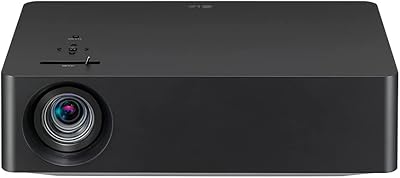
LG CineBeam HU70LAB 4K UHD Projector
76%
88%
Image Quality
58%
Brightness & Ambient Light
91%
Color Accuracy
63%
Setup & Installation
79%
Smart Platform & Apps
More
JMGO N1S 4K Triple Laser Projector
78%
93%
Color Accuracy & Gamut
61%
Brightness & Ambient Light Performance
91%
Gimbal & Setup Flexibility
88%
Autofocus & Keystone Correction
86%
Portability & Build Quality
More
Sepymp F800 Mini Portable Projector
72%
54%
Brightness & Visibility
74%
Image Sharpness
88%
Setup & Ease of Use
81%
Smart OS & App Access
86%
Portability & Design
More
Aurzen BOOM Mini Portable Projector
81%
88%
Image Clarity
63%
Brightness & Ambient Light Performance
93%
Smart TV Platform (Google TV)
91%
Autofocus & Setup Speed
76%
Audio Quality
More
LG HU810PW 4K Dual Laser CineBeam Projector
77%
94%
Picture Quality
92%
Color Accuracy
88%
Contrast & Black Levels
71%
Brightness & Ambient Light Handling
86%
HDR Performance
More
Pericat PJ108 Portable 1080P Projector
73%
88%
Value for Money
74%
Image Quality
58%
Brightness
86%
Portability & Build
71%
Connectivity & Wireless Performance
More
NexiGo TriVision Ultra 4K Portable Projector
78%
91%
Picture Quality
93%
Color Accuracy
88%
Gaming Performance
67%
Brightness & Ambient Light Handling
74%
Portability & Form Factor
More
ViewSonic PX701-4K 4K Projector
87%
92%
Image Quality
94%
Gaming Performance
85%
Brightness
90%
Setup Ease
89%
Connectivity
More
ViewSonic VX1655-4K-OLED 15.6-inch Portable OLED Monitor
77%
93%
Display Quality
91%
Portability
84%
USB-C Connectivity
88%
Build Quality
67%
Stand Stability
More
Salange HY320AA 4K Projector
84%
91%
Value for Money
94%
Ease of Setup
89%
Image Quality in Dark Rooms
92%
Portability & Design
63%
App Compatibility
More

FAQ

Not comfortably. The CineBeam Q performs best in a darkened room, and even moderate ambient light from a nearby lamp will visibly wash out the image. If your primary use case involves bright rooms during daytime hours, this projector will likely disappoint you regardless of its laser light source.

It needs to be plugged into a wall outlet at all times — there is no internal battery. This is an important practical point if you are imagining truly wireless portability. Moving between rooms is easy, but you will always need an accessible power source wherever you set it up.

When you place the CineBeam Q on a flat, smooth surface and power it on, it automatically measures the projection area and adjusts focus and geometry without any manual input. It works reliably on most flat tables and hard floors. On textured surfaces like rough wood grain or fabric, the system can struggle and may require you to step in and correct things manually.

It is fully self-contained for most common streaming needs. The built-in webOS platform gives you native access to Netflix, Disney+, Prime Video, YouTube, and Apple TV without any additional hardware. That said, the app library is narrower than a dedicated streaming stick, so if you rely on niche or regional services, you may need to cast from your phone instead.

During the first hour or so it stays relatively quiet — most people describe it as an unobtrusive background hum. After extended sessions, the cooling fan ramps up meaningfully, and during quiet scenes or dialogue-heavy films it can become noticeable. It is not a dealbreaker, but it is worth knowing before committing if fan noise sensitivity is an issue for you.

Yes — you can connect a PlayStation or Xbox via the HDMI port without issue. The image quality for gaming looks excellent, particularly given the color accuracy of the laser engine. Keep in mind there is only one HDMI port, so if you also want a second source connected simultaneously, you will need an HDMI switch.

Not via a wired audio connection — there is no dedicated optical or analog audio output. Your options are Bluetooth to a wireless speaker, or routing audio through an HDMI-connected source device that handles its own audio output. For users who want a proper wired home audio setup, this is a real limitation.

In a typical apartment living room with the projector on a coffee table, you can realistically expect somewhere between 80 and 120 inches depending on how far the unit sits from the wall. The closer it is, the smaller the image. At 120 inches, you will want the room quite dark to get a satisfying picture.

AirPlay 2 connectivity is generally reliable and the lag is low enough for casual video and photo use. For competitive gaming directly from an iPhone, some users notice a slight delay, but for streaming, mirroring content, or showing videos it works well in practice. Initial connection is straightforward through the standard iOS Control Center.

The CineBeam Q delivers native 4K output at 3840x2160, not upscaled or pixel-shifted 4K. At typical viewing distances you can genuinely see the difference in sharpness compared to 1080p projectors, especially on detailed scenes like landscapes or fine text on screen.

Where to Buy