Overview

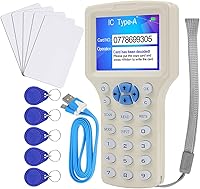
The LEXI NS208 RFID Card Reader Writer Duplicator is a mid-range USB device built for IT technicians, facility managers, and hands-on hobbyists who need to read, clone, or write access cards across multiple frequency standards. It handles both older 125KHz systems and modern 13.56MHz NFC-based cards — a meaningful range that covers most real-world access control setups. One important caveat upfront: Windows-only software means Mac and Linux users are simply out of luck. To its credit, LEXI is also refreshingly candid about the device's limitations, openly stating it won't match every card type in existence. That transparency is worth something — it sets practical expectations before you buy.
Features & Benefits

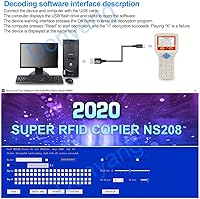
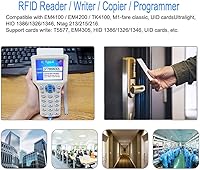
What makes the LEXI card copier stand out in a crowded field is its 10-frequency coverage, stepping through increments from 125KHz all the way up to 13.56MHz. In plain terms, that means it can handle the old-school proximity cards found in aging office buildings as well as the newer NFC-based fobs used in modern systems. HID Prox card support — covering models 1386, 1326, and 1346 — is genuinely uncommon in this category and a real draw for anyone working in corporate access control. It also reads and writes Mifare Classic, NTAG, T5577, and EM-format cards. The device connects via USB Type-A and draws power directly from the port, so there's no adapter or battery to manage. For supported 13.56MHz cards, it can also decode encrypted data, though that function requires an active PC connection.

Best For

This RFID duplicator slots in well for a specific type of user. IT admins overseeing access systems in corporate or multi-tenant buildings will appreciate the HID compatibility — replacing lost cards in-house rather than waiting on a vendor can save considerable time. Locksmiths and security contractors who move between job sites will find the compact, bus-powered design convenient. Small business owners tired of paying re-programming fees every time an employee badge goes missing will also get solid value here. Hobbyists tinkering with NFC projects on Windows machines are well served too. It doubles as a decent card type identifier if you need to figure out what format you're dealing with before investing in a more specialized tool.

User Feedback

Buyers who use this multi-frequency reader with supported cards — particularly HID and Mifare formats — tend to report solid results and a relatively smooth experience. The HID compatibility draws genuine appreciation, since most tools in this category don't touch proprietary HID formats at all. On the other hand, the bundled software draws mixed reviews: the hardware performs reliably, but the interface can feel clunky and dated. The most consistent complaint, by a wide margin, is the Windows-only limitation — Mac users who didn't catch this detail before buying are rarely happy. A smaller number of buyers also report hitting card types that simply weren't recognized, which is frustrating but consistent with what LEXI itself warns about upfront. The encryption-cracking feature gets cautiously positive marks, though it requires a connected PC and doesn't work on every encrypted card.

Pros

  • Supports HID Prox card formats that most competing tools in this category simply ignore.
  • Wide frequency range covers both aging 125KHz proximity systems and modern 13.56MHz NFC cards.
  • Bus-powered via USB Type-A — no wall adapter, no batteries, just plug in and go.
  • Compact and thin enough to toss in a tool bag and carry between job sites without hassle.
  • Handles a broad mix of card formats including Mifare Classic, NTAG, T5577, EM, and UID cards.
  • Can decode encrypted 13.56MHz cards, which is genuinely useful for access card recovery situations.
  • Manufacturer openly discloses compatibility limitations, which helps buyers self-qualify before purchasing.
  • Eliminates vendor re-programming fees for small businesses managing their own access card replacements.
  • Doubles as a card type identifier, useful when you are unsure what format a card uses.

Cons

  • Strictly Windows-only — Mac and Linux users have no supported path to use this device at all.
  • The bundled software interface feels dated and clunky, even when the hardware itself performs well.
  • Encryption cracking requires an active PC connection and does not work on every protected card format.
  • No support for CID cards, which can catch buyers off guard if they do not research compatibility first.
  • The manufacturer warning about unsupported cards is easy to overlook, leading to frustrated returns.
  • No mobile or tablet app support, limiting use on job sites where a laptop is not always available.
  • At nearly 9 ounces, it is heavier than it looks for a device marketed as portable.
  • The learning curve for first-time RFID users is steeper than the simple plug-and-play appearance suggests.

Ratings

The scores below reflect an AI-driven analysis of verified buyer reviews for the LEXI NS208 RFID Card Reader Writer Duplicator, sourced globally and filtered to remove incentivized, bot-generated, and outlier feedback. Ratings are calibrated to surface both what genuinely impresses users and what consistently frustrates them — nothing is smoothed over.

Card Format Coverage
83%
Users working across mixed-format card environments consistently praise the breadth of supported types — from aging EM proximity cards to modern NTAG and Mifare standards. IT admins in particular report being able to handle most of their day-to-day card cloning work with a single device, which reduces the need for multiple tools.
The coverage has a firm ceiling: CID cards are unsupported, and some proprietary corporate formats fall outside the compatibility list entirely. Buyers who assumed broad coverage without checking specifics have reported disappointment, especially when dealing with less common regional access card systems.
HID Card Compatibility
88%
HID Prox support — covering models 1386, 1326, and 1346 — is the feature that draws the most enthusiastic feedback from building managers and security professionals. Reviewers frequently note that finding this capability at a mid-range price is genuinely unusual, and it becomes the deciding factor for buyers managing corporate access systems.
While supported HID formats work reliably, users with newer or less standard HID card variants have hit compatibility walls that the product description does not fully anticipate. A handful of reviewers managing mixed-generation HID deployments found the tool handled only part of their card inventory.
Windows Software Quality
51%
49%
The bundled software does accomplish its core tasks — card reading, writing, and format identification all function as described for supported card types. Users who focus purely on results rather than interface aesthetics tend to rate the experience adequately, noting that it gets the job done even if it does not feel modern.
The software interface is widely described as dated, unintuitive, and lacking clear documentation in English. Several users report confusion during first-time setup, and the overall experience feels more like a utility from the early 2010s than a current product — functional, but noticeably rough around the edges.
OS Compatibility
38%
62%
On a supported Windows machine, the device connects reliably without requiring manual driver installation in most cases, and the USB recognition process is straightforward for users already within that ecosystem.
Windows-only support is the single most common source of negative reviews, and the frustration is significant. Mac users who missed the compatibility note feel the listing undersells this restriction, and the lack of any Linux support also alienates a meaningful segment of technical buyers who expected broader flexibility.
Ease of Use
67%
33%
When the card type is supported and the user has gone through the initial learning curve, the cloning and writing process is described as fairly repeatable and consistent. Locksmiths and IT professionals who use it regularly report building a comfortable workflow after a few sessions.
First-time users without a background in RFID technology frequently struggle with setup, card identification, and understanding why a particular card is not being recognized. The software offers limited guidance, and the documentation does not do enough to bridge the gap for non-specialist buyers.
Build Quality
72%
28%
The physical construction feels reasonably solid for the price point, and the slim profile holds up well through regular handling. Users who carry it to job sites in a tool bag report no issues with chassis integrity after extended use.
The off-white plastic housing picks up scuffs and marks easily, and the overall material quality reads as mid-range at best. A few reviewers note that the device feels lighter and less premium in hand than they expected based on product photos.
Portability
78%
22%
At under an inch thick and USB bus-powered, this multi-frequency reader is easy to slip into a bag and bring on-site without any additional gear. Security contractors and locksmiths appreciate not needing to carry a power adapter alongside it.
The weight of nearly 9 ounces is slightly higher than competing devices of similar dimensions, which some users find surprising. It is not a dealbreaker, but field technicians who carry a full kit all day noticed the difference compared to lighter alternatives.
Read Reliability
76%
24%
For card types squarely within the supported range, read success rates are generally solid and consistent across user reports. Users cloning standard 125KHz proximity cards and Mifare Classic cards describe few missed reads during normal operation.
Read performance drops noticeably when cards are held at non-optimal angles or distances, and some users report intermittent recognition issues with certain NTAG variants. The device lacks clear feedback on read failures, which makes troubleshooting unintuitive for less experienced users.
Write Reliability
73%
27%
Writing to compatible blank cards like T5577 and EM4305 fobs works dependably for most users, and the cloned cards perform correctly in access readers once programmed. Small business owners duplicating employee badges report high success rates for standard office key fob formats.
Write failures are more common than read failures, particularly on older or lower-quality blank cards. A portion of users report inconsistent results when writing 13.56MHz cards, and the software does not always clearly indicate whether a write operation completed successfully or partially failed.
Encryption Handling
61%
39%
For IT professionals attempting to recover access from an encrypted 13.56MHz card they legitimately manage, the decryption capability is a notable feature that most tools in this category skip entirely. Users who have successfully used it for card recovery describe it as a practical rescue tool.
Results are inconsistent — the feature works on a subset of encrypted card types but fails silently on others, leaving users uncertain whether the card is incompatible or the process was performed incorrectly. The requirement for an active PC connection during decryption also limits its usefulness in purely mobile or on-site scenarios.
Value for Money
74%
26%
For Windows users dealing with supported card formats — especially HID Prox cards — the LEXI card copier delivers a level of capability that would otherwise require a significantly more expensive professional tool. IT teams and small businesses consistently cite cost savings on vendor re-programming fees as a tangible return on investment.
For buyers who run into OS restrictions or unsupported card types, the value perception drops sharply. Users who purchased expecting universal compatibility and found themselves unable to use the device with their specific cards feel the price was not justified for what they actually received.
Documentation & Support
44%
56%
LEXI does publish a compatibility list and includes an upfront disclaimer about unsupported card types, which experienced buyers appreciate as a sign of honest product positioning rather than overpromising.
The included manual is sparse and often cited as poorly translated, leaving users to rely on trial and error or community forums for troubleshooting. Customer support responsiveness receives mixed feedback, with some buyers reporting helpful replies and others getting no useful guidance on compatibility questions.
Setup & Installation
63%
37%
On a straightforward Windows 10 or Windows 11 machine, the device typically connects and installs without major friction. Users with basic technical familiarity report getting up and running in under ten minutes in most cases.
Users on older Windows versions, or those unfamiliar with USB device driver management, sometimes encounter installation errors that are not addressed in the included documentation. The software setup process is not guided, and there is no step-by-step onboarding to help first-time RFID tool users get started confidently.

Suitable for:

The LEXI NS208 RFID Card Reader Writer Duplicator is a practical choice for IT administrators and facility managers who regularly deal with access card systems and want an in-house cloning tool that doesn't require a vendor call every time a badge goes missing. Locksmiths and security technicians will appreciate the broad card format coverage, especially the relatively rare HID Prox compatibility that most tools at this price point simply don't offer. Small businesses managing their own key fob inventory can save real money over time by handling replacements internally rather than outsourcing to a system integrator. Hobbyists and makers who want to experiment with RFID and NFC technology on a Windows machine will find it a capable entry point without committing to a high-end industrial reader. It also works well as a diagnostic tool for anyone trying to identify an unknown card type before investing in more specialized hardware.
Not suitable for:

If you are a Mac or Linux user, stop here — the LEXI NS208 RFID Card Reader Writer Duplicator runs only on Windows, and there is no workaround or third-party driver fix that changes that. Anyone expecting a universal card copier that works with every badge, fob, or smart card they hand it will likely be disappointed; LEXI is upfront about the fact that unsupported card types exist, and CID cards are explicitly excluded. Users dealing with heavily proprietary or enterprise-grade encrypted card systems should verify compatibility before purchasing, as the encryption-handling capability is useful for IT recovery scenarios but is not a guaranteed solution for every protected format. If you need a production-level tool for a high-volume professional environment, the bundled software interface may feel underpowered and frustrating over time. Casual buyers who just want to copy a single gym fob or apartment key without doing any research first may find the learning curve and compatibility requirements more trouble than expected.
Specifications

  • Model Number: This device carries the manufacturer model designation NS208, produced by LEXI.
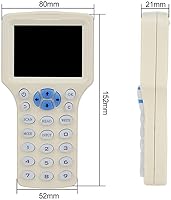
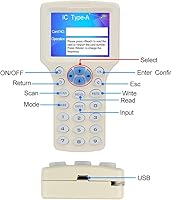
  • Dimensions: The unit measures 6 x 3.2 x 0.8 inches, keeping it slim enough to fit in a jacket pocket or tool bag.
  • Weight: At 8.96 ounces, the device is heavier than it appears but still manageable for field use.
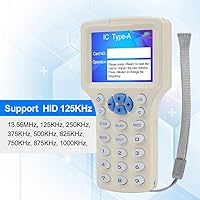
  • Frequencies: Supports nine frequencies: 125KHz, 250KHz, 375KHz, 500KHz, 625KHz, 750KHz, 875KHz, 1000KHz, and 13.56MHz.
  • Protocols: Compatible with ISO14443A and ISO14443B protocols, covering the majority of modern contactless smart card standards.
  • Card Formats: Reads and writes EM, Mifare Classic, UID, T5577, EM4305, HID 1386/1326/1346, and NTAG 213/215/216 card formats.
  • HID Support: Specifically supports HID Prox card models 1386, 1326, and 1346, which is uncommon at this market tier.
  • Unsupported Cards: CID cards are explicitly not supported; buyers should verify their card type before purchasing.
  • Connectivity: Connects to host devices via a standard USB Type-A interface with no proprietary cable required.
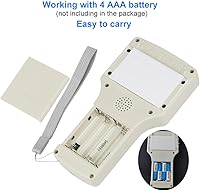
  • Power Source: Draws power entirely from the USB port, requiring no external adapter, wall outlet, or batteries.
  • OS Compatibility: The bundled software runs exclusively on Windows; Mac OS and Linux are not supported in any capacity.
  • Compatible Devices: Works with Windows-based laptops, desktop PCs, and tablets that provide a standard USB Type-A port.
  • Encryption Handling: Capable of decoding encrypted data on most 13.56MHz cards, though an active PC connection is required during this operation.
  • Color: The unit is finished in an off-white housing, giving it a clean, neutral appearance suitable for professional environments.
  • Interface Type: Uses a USB Type-A hardware interface, making it broadly compatible with most Windows computers without additional adapters.

Related Reviews

Keysy RFID Duplicator
84%
94%
Ease of Use
91%
Compatibility with RFID Formats
87%
Build Quality
90%
Portability
89%
Customer Support & Warranty
More
AOKO 4-in-1 M.2 NVMe Hard Drive Duplicator
76%
88%
Ease of Use
83%
Drive Compatibility
86%
Cloning Speed
74%
Offline Cloning Reliability
81%
Build Quality
More
Copystars DVD Duplicator Sata CD-DVD Burner 24X 1 to 1 DVD Copier Duplicator Tower
82%
85%
Performance
92%
Ease of Use
88%
Writing Speed
90%
Compatibility
84%
Reliability
More
FOSA M5015 SAS SATA RAID Controller Card
68%
83%
Value for Money
78%
Compatibility
66%
Firmware Flashing Experience
61%
Build Quality
69%
Drive Detection Reliability
More
XIIXMASK MS2131 Video Capture Card
85%
92%
Chassis Build Quality
88%
Thermal Management
87%
1080p Stream Stability
93%
Value for Money
84%
Plug-and-Play Simplicity
More
Pebblebee Card Universal (2024)
82%
91%
Cross-Platform Compatibility
83%
Battery Life
93%
Form Factor & Portability
74%
Charging & Power Management
77%
Tracking Accuracy
More
LG GP65NB60 Portable USB DVD Burner
81%
96%
Ease of Setup
88%
Read & Burn Performance
93%
Portability & Size
62%
Build Quality
81%
Disc Compatibility
More
PocketBook Verse 6-inch E-Ink E-Reader
81%
93%
Format Compatibility
89%
Battery Life
71%
Display Quality
86%
Frontlight & SMARTlight
91%
Expandable Storage
More
Popl XL NFC Digital Business Card
76%
89%
Recipient Experience
71%
Ease of Setup
52%
Subscription Model
67%
Value for Money
78%
NFC Performance
More
WAVLINK RTL8126 5Gbps PCIe Network Card
80%
91%
Value for Money
88%
Ease of Installation
67%
Linux Compatibility
83%
Real-World Throughput
79%
Build Quality
More

FAQ

Unfortunately, no. The LEXI NS208 RFID Card Reader Writer Duplicator relies on Windows-only software, and there is no supported version for Mac OS, Linux, or ChromeOS. If your primary machine is not a Windows PC or Windows tablet, this device will not function as intended.
It depends entirely on what type of card or fob your building uses. If your fob operates on a standard 125KHz format like EM4100 or T5577, there is a solid chance this reader can handle it. However, if the fob uses a proprietary encrypted system or an unsupported format, it will not work. Check with your building management to find out the card technology in use before buying.

Yes, and that is actually one of the stronger selling points of this multi-frequency reader. It supports HID Prox card models 1386, 1326, and 1346, which are widely used in corporate and commercial building access systems. Support for HID cards at this price range is genuinely uncommon compared to most other RFID duplicators on the market.

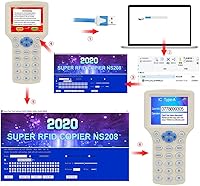
You do need to install the bundled software on a Windows machine to access the full feature set, including writing, cloning, and encryption functions. The hardware will be recognized by Windows as a USB device without special drivers, but the software is required to actually operate it. Just be aware that the software interface is functional but not particularly polished.

The LEXI card copier can decode encrypted data on most 13.56MHz cards, but it is best understood as a recovery and duplication tool rather than a security bypass device. It requires an active connection to a Windows PC to perform this function, and it does not guarantee success with every proprietary or high-security encryption scheme. If you are trying to recover access to a card system you legitimately manage, it is a useful capability — but it is not a universal master key.

In practical terms, 125KHz is the older technology standard found in many legacy proximity cards — the kind that have been in use at offices and apartment buildings for decades. The 13.56MHz standard is newer and is used by Mifare, NTAG, and similar smart card formats that often carry more data and can support encryption. Having a device that handles both means you are covered for a much wider range of real-world card systems without needing two separate tools.

Yes, this is actually a practical use case for the LEXI card copier. When you hold a card to the reader, the software will attempt to identify the card type and display the frequency and format details. It is a decent first step for diagnosing unknown cards before investing in a more specialized tool, though it will not identify every obscure proprietary format.

You can use it to write to compatible blank cards and fobs one at a time — T5577 and EM4305 writable cards are both supported. It is not designed for high-volume batch programming, so if you need to program dozens of fobs quickly, a more industrial solution would serve you better. For occasional replacements or small-scale setups, it handles the job without much fuss.

The device uses a standard USB Type-A connector and draws all its power directly from the host computer's USB port. There is no wall adapter, external battery pack, or charging cable needed. That makes it genuinely portable — as long as you have a Windows laptop nearby, you have a working setup.

Yes. CID cards are explicitly unsupported, and the manufacturer itself advises buyers to verify their card type before purchasing. Certain heavily proprietary or high-security smart card systems may also fall outside its capability. If you are unsure whether your specific card type is compatible, it is worth reaching out to LEXI directly before buying rather than discovering the limitation after the fact.