Overview

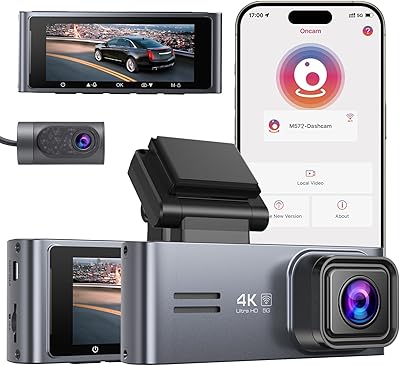
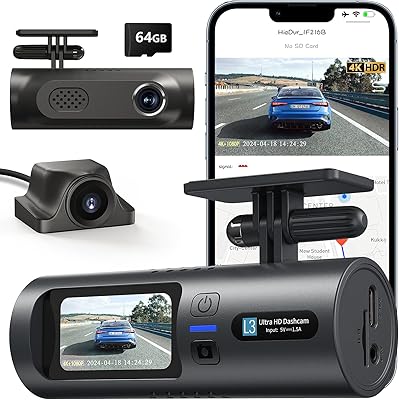
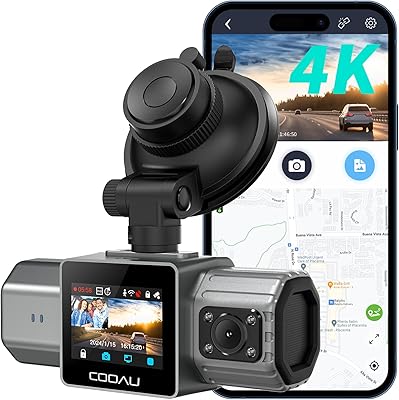
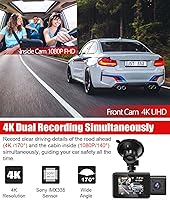
The LAMONKE 4K Dual Dash Cam with GPS sits in a practical sweet spot for drivers who want serious dual-channel coverage without paying flagship prices. It records simultaneously from a front-facing 4K lens and an interior 1080P camera, both powered by a Sony STARVIS IMX335 sensor that handles low-light conditions reasonably well. One hardware choice worth noting: this dual dash cam runs on a supercapacitor instead of a battery, meaning it tolerates dashboard heat far better than most competitors in this range. Setup is straightforward — plug into the cigarette lighter, insert a card, and it starts recording automatically when the car turns on. Loop recording then handles card management on its own.
Features & Benefits

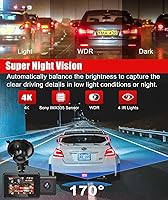
The front camera's 170-degree wide angle paired with WDR technology does a solid job balancing exposure across bright highway glare and shadowed surfaces — useful during morning and evening commutes. Where this rideshare camera earns its keep, though, is the interior IR lens: four infrared LEDs illuminate the cabin in total darkness across a 140-degree angle, capturing driver and rear passengers with enough clarity to matter in a dispute. The included GPS antenna logs speed, route, and position data, but that information is only reviewable on a PC — not inside the RoadCam app. Wi-Fi pulls footage wirelessly to your phone, though the range tops out at around 15 feet.

Best For

This dual dash cam makes the most sense for rideshare and taxi drivers who need documented proof when passenger disputes arise — the interior IR camera is something most single-channel cams simply skip. Commuters focused on insurance and liability protection will find the front 4K lens worthwhile too; just understand that the resolution benefit shows most at distance, where reading a license plate under low-light conditions would otherwise be difficult. Drivers in regions with extreme summer heat will appreciate the supercapacitor build, since there is no battery to fail mid-July. Anyone wanting GPS speed logging on a reasonable budget will find the included antenna a genuine, no-extra-cost addition.

User Feedback

Buyers generally highlight interior night vision quality as a standout, with rideshare drivers in particular noting that passengers are identifiable even in unlit pickup zones. Installation draws mostly positive reactions — the suction mount attaches without fuss, though routing the cable cleanly along the headliner takes a bit of patience. The most consistent criticism revolves around Wi-Fi range: at 15 feet maximum, you have to be physically near the camera to pull clips wirelessly, and some users report the RoadCam app dropping connection intermittently. Loop recording and card compatibility come up cleanly in reviews. The 12-month warranty and responsive customer service get occasional mention as reassuring for a camera at this price point.

Pros

  • Front 4K resolution captures license plates and road signs at distance with enough detail to hold up as evidence.
  • The supercapacitor handles dashboard heat far better than battery-powered competitors, making it a dependable long-term install.
  • Interior IR night vision is genuinely useful — the cabin stays identifiable even during late-night pickups in unlit areas.
  • GPS antenna is included in the box, so speed and route logging come at no extra cost.
  • Loop recording manages storage automatically, so you never have to manually clear old footage.
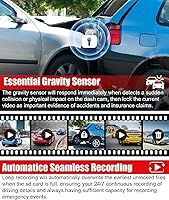
  • G-sensor locks impact clips instantly, protecting key footage from being overwritten after a collision.
  • Plug-and-play setup via the cigarette lighter means most drivers have it running within minutes.
  • WDR on the front lens handles tricky lighting transitions — tunnels, bright intersections, and early-morning glare — without washing out the image.
  • The 12-month warranty and accessible customer support add a layer of confidence for a mid-range purchase.
  • At this price point, getting dual-channel recording with a Sony sensor front lens is genuinely competitive value.

Cons

  • Wi-Fi tops out at around 15 feet, making wireless clip transfers impractical unless you are physically beside the camera.
  • GPS data is only reviewable on a PC — there is no in-app route or speed playback on your phone.
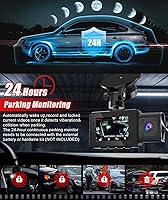
  • Parking mode requires a separate hardwire kit that is not included, adding extra cost and installation effort.
  • The RoadCam app has received mixed feedback, with some users reporting dropped connections and limited functionality.
  • No rear-exterior camera option means you only get cabin coverage, not protection from tailgaters or rear-end collisions.
  • A U3-rated microSD card is required but not included, so factor in that additional purchase before the camera is ready to use.
  • Cable routing from the suction mount to the cigarette lighter can look untidy without careful installation work.
  • Interior resolution at 1080P is functional but noticeably behind the front lens, which can matter in low-contrast cabin situations.

Ratings

The scores below for the LAMONKE 4K Dual Dash Cam with GPS were generated by our AI system after analyzing verified buyer reviews from multiple global markets, with spam, incentivized, and bot-flagged submissions actively filtered out. Each category reflects the honest consensus of real drivers — rideshare operators, daily commuters, and road-trip regulars — who have used this camera in the field. Both the standout strengths and the genuine frustrations are factored in transparently, so you get a clear picture before you buy.

Front Video Quality
83%
Reviewers consistently noted that the 4K front footage holds up well when reviewing plates and road signs after an incident — the detail advantage over 1080P cameras in this price range is real and noticeable. The Sony STARVIS sensor earns quiet praise for delivering usable footage in dawn and dusk conditions without heavy graininess.
Some buyers felt the 4K label raised expectations beyond what the lens and compression can fully deliver at speed. Footage quality in direct afternoon sun occasionally shows overexposure even with WDR active, and a few users noted that heavy compression artifacts appear on longer clips.
Interior Night Vision
88%
This is one of the most praised aspects across buyer feedback, particularly from rideshare drivers who do late-night pickups. The four infrared LEDs illuminate passengers clearly enough that faces and clothing are identifiable even in completely unlit conditions, which is the core use case this camera was built for.
The IR illumination does create some glare on reflective surfaces inside the cabin — dashboards with glossy finishes and rearview mirrors occasionally produce washed-out patches in the frame. A small number of users in larger vehicles noted the 140-degree angle does not quite reach rear-row passengers in full-size SUVs.
Dual-Channel Recording
86%
The ability to capture the road ahead and the cabin interior simultaneously without any manual switching is a genuine practical asset for drivers who need comprehensive coverage. Reviewers appreciated that both streams are time-synced, making it straightforward to match interior and exterior footage during an incident review.
There is no option to add a third lens for rear-exterior coverage, which frustrated some buyers who wanted bumper-to-bumper protection. A handful of users also reported that the interior channel occasionally drops to a lower effective frame rate during high-load recording sessions.
Supercapacitor Reliability
84%
Drivers in hot climates — particularly those in the southern US, Middle East, and Southeast Asia — called out the supercapacitor design as a key reason they chose this camera over battery-based alternatives. Consistent clean shutdowns even after summer days with the car parked in direct sunlight were a recurring positive data point.
The supercapacitor offers virtually no built-in buffer for parking mode, so the camera cannot operate independently after the ignition is cut without a hardwire kit. A small subset of users who did not read the specs carefully were caught off guard by this limitation after purchase.
GPS Accuracy
71%
29%
The included GPS antenna logs speed, route, and location data that can genuinely serve as supporting evidence in insurance disputes or traffic violation challenges. Most reviewers who used the PC software found the tracking data reasonably accurate on highway routes and main roads.
GPS logging is entirely PC-dependent — there is no way to check route or speed data in the RoadCam mobile app, which disappointed a significant number of buyers expecting a modern app-based experience. Accuracy on urban routes with tall buildings was reported as inconsistent, and cold GPS lock times frustrated drivers on short trips.
Wi-Fi & App Experience
58%
42%
The RoadCam app covers the basics adequately — browsing clips, triggering downloads, and tweaking a handful of camera settings without touching the unit. For users who just need to pull a specific clip wirelessly while parked nearby, it gets the job done without requiring a card reader.
The 15-foot maximum Wi-Fi range is a genuine friction point that comes up repeatedly in reviews, especially when drivers want to access footage without sitting in their car. App stability complaints are common — dropped connections mid-download and slow file transfer speeds on larger 4K clips are the two most frequently cited frustrations.
Installation & Setup
81%
19%
Most buyers reported being up and recording within ten to fifteen minutes of unboxing, with the suction mount attaching firmly to the windshield without tools. The automatic start and stop with the ignition is a small but appreciated detail that removes any daily friction from using the camera.
Routing the power cable neatly along the headliner and A-pillar requires patience and typically some prying tools that are not included. A few users found the suction cup lost grip after several weeks on textured or curved windshields, requiring re-mounting.
Parking Mode
47%
53%
When properly set up with a compatible hardwire kit, parking mode with motion detection does function as intended and can capture events like parking lot scrapes or vandalism attempts while the vehicle is unattended.
The hardwire kit is not included and represents an additional purchase and installation effort that many buyers did not anticipate. Without it, parking mode is simply unavailable — the cigarette lighter port loses power with the ignition in most vehicles, making this feature inaccessible for the majority of users straight out of the box.
Build Quality
74%
26%
The camera feels solid enough for a mid-range product — the housing does not flex or rattle on rough roads, and the lens cover on the front camera has held up well in reviews spanning over a year of daily use. The compact 3.14-ounce form factor keeps windshield obstruction minimal.
The plastic finish shows fingerprints easily and a few reviewers noted the front-to-interior hinge feels less premium than the main unit. Long-term durability data past eighteen months is limited given the product's relatively recent market entry.
Loop Recording
87%
Automatic overwrite of the oldest unlocked clips works reliably across most card brands and sizes tested by buyers. Reviewers appreciated that G-sensor-locked clips are consistently protected from deletion, giving confidence that important footage will not be lost in normal use.
A small number of users reported card compatibility issues — particularly with budget or off-brand microSD cards — where the camera failed to recognize the card or threw formatting errors. Sticking strictly to U3-rated cards from reputable brands resolved these issues in most reported cases.
Value for Money
79%
21%
Getting simultaneous 4K front and 1080P interior recording, a Sony sensor, an included GPS antenna, and a supercapacitor design at this price tier is genuinely competitive positioning. Most buyers who compared it to similarly priced single-channel cameras felt the dual-channel capability alone justified the cost.
The value calculus shifts somewhat once you factor in the cost of a quality U3 microSD card and a hardwire kit for parking mode — two essentials that are not included. Buyers who assumed the camera was complete out of the box reported feeling the effective cost was higher than the listing price suggested.
G-Sensor Performance
77%
23%
The three-level sensitivity setting is genuinely useful — medium sensitivity catches real impacts without triggering false locks from speed bumps or railway crossings, which is a common annoyance with fixed-sensitivity alternatives. Reviewers found the clip-locking behavior reliable during actual collision events.
On high sensitivity, the G-sensor locks clips too aggressively for some driving environments — pothole-heavy urban roads and gravel surfaces produce frequent false triggers that fill up the protected clip storage quickly. The low sensitivity setting, conversely, occasionally missed softer impacts in multi-vehicle incidents.
Screen & Interface
69%
31%
The on-device interface is functional and covers the necessary settings without requiring a phone connection for basic configuration. The screen saver mode that blacks out the display while still recording is a practical feature that reduces driver distraction on long trips.
The display is small and not particularly sharp, making it difficult to review footage directly on the unit rather than transferring to a phone or computer. Menu navigation feels dated compared to more modern dash cam interfaces, and language switching is buried deeper in the settings than most users expect.
Fatigue Reminder
62%
38%
The configurable fatigue driving reminder at one, two, three, or four-hour intervals is a thoughtful inclusion that long-haul and rideshare drivers occasionally cited as a useful nudge during extended shifts. It requires no setup beyond selecting the interval.
The alert is purely audio-based and repetitive, which several drivers found more annoying than helpful after the first few uses. There is no adaptive logic — the reminder fires regardless of actual driving conditions or rest stops, reducing its practical value over time.
Warranty & Support
73%
27%
The 12-month warranty is backed by a 24/7 email support team that receives generally positive marks for responsiveness in buyer feedback. Replacement units for hardware failures within the warranty window were processed without excessive friction in most reported cases.
Support is email-only with no live chat or phone option, which slows resolution for time-sensitive issues. A handful of international buyers noted longer-than-expected response times outside of business hours despite the 24/7 claim, and warranty coverage does not extend to microSD card failures.

Suitable for:

The LAMONKE 4K Dual Dash Cam with GPS is built around a very specific real-world need: documenting what happens both in front of the car and inside the cabin at the same time. That makes it a natural fit for rideshare and taxi drivers who want a reliable record in case a passenger dispute, false damage claim, or aggressive complaint ever surfaces. Daily commuters who have been burned by hit-and-run incidents or insurance disagreements will also find the 4K front lens genuinely useful — the resolution advantage is most apparent when you need to read a plate at distance after the fact. Drivers in hot climates get a meaningful reliability edge from the supercapacitor design, since there is no battery to swell or fail after months of sitting in a hot car. Anyone who wants GPS speed and route logging without stepping up to a higher-priced brand will find the included antenna a practical bonus, even though reviewing that data requires a PC rather than a phone.
Not suitable for:

The LAMONKE 4K Dual Dash Cam with GPS is not the right choice for buyers expecting a fully self-contained, app-forward experience. The Wi-Fi connection only works within roughly 15 feet and can be inconsistent, so if quick wireless clip access from a distance matters to you, this camera will frustrate. Drivers who want round-the-clock parking surveillance should know upfront that parking mode requires a separately purchased hardwire kit — the included cigarette lighter connection simply cuts power when the ignition is off. Anyone hoping to review GPS data on their phone will be disappointed, since route and speed logs are only accessible through PC software. If you are already invested in a premium dash cam ecosystem with polished companion apps and cloud backup, this mid-range unit will feel limited by comparison. Buyers wanting rear-exterior coverage rather than an interior cabin view will also need to look elsewhere, as the second lens points into the car, not behind it.
Specifications

  • Front Resolution: The front camera records at 4K (3840x2160P) for detailed capture of road conditions, signage, and license plates.
  • Interior Resolution: The interior cabin camera records simultaneously at Full HD 1080P alongside the front lens.
  • Image Sensor: Both channels are powered by a Sony STARVIS IMX335 sensor, which improves low-light sensitivity compared to generic sensors in this price range.
  • Front FOV: The front lens covers a 170-degree field of view, reducing blind spots across multiple lanes of traffic.
  • Interior FOV: The interior lens covers a 140-degree angle, capturing the driver and rear passenger area in a single frame.
  • Night Vision: Four infrared LEDs on the interior camera provide active illumination for cabin recording in complete darkness.
  • WDR: Wide Dynamic Range is enabled on the front camera to automatically balance exposure between bright and shadowed areas in a single frame.
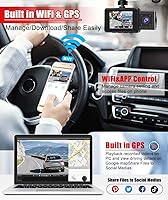
  • Wi-Fi: Built-in 2.4GHz Wi-Fi connects to the RoadCam app on iOS or Android, with an effective range of 9 to 15 feet.
  • GPS: A GPS antenna module is included in the box and logs speed, route, distance, and position data reviewable via PC software only.
  • Storage: Supports microSD cards up to 256GB (U3 rating required); no card is included in the package.
  • Loop Recording: Automatically overwrites the oldest unlocked footage when the card is full, enabling continuous uninterrupted recording.
  • G-Sensor: A built-in G-sensor with High, Medium, and Low sensitivity settings locks clips automatically when a collision or sudden impact is detected.
  • Parking Mode: Parking mode is available but requires a separately purchased external power supply or hardwire kit not included in the box.
  • Power Source: The camera draws power from the vehicle cigarette lighter port and starts or stops recording automatically with the ignition.
  • Capacitor: A supercapacitor replaces a traditional battery, improving heat tolerance and long-term reliability for vehicles parked in hot environments.
  • Dimensions: The unit measures 5 x 3 x 3 inches and weighs 3.14 ounces, making it compact enough for most windshield positions.
  • Mounting: Attaches to the windshield via an included suction cup mount for tool-free installation and repositioning.
  • App: The free RoadCam app for iOS and Android allows wireless footage access, file management, and basic camera settings adjustment.
  • Certifications: The camera carries CE, FCC, and RoHS certifications confirming compliance with standard electronics safety and environmental regulations.
  • Warranty: LAMONKE covers this dual dash cam with a 12-month assurance backed by 24/7 email-based customer support.

Related Reviews
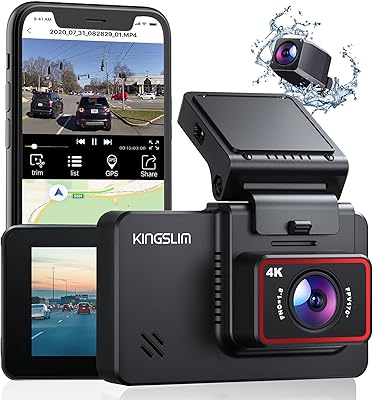
Kingslim D6 4K Dual Dash Cam
84%
91%
4K Video Quality
88%
Night Vision Performance
84%
Ease of Setup
89%
WiFi & GPS Functionality
82%
Build Quality & Durability
More
YEECORE D22 Front and Rear Dash Cam
78%
91%
Front Video Quality
67%
Rear Camera Quality
78%
Night Vision
88%
GPS Accuracy
63%
Wi-Fi & App Performance
More
DDPAI N5 Dual Front and Rear Dash Cam
77%
88%
Video Quality (Front)
71%
Video Quality (Rear)
74%
Parking Mode & Surveillance
82%
Wi-Fi Speed & App Experience
83%
GPS Accuracy & Logging
More
Sarmert M572 4K Dual Dash Camera
75%
84%
Video Clarity (Daytime)
71%
Night Vision & Low Light
63%
App Experience
58%
Parking Mode
89%
Supercapacitor Reliability
More
ROVE R2-4K Dual Dash Cam
80%
91%
Video Clarity (Front)
88%
Night Vision Performance
74%
Rear Camera Quality
78%
Wi-Fi & App Experience
86%
GPS Accuracy & Logging
More
Kolvt L3 4K Dual Dash Cam
77%
86%
Front Video Quality
77%
Rear Video Quality
71%
Night Vision
74%
App and Wi-Fi
76%
Build Quality
More
COOAU D20S Dual Dash Cam
76%
84%
Front Camera Quality
81%
Interior Night Vision
77%
App Experience
79%
GPS Accuracy
62%
Parking Mode
More
70mai 4K Omni X800 Dual Dash Cam
80%
91%
Night Vision Quality
93%
Video Clarity (Daytime)
88%
Rotating Camera Design
79%
4G LTE Remote Monitoring
67%
Parking Mode Usability
More
Thinkware U3000 4K Dual Dash Cam
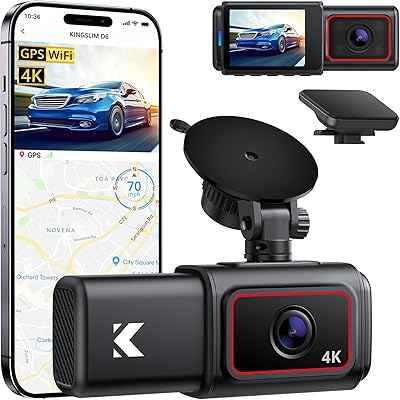
78%
88%
Night Vision Quality
91%
Video Clarity
82%
Parking Protection
63%
App & Connectivity
86%
GPS Accuracy
More
IIWEY N2 4K Dual Dash Cam
83%
92%
Video Quality
84%
Ease of Use
89%
Durability
60%
Installation Process
90%
Wi-Fi Functionality
More

FAQ

Yes, it does. The front lens and the interior cabin camera run simultaneously, so you get road footage and a view of your passengers in a single recording session. There is no need to switch between channels manually.

You will need to purchase a microSD card separately — the camera supports up to 256GB but does not include one. Make sure to get a U3-rated card for reliable 4K recording. Everything else needed for basic installation is included.

You can, but only within about 15 feet of the camera. The built-in Wi-Fi connects to the RoadCam app on your phone, letting you browse and download clips wirelessly. If you are farther away, the connection drops and you will need to physically remove the card or get closer.

GPS logging is only accessible through PC software, not through the RoadCam phone app. The GPS antenna is included in the box, so you do not need to buy a separate module, but reviewing trip data does require sitting down at a computer.

Unfortunately, no. The cigarette lighter port loses power when the ignition is off in most vehicles, which means the camera shuts down too. To use parking mode, you will need to purchase a hardwire kit or external battery pack that provides constant power — neither is included.

In real-world use, the four infrared LEDs do a solid job illuminating the cabin in low-light and dark conditions. Passengers are generally identifiable at normal seating distances. The IR night vision is one of the stronger practical features for rideshare drivers, and it is one reason this camera stands out from front-only alternatives.

Installation is generally straightforward. The suction cup attaches to the windshield without tools, and the power cable runs to the cigarette lighter port. The trickiest part for most people is routing the cable neatly along the headliner and A-pillar to avoid a messy dangling wire, but that is cosmetic rather than technical.

Because the camera uses a supercapacitor rather than an internal battery, it has just enough reserve power to save the current file before shutting down cleanly. This is actually a key advantage over battery-based cameras, which can corrupt footage or fail entirely in sudden power-loss situations.

That depends entirely on the card size and which resolution settings you use. A 128GB card with 4K front and 1080P interior recording running continuously will typically hold several hours of footage before the oldest unlocked clips begin to be overwritten. Important clips locked by the G-sensor or manually are protected from deletion.

The app covers the basics well — browsing clips, downloading footage, and adjusting settings wirelessly. That said, some users have reported occasional dropped connections and limited functionality compared to apps from premium brands. It is functional rather than polished, so keep expectations realistic for a camera in this price tier.