Overview

The Klipsch R-52C Center Channel Speaker sits in a comfortable middle ground within Klipsch's Reference lineup — capable enough to satisfy serious home theater listeners, yet accessible to those stepping up from a basic center channel for the first time. What sets it apart at this tier are its dual 5.25″ spun-copper woofers and a Tractrix Horn-loaded tweeter, both of which point toward genuine audio engineering rather than spec-sheet padding. It pairs naturally with other Reference series bookshelf or tower speakers, making it a logical anchor for a matched surround system. Just keep in mind: this is a dedicated home theater speaker, built to handle dialogue and film dynamics — not a substitute for a stereo music setup.

Features & Benefits

Two spun-copper IMG woofers handle the midrange frequencies where most vocal content lives, and their construction helps minimize cone distortion during complex audio passages — the kind you encounter in action films with densely layered sound design. The aluminum tweeter feeds through a Tractrix Horn, which shapes sound into a wide, controlled pattern rather than letting it scatter unpredictably; listeners seated off-center in a room still get clear, intelligible audio. With a sensitivity of 95dB, the R-52C responds well to modest power inputs, so a mid-range AV receiver handles it without strain. The wood cabinet and rear port contribute a natural resonance that plastic-bodied speakers typically can't match, and the included grill keeps the setup looking clean on a media console.

Best For

This center channel speaker is a strong fit for anyone building or refining a 5.1 or 7.1 surround system, particularly those already invested in Klipsch's Reference lineup. It shines in medium to large rooms where dialogue can easily get lost at normal listening levels — if you've ever found yourself reaching for the remote every time characters start whispering in a thriller, this Klipsch center channel addresses exactly that frustration. It also works efficiently with mid-range AV receivers, so you don't need to spend heavily on amplification to get solid results. That said, it's not the right choice for someone who wants a multipurpose speaker that pulls double duty in a stereo music setup.

User Feedback

Owners consistently point to dialogue clarity as the standout quality — many describe it as the single biggest improvement they noticed after replacing their previous center channel. Long-term users also report solid build durability, with no noticeable degradation after years of regular use. On the critical side, some listeners find the R-52C sounds slightly bright or forward at higher volumes, especially when a receiver's EQ is already boosting the high end. It's not a widespread complaint, but worth factoring in before buying. A handful of buyers were caught off guard by the physical footprint — at nearly 19 inches wide, it demands real shelf space. Those integrating it with non-Klipsch speakers occasionally mention needing manual receiver calibration to achieve a smooth tonal blend.

Pros

  • Dialogue reproduction is noticeably sharper and more intelligible than most entry-level or soundbar alternatives.
  • High sensitivity means the R-52C performs well even with modestly powered AV receivers.
  • The Tractrix Horn disperses sound widely, keeping audio clear for listeners seated off-center.
  • Dual spun-copper woofers deliver clean, composed midrange during complex, layered film soundtracks.
  • Wood cabinet construction produces a more natural resonance than cheaper plastic-bodied competitors.
  • 400-watt power handling provides ample headroom for loud, dynamic movie passages without audible strain.
  • Pairs naturally with other Klipsch Reference series speakers for a tonally consistent surround setup.
  • Long-term owners consistently report solid build quality that holds up after years of regular use.
  • Included grill keeps the speaker looking clean and unobtrusive on a media console.
  • Strong value relative to performance for buyers upgrading from an entry-level center channel.

Cons

  • Can sound bright or harsh at higher volumes, particularly with receivers that have aggressive EQ settings.
  • Physical dimensions catch some buyers off guard — nearly 19 inches wide requires real shelf or console space.
  • Integrating with non-Klipsch speakers often requires manual receiver calibration to avoid tonal imbalance.
  • Not a practical choice for small rooms or compact entertainment setups where space is tight.
  • Bass output is limited by design — buyers expecting low-end impact without a subwoofer will be disappointed.
  • Horn-based tweeter character is an acquired taste and may not suit listeners who prefer a softer, warmer sound.
  • Heavier than it looks at 13.5 pounds, which complicates certain wall-shelf or furniture placement options.

Ratings

The Klipsch R-52C Center Channel Speaker has been scored by our AI system after analyzing thousands of verified owner reviews from global markets, with spam, bot-generated, and incentivized submissions actively filtered out. The scores below reflect where this center channel genuinely excels and where real buyers have run into frustrations — nothing is glossed over. Both the standout strengths and the legitimate trade-offs are transparently represented across every category.

Dialogue Clarity
93%
This is the single quality that drives most purchase decisions for the R-52C, and owners consistently confirm it delivers. Voices in films and TV shows come through with sharp, natural intelligibility even at moderate listening volumes, making it a noticeable upgrade over entry-level alternatives or soundbars.
A small number of users find that at very high volumes, the forward-leaning character of the horn tweeter can make certain voices sound slightly edgy or over-articulated, particularly with compressed streaming audio sources.
Sound Dispersion
88%
The Tractrix Horn design pushes audio across a wide horizontal arc, which means listeners seated toward the sides of a room still get clear, centered sound rather than a muddied off-axis experience. For wider living rooms with seating spread across a couch or sectional, this makes a practical difference.
Vertical dispersion is more limited by the horn geometry, so placement height relative to ear level matters more than buyers might expect. Mounting it too high or too low can affect the perceived clarity in ways that are hard to diagnose without some experimentation.
Build Quality
89%
The wood cabinet feels solid and well-constructed compared to plastic-bodied competitors at a similar price point, and long-term owners frequently note that the speaker holds up well after years of regular use without rattles or finish degradation. The spun-copper woofer cones also add a sense of premium craftsmanship.
The grill attachment mechanism is functional but not particularly refined — a few buyers report that the grill fits loosely or feels less secure than expected for a speaker at this tier, which is a minor but recurring complaint.
Value for Money
84%
Relative to what the R-52C delivers in dialogue clarity, dispersion, and build, most buyers consider it fairly priced for a mid-range center channel. It competes well against similarly priced options from other brands and is often cited as punching slightly above its weight class in real listening comparisons.
Buyers who already own a capable soundbar or a basic HTiB system may struggle to justify the investment unless they are committed to building a full surround setup. As a standalone purchase without matching surround speakers, the value proposition weakens noticeably.
Receiver Compatibility
81%
19%
The high sensitivity rating means this center channel responds well to a wide range of receivers, including budget-friendly models in the 50 to 100 watt range. Most buyers report it integrates without issue into existing systems using standard 8-ohm-compatible AV hardware.
When paired with non-Klipsch surround speakers, the tonal character can clash without manual calibration, and the horn-loaded tweeter can be unforgiving if a receiver's EQ is misconfigured. A few buyers found the setup process less plug-and-play than anticipated.
Bass Response
67%
33%
For a center channel, the rear-ported wood cabinet does a respectable job of extending low-midrange warmth, lending male voices and film scores a fuller body than thinner-cabineted alternatives. Most owners who run it alongside a dedicated subwoofer are satisfied with how the frequencies blend.
Buyers expecting standalone low-end impact will be disappointed — this is a center channel, not a subwoofer, and its bass output reflects that design. Without a dedicated subwoofer in the system, action film sequences can feel thin in the lower frequencies.
Ease of Setup
78%
22%
Connecting the R-52C is straightforward for anyone familiar with standard speaker wire and binding posts — no proprietary connectors or complicated pairing procedures. Most buyers have it integrated and producing sound within minutes of unpacking.
Getting the tonal balance right within a mixed-brand surround system takes more effort, and buyers unfamiliar with receiver calibration menus can find the process confusing. The speaker offers no onboard controls or auto-configuration features to simplify the process.
Placement Flexibility
63%
37%
The speaker's relatively compact height and depth allow it to fit neatly on most media consoles either above or below a television, and the included grill keeps it looking tidy in a living room environment without drawing too much visual attention.
At nearly 19 inches wide and 13.5 pounds, a meaningful number of buyers find it larger and heavier than they expected from online listings alone. Narrower TV stands, floating shelves, or tight entertainment centers may not accommodate it comfortably, and wall mounting requires third-party hardware.
High-Volume Performance
71%
29%
The 400-watt power handling gives the R-52C genuine headroom for loud, dynamic content — it can push through high-stakes action sequences without audible compression or distortion in the midrange, which is where most center channels struggle first.
The brightness tendency becomes most noticeable at elevated volumes, and some listeners report listener fatigue during long sessions when the system is pushed hard. This is particularly evident in acoustically live rooms with hard floors and minimal soft furnishings to absorb the upper frequencies.
Aesthetic Design
76%
24%
The spun-copper woofer cones give the R-52C a distinctive, premium look when the grill is removed, and the black cabinet finish is understated enough to blend into most home theater environments without dominating the room visually.
The overall design language is functional rather than refined — it looks like what it is, a purpose-built speaker, and buyers seeking something more architectural or living-room-friendly may find the aesthetic less polished than some competing options at a similar tier.
Surround System Matching
91%
Within the Klipsch Reference lineup, the tonal coherence between this center channel and matching bookshelf or tower speakers is one of the most frequently praised qualities by serious home theater builders. Sound effects and dialogue transition between channels with a consistency that blended systems rarely achieve.
This advantage only applies when the rest of the system uses Reference series speakers — buyers mixing brands lose this benefit entirely and may find the R-52C's character harder to blend with warmer or more neutral-voiced surround speakers.
Long-Term Durability
86%
Multi-year owners are notably positive about how the R-52C holds up over time, with no reports of driver failure, cabinet warping, or degraded performance appearing frequently in long-term feedback. It comes across as a speaker built to last rather than a cost-cut product.
The warranty terms vary by region and purchase channel, and a few buyers found the claims process less straightforward than expected. There is limited independent durability testing data available for this specific model over extended periods beyond owner anecdotes.
Packaging & Unboxing
73%
27%
The speaker arrives well-protected and the unboxing experience is clean enough for a mid-range product — the grill is packaged separately to avoid pressure damage, and the unit itself is foam-protected on all sides.
The included documentation is minimal, offering basic connection guidance but little practical advice on placement, receiver settings, or integration within different room types. First-time buyers setting up a surround system may have wanted more hand-holding from the included materials.

Suitable for:

The Klipsch R-52C Center Channel Speaker is purpose-built for home theater listeners who are tired of straining to catch dialogue during movies and TV shows. It performs best as part of a matched Klipsch Reference surround setup, where its tonal character aligns naturally with bookshelf or floor-standing speakers in the same family. Medium to large living rooms benefit most from its Tractrix Horn design, which pushes sound wide enough that listeners seated off-center don't feel left out. Because of its high sensitivity, it pairs comfortably with mid-range AV receivers without needing expensive amplification to shine. If you're upgrading from a budget soundbar or a factory-bundled center channel, this Klipsch center channel represents a meaningful step forward in both clarity and build quality.

Not suitable for:

The Klipsch R-52C Center Channel Speaker is not the right pick for buyers expecting a multipurpose speaker that handles stereo music listening on its own — it is engineered specifically for home theater dialogue and film dynamics, and that focus comes with real trade-offs in other contexts. Listeners who prefer a warm, relaxed sound signature may find the high-frequency character of the horn tweeter too forward, especially in rooms that are already acoustically bright or when paired with receivers that boost the upper frequencies. Anyone working with a compact media console or a narrow TV stand should measure carefully first, because at nearly 19 inches wide and 13.5 pounds, this center channel demands more physical space than many buyers anticipate. Those building a mixed-brand surround system may also need to invest time in receiver calibration to get a balanced tonal blend, which can be frustrating for plug-and-play buyers. If your primary use case is background music rather than dedicated movie watching, the R-52C is likely more speaker than your situation calls for.

Specifications

  • Speaker Type: Two-way center channel speaker designed for home theater use within a surround sound system.
  • Woofers: Dual 5.25″ spun-copper IMG woofers engineered to minimize cone breakup for cleaner midrange reproduction.
  • Tweeter: 1″ aluminum Linear Travel Suspension (LTS) tweeter with Kapton suspension for controlled high-frequency response.
  • Horn Design: 90x90 square Tractrix Horn paired with the tweeter to deliver wide, consistent sound dispersion across a room.
  • Frequency Response: Rated from 89Hz to 21kHz, covering the full vocal and dialogue range alongside upper treble frequencies.
  • Sensitivity: 95dB at 2.83V/1m, meaning the speaker produces strong output levels without requiring high amplifier power.
  • Power Handling: Rated at 400 watts maximum, providing substantial headroom for dynamic film soundtracks at high listening levels.
  • Impedance: 8-ohm nominal impedance, compatible with the vast majority of standard AV receivers on the market.
  • Cabinet Material: Wood cabinet construction with a rear-firing port, contributing to a more resonant and natural low-midrange response.
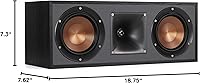
  • Dimensions: Measures 7.62″ deep by 18.75″ wide by 7.3″ tall, requiring a media console or shelf with sufficient width.
  • Weight: 13.5 pounds, which should be accounted for when planning shelf load capacity or furniture placement.
  • Signal-to-Noise Ratio: 75dB signal-to-noise ratio, indicating a relatively clean audio output with minimal background noise at standard listening levels.
  • Included Items: Comes with a removable speaker grill and user manual; no mounting hardware or speaker wire is included.
  • Color: Available in Black with a spun-copper woofer finish that is visible when the grill is removed.
  • Series: Part of Klipsch's Reference (R) series, designed to pair tonally with other speakers in the same lineup.
  • Warranty: Covered by a Klipsch limited warranty; buyers should confirm current warranty terms directly with Klipsch at time of purchase.
  • Connectivity: Passive speaker requiring connection via standard binding posts to a compatible AV receiver or amplifier using speaker wire.
  • Power Source: Corded passive design — draws power entirely from the connected AV receiver or external amplifier, with no internal amplification.

Related Reviews
Klipsch R-34C Center Channel Speaker
89%
93%
Sound Clarity
89%
Dialogue Reproduction
84%
Bass Performance
90%
Build Quality
88%
Ease of Setup
More
Klipsch R-30C Center Channel Speaker
79%
93%
Dialogue Clarity
88%
Soundstage Dispersion
74%
Tonal Balance
81%
Build Quality
91%
Efficiency & Receiver Compatibility
More
Klipsch Reference R-25C Center Channel Speaker
87%
93%
Audio Performance
89%
Bass Response
91%
Clarity of Dialogue
85%
Build Quality
88%
Ease of Integration
More
Klipsch R-50C Center Channel Speaker
83%
93%
Dialogue Clarity
88%
Soundstage Width
91%
Build Quality
84%
High-Frequency Performance
89%
Midrange Accuracy
More
Klipsch RP-450C Center Channel Speaker
86%
92%
Sound Quality
88%
Build Quality
94%
Dialogue Clarity
84%
Bass Performance
87%
Ease of Integration
More
Klipsch RP-250C Center Channel Speaker
87%
92%
Sound Clarity
91%
Dialogue Performance
85%
Bass Quality
90%
Build Quality
88%
Compatibility with Klipsch Systems
More
Klipsch RP-504C Center Channel Speaker
87%
91%
Sound Clarity
87%
Bass Response
90%
Build Quality
85%
Aesthetic Design
82%
Ease of Installation
More
Klipsch RP-500C II Center Channel Speaker
82%
94%
Dialogue Clarity
91%
Sound Dispersion
88%
Build Quality
86%
System Integration
83%
Ease of Setup
More
Klipsch RP-404C II Center Channel Speaker
83%
94%
Dialogue Clarity
91%
Build Quality
89%
Placement Versatility
74%
Value for Money
61%
Bass Performance
More
KEF T101 Satellite and Center Channel Speakers
80%
88%
Sound Clarity
91%
Build Quality
94%
Design & Aesthetics
89%
Dialogue Intelligibility
62%
Value for Money
More

FAQ

It works with virtually any AV receiver that has standard speaker binding post outputs, regardless of brand. The R-52C is a passive speaker, so it just needs a receiver that can handle an 8-ohm load — which covers almost everything on the market. That said, if you're mixing it with non-Klipsch surround speakers, you may need to spend a few minutes in your receiver's setup menu to get the tonal balance right.

That depends on your furniture. The speaker is nearly 19 inches wide and about 7.5 inches deep, so it's not a small unit. Before buying, measure the available space on your console or shelf and make sure there's enough clearance in front of or below your TV. A number of buyers have been surprised by how much room it actually takes up.

It's primarily designed for home theater use — dialogue, film soundtracks, and TV content. It can handle music when used as part of a full surround setup, but it isn't designed to be a standalone stereo speaker. If your main goal is listening to music rather than watching content, a dedicated bookshelf or stereo speaker would serve you better.

Not really. The R-52C's high sensitivity rating means it gets loud from relatively modest power inputs, so a mid-range receiver in the 50 to 150 watt range per channel is more than sufficient. You don't need to invest in expensive high-wattage amplification to get good results from this center channel.

It's worth being aware of. Klipsch speakers, including this one, are known for an energetic, forward-sounding high end, which many listeners love for action films and clear dialogue. However, if your room is acoustically reflective or your receiver's EQ is already boosting the treble, it can tip into harshness at louder volumes. Running your receiver's automatic room correction, or manually pulling back the high-frequency EQ a little, usually addresses it.

The speaker itself doesn't include built-in mounting hardware or keyhole slots, so standard wall mounting isn't straightforward out of the box. Some buyers use third-party center channel wall brackets designed for speakers of similar dimensions, but you'd want to verify weight capacity and fit before committing. At 13.5 pounds, it's not featherlight, so any mounting solution needs to be rated appropriately.

It pairs very naturally with other Reference series speakers because they share the same driver technology and horn design, which means the tonal character stays consistent as sound moves across channels. This kind of tonal matching makes dialogue and ambient effects feel cohesive rather than disjointed — it's one of the strongest reasons to stay within the Reference family when building a surround system.

Speaker wire is not included. The package comes with the speaker and a removable grill, but you'll need to supply your own wire to connect it to your receiver. For most home theater distances, a standard 14 or 16 gauge speaker wire works fine.

For the fabric grill, a light pass with a lint roller or a soft brush is usually all you need. Avoid pressing hard or using liquid cleaners on the fabric. The cabinet can be wiped down with a dry or slightly damp microfiber cloth — no harsh solvents or abrasive materials, as those can damage the finish over time.

Klipsch covers the R series with a limited warranty, but the specific duration and terms can vary by region and purchase channel. It's worth checking Klipsch's official website or contacting their support team at the time of purchase to confirm exactly what's covered and for how long, especially if you're buying from a third-party seller.

Where to Buy