Overview

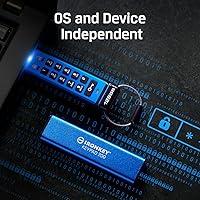
The Kingston IronKey Keypad 200 256GB Flash Drive is not a drive you buy because it looks impressive on a spec sheet — you buy it because the data you carry genuinely cannot fall into the wrong hands. Built around an alphanumeric onboard keypad, it authenticates entirely on the device itself, with no software installation or driver dependency on the host machine. That makes it truly OS-independent, working across Windows, macOS, Linux, and Chrome OS without friction. Physically, it is dust-proof and waterproof, built to handle the daily abuse professional use demands. Within Kingston's IronKey family, this is a serious step up from basic encrypted options — and it comes priced accordingly.

Features & Benefits

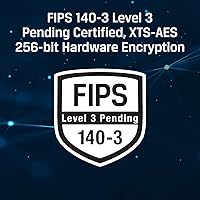
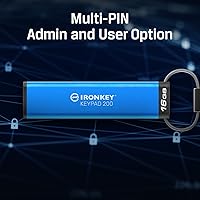
What separates the IronKey Keypad 200 from software-based alternatives is the depth of its security architecture. It holds FIPS 140-3 Level 3 certification, meaning it has passed independent testing for tamper evidence and physical attack resistance — not just encryption strength. The XTS-AES 256-bit encryption runs entirely on the drive's own hardware, so no host computer is ever involved in protecting your data. Brute Force Protection triggers automatic lockdown, and eventually a full crypto-erase, after repeated wrong PIN entries. Digitally signed firmware blocks BadUSB attacks outright. The multi-PIN Admin and User structure is especially practical for organizations issuing drives to staff, and the Read-Only mode adds meaningful control when files need sharing without modification risk.

Best For

This hardware-encrypted USB is squarely aimed at professionals who operate in environments where data security is not optional. IT administrators managing encrypted drives across a team will find the Admin and User PIN separation genuinely practical. Journalists, attorneys, and healthcare providers subject to HIPAA, GDPR, or CMMC mandates will find it fits naturally into their workflows. Government contractors and defense personnel who specifically require FIPS-validated storage will appreciate the certification pedigree. The OS-independent keypad unlock is a real differentiator for people who routinely move between operating systems. If you want a fast everyday USB drive, look elsewhere — this is a purpose-built secure transport solution for sensitive, regulated data.

User Feedback

Buyers who purchased the encrypted keypad drive for the right reasons tend to be satisfied. Build quality draws consistent praise, and the keypad-based unlock is repeatedly described as a practical win — plug it into any machine and it simply works. The premium price does surface in reviews, but most buyers in regulated industries frame it as justified given the certification backing. Where feedback turns critical is transfer speeds: at 280 MB/s read and 115 MB/s write, performance is secondary to security here, and buyers who expected otherwise express clear disappointment. A handful of reviewers also flag a setup learning curve with the Admin and User PIN configuration, though most find it manageable after the initial familiarization.

Pros

  • FIPS 140-3 Level 3 certification provides independently verified, not self-declared, hardware security credentials.
  • The onboard alphanumeric keypad unlocks the drive on any machine without installing a single driver or application.
  • XTS-AES 256-bit hardware encryption keeps data protected even if the physical drive is removed from its enclosure.
  • Brute Force Protection with automatic crypto-erase means a lost drive stays unreadable regardless of who finds it.
  • Digitally signed firmware blocks BadUSB attacks, closing a vulnerability that software-based encrypted drives often leave open.
  • Admin and User PIN separation makes this encrypted keypad drive practical for team deployments and fleet management.
  • Read-Only mode — available globally or per session — adds meaningful control when distributing files to others.
  • Dust-proof and waterproof construction means it survives the conditions most field professionals actually work in.
  • At 256 GB, there is enough capacity to carry substantial working archives without needing multiple drives.
  • A consistent track record in regulated industries gives buyers confidence this hardware will hold up under real compliance scrutiny.

Cons

  • Write speeds of 115 MB/s make bulk file transfers noticeably slower than standard high-performance USB drives.
  • The premium price is a hard sell for individual buyers outside of compliance-mandated or high-risk environments.
  • A forgotten Admin PIN results in a complete crypto-erase with no data recovery path — there is no backdoor.
  • Initial PIN setup and Admin versus User mode configuration has a learning curve that documentation does not always resolve quickly.
  • The USB-A connector requires an adapter on modern laptops and tablets that have moved exclusively to USB-C.
  • 256 GB may feel limiting for users who need to carry large media libraries or full system backups regularly.
  • The keypad buttons, while functional, can show wear with heavy daily use over extended periods.
  • No wireless or cloud backup integration means the drive is entirely dependent on physical access for data recovery planning.

Ratings

Our AI-generated scores for the Kingston IronKey Keypad 200 256GB Flash Drive are derived from analysis of verified buyer reviews worldwide, with spam, incentivized, and bot-generated feedback actively filtered out before scoring. The ratings reflect the full picture — where this hardware-encrypted USB genuinely excels in professional and compliance-driven environments, and where real users have experienced friction or frustration. Both strengths and pain points are transparently weighted into every score below.
Hardware Encryption Security
97%
Buyers in regulated industries consistently describe this as the single most compelling reason they chose the IronKey Keypad 200 over software alternatives. The FIPS 140-3 Level 3 certification is not a marketing claim — it is an independently verified standard, and professionals who understand what that means respond to it with genuine confidence. For healthcare workers and government contractors carrying sensitive data daily, this is the category that justifies the purchase outright.
A small subset of buyers felt the security architecture was more than their actual threat model required, making the added complexity feel unnecessary for their workload. The crypto-erase-on-brute-force feature, while a strong security control, has caused irreversible data loss for a handful of users who mistyped their PIN more times than expected under stress.
OS Compatibility
94%
The keypad-based unlock mechanism is one of the most practically praised features across all reviews — plug it into any machine running Windows, macOS, Linux, or Chrome OS, and it simply works without touching a single system setting. IT professionals who manage mixed-OS environments specifically called this out as a decisive advantage. Consultants and lawyers who carry classified files between client laptops and personal workstations described it as effortless.
A small number of reviewers noted that older machines with USB 2.0 ports still work but see a significant speed drop. A few users also flagged that some locked-down enterprise environments with strict USB device whitelisting required IT policy changes before the drive would mount, which is not a flaw in the drive itself but did create unexpected friction.
Build Quality & Durability
89%
The rubberized overmold casing and dust-proof, waterproof construction drew consistent praise from field professionals who carry the drive in jacket pockets, tool bags, and outdoor environments. Multiple reviewers specifically mentioned dropping the drive without any functional damage. For something small enough to lose easily, it feels reassuringly solid in hand.
A portion of long-term users noted that the keypad buttons show visible wear after six to twelve months of heavy daily use, with some legends beginning to fade. The cap covering the USB connector — while protective — was described by several buyers as easy to misplace, leaving the connector exposed during transit.
Keypad Usability
78%
22%
Most buyers adapt to the keypad within a few days and find the tactile entry faster than expected for a PIN-based system. The ability to set a memorable alphanumeric passphrase rather than a purely numeric PIN was appreciated by users who handle multiple secure devices and need distinct, complex credentials for each. In low-light conditions like evening travel or dim server rooms, the keypad remained functional without backlighting issues for most users.
The lack of keypad backlighting was a genuine frustration for users who frequently unlock the drive in dark environments. A meaningful number of reviewers also noted that entering a longer passphrase on small physical keys feels tedious when done repeatedly throughout a workday, particularly compared to biometric or software-based alternatives.
Value for Money
61%
39%
Buyers from government agencies, law firms, and healthcare organizations consistently framed the price as justified when weighed against the cost of a single compliance violation or data breach incident. For organizations that require FIPS-validated storage by policy, there are very few certified alternatives at this capacity, which makes the pricing less discretionary and more categorical. Procurement officers noted it compares favorably to enterprise software encryption license costs over time.
Individual buyers and small teams without formal compliance mandates found the price difficult to rationalize against far cheaper — if less certified — encrypted alternatives. Several reviewers explicitly stated they would not repurchase at this price for personal use, and a notable cluster of lower ratings on retail platforms were directly tied to price-to-performance comparisons against non-encrypted high-speed drives.
Read Speed Performance
71%
29%
For day-to-day professional tasks — opening documents, transferring presentation files, copying compliance archives — the 280 MB/s read speed is genuinely adequate and does not create noticeable delays. Buyers who understood upfront that this is a security device rather than a performance drive reported being fully satisfied with the read throughput in real working conditions.
Users who regularly transfer large datasets, high-resolution video files, or multi-gigabyte backups found the read speed underwhelming compared to modern unencrypted drives operating over the same USB standard. The USB 3.2 Gen 1 interface ceiling compounds this, and a segment of buyers expressed frustration that faster interface options are not available in the IronKey lineup.
Write Speed Performance
58%
42%
For incremental file saves and small document transfers, the 115 MB/s write speed causes no practical disruption. Users who primarily write smaller files — contracts, reports, medical records — reported the write performance as a non-issue in their actual workflows. The hardware encryption overhead is real, but it is largely invisible for typical professional document workloads.
Writing large files to the drive takes noticeably longer than buyers accustomed to standard USB drives expect, and this was the most frequently cited performance complaint in user reviews. Anyone who needs to back up gigabytes of data quickly or use the drive as a working scratch disk will feel the limitation acutely in daily use.
Admin & Fleet Management
86%
IT administrators deploying encrypted keypad drives across a team praised the Admin and User PIN structure as genuinely well-implemented. The ability to reset a User PIN without data loss — and without revealing the Admin credential — is a practical feature that reduces support overhead in organizational deployments. Security officers noted it maps cleanly onto existing access control policies.
The initial configuration of Admin and User modes has a steeper learning curve than the physical simplicity of the drive suggests, and Kingston's documentation was described by several IT reviewers as adequate but not exceptional. Administrators managing large fleets noted the lack of centralized management software as a gap compared to enterprise-grade encrypted storage solutions.
Setup & Onboarding
72%
28%
For most buyers, the initial setup process — setting an Admin PIN and then a User PIN — takes under ten minutes and does not require any external help. Users who work in security-conscious environments found the process logical and appreciated that it forces deliberate credential creation rather than allowing lazy defaults. The physical keypad makes the steps feel tangible rather than abstract.
Several first-time buyers described confusion during the initial PIN configuration sequence, particularly around the distinction between Admin and User modes that is not immediately obvious from the packaging. A recurring complaint was that recovering from setup mistakes requires wiping the drive and starting over, which created anxiety for buyers who had already transferred data before fully understanding the workflow.
Portability & Form Factor
88%
At 0.8 ounces and just over 3 inches long, this hardware-encrypted USB travels easily in any pocket, badge holder, or carry bag without adding meaningful weight or bulk. Field workers, consultants, and traveling healthcare professionals consistently described its size as ideal for daily carry alongside other EDC essentials. The compact footprint does not sacrifice the feel of a well-built, professional-grade device.
The USB-A connector is the form factor's main limitation in 2024 and beyond — an increasing share of modern laptops and tablets ship exclusively with USB-C ports, requiring an adapter that adds friction and becomes one more item to forget. A few buyers with newer MacBook or iPad setups described the adapter dependency as a persistent minor annoyance.
Data Protection Reliability
93%
Buyers who have carried the IronKey Keypad 200 through airport security checkpoints, client site visits, and international travel reported consistent confidence that even in a loss scenario, their data remains protected. The combination of BadUSB-resistant firmware and automatic crypto-erase means the drive's security posture does not degrade over time or depend on user discipline beyond PIN management.
The irreversibility of the crypto-erase function, while a security strength, generated a small but consistent set of negative reviews from buyers who permanently lost data after exceeding the brute force PIN attempt limit — often due to a forgotten or misremembered passphrase. This is a design feature, not a defect, but it underscores that the drive demands careful credential management from day one.
Compliance Suitability
91%
Legal professionals, healthcare IT teams, and government procurement officers repeatedly cited the FIPS 140-3 Level 3 certification as making this drive directly usable for HIPAA, GDPR, and CMMC-regulated data without additional controls layered on top. Being able to point auditors to a certified hardware solution rather than a software policy significantly simplified compliance documentation for several organizational buyers.
Buyers operating in jurisdictions with encryption regulations beyond U.S. federal standards noted they needed to verify local compliance separately, as FIPS certification does not automatically satisfy every international regulatory framework. A small number of enterprise procurement teams also flagged that the drive lacks centralized audit logging, which some security policies require for portable media.
Brand Trust & Support
82%
18%
Kingston's reputation in professional memory and storage markets carries genuine weight among IT buyers, and the IronKey brand specifically has an established track record in secure storage that predates Kingston's acquisition of the line. Buyers in regulated industries expressed comfort purchasing from a vendor with documented enterprise support infrastructure and a history of honoring warranties.
Several buyers reported that Kingston's customer support response times for technical queries — particularly around PIN configuration edge cases — were slower than they expected for a premium-priced product. A few reviewers noted the warranty documentation lacks detail on what scenarios are covered versus voided, which created uncertainty when submitting claims.

Suitable for:

The Kingston IronKey Keypad 200 256GB Flash Drive is the right choice for professionals and organizations where a data breach is not just inconvenient — it is legally, professionally, or personally catastrophic. IT administrators who need to issue encrypted drives to staff will find the Admin and User PIN structure genuinely useful, allowing central control without ever exposing the master credential. Healthcare providers, attorneys, journalists, and financial professionals who regularly transport sensitive client or patient data will appreciate that compliance requirements like HIPAA, GDPR, and CMMC can be met with hardware that has been independently certified, not just marketed as secure. Government contractors and defense personnel who specifically require FIPS 140-3 Level 3 validated storage will find this one of the few portable drives that actually qualifies. The OS-independent keypad unlock makes it a practical fit for anyone bouncing between Windows, macOS, Linux, or Chrome OS environments where installing software on every machine is not realistic.
Not suitable for:

The Kingston IronKey Keypad 200 256GB Flash Drive is a poor match for buyers who prioritize speed, value, or casual everyday use. At 280 MB/s read and 115 MB/s write, this encrypted keypad drive sits well behind modern high-speed USB drives — anyone moving large video files or doing regular bulk transfers will feel that ceiling quickly. The price point is steep, and for someone who simply wants to carry personal files between a home computer and an office machine, that cost is very hard to justify. The multi-PIN Admin and User setup, while powerful, introduces a configuration process that can be confusing at first, and a forgotten Admin PIN means a crypto-erase with no recovery option — that is an unforgiving scenario for the unprepared. Buyers who expected a straightforward plug-and-play USB experience may find the security-first design philosophy more friction than they bargained for.
Specifications

  • Capacity: The drive provides 256 GB of usable encrypted storage for documents, archives, and sensitive working files.
  • Interface: It connects via USB 3.2 Gen 1 (USB-A), offering broad compatibility with desktops, laptops, and docking stations.
  • Read Speed: Sequential read speed reaches up to 280 MB/s under standard USB 3.2 Gen 1 conditions.
  • Write Speed: Sequential write speed reaches up to 115 MB/s, which reflects the overhead inherent in real-time hardware encryption.
  • Encryption: XTS-AES 256-bit encryption is performed entirely on the drive's own hardware controller, with no reliance on the host computer.
  • Certification: The drive holds FIPS 140-3 Level 3 certification, independently validated for tamper evidence and physical attack resistance.
  • PIN Entry: An integrated alphanumeric keypad on the drive body handles authentication before the drive mounts on any connected host.
  • PIN Modes: Separate Admin and User PIN modes allow administrators to configure and recover drives without exposing master credentials to end users.
  • Attack Protection: Brute Force Protection locks the drive after repeated incorrect PIN entries and can trigger a full crypto-erase after the limit is reached.
  • Firmware Security: Digitally signed firmware prevents BadUSB-style attacks by blocking any unauthorized reprogramming of the drive controller.
  • Read-Only Mode: A Read-Only mode can be set globally or per session, preventing any write operations to the drive on a connected host.
  • OS Compatibility: The keypad-based unlock makes the drive fully OS-independent, working on Windows, macOS, Linux, and Chrome OS without drivers or software.
  • Durability: The drive carries dust-proof and waterproof ratings, making it suitable for field use and daily professional transport.
  • Dimensions: The drive measures 3.15 x 0.80 x 0.43 inches, compact enough for a keychain, laptop bag pocket, or lanyard attachment.
  • Weight: At 0.8 ounces, the drive adds negligible weight to any carry setup.
  • Color: The drive is finished in blue with a rubberized overmold casing that contributes to both grip and physical protection.
  • Manufacturer: The drive is designed and manufactured by Kingston Digital, Inc., a company with a long-standing focus on professional memory and storage products.
  • Model Number: The official model identifier is IKKP200/256GB, which should be referenced when seeking support, procurement documentation, or compliance records.

Related Reviews
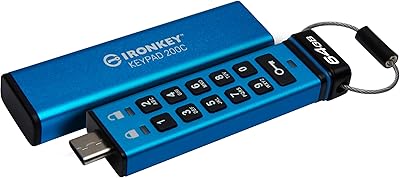
Kingston IronKey Keypad 200 64GB Encrypted Flash Drive
85%
92%
Encryption & Security
88%
Performance & Speed
80%
Ease of Use & Setup
90%
Build Quality & Durability
85%
Keypad Security Functionality
More
Kingston IronKey D500S 256GB Encrypted Flash Drive
85%
94%
Security Features
88%
Data Transfer Speed
92%
Build Quality
90%
Durability
85%
Ease of Use
More
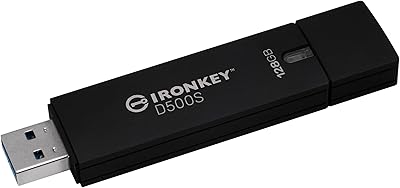
Kingston Ironkey D500S 16GB Encrypted Flash Drive
83%
94%
Security Features
88%
Ease of Use
85%
Transfer Speed
90%
Build Quality/Durability
60%
Price vs. Capacity
More
Kingston IronKey D500S 128GB Encrypted Flash Drive
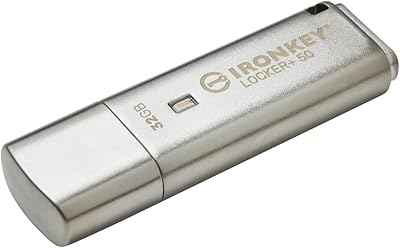
85%
94%
Security & Encryption
88%
Build Quality & Durability
87%
Performance (Speed)
82%
Ease of Use & Setup
80%
Portability & Size
More
Kingston IronKey Locker+ 50 32GB USB Drive
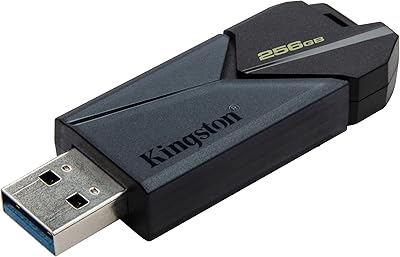
82%
94%
Encryption & Security
88%
Build Quality
76%
Ease of Setup
89%
Cloud Backup Feature
86%
Password Flexibility
More
Kingston DataTraveler Exodia Onyx 256GB USB 3.2 Flash Drive
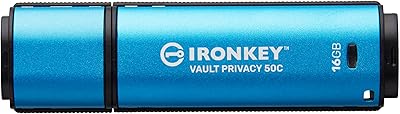
86%
92%
Transfer Speed
85%
Build Quality
94%
Portability
89%
Compatibility
90%
Ease of Use
More
Kingston Ironkey Vault Privacy 50 USB-C 16GB Flash Drive
86%
93%
Data Security
89%
Data Transfer Speed
85%
Build Quality
90%
Portability
88%
Ease of Use
More
Kingston IronKey Vault Privacy 50 USB-C 512GB Encrypted Flash Drive
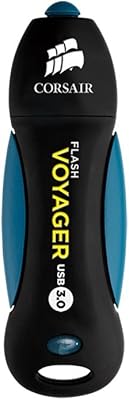
87%
94%
Security & Encryption
88%
Performance (Speed)
85%
Build Quality & Durability
82%
Portability & Size
90%
Ease of Use
More
Corsair Flash Voyager 256GB USB 3.0 Flash Drive
89%
88%
Performance
93%
Durability
90%
Compatibility
72%
Speed (Write)
89%
Water Resistance
More
Corsair Flash Voyager GTX 256GB USB 3.1 Flash Drive
86%
91%
Performance
94%
Speed
89%
Durability
87%
Portability
88%
Compatibility
More

FAQ

No, and that is one of its most practical qualities. The entire unlock process happens on the drive itself using the built-in keypad, so you plug it in, enter your PIN on the device, and it mounts normally on whatever computer you are using. No drivers, no companion apps, nothing to install.

The drive has Brute Force Protection built in. After a set number of consecutive wrong PIN attempts, it locks itself. If the failed attempts continue beyond the threshold, it will perform a crypto-erase, permanently wiping all data on the drive. There is no way to recover that data afterward, which is precisely the point for sensitive environments.

Yes, fully. Because authentication is handled by the onboard keypad rather than any host software, this hardware-encrypted USB works on macOS, Linux, Chrome OS, and Windows without any configuration changes. It is one of the genuine advantages over software-based encrypted drives that often have platform limitations.

The Admin PIN gives full control over drive configuration — setting policies, resetting the User PIN if it is forgotten, and managing Read-Only settings. The User PIN is what an end user enters to access their files day to day. In an organizational setting, an IT administrator can hold the Admin PIN while staff only ever interact with their User PIN, which means the admin can recover a drive without the user needing to know the master credential.

It carries genuine dust-proof and waterproof ratings, which means the casing is designed to resist ingress from both. That said, waterproof does not mean you should leave it submerged indefinitely — it is built to survive the kind of exposure you encounter in real professional field conditions, not prolonged immersion.

You can set the IronKey Keypad 200 to Read-Only mode either permanently or just for the current session. In practice, this is useful when you need to hand a drive to someone else to copy files from it — they can read everything on the drive but cannot add, modify, or delete anything. It is a clean way to distribute files without worrying about accidental or malicious changes.

FIPS 140-3 is a U.S. government security standard administered by NIST for cryptographic hardware. Level 3 specifically adds requirements around physical tamper evidence and identity-based authentication on top of the encryption itself. In practical terms, it means an independent testing lab verified that this drive meets those requirements — it is not a self-certification, which matters significantly for procurement in government or regulated industries.

If you forget your User PIN, an Admin can reset it using the Admin PIN without losing any data. If you forget the Admin PIN itself, there is no recovery path — the drive will need to be crypto-erased, and all data on it will be permanently lost. This is by design and is actually a core part of what makes the drive secure, but it does mean you need a reliable process for recording or safeguarding your Admin PIN from day one.

Nothing is wrong — this is expected behavior. The drive performs real-time XTS-AES 256-bit encryption on every read and write operation using its own hardware processor, and it operates over USB 3.2 Gen 1, which caps theoretical throughput below faster modern standards. At 280 MB/s read and 115 MB/s write, it is perfectly usable for document and data work, but it will not match the raw speed of a non-encrypted high-performance drive. The trade-off is intentional.

It is widely used in healthcare, legal, and financial environments for exactly that purpose. The FIPS 140-3 Level 3 certification, hardware-based encryption, and automatic crypto-erase capabilities align with what those regulatory frameworks require for encrypted portable media. That said, compliance is a broader organizational responsibility — the drive is a strong technical control, but you should confirm with your compliance officer or legal team that it fits within your specific policy framework.

Where to Buy