Overview

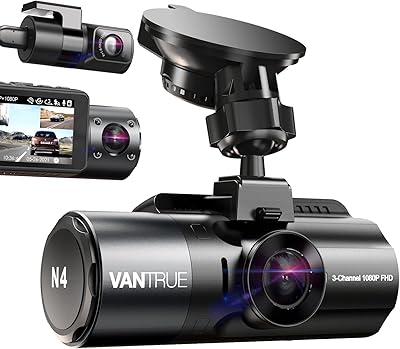
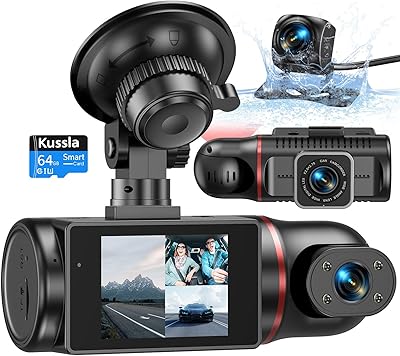
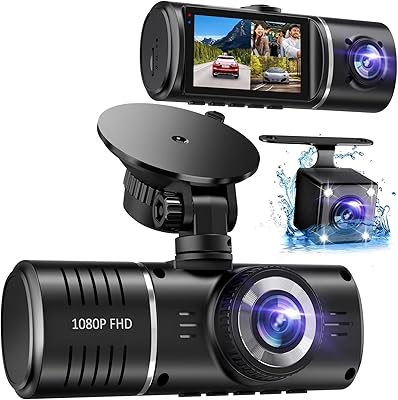
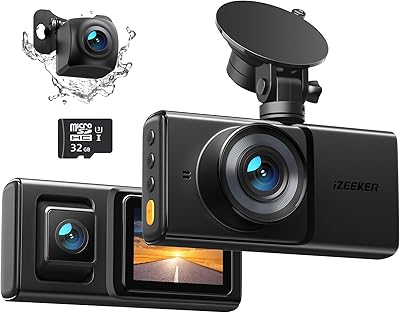
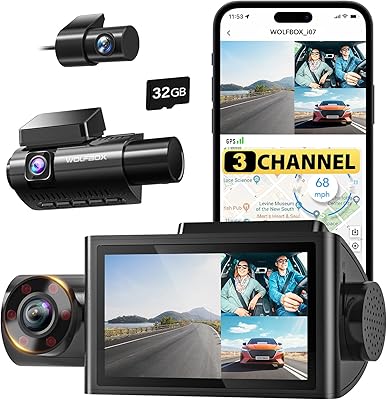
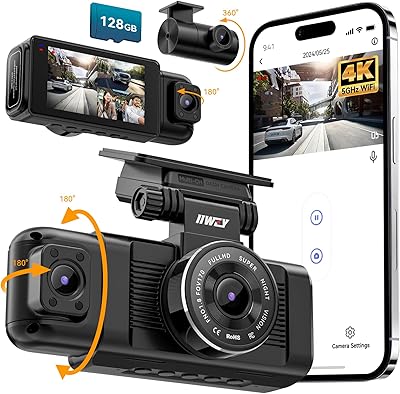
The iiwey T1 3-Channel Dash Cam is one of the more practical options you'll find if you need simultaneous front, rear, and cabin coverage without spending a fortune. Most dash cams at this price point cover one or two angles at best, so getting all three in a single unit is genuinely useful. It arrives ready to use — the 32GB SD card is already in the box, which saves an annoying extra purchase. The Sony sensor and wide-aperture lens are real selling points for low-light situations, and the suction mount means setup takes minutes rather than an afternoon.
Features & Benefits

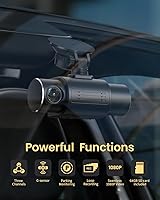
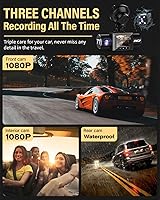
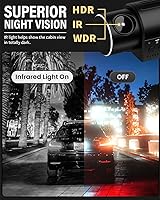
All three cameras record at full 1080P simultaneously, which means you're capturing enough detail to read license plates in daylight. The interior camera is where this cabin-and-road recorder separates itself from standard two-channel units — infrared LEDs kick in automatically in complete darkness, giving you a usable black-and-white view of the passenger area even at 2 a.m. with the dome light off. The WDR processing handles the tricky lighting transitions drivers encounter constantly, like emerging from a parking garage into bright sunlight. G-sensor collision detection locks footage instantly, and the waterproof rear camera can be mounted externally on the bumper.

Best For

Rideshare and taxi drivers are the most obvious audience here. Having footage of the cabin during a passenger dispute — whether it's a false accusation or a damage claim — can make an enormous difference, and the iiwey T1 covers that angle literally. Urban commuters who deal with aggressive traffic and parking lot incidents will also find the three-angle coverage reassuring. If you've been putting off buying a dash cam because of the setup cost or the SD card hassle, this three-channel dash cam removes most of those friction points. Night-shift drivers get particular value from the IR cabin coverage, which works even when the car interior is completely dark.

User Feedback

Buyers generally respond well to how straightforward the setup is — plug it in, insert the included card, and it just works. The value proposition gets mentioned repeatedly, particularly from rideshare drivers who appreciate having cabin evidence without investing in a more expensive system. That said, not every review is glowing. A handful of users flag the mount stability as less reliable than expected on bumpy roads, and some find the companion app experience underwhelming for managing footage remotely. Long-term durability is a mixed picture; many report no issues after several months, but a smaller group notes quality concerns after heavy daily use.

Pros

  • All three cameras record simultaneously, covering the road ahead, behind, and the cabin interior at once.
  • The infrared interior camera works in complete darkness, a rare capability at this price point.
  • Arrives ready to use — the SD card is included, so there is no extra purchase required before hitting the road.
  • The waterproof rear camera can be mounted externally on the bumper for true rear-road coverage.
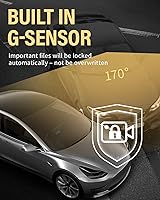
  • G-sensor collision detection automatically locks footage, preventing it from being overwritten during loop recording.
  • WDR processing handles tricky lighting transitions like tunnels and bright morning sun reasonably well.
  • Rideshare and taxi drivers get genuine, timestamped cabin evidence for passenger disputes without a premium investment.
  • Suction mount installation takes minutes and leaves no permanent marks on the windshield.
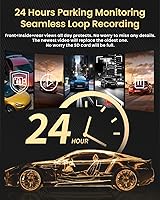
  • Parking mode activates on impact detection, providing passive surveillance even when the engine is off.
  • The Sony sensor and wide aperture lens produce noticeably better low-light road footage than many competitors in the same price range.

Cons

  • The companion app experience is limited and feels underdeveloped compared to more established dash cam brands.
  • Managing video files requires direct SD card access, with no convenient wireless transfer option.
  • The suction mount can lose its grip on bumpy or heavily textured dashboards over time.
  • Interior night vision footage is black and white only, which may limit detail identification in some cabin incidents.
  • Long-term durability under heavy daily use has drawn mixed feedback from owners past the six-month mark.
  • The overall video quality, while functional, lacks the color depth and sharpness of mid-range dash cam alternatives.
  • Cable routing for three cameras can be messy without professional installation or careful planning.
  • Loop recording file management may require occasional manual attention to ensure locked clips are not filling storage unexpectedly.

Ratings

The scores below for the iiwey T1 3-Channel Dash Cam were generated by our AI engine after systematically analyzing verified global buyer reviews, actively filtering out incentivized, bot-generated, and unverified feedback to surface genuine ownership experiences. Each category reflects both what users consistently praised and where they ran into real frustrations — nothing has been smoothed over to make the product look better than it is. The result is a transparent, balanced picture of how this three-channel dash cam actually performs in daily use across rideshare, taxi, and personal driving contexts.
Value for Money
88%
For a unit that covers three camera angles, includes an SD card, and arrives ready to use out of the box, most buyers feel they are getting a genuinely fair deal. Rideshare drivers in particular consistently note that the cabin coverage alone justifies the price, since comparable three-channel systems from established brands cost significantly more.
A small segment of buyers who experienced early hardware failures feel the value proposition collapses quickly if the unit stops working outside the return window. At this price tier, replacement or repair support is limited, which colors the long-term value perception for a minority of owners.
Ease of Installation
83%
The suction mount attaches in seconds and the cable routing process, while not totally trivial, is manageable for most drivers without professional help. Many rideshare users mention getting the front and interior cameras running within 30 minutes of opening the box, which is a meaningful real-world advantage.
Running the rear camera cable through the vehicle interior is where installation gets tedious, particularly in sedans with tighter headliners. A handful of buyers found the cable length for the rear camera slightly short for certain vehicle configurations, requiring creative routing or an extension.
Video Quality (Daytime)
76%
24%
Under normal daylight conditions, the front camera captures enough detail to read license plates at reasonable distances and cover multiple lanes simultaneously. Drivers who have submitted footage in insurance claims generally report it was accepted without issue, which is the practical benchmark that matters most.
Compared to mid-range dash cams in a higher price bracket, color reproduction is somewhat flat and fine detail softens noticeably at the edges of the wide-angle frame. Buyers upgrading from a branded competitor sometimes express disappointment that the step up in channel count did not come with a comparable step up in image sharpness.
Night Vision Performance
71%
29%
The infrared interior camera genuinely works in a fully dark cabin, which is not a given at this price point. Night-shift taxi and rideshare drivers specifically call out the IR cabin view as reliable and clear enough to identify passenger behavior, even with zero ambient light inside the vehicle.
The road-facing cameras are less impressive after dark, with noticeable noise in low-light footage compared to units with larger sensors or better onboard processing. IR cabin footage is strictly black and white, which can limit color-based identification in incident footage — a trade-off buyers should understand before purchasing.
Build Quality
63%
37%
The unit feels solid enough for daily use and the rear camera's weatherproofing holds up adequately through normal rain exposure. Most buyers who use the device for standard commuting or rideshare shifts report no structural issues in the first few months of ownership.
The plastic housing has a distinctly budget feel that becomes more apparent over time, and the suction mount loses its grip on some windshield surfaces after repeated temperature cycles. A notable share of longer-term owners report issues with buttons, connectors, or the mount mechanism after six or more months of daily use.
G-Sensor & Emergency Recording
79%
21%
The collision detection works reliably at moderate sensitivity settings, locking footage almost immediately after an impact without requiring any driver interaction. Several users specifically mention the G-sensor as the feature that gave them useful evidence after a parking lot scrape or minor rear-end collision.
At higher sensitivity settings, urban driving over rough roads or speed bumps can trigger false locks that gradually fill up the protected storage partition. Buyers who do not periodically review and clear their locked file folders occasionally find their available recording space significantly reduced without realizing why.
Loop Recording Reliability
74%
26%
The continuous loop recording works as described under normal conditions, with the oldest unlocked footage being replaced cleanly once the card fills. Drivers who run the unit for long shifts report no unexpected gaps or missed recording windows in typical operation.
A subset of buyers have reported confusion around locked file management, where accumulated G-sensor-triggered clips quietly consumed most of the available card space and caused the unit to stop recording new footage. The lack of an intuitive on-screen warning about storage partitioning is a recurring complaint.
Parking Mode
67%
33%
When used with a dedicated hardwire kit, the parking surveillance feature provides a meaningful layer of passive protection against lot damage and vandalism. Urban drivers who leave their vehicles parked on busy streets mention the peace of mind this feature adds, even if they rarely need to review the footage.
Parking mode on the standard car charger connection carries a real risk of battery drain for vehicles parked overnight, which the manual does not explain clearly enough for the average buyer. Several owners discovered this limitation only after experiencing a dead battery, which is an avoidable frustration with better documentation.
Interior Camera Coverage
81%
19%
The cabin camera captures the full interior of most standard passenger cars and rideshare vehicles in a single wide frame, which is exactly what drivers need for recording passenger interactions. The field of view is wide enough that a single interior camera position covers the rear seat area without requiring adjustment.
In larger SUVs or vans, the interior camera may not capture the full rear seating row without repositioning, which can be tricky given the fixed cable length. The black-and-white IR mode, while functional, occasionally draws criticism from buyers who expected color cabin footage in low-light conditions.
App & Connectivity
41%
59%
For drivers who are comfortable pulling the SD card and reviewing footage on a computer, the basic USB file access works without any complications. The absence of a proprietary app means there is no software to install or update, which some buyers actually prefer for its simplicity.
Buyers who expected smartphone app integration for live view, remote playback, or wireless clip sharing are consistently disappointed — this functionality simply does not exist. Compared to competing units with built-in Wi-Fi and dedicated apps, the iiwey T1 feels noticeably behind in terms of modern connectivity, and this is the most frequently cited frustration in negative reviews.
SD Card & Storage
82%
18%
Including a 32GB card in the box is a genuine convenience that removes a common barrier to getting started, and buyers consistently mention it as a positive in early reviews. The card performs reliably with the unit and does not appear to be a low-grade inclusion, which is sometimes a concern with bundled storage.
32GB fills up relatively quickly with three simultaneous 1080P streams, leaving some buyers wanting more headroom before the loop resets. Upgrading to a larger card is straightforward, but the process of identifying a compatible high-endurance card is left entirely to the buyer without guidance in the manual.
Rear Camera Performance
69%
31%
The weatherproof rear camera holds up well through daily exposure to rain and road conditions when mounted externally, which is a legitimate durability advantage over non-waterproofed alternatives. Image quality is acceptable for capturing following vehicles and rear-collision events in daylight hours.
Night footage from the rear camera is the weakest link in the three-channel system, with more noise and less detail than the front camera under equivalent lighting conditions. The mounting hardware for the rear camera also draws some criticism for being fiddly to secure cleanly on curved rear windshields.
Long-Term Reliability
58%
42%
A meaningful proportion of buyers report trouble-free operation for six months or longer under daily driving conditions, particularly those using the unit in personal vehicles with moderate usage hours. Early adopters in warmer climates who avoid extreme heat exposure to the unit tend to report better longevity.
There is a consistent thread of negative feedback from buyers who experienced component failures — particularly with the rear camera connection or the main unit power input — after several months of continuous rideshare use. The 12-month warranty provides some reassurance, but the claims process through third-party Amazon sellers can be slow and inconsistent.

Suitable for:

The iiwey T1 3-Channel Dash Cam was practically designed with rideshare and taxi drivers in mind. If you drive for Uber, Lyft, or any cab service, having a dedicated interior camera that works in complete darkness is a meaningful layer of protection — the kind that can settle a dispute before it becomes a legal headache. Beyond the gig economy, urban commuters who regularly navigate dense traffic, tight parking structures, and aggressive drivers will appreciate having all three angles covered simultaneously. Fleet operators running small delivery or transport businesses on tight margins will find the per-unit cost reasonable enough to outfit multiple vehicles without a significant budget hit. Night-shift drivers in particular get outsized value here, since the infrared cabin coverage functions even when the interior is completely unlit. Anyone who wants a ready-to-go setup without sourcing a compatible SD card separately will also find the out-of-the-box experience refreshingly uncomplicated.
Not suitable for:

If your priority is cutting-edge video quality or a polished smartphone app experience, the iiwey T1 3-Channel Dash Cam is probably not the right fit. This is a budget-tier device, and while the footage is functional and clear enough for evidentiary purposes, it does not compete with mid-range or premium dash cams on dynamic range, color accuracy, or overall video richness. Drivers who want seamless wireless footage transfer or cloud backup will find the connectivity options here fairly limited — USB access to the SD card is the primary method, which can feel dated. If you commute exclusively on smooth highways with no real concern about passenger liability, the added complexity of three cameras and their cables may feel like more than you need. Buyers with high expectations for long-term durability under heavy daily use should also proceed with some caution, as a portion of owners report performance issues after extended periods of continuous operation.
Specifications

  • Recording Channels: The unit records simultaneously across three channels: front-facing road, rear-facing road, and interior cabin.
  • Video Resolution: All three cameras capture footage at 1920x1080P resolution and 30 frames per second.
  • Image Sensor: The front and main cameras use a Sony sensor paired with an F1.8 aperture lens for improved low-light capture.
  • Night Vision: The interior camera uses built-in infrared LEDs to record in complete darkness, producing black-and-white cabin footage.
  • Dynamic Range: Wide Dynamic Range (WDR) processing is applied to reduce overexposure and underexposure in high-contrast lighting conditions.
  • Field of View: The front camera covers a 170-degree wide-angle field of view, capturing multiple lanes of traffic simultaneously.
  • G-Sensor: A built-in G-sensor detects sudden impact or collision and automatically locks the current video file to prevent it from being overwritten.
  • Loop Recording: The unit records continuously in a loop, with the oldest unlocked footage replaced automatically once the card is full.
  • Parking Mode: Parking surveillance mode activates recording automatically when the camera detects an impact while the vehicle is stationary.
  • Rear Camera: The rear camera is waterproof and suitable for external mounting on the bumper or rear windshield.
  • Mounting Type: The main unit attaches to the windshield via a suction cup mount, requiring no permanent adhesive or installation.
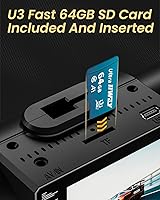
  • Included Storage: A 32GB SD card is included in the box, allowing the unit to be used immediately without a separate purchase.
  • In the Box: Package contents include the main dash cam unit, a car charger, a 32GB SD card, and a printed user manual.
  • Connectivity: The device connects to a computer or power source via USB for file access and firmware updates.
  • Power Source: The unit is powered via the included car charger, which connects to the vehicle's 12V outlet; a lithium polymer battery provides short-term backup power.
  • Dimensions: The main unit measures 1.97 x 4.53 x 1.77 inches, making it compact enough to sit behind a rearview mirror without obstructing the driver's view.
  • Weight: The complete unit weighs 14.1 ounces, which is typical for a multi-camera dash cam system of this type.
  • Compatible Vehicles: Designed for use in standard passenger cars, taxis, and rideshare vehicles; not intended for motorcycles or heavy commercial trucks.
  • Warranty: The manufacturer provides a 12-month service warranty and a 30-day money-back guarantee from the date of purchase.
  • Model Identifier: This unit is manufactured by iiwey and sold under the model designation T1.

Related Reviews
iiwey N7 3-Channel Dash Cam
76%
84%
Video Clarity
78%
Night Vision
88%
Value for Money
82%
Ease of Setup
67%
App Experience
More
Zengest 3 Channel Dash Cam
86%
88%
Video Quality
85%
Ease of Installation
92%
Night Vision Performance
72%
App Control Experience
90%
Parking Mode Reliability
More
Kussla X30 3-Channel Dash Camera
67%
83%
Night Vision
81%
Front Camera Quality
62%
Rear & Interior Quality
74%
Ease of Installation
86%
Value for Money
More
Icesky M4 Three-Channel Dash Cam
71%
83%
Daytime Video Clarity
67%
Night and Low-Light Performance
61%
App Experience
69%
Installation Process
72%
Build Quality
More
AZDOME M580 3-Channel Dash Cam
85%
93%
Video Quality
88%
Ease of Setup
85%
GPS Tracking Accuracy
90%
Night Vision Performance
82%
Build Quality
More
SUVCON J06 3-Channel Dash Cam
76%
89%
Value for Money
91%
Ease of Installation
74%
Video Quality (Daytime)
86%
Night Vision (Cabin Camera)
67%
Night Vision (Front & Rear Cameras)
More
iZEEKER iD230 3-Channel Dash Cam
75%
83%
Front Camera Quality
88%
Cabin Night Vision
61%
Rear Camera Quality
79%
Ease of Installation
67%
G-Sensor Reliability
More
Rexing M3 3-Channel Mirror Dash Cam
75%
83%
Video Clarity (Daytime)
61%
Night Vision Performance
88%
Screen Quality
58%
GPS Accuracy
86%
Cabin Camera Utility
More
Vantrue N4S 3-Channel Dash Cam
77%
88%
Front Camera Video Quality
91%
Night Vision Performance
86%
Cabin IR Recording
83%
Rear Camera Quality & Weatherproofing
71%
Parking Mode Reliability
More
Vantrue N4 3-Channel Dash Cam
70%
88%
Video Quality
92%
Interior Night Vision
86%
Build & Durability
89%
Heat & Cold Resistance
74%
Parking Mode
More
ZKCAMSPY Triple Channel 1080P Dash Cam
72%
86%
Value for Money
88%
Multi-Channel Coverage
79%
Night Vision Performance
61%
Build Quality
57%
Parking Monitor
More

FAQ

Yes, and it is one of the more useful things about this unit. The interior camera has its own infrared LEDs that switch on automatically in low-light conditions. You will not get color footage — it is black and white — but the image is clear enough to identify faces and activity inside the cabin, which is really what matters for rideshare or taxi use.

No, a 32GB card comes included in the box. You can plug it in and start recording right away. That said, if you drive long shifts and want to retain more footage before it loops over, upgrading to a larger card is straightforward — just make sure it is a Class 10 or UHS-1 card for reliable write speeds.

Yes. The front and interior cameras can be used independently if you prefer a simpler two-camera or single-camera setup. The system does not require all three channels to be active simultaneously.

The G-sensor is adjustable in sensitivity, which matters a lot on rough city roads where minor jolts could otherwise trigger constant file locks. You can tune it so it responds to genuine impacts rather than speed bumps or potholes. When it does lock a file, that clip stays protected from loop overwriting until you manually delete it.

The rear camera is rated for outdoor use and can handle rain and road spray in a typical external mounting position. Most owners mount it on the inside of the rear windshield for simplicity, but bumper mounting is an option if you want a cleaner wide-angle shot of the road directly behind the vehicle.

No, wireless connectivity is not included. Footage is accessed by removing the SD card and inserting it into a card reader, or by connecting the unit to a computer via USB. If wireless file management is important to you, this is a genuine limitation worth considering before buying.

Parking mode does draw a small amount of continuous power, so if you leave it running on the standard car charger for extended periods with the engine off, there is a risk of draining a weaker battery. The manufacturer recommends using a dedicated hardwire kit for parking mode, which allows the unit to cut power once the battery drops below a safe voltage threshold.

That depends on how many cameras are active and what resolution they are recording at. With all three channels running on the included 32GB card, expect roughly two to four hours of footage before the loop starts overwriting the oldest clips. Any file locked by the G-sensor or manually by you will not be overwritten regardless.

For the most part, yes. The suction mount attaches quickly, and routing the power cable along the headliner to the 12V outlet takes maybe 20 to 30 minutes with a trim tool or even just a credit card. The rear camera cable run is the trickiest part, especially in sedans, but there are plenty of installation guides online specific to this camera type that make it manageable.

Remove the SD card from the unit and insert it into any standard SD card reader connected to your computer. Locked files — those saved automatically by the G-sensor or manually locked by you — will appear in a separate folder and can be copied directly to your hard drive. It is a good habit to back up any important clips as soon as possible after an incident rather than relying on the card indefinitely.