Overview

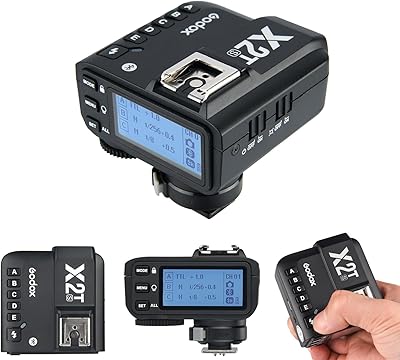
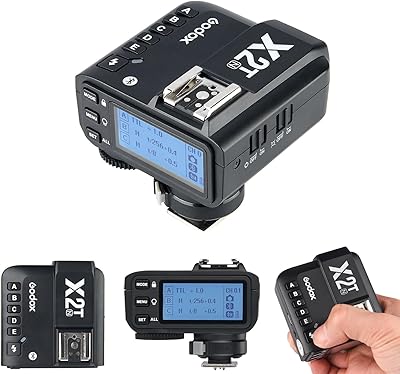
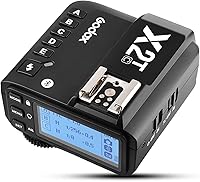
The Godox X2T-C TTL Wireless Flash Trigger sits comfortably in Godox’s mid-range trigger lineup — capable enough for serious work without the pricing pressure of high-end alternatives. It supports Canon’s native E-TTL and E-TTL II, meaning it slots directly into any existing Godox flash setup without workarounds. Arriving in 2019, it addressed real frustrations with the older X1T-C: Bluetooth app control, a USB-C port for firmware updates, and a locking hot-shoe that doesn’t shift mid-shoot. The compact build feels solid in hand. That said, be clear-eyed from the start — this Godox trigger is designed to work within the Godox ecosystem, not as a universal flash controller.
Features & Benefits

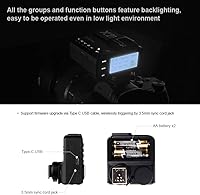
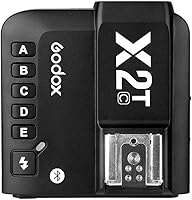
The X2T-C’s most notable addition is its Bluetooth app control via GodoxPhoto — once paired, you can adjust power output, switch between flash modes, or toggle the modeling light from your phone without touching the trigger. It works well, though the initial pairing isn’t always instant. High-speed sync up to 1/8000s is a practical asset for outdoor work, particularly when shooting wide-open under strong ambient light. Five dedicated group buttons let you adjust each flash unit independently without menu-diving. The 32-channel system with 99 wireless ID settings is particularly useful in busy event venues where nearby triggers could otherwise bleed into your setup. USB-C for firmware updates is a small but welcome step forward.

Best For

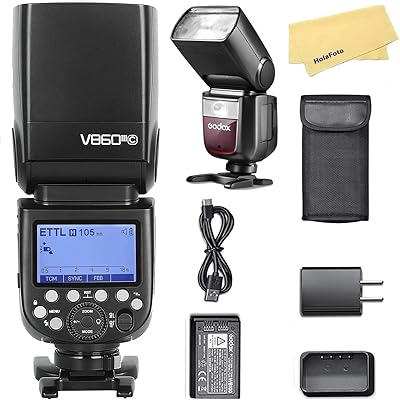
This Canon flash trigger is a natural fit for photographers already running a Godox flash lineup — whether that’s V860III-C speedlights at a wedding or an AD200 Pro on a location portrait session. Event and portrait photographers benefit most, since the five group buttons make it fast to drop a key light or bring fill up between frames. Outdoor photographers shooting wide-open in daylight will lean on HSS consistently. It’s also a practical option for solo shooters who want to step back and make adjustments through the app. Those upgrading from the X1T-C will notice the improved build and layout almost immediately.

User Feedback

The pattern that emerges from user experiences with the X2T-C is consistent TTL communication — even at distance, signal reliability across Godox flash units is a frequent highlight, which is exactly what matters on a paid shoot. The ergonomic overhaul also earns real appreciation; the relocated control wheel and dedicated group buttons are cited often by photographers who switched from the X1T-C. On the downside, Bluetooth pairing occasionally requires a second attempt to connect reliably — not a dealbreaker, but worth knowing. The single AA battery can run out faster than expected during long event days. LCD readability in bright sun is a genuine limitation, and non-Godox flash compatibility remains essentially nonexistent.

Pros

  • TTL communication stays rock-solid across Godox flash units, even when working up to 100 meters away.
  • Five dedicated group buttons make real-time power adjustments fast — no menu-diving between shots.
  • High-speed sync up to 1/8000s is a genuine asset for outdoor fill-flash work at wide apertures.
  • Bluetooth app control via GodoxPhoto lets you adjust flash settings from your phone during solo sessions.
  • The locking hot-shoe keeps the trigger firmly in place — a clear improvement over earlier Godox designs.
  • USB-C connectivity for firmware updates feels current and is far less fragile than the old Micro-USB port.
  • 32 channels and 99 wireless ID settings provide real separation from other triggers in crowded venues.
  • The visible-light AF assist beam improves autofocus accuracy in low light on compatible Canon bodies.
  • Compact and light enough that it adds almost nothing to a packed camera bag.
  • The relocated control wheel and cleaner button layout make it noticeably more intuitive than the X1T-C.

Cons

  • Strictly Godox-ecosystem only — non-Godox flashes are not reliably supported, which significantly limits flexibility.
  • Bluetooth pairing is inconsistent for some users; first-time connections occasionally require more than one attempt.
  • A single AA battery is all you get — extended shoots will have you reaching for spares sooner than expected.
  • The LCD becomes genuinely difficult to read in bright direct sunlight, a real frustration on outdoor assignments.
  • Canon-only mount design means you cannot carry one trigger across different camera system brands.
  • The GodoxPhoto app, while useful, lacks the polish and reliability needed when shooting under real time pressure.
  • Studio flashes without a built-in Godox X receiver require an additional receiver unit, adding cost to older setups.
  • At crowded events, manually configuring wireless IDs to avoid cross-trigger bleed takes meaningful setup time upfront.

Ratings

The scores below were generated by our AI engine after analyzing verified buyer reviews sourced from around the world, with spam, bot submissions, and incentivized feedback actively filtered out before any scoring was calculated. The Godox X2T-C TTL Wireless Flash Trigger performed strongly in core areas like signal reliability and multi-flash control, while real friction points around Bluetooth consistency and ecosystem lock-in are equally reflected. Every score here represents the honest aggregate of real shooter experiences, not a curated highlight reel.
Signal Reliability
91%
Across diverse environments — from cramped wedding receptions to open-air portrait sessions — users consistently report that the X2T-C maintains a stable wireless connection without dropped triggers or misfires. The 2.4GHz signal holds up reliably across the rated 100-meter range, which matters most when flashes are positioned far from the camera on larger sets.
A small number of users report occasional signal hiccups in environments with heavy 2.4GHz congestion, such as large convention halls with dozens of active wireless devices. These are edge-case incidents rather than a persistent pattern, but photographers working in extremely RF-dense venues should be aware of the possibility.
TTL Accuracy
88%
Canon shooters consistently rate the trigger's TTL communication highly, citing accurate flash exposures across a wide range of scenarios — from backlit outdoor portraits to dimly lit reception halls. The E-TTL II compatibility integrates cleanly with Canon's metering system, which reduces the need for constant manual compensation between shots.
TTL metering can behave inconsistently in scenes with complex or rapidly changing lighting, which is a limitation of the protocol itself rather than the trigger specifically. A portion of users note exposure variance between consecutive frames that occasionally requires compensation adjustments during fast-paced event shooting.
High-Speed Sync
89%
For outdoor portrait photographers shooting wide-open at f/1.4 or f/1.8 under midday sun, HSS capability up to 1/8000s is one of the trigger's strongest practical assets. It fires accurately at high shutter speeds across all compatible Godox flash units, giving photographers real creative flexibility without reaching for neutral density filters.
As with any HSS implementation, flash output drops noticeably at very high shutter speeds, requiring higher power settings or closer flash positioning to maintain proper exposure. Users newer to HSS occasionally encounter unexpected underexposure above 1/2000s until they adjust their approach to power compensation.
Bluetooth App Control
67%
33%
When the GodoxPhoto app pairs successfully, the ability to adjust flash power and switch modes from a phone — without walking back to the camera — is a genuine time-saver during solo portrait or product sessions. The feature works well on most modern Android and iOS devices once the initial connection is properly established.
The initial pairing process is where most user frustration surfaces: some photographers report needing multiple attempts before the trigger and app communicate reliably, especially on first use. The app interface itself also feels less refined than the trigger's physical controls, with occasional lag that undermines confidence when adjusting settings quickly on a live shoot.
Ecosystem Compatibility
54%
46%
Within the Godox lineup, the X2T-C communicates flawlessly — TTL, HSS, Multi, and TCM all function as expected with speedlights like the V860III-C and outdoor strobes like the AD200 Pro. For photographers who have built their entire lighting kit around Godox, compatibility is a non-issue in day-to-day use.
Step outside the Godox ecosystem and the trigger becomes largely unusable for full-featured flash control — non-Godox units will not respond to TTL or HSS commands, which is a hard stop for photographers running mixed-brand kits. Those comparing this to PocketWizard or Profoto Air Remote should understand upfront that this is a Godox-first device, not a universal trigger.
Ergonomics & Controls
84%
The five dedicated group buttons — one of the most praised ergonomic changes from the previous generation — let photographers adjust individual flash groups without navigating menus mid-shoot. Photographers upgrading from the X1T-C consistently cite the reorganized control layout as the single most noticeable day-to-day improvement in their workflow.
The control wheel, though better positioned than before, can feel cramped for users with larger hands when making quick adjustments in cold weather or while wearing gloves. A portion of reviewers also note that button labeling is small enough to require some memorization before shooting confidently in low-light conditions.
Build Quality
82%
18%
The X2T-C feels noticeably more substantial than its predecessor, with tighter button action and a locking hot-shoe that stays firmly seated through a full day of active shooting. The compact 6.4 oz body holds up well under regular professional use, and the control wheel placement reduces the chance of accidental mid-session changes.
The plastic construction, while adequate for most conditions, doesn't inspire confidence for photographers who regularly work outdoors without environmental protection on the gear. The trigger carries no splash or dust resistance rating, which means wet-weather sessions require extra caution or a protective cover.
Multi-Flash Control
86%
Running five independent flash groups from a single trigger is where the X2T-C consistently earns praise from working photographers managing complex lighting setups. Portrait and event photographers particularly appreciate the ability to bring fill down or boost a hair light between frames without disrupting or resetting the entire configuration.
For photographers stepping up from simpler one-or-two-light setups, configuring five groups across multiple channels has a genuine learning curve before it feels natural. Some users also note that switching between dramatically different group configurations mid-event takes more steps than they would prefer when time is short.
Interference Resistance
83%
The combination of 32 selectable channels and 99 wireless ID settings gives photographers working alongside other shooters a reliable way to isolate their own flash system. At crowded wedding venues or multi-photographer commercial sets, the layered signal separation approach works as advertised in the vast majority of reported use cases.
Setting up the correct channel and ID combination to avoid cross-triggering requires an upfront coordination step that photographers used to simpler systems can find unnecessarily manual. In heavily RF-saturated environments, even with careful configuration, a small number of users have reported intermittent false triggers that interrupted their shooting rhythm.
Value for Money
87%
At its mid-range price point, this Godox trigger delivers a feature set that competes well above its cost bracket: HSS, Bluetooth, five independent groups, 32 channels, and USB-C all in one compact unit. For photographers already in the Godox ecosystem, the cost-to-functionality ratio is consistently rated as strong relative to competing options.
Buyers who step outside the Godox flash system quickly find that the value proposition erodes — the trigger's full feature set is only unlocked when paired with compatible Godox units. Compared to more expensive but ecosystem-agnostic alternatives, the long-term cost of Godox-only compatibility is worth factoring into the overall value calculation.
LCD Display
61%
39%
In controlled indoor environments and shaded outdoor conditions, the LCD is clear and shows all essential parameters — group settings, flash mode, channel, and output level — in a compact, readable layout that most photographers learn to scan quickly. Navigating between settings in a dim studio or indoor venue is generally comfortable.
In bright direct sunlight, LCD legibility drops significantly, and this is one of the more consistent complaints from outdoor photographers needing quick adjustments between shots. The trigger has no automatic brightness adaptation, and squinting at the display during a fast-paced outdoor session creates real friction that some competing triggers handle more gracefully.
Battery Life
63%
37%
For typical portrait or event sessions lasting a few hours, the single AA battery holds without issue during active use. The trigger's idle power draw is low enough that many photographers report the same battery lasting across several spread-out shooting days before needing a replacement.
For photographers running all-day event shoots or multi-day assignments, a single AA becomes a real inconvenience — particularly because there is no low-battery indicator that provides meaningful advance warning before the trigger cuts out. The lack of any built-in rechargeable option means carrying spare batteries is simply a non-optional habit.
Firmware & Connectivity
78%
22%
The USB-C port for firmware updates is a meaningful improvement over the Micro-USB port on the X1T-C, and Godox has a reasonable track record of releasing firmware updates that expand compatibility and address user-reported issues. The update process itself is straightforward for anyone comfortable connecting a device to a computer.
Firmware updates still require a physical cable and a computer — there is no wireless or over-the-air update path, which feels inconsistent for a device that otherwise emphasizes its Bluetooth connectivity. Photographers who don't check for new firmware releases proactively may miss meaningful improvements without realizing it.
AF Assist Performance
74%
26%
The switch to a visible-light AF assist beam is a practical improvement over the infrared pattern used on older Godox triggers, and photographers working in dimly lit venues report better autofocus acquisition on compatible Canon bodies during posed shots. The beam activates reliably when needed without staying on unnecessarily between frames.
The visible-light beam, while more effective for some Canon body pairings, can be distracting to subjects in very dark environments — particularly during candid event work where a visible beam draws unwanted attention. Compatibility and effectiveness with the AF assist feature also vary noticeably across different Canon body generations.

Suitable for:

The Godox X2T-C TTL Wireless Flash Trigger is built for Canon photographers who are already committed to the Godox flash ecosystem and want a reliable, centralized way to manage multiple lights. If you’re running a V860III-C as your key light, an AD200 Pro for fill, and a third unit in the background, this trigger lets you adjust all three independently from one controller without breaking your shooting rhythm. Event photographers will particularly appreciate the five dedicated group buttons — dropping fill power between a ceremony and a reception setup is fast and intuitive without pulling up a single menu. Outdoor portrait shooters who regularly fight harsh ambient light at wide apertures will get real value from the HSS capability, which pushes sync speed up to 1/8000s. It’s also a practical step up for anyone still on the X1T-C who wants Bluetooth app control and a modern USB-C connection without jumping to a significantly higher price point.
Not suitable for:

The Godox X2T-C TTL Wireless Flash Trigger is not the right tool if your flash bag is a mix of brands — it does not reliably trigger non-Godox units, so photographers running Profoto, Elinchrom, or older third-party flashes should look at brand-agnostic options like the PocketWizard line instead. It’s also worth skipping if you shoot across Canon and Sony or Nikon bodies and need one trigger that works across systems; this one is strictly Canon E-TTL, full stop. Photographers who depend on a clear, readable display during bright outdoor sessions may find the LCD genuinely frustrating in direct sunlight. If Bluetooth app control is a top priority, be aware that the pairing experience can be inconsistent — it often works fine, but it is not the plug-and-play reliability you’d expect from a dedicated hardware controller. Those running extended multi-day shoots on a single AA should carry spares, as battery life is workable but not generous enough to take for granted.
Specifications

  • Brand: Manufactured by Godox, a widely used lighting brand in the mid-range professional photography market.
  • Model: Model designation is X2T-C, where the C suffix indicates exclusive compatibility with Canon camera systems.
  • Compatibility: Supports Canon E-TTL and E-TTL II autoflash protocols for accurate through-the-lens flash metering on compatible Canon bodies.
  • Wireless System: Operates on Godox's proprietary 2.4GHz X wireless radio system for stable, real-time signal transmission between trigger and flash units.
  • Sync Speed: Supports High-Speed Sync (HSS) up to 1/8000s, well beyond the standard flash sync ceiling of most Canon DSLR and mirrorless cameras.
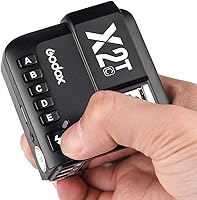
  • Flash Groups: Provides five independently controllable flash groups (A through E), each accessible via its own dedicated front-panel button.
  • Channels: Offers 32 selectable wireless channels to reduce signal overlap in environments where multiple photographers are shooting simultaneously.
  • Wireless IDs: Includes 99 wireless ID settings as a secondary layer of interference prevention, allowing fine-grained separation between nearby wireless systems.
  • Range: Rated for an operating distance of up to 100 meters in open, unobstructed conditions.
  • Connectivity: Features Bluetooth for pairing with the GodoxPhoto app and a USB-C port for firmware updates via computer.
  • Display: Equipped with an LCD screen that shows active flash mode, group assignments, channel selection, and output levels.
  • AF Assist: Uses a visible-light AF assist beam rather than an infrared pattern, improving autofocus acquisition in low light on compatible Canon bodies.
  • Flash Modes: Supports TTL, Manual, Multi (stroboscopic), and TCM (TTL-to-Manual conversion) flash modes.
  • Battery: Powered by a single AA battery (lithium-ion type compatible); no rechargeable battery is built into the unit.
  • Dimensions: Measures 2.36 × 1.97 × 1.97 inches, maintaining a compact footprint when mounted on the camera hot-shoe.
  • Weight: Weighs 6.4 oz, adding negligible load to a standard camera and lens combination.
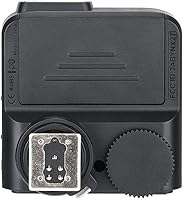
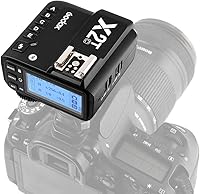
  • Mount: Uses a locking hot-shoe mechanism that secures the trigger firmly to the camera and resists accidental loosening during active shooting.

Related Reviews

Godox X2T-S TTL Wireless Flash Trigger
81%
91%
TTL Accuracy
88%
High-Speed Sync
86%
Build Quality
84%
Interface & Usability
61%
Bluetooth App Integration
More
Godox X2T-N Wireless Flash Trigger Transmitter
81%
91%
Wireless Reliability
87%
TTL Accuracy
84%
High-Speed Sync Performance
79%
Build Quality
88%
Ease of Use
More
Godox X3-F TTL Wireless Flash Trigger
82%
88%
Touchscreen Usability
86%
TTL Accuracy
84%
Wireless Reliability
74%
Battery Life
82%
Value for Money
More
Godox AD600Pro Outdoor Studio Strobe Flash
81%
93%
Output Power & Consistency
78%
High-Speed Sync Performance
71%
Battery Life & Real-World Endurance
89%
Build Quality & Durability
84%
Wireless System & TTL Accuracy
More
Godox V100-CU Canon Touchscreen Flash
82%
93%
Output Power
91%
Touchscreen Interface
82%
TTL Accuracy
88%
High-Speed Sync Performance
84%
Detachable Sub Flash
More
Godox TT685II-C Canon Speedlight Flash
81%
88%
TTL Exposure Accuracy
86%
Wireless Reliability
84%
High-Speed Sync Performance
79%
Build Quality
91%
Value for Money
More
Godox TT600 Camera Flash Speedlite
76%
94%
Value for Money
88%
Wireless Reliability
86%
Output Power
83%
Build Quality
11%
TTL and Automation
More
Godox V860III Canon Speedlite Flash
83%
93%
Battery Life & Endurance
91%
Recycle Time
74%
TTL Accuracy & Consistency
78%
Wireless Reliability
82%
Build Quality & Durability
More
PocketWizard PlusX Wireless Flash Trigger
83%
94%
Trigger Reliability
91%
Ease of Use
83%
Build Quality
87%
Range & Signal Strength
79%
Compatibility
More
Godox Lux Master Retro TTL Camera Flash
82%
91%
Build Quality & Design
88%
Touchscreen Usability
84%
TTL Accuracy
82%
High-Speed Sync (HSS) Performance
67%
Flash Power Output
More

FAQ

Not reliably. The X2T-C is built specifically for the Godox X wireless ecosystem, and while it may fire some third-party flashes in a basic mode through certain adapters, TTL, HSS, and group control will not function with non-Godox units. If you own Profoto, Elinchrom, or similar flashes, you would be better served by a trigger designed for those systems.

It works with both. The trigger communicates through the standard hot-shoe contacts, so any Canon camera with a hot-shoe and E-TTL support is compatible — including popular mirrorless bodies like the EOS R5, R6, R7, and R10. The camera type matters far less than whether it supports Canon’s E-TTL metering protocol.

You download the GodoxPhoto app, enable Bluetooth on your phone, and pair it with the trigger through the app interface. Once connected, you can remotely adjust flash power, switch modes, and toggle settings without touching the trigger itself, which is genuinely useful during solo shoots. That said, the initial pairing can occasionally be stubborn and may need a second attempt to stabilize. It’s a helpful feature, but it works best treated as a convenient supplement to the physical controls rather than a primary control method.

If you use your trigger regularly, the upgrade makes practical sense. The Godox X2T-C TTL Wireless Flash Trigger adds Bluetooth app control, swaps the old Micro-USB port for USB-C, introduces a locking hot-shoe, and replaces the older group navigation with five dedicated physical buttons. The relocated control wheel also makes single-handed adjustments significantly easier. If you rarely update firmware and shoot with just one or two flashes, the case is less urgent, but for heavier everyday use the ergonomic and build improvements are real.
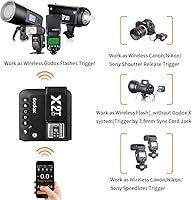
You can control up to five groups (A through E), and each group can have multiple flash units assigned to it. In practice, this means you could independently manage a key light, fill light, hair light, background light, and rim light all from one trigger. For most portrait and event setups, five groups is more than enough headroom.

It runs on a single AA battery, and Godox rates it for up to three years of use, though that reflects typical standby consumption rather than continuous active triggering. In real-world shooting conditions, most photographers get through multiple sessions before needing a replacement, but the math changes fast during all-day events. Keeping a spare AA in your bag is a simple precaution that’s worth forming as a habit.

HSS is enabled through the trigger’s LCD menu or via the GodoxPhoto app, and your Godox flash units also need to support HSS, which most current models do. Once active, you can shoot at shutter speeds all the way up to 1/8000s. Keep in mind that HSS reduces effective flash output at very high shutter speeds, so you may need to bump up power or get your flash closer to the subject when shooting at 1/4000s or beyond in bright daylight.

Yes, and the 32-channel system combined with 99 wireless ID settings is specifically designed for this scenario. By assigning different channel and ID combinations, two shooters can work side-by-side without cross-triggering. It does require a quick coordination step before you start shooting, but once each photographer has a unique channel and ID set, the separation holds reliably.

It works with studio strobes too, provided they have a built-in Godox X wireless receiver — many newer Godox AD and SK series lights include this. For older Godox studio lights without a built-in receiver, you’ll need to add a compatible Godox X receiver unit to each light. Once that’s in place, the studio lights respond to the trigger exactly the same way speedlights do.

TCM stands for TTL-Convert-to-Manual. It works by taking a TTL reading first — letting the system automatically calculate a correct exposure — and then locking that power level in as a fixed manual setting. It’s particularly useful when your lighting conditions are consistent but you want the repeatability of manual control without having to guess a starting power level. Think of it as using TTL to do the initial math, then switching to manual for precise, predictable results from that point forward.

Where to Buy