
Overview

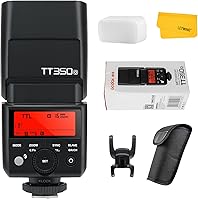
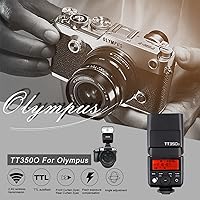
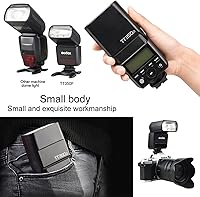
The Godox TT350O Mini TTL Speedlite is a compact flash built from the ground up for Micro Four Thirds shooters — specifically those using Olympus or Panasonic mirrorless bodies. It arrived in 2017, and while that might sound dated, continued firmware support and a solid build have kept it competitive. The appeal is straightforward: you get genuine TTL automation and 2.4G wireless capability in a body small enough to tuck into a jacket pocket. For enthusiasts ready to move beyond a camera's built-in pop-up flash, this mini speedlite offers a practical on-ramp without demanding a premium-tier budget.

Features & Benefits

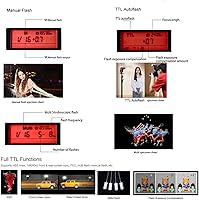
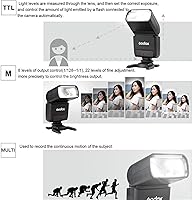
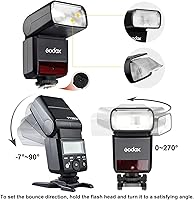
The TT350O's headline trick is high-speed sync up to 1/8000s, which means you can use fill flash wide open in harsh midday sun — something that trips up shooters who attempt it without HSS. TTL metering handles exposure automatically when you're moving fast, and switching to full manual gives precise control for more deliberate setups. The zoom head adjusts automatically or manually between 24mm and 105mm, so output actually tracks your lens. Add in rear curtain sync, multi-flash mode, and S1/S2 optical slave support, and this compact flash unit punches well above its physical size.

Best For

This mini speedlite makes the most sense for travel and street photographers who shoot Olympus or Panasonic gear and refuse to carry a full-size flash. If you're already in the Godox ecosystem — or planning to be — the TT350O slots in neatly as either a master controller or a triggered slave alongside larger strobes, which makes it genuinely useful beyond simple on-camera fill. Portrait shooters wanting a lightweight location light will find it fits that role well. It also works as a capable backup unit for event photographers who'd rather not rely solely on ambient light.

User Feedback

Owners are generally pleased with this compact flash unit, and the feedback pattern is consistent: people love how light it is and how little it intrudes during a long shoot. On Olympus bodies, TTL accuracy earns strong marks from most buyers; on certain Panasonic models, a handful of users report occasional exposure inconsistencies, though this appears to be the exception rather than the rule. Two complaints surface regularly — the LCD can be tough to read in direct sunlight, and recycle time at full power lags behind pricier options. Neither is a dealbreaker, but both are worth knowing before buying.

Pros

  • Genuinely pocket-sized body that barely registers as added weight during a full day of shooting.
  • Native TTL support for Olympus and Panasonic means correct exposures without constant manual tweaking.
  • High-speed sync up to 1/8000s makes outdoor fill flash practical, even shooting wide open.
  • Acts as both a master and slave unit, making it expandable as your lighting kit grows.
  • Auto zoom from 24mm to 105mm means the flash output actually matches what your lens is covering.
  • Wireless range of roughly 30 meters gives real flexibility for off-camera positioning.
  • LCD panel and jog dial make in-field adjustments straightforward without digging through menus.
  • Rear curtain sync and multi-flash modes open up creative options that go well beyond basic fill flash.
  • Runs on standard AA batteries — no proprietary packs to charge or replace.
  • Solidly above-average user ratings with most criticism focused on edge cases, not core function.

Cons

  • Recycle time at full power lags noticeably behind larger or more expensive flashes.
  • TTL accuracy varies across Panasonic bodies — results are less predictable than on Olympus cameras.
  • LCD panel is hard to read in direct sunlight, which is exactly when you often need to adjust flash settings.
  • Guide number of GN36 limits usefulness in large spaces or situations that demand serious light output.
  • No built-in USB firmware update port, which can complicate keeping the unit current.
  • Older design means some newer camera models may need firmware checks before confirming full compatibility.
  • Optical slave modes S1 and S2 can misfire in bright ambient light, limiting their reliability outdoors.

Ratings

The scores below for the Godox TT350O Mini TTL Speedlite were generated by our AI rating engine after analyzing verified global buyer reviews, with spam, incentivized posts, and bot activity actively filtered out before scoring. Each category reflects the honest consensus of real-world shooters — strengths are credited where earned, and genuine pain points are not glossed over. The result is a transparent snapshot of what this compact flash unit actually delivers across a range of shooting conditions and user expectations.

Portability
96%
Reviewers across multiple regions consistently describe this mini speedlite as the first flash they have actually kept in their camera bag full-time, rather than leaving at home to save weight. For mirrorless shooters already traveling light, the compact body adds almost nothing to the load.
A small number of users with larger hands find the body slightly awkward to grip and adjust on the fly, particularly when changing settings without removing it from the hot shoe. This is more ergonomic preference than a functional flaw.
TTL Accuracy
78%
22%
On Olympus bodies like the E-M1 and E-M5 II, TTL metering earns consistent praise for delivering well-exposed shots in mixed lighting without constant manual intervention. Wedding and event photographers in particular appreciate how reliably it handles tricky reception lighting.
On certain Panasonic bodies, a noticeable subset of users report TTL results that require more manual compensation than expected, especially in high-contrast scenes. The gap in consistency between Olympus and Panasonic performance is real enough that Panasonic shooters should factor it in.
High-Speed Sync
91%
The ability to shoot fill flash at shutter speeds up to 1/8000s is a genuine practical advantage that portrait photographers shooting wide open outdoors mention repeatedly. Reviewers describe it as the feature that pushed them to buy this over a cheaper, HSS-less alternative.
A few users note that HSS does reduce effective flash power, which can be limiting in very bright midday sun at longer distances. At maximum sync speed, output drops enough that the flash works better as subtle fill than as a primary light source in harsh conditions.
Wireless Performance
88%
The Godox 2.4G X system earns strong marks for reliable triggering across the roughly 30-meter rated range, with very few reports of misfires in typical indoor and outdoor shooting environments. Users who already own other Godox gear specifically highlight how well the TT350O integrates without any extra configuration.
The 2.4G wireless ecosystem advantage only applies if you are already using — or plan to invest in — other Godox equipment. Buyers who want a simple standalone flash with no ecosystem commitment will not benefit from this aspect of the unit at all.
Build Quality
74%
26%
Most buyers describe the TT350O as feeling solid enough for regular use, with the hot shoe mount and control buttons holding up well over time. For a flash at this price tier, the construction meets expectations and shows no obvious shortcuts in the areas that matter most.
The plastic housing feels noticeably less substantial than premium-tier competitors, and a handful of long-term owners report wear around the jog dial after extended use. It is not a fragile flash, but it does not feel like it was built to absorb significant abuse.
Recycle Time
61%
39%
At power settings of half or below, recycle time is fast enough for normal portrait and travel shooting without creating any frustrating gaps between shots. For most casual and hobbyist use cases, the speed is entirely workable.
At full power, the recycle time is a meaningful limitation — several users peg it at around 3 seconds, which falls behind both larger Godox units and competing flashes at similar price points. Event photographers shooting rapid bursts in low light will notice this ceiling fairly quickly.
LCD Display
67%
33%
The LCD panel is clear and well-organized in indoor and shaded conditions, and the four-button layout with jog dial is logical enough that most users get comfortable with navigation within an hour of first use. For studio and indoor shooting, it gets the job done without friction.
Bright sunlight renders the LCD nearly unreadable, which is a frustrating problem precisely because HSS outdoor shooting is one of this flash's strongest selling points. This is one of the most consistently repeated minor complaints across buyer feedback.
Ease of Use
83%
Beginners transitioning from built-in flash report a surprisingly short learning curve, particularly because TTL mode handles exposure automatically in most situations. The menu structure is sensible rather than buried, and the physical controls reduce the need to navigate complex nested settings.
Switching between master and slave modes, or configuring group assignments for multi-flash setups, requires reading the manual carefully the first time around. Users who have not used a wireless flash system before may find the initial setup less intuitive than the day-to-day operation.
Ecosystem Value
89%
Photographers who view this compact flash unit as an entry point into the Godox system — rather than a standalone purchase — consistently rate it as exceptional value. The ability to add an X2T-O trigger and immediately start controlling off-camera strobes makes the upgrade path concrete and affordable.
The ecosystem value is entirely contingent on staying within the Godox family, which is a long-term commitment some buyers are not ready to make. Users who switch camera brands later may find their TTL investment only partially transferable.
Value for Money
86%
At its price point, the TT350O delivers a feature set — HSS, TTL, 2.4G wireless, master/slave — that would have cost significantly more from a brand-name competitor even a few years ago. Buyers consistently describe it as punching above its weight relative to what it costs.
Shoppers who compare it purely on output or build quality against premium alternatives may feel the value proposition is less clear. The price-to-performance ratio is strong specifically because of the feature breadth, not because any single specification is class-leading.
Flash Modes & Versatility
81%
19%
Having TTL, Manual, S1, S2, multi-flash, and rear curtain sync in a pocket-sized unit genuinely surprises buyers who expected a stripped-down feature set at this size. Creative photographers experimenting with stroboscopic effects or slow-sync portraits appreciate not being locked out of advanced modes.
Multi-flash and rear curtain modes require some experimentation to use well, and the LCD's outdoor readability issue makes on-location fine-tuning more cumbersome than it should be. A few users also note that S1 optical triggering can misfire in bright ambient light.
Zoom Head Range
77%
23%
Auto zoom from 24mm to 105mm covers the focal lengths that most Micro Four Thirds shooters rely on daily, and the automatic adjustment means the flash head tracks the lens without any manual intervention during fast-paced shooting.
The zoom motor on some units produces a faint but audible click when adjusting, which a small number of users find distracting in quiet environments like small ceremonies or intimate portrait sessions. The range also stops at 105mm, which may not fully serve shooters using longer telephoto lenses.
Battery Efficiency
72%
28%
Running on two AA batteries keeps things simple for travelers who want to carry spares without worrying about proprietary charging cables or dead lithium packs. The rated 210-minute battery life is adequate for a typical half-day shoot at moderate power settings.
Heavy full-power shooting drains AAs noticeably faster than the rated figure suggests, and some users find themselves burning through batteries more quickly than expected during all-day events. Switching to lithium AAs helps, but adds ongoing running costs compared to a rechargeable proprietary pack.
Compatibility Range
69%
31%
Within the Olympus and Panasonic ecosystem, the supported camera list covers the vast majority of current and recent mirrorless bodies, giving most MFT shooters a straightforward path to confirmed compatibility before buying.
The compatibility ceiling is a hard limit — Canon, Nikon, Sony, and Fujifilm shooters are completely excluded from TTL functionality, and even within the supported brands, a few older or niche body models are not listed as confirmed. Buyers should verify their specific model before purchasing.
Manual Focus Assist
71%
29%
The built-in manual focus assist beam is a small but genuinely useful feature in low-light situations where autofocus struggles, and portrait photographers shooting in dimly lit venues mention it as a reliable fallback when ambient light drops too low for the camera to lock focus quickly.
The focus assist beam has a limited effective range and works better with central AF points than with edge-zone or eye-detection systems. Users relying on advanced subject-tracking AF may find the beam less consistently helpful than a dedicated focus light would be.

Suitable for:

The Godox TT350O Mini TTL Speedlite was built for a specific type of shooter, and it delivers best when used by that person. Olympus and Panasonic mirrorless users who want native TTL performance without hunting for obscure third-party compatibility will find it slots in cleanly with their existing kit. Travel photographers are an obvious fit — the compact body adds almost no weight to a bag that's already optimized for mobility, yet it delivers real wireless flash capability rather than just a small bounce head. If you're new to off-camera lighting and already eyeing the Godox ecosystem, starting here makes long-term sense: this mini speedlite can eventually serve as a triggered slave unit once you add larger strobes or a dedicated transmitter. Event and street photographers who need a reliable backup flash — something small enough to pocket but capable enough to actually use — will also find this compact flash unit earns its keep.

Not suitable for:

The Godox TT350O Mini TTL Speedlite is not the right call for every flash buyer, and it's worth being honest about where it falls short. Photographers shooting Canon, Nikon, Sony, or Fujifilm bodies are immediately out — this unit's TTL system is wired specifically for Olympus and Panasonic, and no amount of manual-mode workarounds replaces proper native integration. Studio photographers or anyone who regularly shoots at full power will find the recycle time frustrating compared to what a larger, more powerful flash can deliver. If your priority is sheer output — covering large group shots in dim reception halls, for example — the guide number here may simply not be enough. Panasonic shooters in particular should read user feedback carefully before committing, as TTL accuracy appears less consistent across some Panasonic bodies than it is on Olympus. And if you have no interest in the broader Godox wireless system, some of the TT350O's best practical advantages simply won't apply to your situation.

Specifications

  • Guide Number: Rated GN36 at ISO 100 with the zoom head set to 105mm, providing sufficient power for portraits and close-range event work.
  • Sync Speed: Supports high-speed sync up to 1/8000s, allowing use of wide apertures in bright outdoor lighting without overexposure.
  • Flash Modes: Operates in TTL, Manual, S1 optical slave, and S2 optical slave modes to cover both automatic and fully controlled shooting scenarios.
  • Zoom Range: Flash head zooms automatically or manually between 24mm and 105mm to match output angle with the lens in use.
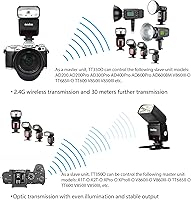
  • Wireless Protocol: Uses the Godox 2.4G X system for reliable wireless transmission with a range of approximately 30 meters.
  • Master/Slave: Functions as either a master unit controlling compatible Godox flashes or a slave unit triggered by supported Godox transmitters and speedlites.
  • Compatibility: Designed for Olympus and Panasonic Micro Four Thirds camera bodies with a dedicated hot shoe mount for native TTL communication.
  • Power Source: Powered by two standard AA batteries, which are widely available and require no proprietary charging equipment.
  • Battery Life: Rated for approximately 210 minutes of use per charge cycle under typical shooting conditions.
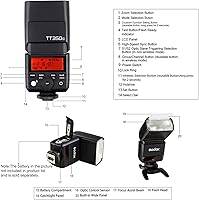
  • Display: Features an LCD panel operated via four function buttons and a jog dial for adjusting settings in the field.
  • Dimensions: Measures 6.61 x 3.43 x 2.6 inches, making it roughly half the size of a conventional full-size speedlite.
  • Weight: Weighs 12.6 ounces including batteries, which adds minimal burden when mounted on a mirrorless camera body.
  • Curtain Sync: Supports both front and rear curtain sync modes for creative control over motion blur in longer exposures.
  • Multi Flash: Includes a stroboscopic multi-flash mode that fires repeatedly in a single exposure for motion-study style effects.
  • Exposure Comp: Allows flash exposure compensation adjustment to fine-tune output relative to the camera's metered exposure.

Related Reviews
Godox iA32 Mini Hot Shoe Flash
75%
93%
Portability & Form Factor
78%
Build Quality
61%
Flash Output Power
54%
Auto Mode Usability
84%
Manual Mode Control
More
Godox AD600Pro Outdoor Studio Strobe Flash
81%
93%
Output Power & Consistency
78%
High-Speed Sync Performance
71%
Battery Life & Real-World Endurance
89%
Build Quality & Durability
84%
Wireless System & TTL Accuracy
More
NEEWER NW700-N TTL Flash Speedlite
79%
84%
TTL Metering Accuracy
79%
TCM Function Usability
82%
High-Speed Sync Performance
71%
Build Quality & Durability
86%
Recycle Speed
More
Godox V860II-N TTL Speedlite Flash
82%
93%
Battery Life & Efficiency
76%
TTL Accuracy
91%
High-Speed Sync (HSS)
72%
Wireless Performance
89%
Recycle Time
More
Godox TT600 Camera Flash Speedlite
76%
94%
Value for Money
88%
Wireless Reliability
86%
Output Power
83%
Build Quality
11%
TTL and Automation
More
Godox TT350S Mini Speedlite Flash
81%
83%
TTL Accuracy
88%
High Speed Sync (HSS)
86%
Wireless Performance
93%
Portability & Form Factor
78%
Build Quality
More
Neewer 750II TTL Camera Flash Speedlite
78%
76%
TTL Metering Accuracy
91%
Value for Money
62%
Build Quality
88%
Ease of Use
84%
LCD Screen Clarity
More
Zeniko ZF04 Mini Hot Shoe Flash
80%
96%
Portability & Size
91%
Ease of Use
51%
Power Control & Flexibility
83%
Recycle Time
87%
Battery Life
More
ZENIKO ZF08 Mini Camera Flash Speedlite
79%
94%
Portability & Form Factor
91%
Ease of Use
61%
Build Quality
58%
Output Power & Range
67%
Color Temperature Accuracy
More
NEEWER NW645II-S TTL Flash Speedlite
81%
86%
TTL Accuracy
83%
High-Speed Sync Performance
78%
Build Quality
61%
Optical Slave Reliability
81%
Recycle Speed
More

FAQ

Yes, the E-M10 Mark II is one of the explicitly supported bodies. TTL metering, high-speed sync, and wireless control all work natively without any adapters or workarounds.

Generally yes, but it's worth being aware that a handful of Panasonic users report occasional TTL exposure inconsistencies, particularly in high-contrast scenes. The flash works fine in manual mode on all supported bodies if you want a guaranteed consistent output.

The TT350O has built-in 2.4G wireless and can act as a slave unit when triggered by a compatible Godox master transmitter like the X2T-O or XPro-O. If you want to fire it off-camera, you will need one of those triggers — it cannot self-trigger wirelessly without a master unit sending the signal.

Yes, it can function as a master unit to trigger and control a range of other Godox flashes including the AD200, V860III, and TT685II, among others. This makes it useful as a compact on-camera controller while larger lights do the heavy lifting off to the side.

It runs on two standard AA batteries, which is convenient for travel since you can grab replacements almost anywhere. Battery life is rated at around 210 minutes under normal use, though heavy full-power shooting will drain them faster.

If you're shooting portraits outside on a sunny day and want to use a wide aperture like f/1.8 to blur the background, your camera's normal sync speed would force you to overexpose the ambient light or close down the aperture. HSS lets you shoot at shutter speeds up to 1/8000s so you can keep that wide aperture and still add fill flash without blowing out the sky.

The 2.4G X system is shared across the Godox lineup, but the TTL channels are brand-specific. If you have an X2T for Sony or Canon, the TT350O will still fire in manual mode via the wireless trigger, but you won't get TTL or HSS through a non-Olympus transmitter.

It's fine in typical indoor or shaded conditions, but several users note it can be genuinely difficult to read in bright direct sunlight. If you're shooting outdoors a lot, plan to shade the panel with your hand or memorize your most-used settings adjustments.

At lower power settings, recycle time is fast enough to keep up with normal shooting. At full power, it does take noticeably longer than larger premium speedlites — some users estimate around 3 seconds at maximum output. For most portrait and travel work this isn't a problem, but for rapid-fire event shooting it can be a limiting factor.

Yes. The S1 and S2 optical slave modes let the flash trigger off another flash's burst — S1 for basic optical triggering and S2 for pre-flash cameras that use a TTL pre-burst. This is handy if you want a simple two-flash setup without investing in wireless triggers right away.

Where to Buy