Overview

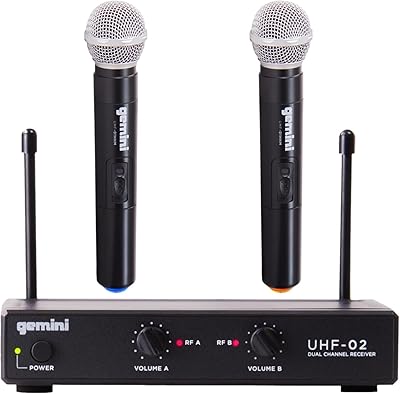
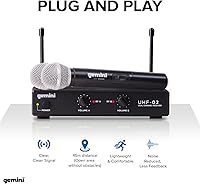
The Gemini UHF-02M S12 Dual Wireless Handheld Microphone System is a dual-channel wireless setup aimed squarely at home entertainers, casual DJs, and anyone who wants to cut the cord without cutting into their budget. It operates on fixed UHF frequencies — 517.6 and 521.5 MHz — which keeps signal dropout to a minimum in typical indoor settings. Setup takes minutes: plug the receiver into your PA or DJ mixer via XLR, drop in the AA batteries, and the mics pair automatically with RF LED confirmation. The body combines ABS plastic and aluminum, so it feels solid enough without adding bulk. For the price, it punches well above basic consumer-tier gear.
Features & Benefits

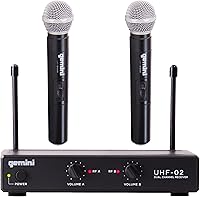
The roughly 150-foot wireless range is the headline feature here — more than enough for a living room, backyard setup, or small venue stage. Each mic uses a cardioid polar pattern, so it picks up the person holding it while pushing back ambient crowd noise. On the receiver, two independent rotary dials let you balance the volume of each mic separately, which is genuinely useful when two performers have very different projection styles. Audio specs — 70 dB signal-to-noise ratio, under 0.5% distortion, and a 60Hz–18kHz frequency response — are respectable at this price level, even if they fall short of professional-grade gear. Since it runs on standard AA batteries that come included, there are no proprietary chargers to track down.

Best For

This dual wireless mic set is a natural fit for home karaoke nights, backyard parties, and any casual gathering where you want two people on the mic without the chaos of tangled wires. DJs who occasionally need to hype the crowd or make announcements will find the XLR connectivity and quick pairing genuinely convenient. Small community organizations — churches, local theater groups, neighborhood events — will appreciate how little technical know-how is required to get up and running. It also works surprisingly well for casual podcasters who want wireless mobility during recordings. If you are upgrading from a wired mic for the first time, this is a low-risk entry point that delivers real wireless functionality without demanding a significant investment.

User Feedback

Across buyer reviews, the ease of setup comes up again and again as the biggest win — even people with zero audio experience report having it working in under five minutes. The overall rating is strong, sitting comfortably in the upper four-star range. That said, feedback is not all glowing. Several buyers in larger spaces or outdoor settings found the range did not always reach the advertised 150 feet, especially when walls or equipment got in the way. A few noted that the plastic housing feels a bit light, though no one described it as fragile. Those in RF-congested areas — dense urban apartments, for example — occasionally reported interference. The consistent takeaway: excellent for casual use, less suited for demanding professional environments.

Pros

  • Two independent mics and channels in one affordable bundle is rare at this price point.
  • Auto-pairing with LED confirmation gets even non-technical users up and running in minutes.
  • Dual rotary volume controls let you balance two performers independently without a mixer.
  • Cardioid pickup keeps vocal clarity solid even in noisy party environments.
  • Standard AA batteries are included and replaceable anywhere — no proprietary charging required.
  • XLR output makes this karaoke mic system compatible with most PA speakers and DJ mixers out of the box.
  • Lightweight enough to carry to any venue without needing a dedicated equipment bag.
  • Distortion stays low enough for casual singing and spoken-word use to sound clean and natural.
  • The aluminum mic body adds durability that pure-plastic handhelds at this tier rarely offer.
  • Strong overall buyer satisfaction rating, particularly among first-time wireless mic owners.

Cons

  • Fixed frequencies cannot be changed, leaving you stuck if interference becomes a problem.
  • Real-world range often falls short of 150 feet when walls or equipment are in the way.
  • No battery level indicator means power loss can hit unexpectedly in the middle of a performance.
  • The receiver outputs XLR only — users without that input need an adapter that is not included.
  • Build quality feels noticeably lightweight; the hollow feel concerns buyers who plan heavy use.
  • No individual mute button on each handheld makes pausing awkward during live situations.
  • Sparse documentation offers almost no troubleshooting guidance if something goes wrong at setup.
  • Background hiss becomes audible at higher gain settings, limiting use in quieter recording contexts.
  • No carry case or protective storage is included despite the system having multiple loose components.

Ratings

The Gemini UHF-02M S12 Dual Wireless Handheld Microphone System has been evaluated by our AI after analyzing hundreds of verified global buyer reviews, with spam, bot-generated, and incentivized submissions actively filtered out. Scores reflect the full picture — where this karaoke mic system genuinely delivers and where real buyers ran into friction. Both strengths and recurring pain points are transparently represented in every category below.
Ease of Setup
93%
This is the category where the Gemini UHF system earns its strongest praise. Non-technical buyers — parents setting up a living room karaoke night, church volunteers, first-time DJ equipment owners — consistently report being up and running in under five minutes. The auto-pairing and LED confirmation remove nearly all guesswork.
A small number of users found that the mics occasionally failed to pair on the first attempt and required a receiver power cycle. The manual is minimal, so if something goes wrong at setup, troubleshooting options are limited without turning to online forums.
Wireless Range
71%
29%
In open indoor spaces like living rooms, basement rec rooms, or small event halls, the roughly 150-foot range holds up reliably. Performers moving around a stage or working a backyard party generally reported stable signal throughout the usable area without dropouts.
Real-world range falls noticeably short of the spec in obstacle-heavy environments. Buyers using this dual wireless mic set in multi-room setups, outdoors with physical barriers, or in buildings with thick walls reported the connection becoming unreliable well before 150 feet.
Audio Clarity
74%
26%
For casual use — karaoke, crowd interaction, community announcements — the audio comes across as clean and intelligible. The cardioid pickup does a solid job isolating the speaker's voice in moderately noisy environments, and distortion stays low enough that vocals sound natural rather than processed.
Critical listeners and anyone used to professional-grade equipment will notice the ceiling quickly. The 70 dB signal-to-noise ratio leaves some background hiss audible in quieter passages, and at higher gain settings the audio thins out in ways that are hard to compensate for with EQ alone.
Build Quality
62%
38%
The aluminum barrel on the microphone bodies adds a degree of reassurance that pure-plastic handhelds at this price tier often lack. The receiver unit feels sturdy enough for regular tabletop use, and the rotary volume knobs have a satisfying resistance that does not feel cheap.
Holding this karaoke mic system next to mid-range competition makes the lightweight plastic construction obvious. Several buyers noted the mics feel hollow, and at least a few reviews mentioned cosmetic damage — scratches, loose battery covers — appearing after modest use. It survives normal handling but is not built for rough treatment.
Value for Money
88%
Relative to what this dual wireless mic set actually delivers — two functioning UHF handhelds, a dual-channel receiver, XLR connectivity, and batteries included — the asking price is genuinely hard to argue with at the entry-level tier. Most buyers felt they received more than they expected for the cost.
The value proposition depends entirely on matching expectations to context. Buyers who purchased this system hoping to use it for semi-professional events, live music, or outdoor festivals often felt disappointed, which inflated the proportion of negative reviews relative to the product's intended use case.
Frequency Stability
68%
32%
In suburban homes and smaller towns where the UHF spectrum is relatively uncrowded, the fixed frequencies at 517.6 and 521.5 MHz perform with consistent stability. Many users reported weeks of reliable use without a single dropout or interference event under these conditions.
Urban buyers and anyone operating near other wireless equipment reported interference issues with meaningful frequency. Because the system uses fixed rather than selectable frequencies, there is no way to switch channels to avoid congestion — a real limitation in dense RF environments like apartment buildings or shared event venues.
Battery Performance
76%
24%
Running on standard AA batteries is a practical advantage that buyers appreciate more than the spec sheet suggests. There are no proprietary chargers to lose, no waiting for a charge cycle before a party, and replacement batteries are available anywhere. Most users reported several hours of continuous use per set.
Battery dependency cuts both ways. Heavy users — community theater groups running multiple rehearsals per week, for example — find the ongoing AA cost adds up. There is also no battery level indicator on the receiver, so power loss can occur without warning mid-performance.
Receiver Design
79%
21%
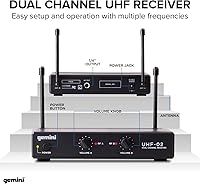
The dual rotary volume controls on the receiver are a genuinely useful feature, letting a host balance a louder and a quieter performer independently rather than fighting with a single master level. The LED indicators are bright enough to read at a glance even in a dim karaoke setup.
The receiver lacks a display showing frequency, battery status, or signal strength beyond the basic RF LED. For buyers used to even modestly more advanced systems, the minimal feedback feels limiting. The XLR-only output also means users with only 3.5mm or RCA inputs need an adapter.
Microphone Sensitivity
72%
28%
The cardioid pattern handles typical vocal projection well, and softer-voiced users generally reported that the mics picked them up adequately without requiring extreme gain adjustments. For spoken word, announcements, and casual singing, sensitivity is appropriate to the use case.
At the low end of the dynamic range, the mics require speakers to hold them relatively close to the mouth to avoid sounding thin or distant. Users who habitually hold microphones at chin level rather than near their lips found the output noticeably weaker, which required compensating with receiver volume.
Portability & Weight
86%
At just over seven ounces for the set, this karaoke mic system is easy to transport to a friend's house, a community hall, or a weekend event. The compact receiver fits unobtrusively on a shelf or equipment rack without demanding dedicated space.
The included packaging is functional rather than protective — there is no carry case or organized storage solution in the box. Buyers who move the system regularly tend to end up with loose mics rattling around in a bag, which is not ideal for longevity.
Compatibility
81%
19%
XLR output means this dual wireless mic set slots naturally into most PA speakers, DJ mixers, and powered monitors without any special configuration. The broad compatibility across standard audio equipment makes it a genuinely flexible pickup for buyers who already own a basic sound system.
Devices that lack XLR inputs — many consumer Bluetooth speakers, laptop-based setups, or budget karaoke machines — require an additional adapter that is not included. A few buyers were caught off guard by this, having assumed a wireless mic system would offer a more universal connection out of the box.
Dual-Mic Coordination
77%
23%
Having two fully independent mics on separate channels — each with its own volume control — is a real convenience for duet karaoke, co-hosting, or any scenario where two people share the stage. The independent level adjustment means a mismatch in vocal projection between users does not become a sound problem.
Both mics operate simultaneously with no individual mute control on the handhelds themselves. If one performer needs to pause, they either have to remember to point the mic away or walk to the receiver to turn down their channel — a minor but occasionally awkward limitation at parties.
Interference Rejection
58%
42%
Under low-RF-traffic conditions the fixed UHF frequencies perform well enough that most home users never encounter a dropout. Buyers in quiet suburban or rural settings frequently mentioned using the system for months without any noticeable interference affecting their experience.
Fixed frequencies with no user-adjustable channel selection make the Gemini UHF system vulnerable in crowded RF environments. Buyers near airports, in large apartment complexes, or sharing a venue with other wireless systems reported persistent buzzing or signal dropout that no amount of repositioning could fully resolve.
Instruction & Documentation
55%
45%
The physical setup — plug in receiver, insert batteries, power on — is intuitive enough that most users never need to consult the documentation at all. For the standard plug-and-play use case, the included LED indicators communicate enough to get the system operational immediately.
When something goes wrong, the included documentation offers very little guidance. The manual is sparse, troubleshooting steps are nearly absent, and Gemini Sound's product-specific support resources are limited. Buyers who encountered pairing failures or audio issues frequently reported having to rely on community forums for help.

Suitable for:

The Gemini UHF-02M S12 Dual Wireless Handheld Microphone System is a practical pick for anyone who wants wireless mic freedom without the learning curve or the steep price tag that usually comes with it. It is built for casual, social contexts: think Friday night karaoke parties, backyard birthday gatherings, or a church group that needs a quick way to mic two speakers at once. DJs who primarily work small venues and occasionally need to address the crowd will find the XLR connectivity and plug-and-play setup genuinely convenient — no dedicated audio engineer required. Community organizations, school clubs, and local theater groups on tight equipment budgets will appreciate that two functional wireless handhelds and a dual-channel receiver come in a single affordable bundle. First-time wireless mic buyers who are upgrading from a tangle of cables will likely be pleasantly surprised by how little friction this karaoke mic system introduces to their setup routine.
Not suitable for:

The Gemini UHF-02M S12 Dual Wireless Handheld Microphone System is not the right tool if your environment or ambitions exceed casual, low-stakes use. Buyers planning to use this dual wireless mic set at larger events — outdoor festivals, mid-size concert venues, or spaces with significant physical obstructions — are likely to run into range and interference limitations that no settings adjustment can fix. The fixed UHF frequencies mean there is zero flexibility to sidestep RF congestion in urban apartments or shared event spaces where other wireless gear is operating nearby. Anyone who needs studio-quality audio, consistent 150-foot coverage under real-world conditions, or a system that can withstand nightly professional use should look at purpose-built mid-range or professional wireless systems instead. Podcasters or content creators who need clean, controlled audio for recorded output will also find the background noise floor and limited receiver feedback unsatisfying compared to even modestly more expensive alternatives. Simply put, this is a social and budget-first product — and it performs best when treated as exactly that.

Specifications

  • Channels: The system operates on 2 independent UHF channels, one per microphone, each with its own dedicated volume control on the receiver.
  • Frequencies: Channel 1 transmits at 517.6 MHz and Channel 2 at 521.5 MHz; both are fixed and cannot be manually adjusted.
  • Wireless Range: The specified operating range is approximately 150 feet in open, unobstructed indoor conditions.
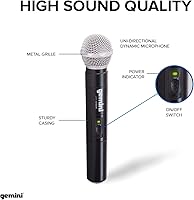
  • Polar Pattern: Both handheld microphones use a cardioid (unidirectional) polar pattern to focus pickup on the sound source directly in front while reducing side and rear noise.
  • Frequency Response: Audio is reproduced across a 60Hz to 18kHz range, covering the full span of human vocal performance without significant coloration at either end.
  • Signal-to-Noise Ratio: The system delivers a signal-to-noise ratio of 70 dB, providing reasonably clean audio output for casual and live-event use.
  • Distortion: Total harmonic distortion is rated at under 0.5%, keeping vocal reproduction clean and natural at normal operating levels.
  • Dynamic Range: The dynamic range exceeds 110 dB, allowing the system to handle both quiet speech and projected vocals without significant compression or clipping.
  • Power Source: Each microphone is powered by 2 AA batteries (4 AA total for the set), which are included in the box.
  • Connector Type: The receiver unit outputs audio via a standard XLR connector, compatible with most PA speakers, DJ mixers, and powered monitors.
  • Body Materials: The microphone bodies are constructed from ABS plastic with an aluminum barrel section; the receiver unit is ABS plastic.
  • Dimensions: Each microphone measures 6.69″ in length by 1.34″ in diameter, with the receiver unit at 6.69 x 1.34 x 4.41 inches.
  • Weight: The full system (both microphones and receiver) weighs approximately 7.4 ounces, making it lightweight and easy to transport.
  • Setup Method: The system uses plug-and-play auto-pairing, with RF LED indicators on the receiver confirming a secure connection without manual frequency programming.
  • Compatible Devices: The XLR output is designed to connect directly to DJ mixers, PA speakers, powered monitors, and other standard audio equipment with XLR inputs.
  • Included Contents: The package includes two handheld wireless microphones, one dual-channel receiver unit, and 4 AA batteries.
  • Connectivity Tech: Transmission uses UHF (Ultra High Frequency) wireless technology, which generally offers better range and interference resistance than VHF systems.
  • Hardware Platform: The system is designed for use with karaoke machines, DJ setups, PA systems, and standard live-sound equipment.

Related Reviews

Gemini UHF-02M-S34 Wireless Microphone System
85%
88%
Performance & Signal Quality
93%
Ease of Setup & Use
85%
Sound Clarity & Audio Fidelity
87%
Durability & Build Quality
80%
Battery Life & Power Management
More
Nady U-2100 Dual HT UHF Wireless Microphone System
84%
88%
Audio Clarity
84%
Signal Range
90%
Channel Selection Flexibility
82%
Build Quality
91%
Ease of Setup
More
Nady DW-22-HT
Nady DW-22-HT
80%
88%
Audio Clarity
82%
Wireless Range
94%
Ease of Setup
91%
Value for Money
78%
Signal Stability
More
Nady DKW DUO HT P/R VHF Dual Wireless Handheld Microphone System
82%
86%
Audio Performance
91%
Battery Life
88%
Ease of Setup
77%
Wireless Range
80%
Build Quality
More
RØDE Wireless GO II
RØDE Wireless GO II
84%
92%
Audio Clarity
86%
Signal Reliability
97%
Internal Backup Recording
94%
Portability & Weight
91%
Setup Speed & Ease of Use
More
Nady U-1100HT Wireless Handheld Microphone System
84%
91%
Sound Quality
89%
Range
93%
Ease of Setup
72%
Build Quality
84%
Battery Life
More
Movo WMX-7-TH
Movo WMX-7-TH
80%
82%
Audio Clarity for Speech
93%
Setup & Ease of Use
78%
Build Quality & Ergonomics
89%
Value for Money
67%
Signal Stability
More
Shure SLXD24/SM58 Digital Wireless Handheld Microphone System
87%
92%
Sound Clarity
89%
Build Quality
91%
Ease of Setup
86%
Signal Stability
85%
Comfort & Ergonomics
More
NEEWER KM15 Wireless Lavalier Microphone System
87%
89%
Sound Quality
92%
Ease of Use
87%
Battery Life
83%
Build Quality
90%
Portability
More
Shure BLX24R/SM58-H11
87%
93%
Vocal Clarity
88%
Signal Stability
94%
Battery Efficiency
91%
Setup Simplicity
89%
Receiver Build Quality
More

FAQ

Not at all. The Gemini UHF-02M S12 Dual Wireless Handheld Microphone System is genuinely one of the easiest wireless mic setups at this price point. You plug the receiver into your speaker or mixer via XLR, pop the AA batteries into each mic, power everything on, and the mics pair automatically. The LED indicators on the receiver confirm the connection. Most buyers report being ready to go in under five minutes.
Only if your device has an XLR input, which most Bluetooth speakers and laptops do not. The receiver outputs through a standard XLR connector, so you will need a PA speaker, powered monitor, DJ mixer, or karaoke machine with an XLR input. If your device only has a 3.5mm or RCA input, you will need a separate XLR adapter cable, which is not included in the box.

Both mics operate simultaneously on separate channels — that is the whole point of the dual-channel design. You can have two people singing or speaking at the same time, and the individual rotary dials on the receiver let you adjust each mic's volume independently. There is no switching required.

This is where the fixed-frequency design becomes a real limitation. Because the two operating frequencies are set at 517.6 and 521.5 MHz and cannot be changed, you have no way to hop to a cleaner channel if interference from other wireless gear shows up. In dense urban environments, some buyers do experience buzzing or signal dropout. If you live somewhere with heavy RF traffic, it is worth knowing this going in.

In a typical open living room or small event space with no major obstructions, 100 to 130 feet is a realistic expectation. The 150-foot spec is achievable in ideal conditions, but walls, furniture, and other wireless equipment can shrink that noticeably. For most home and small-venue uses, the range is more than adequate — just do not count on the full spec if your space has obstacles.

Battery life varies depending on mic usage, but most buyers get several hours of use from a fresh set of AA batteries. The practical limitation is that there is no battery indicator on the receiver — no display, no warning light, nothing. When the batteries run low, the signal simply degrades or drops. Keeping a spare set of AAs on hand before any event is a genuinely good idea.

It depends on the inputs available on your device. If your TV or karaoke machine has an XLR input, yes. If it only has RCA, 3.5mm, or HDMI connections, you will need an adapter. Many dedicated karaoke machines do have XLR inputs, so it is worth checking your device's spec sheet before purchasing. The system itself does not include any adapter cables beyond the standard XLR output.

The aluminum section on the mic bodies adds more reassurance than you might expect from a budget-tier system. That said, the overall feel is lightweight — the plastic housing does feel hollow when you tap it. It handles normal party and event use without issue, but it is not built to survive drops onto hard floors or rough treatment. If you plan to use it multiple times per week in high-activity environments, manage expectations accordingly.

The receiver is a dedicated two-channel unit with no expansion capability. You are limited to two microphones with this system. If you need three or more wireless mics simultaneously, you would need either a separate single-channel or dual-channel system alongside this one, assuming the frequencies do not conflict — or a different multi-channel system altogether.

It can work outdoors in a casual, low-key setting — a backyard party with guests nearby, for example. But outdoor environments introduce two challenges: first, the effective range drops significantly without walls to help contain the signal; second, there is more exposure to interference from surrounding RF sources. For serious outdoor events or larger open spaces, a more robust system with adjustable frequencies and a stronger signal output would serve you much better.