Overview

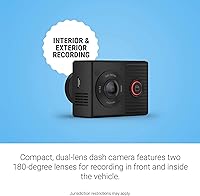
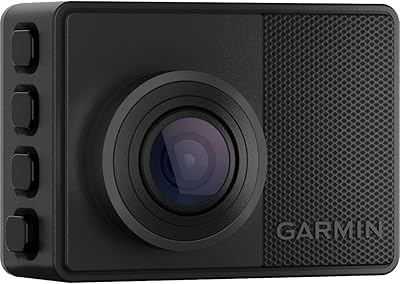
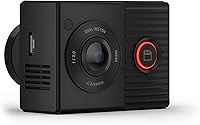
The Garmin Dash Cam Tandem Dual-Lens Dash Camera takes a different approach than most dual-camera setups — the second lens isn't pointed at your rear bumper, it's watching your cabin interior. That distinction matters enormously if you're a rideshare driver, a parent with teen drivers, or managing a small fleet. Despite weighing barely over two ounces, it mounts discreetly behind the rearview mirror with a low-profile magnetic mount. Garmin's background in GPS and navigation hardware shows clearly in the sensor quality and location-tagging features. The price sits firmly in premium territory, so this is aimed at buyers with a specific need for simultaneous road and passenger documentation.
Features & Benefits

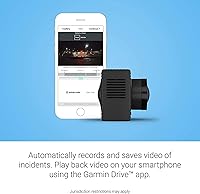
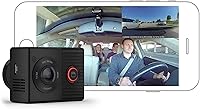
The front lens shoots at 1440p with Clarity HDR processing and a 180-degree field of view — wide enough to catch side-street intersections and still resolve license plates at a reasonable distance. The interior lens records at 720p, which is adequate for identifying passengers, and the NightGlo night vision does a solid job in dark cabins without washing out faces. Both lenses log exact incident location via built-in GPS and Galileo sensors, and you can pull footage wirelessly through the Garmin Drive app over Wi-Fi. Voice commands let you save clips without taking your hands off the wheel, and Dash Cam Auto Sync can tie together up to four cameras in one app view — genuinely useful for fleet operators.

Best For

This dual-lens dash cam is most naturally suited to rideshare drivers — Uber and Lyft operators who need a contemporaneous record of every passenger interaction for liability or dispute resolution. Parents monitoring new or teen drivers will also find the interior view genuinely useful, particularly at night when NightGlo keeps cabin footage legible. Fleet managers running up to four vehicles can unify footage review through one app, which cuts down on administrative friction. If you're already using other Garmin dash cams, the Auto Sync compatibility is a real practical benefit. One note worth keeping in mind: recording passengers inside a vehicle is regulated or outright prohibited in some jurisdictions, so always verify local laws before mounting this.

User Feedback

Owners consistently highlight the interior night vision as the standout feature — NightGlo performance in low-light conditions earns genuine praise rather than polite acknowledgment. The 180-degree field of view does produce noticeable fisheye distortion in footage, which surprises some buyers; it's a predictable trade-off for the wide coverage angle, not a manufacturing flaw. The Garmin Drive app gets mixed marks: many users find wireless access convenient, but Wi-Fi pairing hiccups come up often enough to be worth noting. The included microSD card and dual USB charger are consistently mentioned as thoughtful inclusions. The most common frustration centers on parking mode, which requires a separately purchased hardwire cable — an extra cost that feels like it should be bundled at this price point.

Pros

  • The front lens captures sharp 1440p HDR footage that holds up well as evidence in insurance claims and disputes.
  • NightGlo interior night vision keeps passenger faces identifiable even during late-night rideshare shifts.
  • Built-in GPS and Galileo sensors automatically embed accurate location and speed data into every recorded clip.
  • The 180-degree field of view on both lenses eliminates blind spots that narrower cameras routinely miss.
  • Voice commands let drivers save clips without touching a screen or fumbling with an app mid-drive.
  • The Garmin Tandem ships ready to use — the included microSD card and dual USB charger are genuinely useful, not filler.
  • The low-profile magnetic mount keeps the camera discreet and makes temporary removal easy when parked in risky areas.
  • Dash Cam Auto Sync lets fleet operators review synchronized footage from up to four vehicles in one app session.
  • At just over two ounces, this dual-lens dash cam is compact enough to mount behind the rearview mirror without obstructing the driver's sightline.

Cons

  • The 180-degree fisheye distortion can make footage look noticeably warped, which surprises buyers expecting clean rectilinear video.
  • The hardwire cable needed to run parking mode without draining the battery is sold separately — an extra cost that should be included at this price.
  • Wi-Fi pairing with the Garmin Drive app is inconsistent enough that some users resort to re-pairing after every phone restart.
  • At 720p, the interior lens resolution feels like a compromise, particularly when fine details like clothing or small objects matter in a dispute.
  • There is no wired data transfer option as a fallback, so footage retrieval depends entirely on a reliable wireless connection.
  • The adhesive mount pad loses grip after repeated removal and reattachment, making it impractical for drivers who swap the camera between vehicles.
  • Buyers in jurisdictions that restrict interior passenger recording face real legal risk if they do not research local laws before installation.
  • The four-camera sync limit in the Garmin Drive app is too restrictive for medium or large fleet operations.
  • Voice recognition degrades noticeably in noisy cabin environments, causing missed commands during exactly the moments it is most needed.

Ratings

The Garmin Dash Cam Tandem Dual-Lens Dash Camera earned its scores through AI-driven analysis of verified global buyer reviews, with spam, bot-submitted, and incentivized feedback actively filtered out before scoring. The ratings below reflect what real owners consistently experienced across daily commutes, rideshare shifts, and fleet deployments — strengths and frustrations alike. Nothing has been softened to protect the brand.
Video Quality (Front Lens)
88%
The 1440p Clarity HDR front lens consistently impresses drivers who need actionable footage — license plates at intersections, road signs in overcast conditions, and oncoming headlights at night all come through with solid detail. Reviewers who've used the footage in insurance claims specifically praise the sharpness.
The 180-degree field of view introduces noticeable fisheye distortion toward the frame edges, which can make it harder to judge distances in footage. A few buyers expected near-perfect rectilinear video and were caught off guard by the wide-angle warping.
Interior Night Vision
83%
NightGlo night vision is the most praised feature among rideshare drivers who rely on this camera during late-night shifts. Passenger faces remain identifiable even in near-total darkness, which is a meaningful practical advantage over interior cameras that go grainy after sunset.
In very bright daytime conditions, the interior lens can overexpose lighter-skinned subjects or blow out window glare from rear passenger windows. The 720p resolution ceiling also means the footage won't hold up well if heavily cropped or zoomed during review.
Interior Video Resolution
61%
39%
For basic documentation — confirming a passenger was present, identifying a face, or noting a general incident — 720p delivers enough clarity to be useful in most real-world scenarios where the lighting is controlled.
At a premium price point, a 720p interior lens feels like a compromise that buyers notice quickly. Several reviewers expressed frustration that fine details like clothing colors or small objects on the seat are difficult to confirm, especially in motion.
GPS & Location Accuracy
91%
The dual GPS and Galileo sensor setup locks on quickly and embeds accurate location and speed data into every clip. Drivers who have submitted footage to insurers or legal teams find the timestamped coordinates genuinely persuasive as supporting evidence.
In dense urban canyons or underground parking structures, GPS signal can drop or lag momentarily before re-acquiring. This is a hardware limitation of any consumer GPS unit rather than a Garmin-specific flaw, but it's worth knowing if you park in covered structures frequently.
App Experience (Garmin Drive)
67%
33%
When the Wi-Fi connection cooperates, the Garmin Drive app gives you a clean interface for reviewing, clipping, and sharing footage directly from your phone without touching the camera. Fleet users running multiple synced cameras particularly appreciate having everything in one view.
Wi-Fi pairing is a recurring complaint — some users report having to re-pair the camera after every phone restart, and initial connection can take several attempts. The app itself has also received criticism for sluggish video loading on older Android devices.
Voice Control
79%
21%
Being able to say a command to save a clip hands-free is a genuinely practical feature during active driving, especially for rideshare operators who can't safely tap a screen mid-trip. Recognition accuracy in quiet vehicles is reported as reliable.
Road noise, music, or passenger conversation can cause the voice commands to miss or misfire. A few users stopped using voice control after repeated failed triggers and defaulted to manual app control instead.
Build Quality & Form Factor
84%
At just over two ounces and barely larger than a matchbox, the Garmin Tandem sits behind the rearview mirror without obstructing sightlines. The housing feels dense and well-assembled, with none of the cheap plastic flex common in budget dash cams.
The compact body means there are no physical buttons to speak of, so everything depends on voice or the app. Some drivers who prefer tactile controls find this frustrating, particularly for quick saves in the moment.
Mounting & Installation
77%
23%
The low-profile magnetic mount attaches quickly and holds the camera securely even on rough roads. The magnetic design also makes it easy to remove the unit temporarily if you park in areas where visible cameras invite theft.
The adhesive pad that anchors the mount can leave residue on windshields and is difficult to reposition once set. Buyers who mount and re-mount frequently — switching between vehicles, for instance — find the adhesive loses grip after a few cycles.
Parking Mode
58%
42%
When fully set up, parking mode does what it promises — detecting motion in front of and inside the parked vehicle and capturing a clip automatically. For drivers who park overnight in high-traffic lots, this is a meaningful security layer.
The hardwire cable required to run parking mode without draining the car battery is sold separately, which is a frustrating omission at this price. Multiple reviewers felt this should be included in the box and described the extra purchase as a hidden cost that the product listing undersells.
Multi-Camera Sync (Auto Sync)
74%
26%
For small fleet operators managing two to four vehicles, the Dash Cam Auto Sync feature through the Garmin Drive app genuinely reduces the hassle of reviewing footage across cameras. Switching between synchronized feeds in one interface saves real administrative time.
The four-camera limit will feel restrictive for larger operations, and the sync functionality depends entirely on consistent Wi-Fi performance — which, as noted, is not always reliable. The feature is compelling in theory but inconsistent enough in practice to temper expectations.
Value for Money
63%
37%
For rideshare drivers and fleet operators who genuinely need simultaneous road and cabin documentation, the specialized dual-lens design is hard to replicate cheaply. The included microSD card and dual USB charger add real out-of-box value.
Casual drivers will find the price difficult to justify, particularly given the 720p interior resolution and the additional parking mode cable cost. Competing cameras at lower price points offer better pure video quality if interior monitoring is not a priority.
Box Contents & Accessories
82%
18%
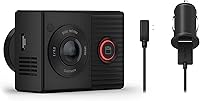
The package includes a microSD card, a 4-meter power cable, a 1.5-meter USB cable, and a dual USB adapter that lets you charge your phone simultaneously — all items buyers note are actually useful rather than filler. Most rival cameras require separate memory card purchases.
As mentioned, the hardwire cable for parking mode is absent. Given the otherwise thoughtful accessory bundle, its omission stands out even more sharply and suggests a cost-cutting decision that buyers notice.
Field of View Coverage
86%
The 180-degree coverage on both lenses means the front camera captures the full intersection width, not just the lane ahead, and the interior lens sees all rows of passengers without repositioning. For rideshare and taxi use, this total coverage is a strong operational advantage.
The wide angle is inseparable from fisheye distortion, and not all buyers read the fine print before purchasing. Those expecting clean, rectilinear footage comparable to a narrower-angle camera are consistently disappointed once they review their first clips.
Privacy & Legal Compliance
69%
31%
Garmin openly acknowledges the legal complexity of interior passenger recording in the product documentation, which is a responsible stance. Professional drivers who operate in jurisdictions that permit it with proper disclosure find the device fully fit for purpose.
The legal landscape around in-car passenger recording varies significantly by country, state, and even city — and some buyers only discovered local restrictions after mounting the camera. There is no in-app guidance or jurisdiction lookup to help users stay compliant.
Connectivity Reliability
66%
34%
Bluetooth pairing for initial setup is generally quick and stable, and the Wi-Fi connection is fast enough to pull short clips to a phone in reasonable time when it works correctly. Users with newer iPhones and recent Android flagships report fewer issues.
Older devices or those running non-updated operating systems experience noticeably more dropped connections and app crashes. The camera also does not support a wired data transfer option as a fallback, which would have provided a more reliable alternative for footage retrieval.

Suitable for:

The Garmin Dash Cam Tandem Dual-Lens Dash Camera was clearly designed with a specific type of driver in mind, and if you fall into that category, it delivers real practical value. Rideshare and gig-economy drivers — anyone doing Uber, Lyft, or taxi work — are the most obvious fit, since having a timestamped, GPS-tagged interior record of every passenger interaction is genuine liability protection that cheaper single-lens cameras simply cannot provide. Parents of teen drivers will also find the cabin-facing lens useful for monitoring behavior inside the vehicle, particularly during nighttime driving when NightGlo keeps the footage legible without a separate light source. Small fleet operators managing up to four vehicles benefit from the Dash Cam Auto Sync feature, which consolidates footage review across multiple cameras into a single app — a meaningful time-saver compared to pulling SD cards individually. If you already own other Garmin dash cams, the ecosystem compatibility makes this a natural addition rather than a standalone investment.
Not suitable for:

If you are shopping for a traditional front-and-rear dash cam that covers your rear bumper in a collision, the Garmin Dash Cam Tandem Dual-Lens Dash Camera is not that product — the second lens faces your cabin interior, not the road behind you, and confusing these two setups leads to a lot of the disappointed reviews online. Everyday commuters who just want straightforward road recording at a fair price will find the premium cost hard to justify, especially since the interior lens shoots at 720p, which feels modest given what the camera costs. Drivers who rely heavily on parking mode should also know upfront that the required hardwire cable is sold separately, adding to the total cost of ownership in a way that feels avoidable. Anyone operating in a jurisdiction that restricts or prohibits interior passenger recording without consent should verify local laws before buying — this is genuinely a legal consideration in several U.S. states and many international markets. Finally, buyers who prefer a simple plug-in-and-forget setup may be frustrated by the occasional Wi-Fi pairing issues with the Garmin Drive app, which can require troubleshooting that less technically inclined users find off-putting.
Specifications

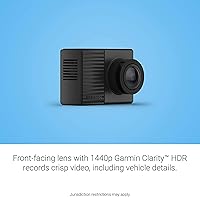
  • Front Resolution: The forward-facing lens records at 1440p using Garmin Clarity HDR processing, which improves detail retention in high-contrast lighting conditions like bright sky against dark road surfaces.
  • Interior Resolution: The cabin-facing lens records at 720p and is paired with NightGlo night vision technology for improved low-light passenger visibility without an additional light source.
  • Field of View: Both the front and interior lenses cover a 180-degree field of view, providing wide-angle coverage that captures full intersections ahead and the entire passenger cabin.
  • GPS System: The camera includes built-in GPS and Galileo satellite sensors that automatically log vehicle location, speed, and incident timestamps directly into recorded footage metadata.
  • Connectivity: The device supports both Bluetooth and Wi-Fi connectivity, enabling wireless pairing with the Garmin Drive smartphone app for footage review and sharing without removing the memory card.
  • Voice Control: An integrated voice command system allows drivers to trigger clip saves and camera controls hands-free while keeping full attention on the road.
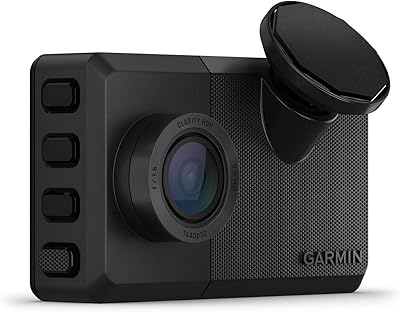
  • Mount Type: The camera attaches via a low-profile magnetic adhesive mount designed to sit discreetly behind the rearview mirror with minimal windshield footprint.
  • Dimensions: The unit measures 0.93 × 2.17 × 1.61 inches, making it one of the more compact dual-lens dash cameras available in the consumer market.
  • Weight: At 2.24 ounces, the camera is light enough that the magnetic mount holds it firmly without stress on the windshield adhesive over time.
  • Included Storage: A microSD card is included in the box, so the camera is ready to record immediately after mounting without requiring a separate memory purchase.
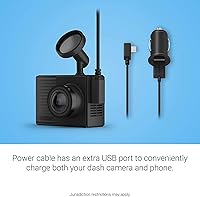
  • Power Adapter: The included dual USB power adapter provides one port for the camera and one spare port for simultaneously charging a phone or other device.
  • Power Cable: A 4-meter power cable is included, providing sufficient length to route the cord cleanly along the headliner and down the A-pillar to the 12V socket.
  • Parking Mode: Parking mode enables automatic motion-triggered recording when the vehicle is parked and the ignition is off, though it requires a separately purchased hardwire cable to operate without draining the car battery.
  • Multi-Cam Sync: The Dash Cam Auto Sync feature allows synchronized playback and control of up to four compatible Garmin dash cameras through a single Garmin Drive app session.
  • App Compatibility: The Garmin Drive app is available for both iOS and Android devices and serves as the primary interface for wireless footage access, clip sharing, and multi-camera management.
  • Power Requirement: The camera requires one lithium-ion battery for internal operation and draws primary power from the vehicle's 12V accessory socket via the included cable.
  • Secondary Cable: A 1.5-meter USB cable is also included in the box for direct device connections where a shorter cable run is preferred or required.

Related Reviews

YOVDA Y8-32 Dual Dash Cam
67%
88%
Value for Money
76%
Video Quality (Daytime)
67%
Night Vision (Interior Camera)
61%
Night Vision (Front Camera)
91%
Ease of Installation
More
Garmin Dash Cam 67W 1440p Dash Camera
75%
88%
Video Quality
83%
Wide-Angle Coverage
81%
Build Quality & Design
61%
Parking Mode Reliability
54%
Cloud Storage & Vault
More
Garmin Dash Cam Live 1440p LTE Camera
78%
83%
Live Connectivity
86%
Video Quality
71%
Parking Guard
81%
App Experience
61%
Value for Money
More
ORSKEY S800 Dual Dash Cam
73%
88%
Value for Money
82%
Front Camera Video Quality
53%
Rear Camera Video Quality
61%
Night Vision Performance
91%
Ease of Installation
More
Ecomoment S70 Dual Dash Cam
83%
88%
Video Quality (Front & Rear)
91%
Night Vision Performance
85%
Ease of Installation
89%
Field of View (Wide Angle)
82%
Durability & Build Quality
More
Thinkware Q200 2-Channel Dash Cam
76%
84%
Front Camera Clarity
67%
Rear Camera Clarity
72%
Night Vision Performance
76%
Parking Mode
63%
GPS Alert Accuracy
More
70mai A410 Dual Dash Camera
78%
88%
Daytime Video Clarity
71%
Night Vision Performance
74%
Rear Camera Quality
67%
App & Wi-Fi Experience
84%
GPS Accuracy & Data Logging
More
Meiqils Dual 1080P Front and Inside Dash Cam
73%
91%
Value for Money
89%
Ease of Installation
82%
Video Quality (Daytime)
63%
Night Vision Performance
78%
G-Sensor Reliability
More
70mai 4K Omni X800 Dual Dash Cam
80%
91%
Night Vision Quality
93%
Video Clarity (Daytime)
88%
Rotating Camera Design
79%
4G LTE Remote Monitoring
67%
Parking Mode Usability
More
Camcamp BC1018 8-Channel POE Security Camera System
78%
88%
Image Clarity
83%
Night Vision Performance
74%
PTZ Auto-Tracking
61%
Installation Experience
59%
Mobile App & Remote Access
More

FAQ

No, and this is the most common point of confusion before buying. The second lens on the Garmin Dash Cam Tandem Dual-Lens Dash Camera faces inward toward your vehicle's cabin, not backward toward the road. If you need coverage of the rear bumper in a rear-end collision, this is not the right setup — you would need a separate rear-facing camera for that purpose.
The NightGlo night vision on the interior lens is probably the most praised feature among rideshare drivers. It handles low-light cabins well enough to keep passenger faces identifiable without a separate infrared light source. It is not perfect in complete darkness, but in typical urban nighttime conditions — city lighting, passing streetlights — it performs noticeably better than standard 720p cameras without night vision.

A microSD card is included in the box, so the camera is ready to record right after you mount it. That said, if you plan to use parking mode heavily or want a higher-capacity card for longer recording loops, you may eventually want to upgrade to a larger card on your own.

Parking mode is supported, but it requires a hardwire cable that is sold separately — it is not in the box. Without the hardwire cable, running the camera while parked would drain your car battery over time. The hardwire cable connects directly to your vehicle's fuse box to draw a small trickle of power safely. Budget for that extra accessory if parking mode is important to you.

It is almost certainly fine. A 180-degree field of view inherently produces fisheye-style distortion toward the edges of the frame — that curvature is a geometric consequence of fitting that much visual information into a single lens, not a manufacturing defect. The wide coverage is the trade-off. If you need undistorted footage that looks like a standard camera angle, a narrower-field dash cam would suit you better.

Yes. The Garmin Tandem connects to the Garmin Drive app over Wi-Fi, so you can browse, clip, and share footage wirelessly from your phone. That said, Wi-Fi pairing is one of the more commonly reported frustrations — some users need to re-pair after phone restarts or app updates. When it works, it is convenient; just be prepared for occasional troubleshooting.

It depends entirely on where you are. Some U.S. states and many countries require that all parties in a recorded conversation give consent, which means a visible notice or verbal acknowledgment before recording begins. Garmin explicitly notes in the product documentation that it is the driver's responsibility to comply with local laws. If you are using this for rideshare work, check the specific regulations for your city or state before mounting it.

The Dash Cam Auto Sync feature works with compatible Garmin dash cameras only — it will not pull in footage from third-party brands. If you already have other Garmin dash cams in your fleet or across your vehicles, you can manage up to four of them simultaneously through one Garmin Drive app session. It is a genuinely useful feature for small fleet operators already in the Garmin ecosystem.

The magnetic mount is generally reported as secure during normal driving, including highway speeds and city potholes. The potential weak point is the adhesive pad that anchors the base to the windshield — if you frequently remove and reattach the mount, the adhesive degrades over time and may need to be replaced. Garmin sells replacement adhesive pads if that becomes an issue.

You can use voice commands to save clips, which is practical for keeping your hands on the wheel when something happens. In a quiet cabin it works reliably. In a busy environment — heavy road noise, music playing, or passengers talking — it can miss commands or respond inconsistently. If you know you will typically be driving in noisy conditions, it is worth knowing that the Garmin Drive app on your phone serves as a backup control option.

Where to Buy