Overview

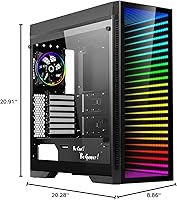
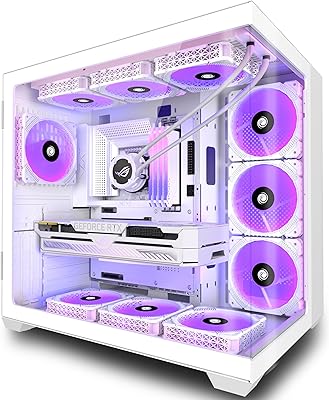
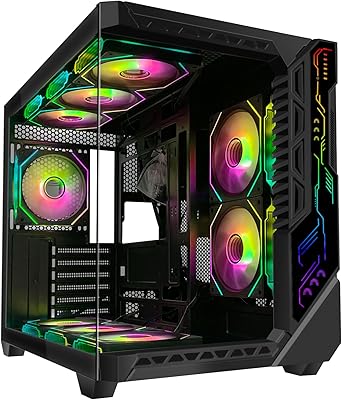
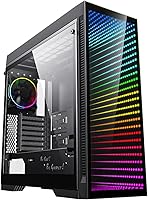
The GAMEMAX Abyss-TR Full Tower Gaming Case sits in a sweet spot that not many competitors occupy: a genuinely attention-grabbing chassis that doesn't demand a flagship-tier budget. The defining feature is the infinity mirror ARGB front panel, which creates a layered depth-of-light effect that looks striking even when the PC is idle. Beyond the visuals, this full tower case backs up its looks with real build headroom — E-ATX motherboard support and a 455mm GPU clearance mean you're not squeezing in high-end hardware. The dual tempered glass panels frame your components nicely. Just keep in mind: at this price tier, some build quality trade-offs are possible, and going in with realistic expectations is worth it.
Features & Benefits

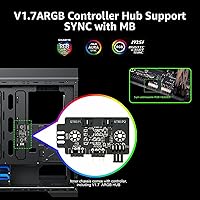
The V1.7 ARGB controller hub is one of the more practical inclusions here — it lets you manage fan speeds and lighting either manually via a button or through your motherboard's software, which is handy if you're running Asus Aura or MSI Mystic Light. Cooling headroom is generous: the Abyss-TR accommodates up to seven 120mm fans and supports radiator mounting on three sides, so a custom water-cooling loop is a realistic option. Internally, the 455mm GPU clearance handles even the bulkiest current-gen cards without issue, and the tool-less HDD bays make drive swaps straightforward. The bottom-mount PSU design with a dust filter helps keep airflow organized, though cable routing can get crowded with a full drive complement.

Best For

This GAMEMAX chassis makes the most sense for builders stepping up from a mid-tower for the first time and wanting their rig to actually turn heads. If you're running a triple-slot GPU or anything pushing past 380mm, the generous internal clearances remove the guesswork a smaller case would force. It's also a solid pick for anyone experimenting with a beginner water-cooling loop — three-sided radiator support at this price is not a given. And if your PC lives on a desk in plain view, the mirrored front panel and tempered glass side window genuinely reward the exposure. Less ideal if you value a compact footprint; at 27 lbs, desk placement deserves some advance thought.

User Feedback

With a 4.0 out of 5 rating across roughly 160 reviews, the Abyss-TR has a reasonably positive track record — though the sample size is modest enough to treat the average with some caution. Buyers consistently praise the visual impact of the front panel and the roomy interior as real strengths for the price. On the downside, some users flag concerns about tempered glass panel rigidity and note that the included fans, while functional, aren't particularly quiet under load. A handful of builders also mention that wrangling all the ARGB and fan headers gets messy once the build fills out. Occasional notes about packaging quality and shipping damage are worth keeping in mind before ordering.

Pros

  • The infinity mirror ARGB front panel is a genuine showpiece that stands out at this price point.
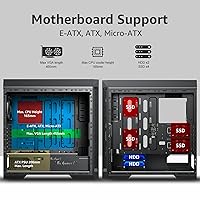
  • Fits E-ATX, ATX, and Micro-ATX motherboards, giving builders real flexibility in platform choice.
  • A 455mm GPU clearance means even the largest current-gen graphics cards slot in without issue.
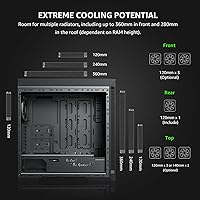
  • Seven 120mm fan mounts and three-sided radiator support make serious cooling setups achievable.
  • The V1.7 ARGB controller hub supports both manual control and motherboard software sync.
  • Tool-less 3.5-inch HDD bays make drive installation and swaps quick and straightforward.
  • Dual tempered glass panels — front and side — give the interior a clean, well-framed look.
  • Bottom-mount PSU placement with a dust filter keeps the airflow path logical and the internals tidier.
  • Offers a lot of internal volume and compatibility headroom for a mid-range price.

Cons

  • Included stock fans are functional but can get noticeably loud under sustained load.
  • Some buyers report flex or fitment concerns with the tempered glass panels — worth inspecting on arrival.
  • Managing the full array of ARGB and fan headers can get messy, especially in a heavily populated build.
  • Cable routing becomes a real challenge when all drive bays and fan slots are occupied.
  • At 27 lbs, this GAMEMAX chassis is heavy and awkward to reposition once your build is complete.
  • The review sample size is modest, so the 4.0 rating reflects limited real-world feedback.
  • Packaging quality has been flagged by a handful of buyers, with occasional shipping damage reported.
  • No tool-less panel removal mechanism is confirmed, which can slow down access during iterative builds.
  • The front mirror panel aesthetic is polarizing — it does not suit minimalist or all-black stealth builds.

Ratings

The scores below were generated by AI after analyzing verified buyer reviews for the GAMEMAX Abyss-TR Full Tower Gaming Case from global sources, with spam, bot-flagged, and incentivized submissions actively filtered out before scoring. Each category reflects the honest pattern that emerged from real builders — where this chassis genuinely earns its place and where it shows its limitations. Both standout strengths and recurring frustrations are weighted transparently so you can make an informed decision.
Visual Design
89%
The infinity mirror ARGB front panel is the single most praised aspect across buyer feedback — it delivers a depth-of-light effect that looks genuinely impressive on a desk or open shelf. Paired with the tempered glass side window, the overall presentation punches well above what you would expect at this price tier.
The mirror aesthetic is bold and specific, which means it will not suit every build style. Buyers going for a clean, understated look often find the front panel too flashy, and there is no simple way to turn the effect off without physically disconnecting the lighting hardware.
Interior Space
92%
Builders consistently highlight the roomy interior as one of the Abyss-TR's most practical advantages. Fitting a triple-slot GPU, a large tower cooler, and an E-ATX motherboard simultaneously — without the layout feeling cramped — is exactly the kind of headroom that justifies choosing a full tower over a mid-tower in the first place.
The sheer size of the interior can feel like overkill for mid-range builds using standard ATX hardware, leaving noticeable dead space that can make cable runs longer and harder to route neatly. Builders who do not need all that room may find a smaller chassis tidier and easier to work with.
Cooling Potential
83%
Seven 120mm fan mounting positions and three-sided radiator support give this full tower case more thermal flexibility than most competitors at a similar price point. Builders setting up a custom water-cooling loop particularly appreciate that the layout does not force uncomfortable compromises between radiator placement and drive access.
The stock fans that ship with the case are functional but underwhelming — they move air adequately under moderate loads but are not optimized for high static pressure or airflow efficiency. Most serious cooling setups end up replacing them, which adds to the total build cost.
Value for Money
84%
For a mid-range full tower that includes E-ATX support, dual tempered glass panels, an ARGB infinity mirror, and a built-in lighting controller, the overall package represents solid value. Buyers who compare it against similarly priced alternatives consistently note that this GAMEMAX chassis offers more visual and spatial bang for the investment.
The value proposition weakens slightly once you factor in the likelihood of replacing the stock fans and potentially investing time fixing panel fitment issues. What looks like a complete out-of-the-box solution may end up requiring a few additional purchases to reach its full potential.
Panel Quality
66%
34%
Both the front and side tempered glass panels create a polished, premium-looking build environment that photographs well and impresses in person. Buyers who receive units in good condition are generally satisfied with how the panels frame their components and diffuse the ARGB lighting.
A recurring thread in user feedback involves concerns about panel rigidity and fitment consistency — some buyers report the glass feeling less solid than expected, with minor flex or alignment gaps noticeable on close inspection. At this price tier it is not unusual, but it is worth a careful check on arrival rather than assuming a perfect fit.
Build Quality
69%
31%
The steel frame of this full tower case feels substantial enough for everyday stationary use, and the overall chassis does not exhibit flex under the weight of heavy hardware. For a build that will sit in one place, the structural rigidity is adequate and the fit of internal components is generally well-executed.
Fit and finish inconsistencies — most commonly around panel mounts and I/O alignment — appear with enough frequency in buyer reports to suggest some variance in manufacturing quality control. The construction does not match what you would find in a premium flagship case, which is expected at this price but worth knowing upfront.
Cable Management
61%
39%
The case includes routing channels and cutouts behind the motherboard tray that make a tidy build achievable with some effort. Builders who take their time planning cable runs before installing components report reasonably clean results, especially with modular PSUs.
The volume of fan and ARGB headers that need to be managed simultaneously is the most consistent complaint in this area. Populating all seven fan slots alongside the ARGB controller leads to a lot of wires competing for limited space behind the tray, and the routing channels are not deep enough to fully absorb the clutter.
Noise Levels
57%
43%
At idle and low loads, the included fans are quiet enough that the system blends into the background. For casual gaming or productivity use where the system rarely hits sustained high loads, most buyers find the noise levels acceptable without any immediate need to replace the fans.
Under sustained load — gaming sessions that push the GPU and CPU hard simultaneously — the stock fans ramp up to speeds that several buyers describe as noticeably loud. Builders who prioritize a quiet environment consistently recommend swapping the included fans for aftermarket options rated for low noise at higher RPMs.
RGB & Lighting
81%
19%
The V1.7 ARGB controller hub is a practical implementation — the ability to switch between manual mode and motherboard sync without needing additional software is appreciated by builders who want flexibility. The lighting effects on the infinity mirror panel in particular are consistently praised as a visual highlight of the build.
Users running older motherboards without a dedicated 5V ARGB header are limited to manual mode only, which offers fewer customization options. The controller hub also adds to the cable clutter inside the case, and a small number of buyers have reported inconsistent behavior when switching between control modes.
Ease of Assembly
73%
27%
The tool-less HDD bays and the spacious interior make the physical assembly process relatively straightforward, even for builders tackling their first full tower build. Component installation — particularly for large coolers and long GPUs — benefits from the extra working room compared to tighter mid-tower cases.
Managing the ARGB and fan header connections during assembly adds meaningful complexity that first-time builders may underestimate. The instruction documentation is reportedly basic, which means figuring out the controller hub and sync options can require some independent research before everything runs as expected.
Storage Options
76%
24%
Four 2.5-inch SSD mounts and two tool-less 3.5-inch HDD bays cover the needs of most typical builds without requiring adapters or workarounds. The tool-less mechanism for the HDDs in particular is a convenient touch that speeds up drive swaps during iterative builds.
Six total drive bays is a reasonable number for most users but may feel limiting for builders running NAS-adjacent setups or heavy media storage configurations. The SSD mounting points are also somewhat exposed within the cable management zone, which can complicate routing when all four slots are occupied.
Front I/O
63%
37%
Having two USB 3.0 ports and two USB 2.0 ports on the top I/O panel covers basic connectivity needs for peripherals, headsets, and flash drives without requiring desk cable runs. The port placement on the top of the case is convenient for most desk setups.
The absence of a USB-C front port is a notable omission for a case launched in 2020 and still sold today, as many modern peripherals and devices rely on USB-C for faster data transfer. Builders pairing this chassis with newer motherboards with front USB-C headers will find that connectivity unused.
Dust Management
74%
26%
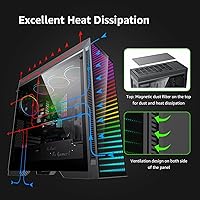
The bottom-mounted dust filter over the PSU intake is a genuinely useful inclusion that catches particulate before it enters the most heat-sensitive components. Combined with the ventilation channel design on the side panels, the case shows reasonable attention to long-term maintenance needs.
Dust filtration coverage is limited to the bottom intake only, leaving the front and top fan mounts without dedicated filters. Builders in dusty environments will likely need to supplement with aftermarket fan filters or commit to more frequent interior cleaning to keep the system running efficiently.
Packaging & Unboxing
58%
42%
Most buyers receive their unit in acceptable condition, and the packaging does provide basic foam protection around the chassis. For orders that arrive undamaged, the unboxing experience is straightforward and the accessory kit is organized well enough to locate parts without frustration.
A recurring pattern in buyer feedback involves cosmetic damage — most often to the tempered glass panels — that appears to originate during transit rather than in manufacturing. The packaging protection, while standard for the category, has not proven consistently robust enough to prevent edge chips or surface scratches on the glass under rougher shipping conditions.

Suitable for:

The GAMEMAX Abyss-TR Full Tower Gaming Case is a strong match for PC builders who want a visually striking rig without paying flagship prices for the privilege. If you're running a large GPU — anything in the triple-slot, 400mm-plus range — the generous internal clearances mean you won't be wrestling with fitment the way you might in a mid-tower. It's also well-suited to builders who have E-ATX or full ATX boards and need the extra real estate a full tower provides. Cooling enthusiasts on a tighter budget will appreciate the three-sided radiator support and seven fan mounts, which make a custom water-cooling loop genuinely achievable here. And if your setup lives on a desk where the case is visible, the infinity mirror front panel and tempered glass side window make a real visual impression that cheaper cases simply can't replicate.
Not suitable for:

Buyers in compact or space-constrained setups should look elsewhere — this GAMEMAX chassis weighs in at 27 lbs and takes up a serious footprint, so it demands dedicated desk or floor space and isn't easy to move around once placed. If you prefer a clean, minimalist build aesthetic with no RGB, the mirror front panel will likely feel like overkill, and there's no obvious way to disable the visual effect entirely without disconnecting hardware. The GAMEMAX Abyss-TR Full Tower Gaming Case also may not satisfy enthusiasts who prioritize premium build quality above all else, as some buyers have flagged concerns about panel rigidity and the long-term durability of the tempered glass fitment — something worth verifying before committing. Those who plan a very storage-heavy build with multiple drives and complex cable runs should budget extra time for routing, as the header count and wiring can get unwieldy. Finally, if near-silent operation is a priority, the stock fans are functional but not whisper-quiet, and you may end up replacing them.
Specifications

  • Form Factor: Full Tower chassis designed to accommodate E-ATX, ATX, and Micro-ATX motherboards.
  • Dimensions: The case measures 20.28 x 8.86 x 20.91 inches (length x width x height).
  • Weight: Shipping weight is approximately 27 pounds, reflecting a substantial steel-frame construction.
  • GPU Clearance: Supports graphics cards up to 455mm in length, comfortably fitting even triple-slot flagship GPUs.
  • CPU Clearance: Maximum CPU cooler height is 165mm, accommodating most tower air coolers and 240mm AIO brackets.
  • PSU Clearance: Bottom-mounted PSU bay supports power supplies up to 200mm in length.
  • Fan Support: Provides mounting positions for up to seven 120mm fans across the front, top, and rear panels.
  • Radiator Support: Supports water-cooling radiator installation on three sides, enabling 120mm, 240mm, and 360mm configurations depending on the panel.
  • Storage Bays: Includes two tool-less 3.5-inch HDD bays and four dedicated 2.5-inch SSD mounting points.
  • Front Lighting: The front panel features an addressable RGB (ARGB) infinity mirror with a rainbow LED effect that is fully customizable.
  • ARGB Controller: Ships with a V1.7 ARGB controller hub that supports both manual button control and motherboard software synchronization.
  • Side Panel: Full-length tempered glass side panel provides an unobstructed view of internal components.
  • Front Panel: Tempered glass front panel houses the ARGB infinity mirror and allows visible light diffusion from the front fans.
  • Front I/O: Top I/O includes two USB 2.0 ports and two USB 3.0 ports for peripheral and device connectivity.
  • Dust Filtration: A removable dust filter is located at the bottom of the chassis, covering the PSU intake area.
  • Airflow Design: Ventilation channels run along both side panels to support passive airflow alongside active fan configurations.
  • Color: Available in black with a steel and tempered glass exterior finish.
  • Manufacturer: Designed by GAMEMAX and manufactured by Sohoo, first made available in January 2020.

Related Reviews

darkFlash DY470 Full-Tower ATX PC Case
80%
93%
Cable Management
78%
Build Quality & Materials
84%
Cooling Potential
91%
Aesthetics & Visual Design
89%
GPU Compatibility & Mounting
More
Antec Performance 1 FT Full Tower Gaming Case
84%
91%
Cooling Performance
88%
Build Quality
85%
Ease of Assembly
93%
Design & Aesthetics
87%
Cable Management
More
HYTE Y70 Mid-Tower ATX Gaming Case
80%
93%
Build Quality
96%
Aesthetic Design
78%
Cooling Potential
91%
Vertical GPU Mounting
88%
Cable Management
More
Cooler Master Cosmos C700M Full-Tower Case
81%
93%
Build Quality
88%
Cooling Performance
91%
Design & Aesthetics
89%
Interior Layout & Flexibility
71%
Value for Money
More
Corsair 7000D Airflow Full-Tower PC Case
80%
93%
Build Quality
91%
Airflow Performance
94%
Interior Space & Layout
89%
Cable Management
96%
Cooling Potential
More
Antec C8 Full-Tower E-ATX PC Case
81%
93%
Build Quality
96%
Cooling Flexibility
89%
Cable Management
91%
Aesthetic Design
74%
Assembly Experience
More
ANSAITE W9 Mid-Tower ATX PC Case
77%
88%
Value for Money
91%
RGB & Lighting Performance
74%
Airflow & Cooling Capacity
63%
Build Quality & Materials
84%
Cable Management
More
Thermaltake View 600 TG Full Tower Case
80%
88%
Build Quality
93%
Aesthetic Design
91%
Cooling Potential
89%
Interior Space & Layout
82%
Cable Management
More
SZSKYING CMSVB-1 Mid-Tower PC Gaming Case
74%
91%
Value for Money
88%
Included Fans
86%
Aesthetics & RGB
61%
Build Quality
74%
Airflow Performance
More
darkFlash DRX70 ATX Mid-Tower PC Case
74%
83%
Value for Money
78%
Airflow Performance
89%
Ease of Assembly
67%
RGB Lighting
71%
Build Quality & Materials
More

FAQ

Yes, the Abyss-TR officially supports E-ATX boards, so you should be fine with standard E-ATX form factors. That said, it is always worth double-checking the exact dimensions of your specific board against the case specs, as E-ATX sizing can vary slightly between manufacturers. Standard ATX and Micro-ATX boards fit without any issue.

Yes, the front panel supports a 360mm radiator, which is one of the more useful aspects of this full tower case for water-cooling enthusiasts. The top and rear panels also support radiator mounting, giving you real flexibility in how you route your loop. Just account for fan and radiator thickness together when planning clearance against your RAM and motherboard.

Yes, the included V1.7 ARGB controller hub supports both motherboard software sync and manual control via a button on the case. If your board has a 5V ARGB header, you can plug in and control the lighting directly through your motherboard's software ecosystem. If you prefer to keep things simple, the manual mode cycles through preset effects without needing any software at all.

Honest answer: they are not the quietest fans on the market. Under light loads they are tolerable, but several builders have noted that they become audibly noticeable when running at higher speeds. If near-silent operation matters to you, budgeting for aftermarket fan replacements is a reasonable expectation with this chassis.

The GAMEMAX Abyss-TR Full Tower Gaming Case offers up to 455mm of GPU clearance, which is enough for most current-gen cards including reference and AIB RTX 4090 models, the majority of which land in the 336mm to 366mm range. You have meaningful headroom to spare. That said, always verify your specific card model length before purchasing, as some extreme triple-fan designs push well past 340mm.

It is manageable but requires some patience, especially if you are populating all fan and ARGB headers alongside a full storage complement. The internal design includes routing channels, but the sheer number of headers from seven fan slots and ARGB strips can create clutter behind the motherboard tray. Velcro ties and a bit of planning ahead make a real difference here.

Based on available buyer feedback, the tempered glass panels look impressive but have drawn some concern around rigidity and panel fitment, particularly on the front. It is not a reported dealbreaker for most buyers, but it is an area worth inspecting carefully when your unit arrives rather than assuming it will match the fit and finish of higher-priced competitors.

The Abyss-TR ships with fans included, and they are connected through the onboard ARGB controller hub. The number of pre-installed fans and their exact placement should be confirmed in the box contents, but the case is not empty out of the box. Replacing them with higher-quality fans is a popular upgrade among builders who prioritize acoustics.

Not particularly. At 27 pounds empty, this GAMEMAX chassis is heavy before you add any hardware, and a fully loaded build with a full tower air cooler, large GPU, and multiple drives can push total weight well past 50 pounds. It is best treated as a place-it-and-leave-it case rather than something you plan to transport to LAN events regularly.

A small number of buyers have reported packaging quality concerns and occasional cosmetic damage on arrival, so it is worth doing a thorough inspection before you start the build. Check the tempered glass panels on both the front and the side for chips or cracks, and verify that the I/O panel connectors and the ARGB controller are intact. If anything looks off, documenting it immediately with photos makes the return or exchange process much easier.