Overview

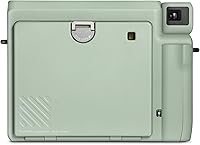
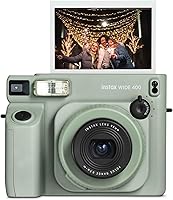
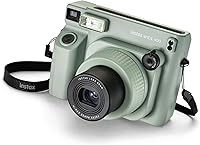
The Fujifilm Instax Wide 400 arrived in mid-2024 as a confident step up from Fujifilm's entry-level instant cameras, and the difference is immediately obvious the moment you hold it. Where the Mini format produces wallet-sized prints, this wide-format instant camera delivers credit-card-wide images that actually show the full scene — more sky, more faces, more context. The sage green finish looks genuinely attractive in person, not just in product photos, giving it the feel of something worth carrying around. Automatic exposure and flash handle the technical side quietly in the background, so you can focus on the moment rather than the settings.
Features & Benefits

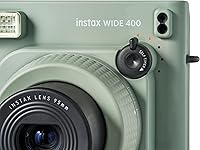
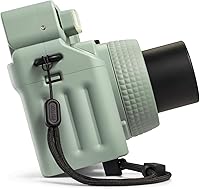
The three focus modes are where the Wide 400 earns its place above simpler models. Normal handles everyday snapshots, Landscape locks focus for distant scenes, and switching to Macro — using the included close-up lens — lets you photograph objects just a foot away. The self-timer with its LED countdown is genuinely handy at group dinners or solo travel stops; you set the camera down, step into frame, and the shot takes itself. The camera angle accessory is a small plastic clip that lets you prop the camera at a consistent tilt — useful, if unspectacular. Running on standard AA batteries means you'll never be stranded hunting for an obscure power source.

Best For

This Instax model is a natural fit for anyone who has felt cramped by the Mini format but isn't ready to commit to a film SLR. Gift buyers in particular tend to love it — it's stylish, approachable, and arrives ready to shoot. It shines at parties, weddings, and family gatherings where physical prints get passed around on the spot. Travelers appreciate its relatively light build and the fact that it doesn't demand technical knowledge to produce decent shots. One honest caveat: because all controls are fully automatic, photographers who want to experiment with exposure or flash compensation will find themselves hitting a wall fairly quickly.

User Feedback

Buyers consistently highlight the wide print size as the biggest draw — once people see how much more a Wide print captures compared to the Mini, it's hard to go back. Build quality and the sage green finish generally land well; most say it looks better in person than in photos. The sticking point that comes up repeatedly is film cost: each pack of ten shots adds up fast, and buyers at this price tier expect to factor that into the long-term spend. Battery life earns mostly positive remarks, with users reporting solid coverage across several film packs per set of AAs. A notable minority found the angle accessory underwhelming, describing it as a minor extra rather than anything essential.

Pros

  • Wide-format prints capture noticeably more of the scene than Mini cameras, making group shots genuinely usable.
  • The automatic exposure and flash system produces consistently decent results without any setup or guesswork.
  • Three focus modes — including Macro with the bundled close-up lens — add real versatility absent from simpler Instax models.
  • The sage green finish looks premium in person and regularly draws compliments at events.
  • Standard AA batteries mean you can restock anywhere in the world without hunting for specialty power sources.
  • The self-timer with LED countdown lets solo travelers and small groups get into the frame without outside help.
  • Everything needed to start shooting arrives in the box — lens, strap, and angle accessory included.
  • Build quality feels sturdy enough for everyday social use and regular bag carry without babying it.
  • Beginner photographers get usable, shareable prints from their very first roll with almost no trial and error.

Cons

  • Wide film packs cost significantly more per shot than Mini film, making frequent shooting an expensive habit.
  • No manual controls whatsoever — flash power, exposure, and focus distance are entirely out of the shooter's hands.
  • The camera angle accessory is a basic plastic clip; useful in specific situations, but not the versatile tool the name implies.
  • The flash tends to overexpose subjects at very close range, washing out detail in tight indoor portraits.
  • No protective lens cover or carrying case is included, leaving the front exposed to dust and scratches in a bag.
  • The low-battery warning comes too late to plan around, catching some users mid-roll at events.
  • The large footprint makes spontaneous, pockets-only carry impractical compared to Mini-format alternatives.
  • Glossy sections of the body attract fingerprints and smudges noticeably, requiring regular wiping to look presentable.

Ratings

The Fujifilm Instax Wide 400 has been evaluated by our AI rating system after analyzing thousands of verified global buyer reviews, with spam, bot-generated, and incentivized submissions actively filtered out. Scores reflect the full picture — what real users genuinely love and where this wide-format instant camera falls short — so you can make a confident, informed decision.
Print Size & Quality
88%
The wide-format prints are consistently the first thing buyers rave about. Compared to the Mini format, the larger frame captures full group faces, open landscapes, and event moments without awkward cropping — buyers describe handing these prints around at weddings and parties as a genuinely different experience.
Print quality can look slightly washed out in low-contrast lighting even with the automatic flash active. A handful of users noted that skin tones occasionally come out cooler than expected, which is a known quirk of Instax Wide film rather than a camera fault specifically.
Ease of Use
91%
Almost every beginner reviewer mentions how quickly they were shooting confidently — often within minutes of unboxing. Automatic exposure and flash mean there are no dials to second-guess, which is exactly what casual shooters at parties or family gatherings want from an instant camera.
The fully automatic design is a deliberate trade-off. Enthusiasts who want to dial in exposure compensation, adjust flash intensity, or experiment with slow sync find this model quickly frustrating, and several intermediate users noted they eventually felt constrained by the lack of any manual override.
Value for Money
67%
33%
The camera body itself feels reasonably priced for a mid-range Instax model with genuine extras included. The bundled close-up lens, angle accessory, and shoulder strap mean you are not immediately shopping for add-ons, which buyers appreciate at this price tier.
The ongoing film cost is where the real-world expense bites. Wide film packs cost noticeably more per shot than Mini packs, and buyers who shoot frequently flag that the annual running cost can easily dwarf the original camera purchase, making this a harder sell for high-volume shooters.
Build Quality & Durability
79%
21%
The plastic body feels solid enough for everyday social use — buyers describe tossing it into tote bags and weekend luggage without babying it, and most report no creaking or flex after extended use. The finish holds up well to light handling scratches.
It is still an all-plastic construction, and a few buyers noted the film door hinge feels less reassuring than the main body. It is not a camera you would want to drop on a hard floor repeatedly, and the glossy sections show fingerprints fairly easily in person.
Focus Modes & Versatility
82%
18%
Having three distinct focus modes — Normal, Landscape, and Macro — puts the Wide 400 genuinely ahead of simpler one-mode Instax cameras. The included close-up lens enabling macro shots is a practical bonus that buyers use for flat-lay photos, food shots, and product keepsakes.
Switching between modes requires remembering which setting you left the camera on, and there is no on-body indicator that clearly confirms the active mode at a glance. A couple of reviewers mentioned accidentally shooting landscapes in Normal mode and getting slightly soft results.
Self-Timer Functionality
83%
The LED countdown self-timer solves a real practical problem — solo travelers and small groups use it regularly to get everyone in frame without hunting for a stranger to hold the camera. The visual countdown is clear enough to see from a few feet away when setting up a shot.
The timer offers only one fixed delay, so if you need more time to compose and get into position, you are working around the clock rather than with it. Users wanting a two-step delay or remote shutter option will find this a minor but recurring annoyance.
Camera Angle Accessory
58%
42%
For what it is, the angle adjustment clip does its job — it props the camera at a consistent downward tilt for overhead table shots or flat-lay style photos, which is a niche but real use case that some creative buyers genuinely appreciate having available.
The majority of buyers describe it as a basic plastic clip that feels like an afterthought rather than a precision tool. Several reviewers noted it adds bulk without adding much shooting flexibility, and a few admitted they left it in the box after the first try.
Battery Life
81%
19%
Running on four standard AA batteries is a practical advantage that frequent travelers appreciate — replacements are available at virtually any corner store worldwide. Most users report getting through multiple film packs per set, which is a respectable yield for an instant camera with automatic flash.
Heavy flash usage in dark environments drains batteries faster than lighter daytime shooting, and a small group of buyers were caught short at events after assuming batteries would last longer. There is no low-battery warning early enough to plan around, which caught a few users mid-roll.
Flash Performance
76%
24%
The automatic flash handles typical indoor party lighting competently, producing evenly lit prints from conversational distances. Buyers shooting at dimly lit restaurants and evening events generally get usable results without any manual adjustment, which is the core promise fulfilled.
At close distances — under two feet — the flash tends to overexpose faces and wash out fine details, a limitation inherent to fixed-output flashes. Buyers who shoot a lot of close portraits indoors notice this repeatedly, and it cannot be dialed back or disabled for a softer look.
Film Loading & Handling
84%
Loading a new film pack is quick and foolproof — the door mechanism is clearly marked, and the film slots in with a satisfying click. Buyers new to instant photography consistently praise how little friction there is between picking up the camera and being ready to shoot.
The film ejection slot is positioned in a way that occasionally leads new users to block it with their hand, resulting in a ruined first shot on a fresh pack. It is easy to learn but takes one accidental wasted frame before the habit sticks.
Design & Aesthetics
86%
The sage green colorway photographs beautifully and earns genuine compliments in person — multiple buyers mention friends asking about the camera at events before they have even taken a shot. It reads as a considered lifestyle object rather than a purely utilitarian gadget.
The color selection is limited to a single option for this variant, which may not suit buyers who prefer neutral or bolder tones. The glossy plastic on parts of the body picks up oils and smudges quickly, and keeping it looking sharp requires a lens cloth or soft wipe handy.
Portability
77%
23%
At just over a pound, the Wide 400 is light enough to carry in a tote or day bag without noticing the weight. The included shoulder strap makes it feel like a proper camera accessory rather than just a box with a button, and buyers appreciate having hands-free carrying as a built-in option.
The footprint — nearly ten inches wide — is genuinely bulky compared to Mini-format cameras, and buyers used to slipping an Instax Mini into a jacket pocket will feel the size difference immediately. It is a shoulder-bag camera, not a pocket camera, and that limits spontaneous carry.
Accessories & Inclusions
78%
22%
The package covers the essentials without requiring immediate add-on purchases — close-up lens, shoulder strap, and angle clip are all present out of the box. Buyers consistently note that the included close-up lens alone justifies part of the price premium over simpler bundles.
There is no protective case or lens cover included, which feels like an oversight at this price point. A few buyers flagged that the viewfinder can get smudged quickly in a bag, and without a cover, the lens area is exposed to dust and pocket debris between shoots.
Beginner Friendliness
92%
The learning curve is practically nonexistent for someone who has never used an instant camera before. Point, press, wait a minute — that is genuinely the full process. Parents buying this for teenagers and gift-givers shopping for non-photographer friends consistently highlight this as the model's greatest practical strength.
The same simplicity that makes this approachable for beginners is what limits it as a user grows. There is nowhere to graduate within this camera itself, so buyers who develop a real interest in instant photography will likely be shopping for a more capable model within a year or two.

Suitable for:

The Fujifilm Instax Wide 400 was built for people who want physical memories without the learning curve — and it delivers on that promise best in the hands of casual, social shooters. If you are the person at every gathering who wishes the photos felt more tangible, this wide-format instant camera turns that instinct into a reliable habit. The larger print size makes it particularly well-suited to group portraits and event photography, where a Mini-sized print would crop out half the faces. Gift buyers will find it hard to beat for a teenager, a college student heading into a new chapter, or a travel-loving friend — it is attractive enough to carry proudly and simple enough that nobody needs to read a manual. Travelers who want analog keepsakes without lugging serious gear will also appreciate the reasonable weight and the fact that AA batteries are available in virtually every country.
Not suitable for:

The Fujifilm Instax Wide 400 is not the right fit for anyone who wants creative control over their photography. Because every exposure decision is handled automatically, there is no way to adjust flash intensity, tweak exposure compensation, or experiment with longer shutter effects — the camera makes all those choices for you, and you either accept the result or you do not. Photographers who already own a more capable instant camera and are hoping this is a meaningful step up in creative range will likely be disappointed. Budget-conscious buyers also need to think carefully before committing: Wide film is more expensive per shot than Mini film, and if you shoot frequently, the running costs accumulate quickly enough to reframe the value calculation entirely. Anyone expecting a pocketable carry-everywhere camera should also know upfront that the nearly ten-inch body is a shoulder-bag proposition, not a jacket-pocket one.
Specifications

  • Brand & Model: Manufactured by Fujifilm under the model designation Instax Wide 400, released in June 2024.
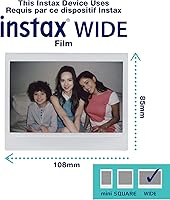
  • Film Format: Uses Instax Wide film, producing prints approximately 99mm x 62mm — noticeably larger than the Instax Mini format.
  • Focus Modes: Three selectable focus modes are available: Normal (0.9m to 3m), Landscape (3m to infinity), and Macro (0.4m to 0.6m with the included close-up lens).
  • Exposure Control: Exposure is fully automatic, with the camera measuring ambient light and adjusting accordingly without any manual override.
  • Flash: Built-in automatic flash fires on every shot; range is approximately 0.4m to 2.7m depending on lighting conditions.
  • Shutter Speed: Fixed minimum shutter speed of 1/125 sec, with automatic adjustment for varying lighting environments.
  • Self-Timer: Built-in self-timer with a visible LED countdown, allowing hands-free shooting after the shutter button is pressed.
  • Power Source: Requires four AA batteries, which are included in the box; no proprietary charger or battery pack is needed.
  • Dimensions: The camera body measures 9.75 x 4.24 x 5.75 inches, making it a mid-sized instant camera suited to bag carry rather than pocket carry.
  • Weight: Complete camera body weighs 1.34 pounds, which is manageable for extended handheld use or shoulder-strap carry.
  • Color: Available in Sage Green, a muted earthy tone with a semi-gloss finish across the body.
  • In the Box: Package includes the camera body, close-up lens for Macro mode, camera angle adjustment accessory, shoulder strap, and a Quick Start Guide.
  • Warranty: Covered by a 1-year limited manufacturer warranty from Fujifilm from the date of purchase.
  • Viewfinder: Optical real-image viewfinder with a target spot for framing reference; no electronic display or screen is present.
  • Film Loading: Film is loaded via a hinged door on the back of the camera; each Instax Wide film pack contains 10 exposures.
  • Battery Indicator: A basic low-battery indicator lamp alerts users when charge is running low, though it activates close to depletion.
  • Manufacturer: Designed and manufactured by Fujifilm Corporation, a Japanese imaging and photography brand with decades of instant film heritage.

Related Reviews
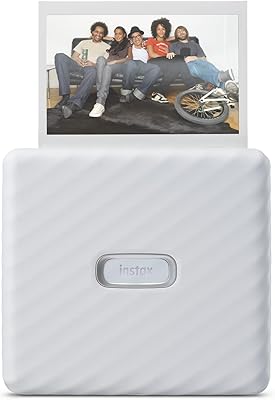
Fujifilm Instax Link Wide Printer
84%
91%
Print Quality
88%
Ease of Use
85%
App Functionality
92%
Portability
78%
Print Speed
More
Fujifilm Instax Square SQ1 Instant Camera
83%
91%
Ease of Use
80%
Image Quality
88%
Design & Build Quality
85%
Battery Life
90%
Portability & Size
More
Fujifilm Instax mini 41 Instant Camera
85%
91%
Ease of Use
88%
Selfie Functionality
84%
Photo Quality
94%
Portability
86%
Build Quality
More
Fujifilm Instax Mini 11 Instant Camera
86%
92%
Ease of Use
89%
Portability
87%
Image Quality
90%
Selfie Mode
80%
Battery Life
More
Fujifilm Instax Mini 12
78%
94%
Ease of Use
83%
Photo Quality in Good Light
61%
Low-Light Performance
81%
Selfie & Close-Up Capability
78%
Build Quality & Design
More
Fujifilm Instax Mini EVO
81%
88%
Image Quality
91%
Creative Effects & Versatility
83%
Smartphone Integration
86%
Build Quality & Design
71%
Value for Money
More
Fujifilm Instax Mini 9
75%
93%
Ease of Use
67%
Image Quality
74%
Build Quality
61%
Value for Money
71%
Selfie & Portrait Performance
More
Fujifilm Instax Mini 40 Instant Camera
82%
85%
Photo Quality
92%
Ease of Use
88%
Selfie Functionality
80%
Build Quality
90%
Portability
More
Fujifilm INSTAX Mini LIPLAY Hybrid Instant Camera
85%
77%
Photo Quality
85%
Ease of Use
90%
Connectivity (Bluetooth)
82%
Editing Features
89%
Sound Feature
More
Fujifilm Instax Mini Link 2 Smartphone Printer
84%
91%
Print Quality
94%
Portability
89%
Ease of Use
85%
Connectivity
92%
Customization Options
More

FAQ

No, film is not included in the box. You will need to purchase Instax Wide film separately before you can start shooting. Wide film packs typically contain 10 exposures, and it is worth buying at least two packs upfront so you are not running out quickly at an event.

The difference is significant enough to notice immediately. Wide prints measure roughly 99mm x 62mm, which gives you a much larger image area than Mini prints — closer to a standard credit card in width versus a passport photo. For group shots and landscapes, the extra space genuinely matters.

No — the flash fires automatically on every shot and cannot be disabled. In bright outdoor conditions this rarely causes problems since the flash output is relatively subtle, but it is worth knowing that you have no control over it.

The close-up lens clips over the main lens and shifts the focus range to approximately 0.4m to 0.6m, which is useful for photographing objects, food, or flat-lay arrangements at short distances. You also need to switch the focus mode dial to Macro when using it. It is straightforward once you do it once, but easy to forget if you switch back and forth.

Most users report getting through several film packs — typically three to five — on a single set of four AA batteries under normal shooting conditions. Heavy use in dark environments where the flash is working hard will drain them faster. Carrying a spare set of AAs to an all-day event is a sensible habit.

It is one of the better options for a complete beginner. The wide-format instant camera handles all exposure and flash decisions automatically, so there is no manual setup required. The accessories in the box and the attractive sage green design also make it feel like a considered, well-packaged gift rather than just a gadget.

It must be Instax Wide film specifically — not Instax Mini, not Instax Square, and not any third-party film. Using the wrong film type will not fit the camera correctly. Instax Wide film is widely available online and in most electronics or photography retailers.

It is a small plastic attachment that props the camera at a fixed downward angle, which is handy for shooting objects on a table or getting a consistent overhead-style shot. It is not adjustable or precision-engineered — think of it as a basic stand-in for a small tripod rather than a sophisticated accessory. Useful occasionally, but not a compelling reason to choose this model.

It holds up reasonably well for the way most people travel — in a tote bag or daypack alongside other items. The all-plastic construction is not fragile, but it is also not weather-sealed or ruggedized. A padded pouch is a worthwhile addition if you plan to carry it in a busy bag regularly, since there is no lens cover included in the box.

Instax Wide prints typically develop fully within 90 seconds to three minutes, depending on ambient temperature. In cold weather the process slows down noticeably — keeping the print in a warm pocket while it develops helps. Avoid bending or exposing the print to direct sunlight immediately after it ejects.