Freenove ESP32-WROVER CAM Board Ultimate Starter Kit (FNK0047B)
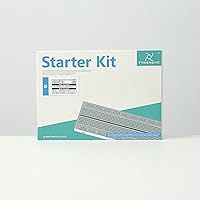
Overview
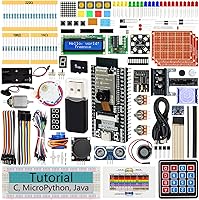
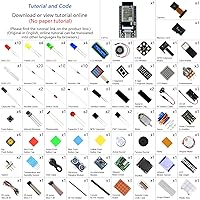
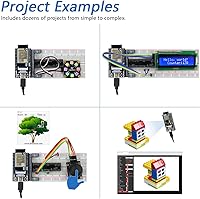
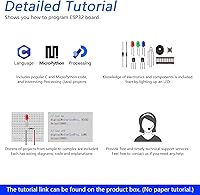
The Freenove ESP32-WROVER CAM Board Ultimate Starter Kit (FNK0047B) is built around one clear idea: give learners everything they need to go from zero to functional IoT projects without hunting for extra parts or scattered tutorials. At its core is an ESP32-WROVER development board with onboard Wi-Fi, Bluetooth, and a camera module — a combination that opens up a surprisingly wide range of real-world applications. The kit ships with 240 components and guides you through 122 projects of increasing complexity, all while supporting three coding languages: MicroPython, C, and Processing. Whether you are a student, a hobbyist, or a self-taught engineer exploring embedded systems, this ESP32 starter kit was clearly designed with hands-on learning in mind.
Features & Benefits
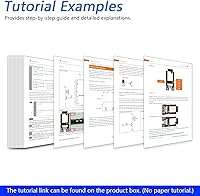
The ESP32-WROVER processor at the heart of this maker learning bundle runs at up to 240 MHz across two cores, backed by 8 MB of PSRAM — enough headroom to handle wireless data, image capture, and sensor processing simultaneously. The onboard camera pairs with a 1 GB memory card, making projects like motion detection or simple surveillance genuinely accessible. Rather than a thin quick-start sheet, you get a 795-page digital tutorial that covers every project with full code, wiring diagrams, and clear explanations — worth noting that it is download-only, with no paper version in the box. One practical standout is multi-language support: MicroPython, C, and Processing all work natively. A built-in USB uploader means you are coding from day one, no extra hardware needed.
Best For
This ESP32 starter kit is a strong fit for beginners who want a single purchase to carry them from blinking an LED to building a Wi-Fi connected camera project. Students and educators will appreciate the structured, curriculum-style sequence — 122 projects that build on each other logically without leaving gaps. Hobbyists drawn to IoT, wireless sensors, or basic computer vision will find the camera and connectivity features genuinely useful rather than gimmicky. It also works well for intermediate makers who have outgrown simple Arduino sketches and want a more capable microcontroller without assembling a learning path from scratch. The multi-language support is a quiet but real advantage for anyone already comfortable coding in Python.
User Feedback
Most buyers who leave reviews for the Freenove CAM kit settle on the same general take: the tutorial depth is genuinely impressive compared to other kits at a similar level. A handful of reviewers were caught off guard by the absence of a printed manual — the guide is digital only, accessed via a link on the product box. Component quality inconsistencies come up occasionally, and IDE configuration on Windows is the most commonly cited friction point for beginners getting started. On the positive side, the kit earns consistent praise for how much it packs in relative to its tier, and Freenove's customer support is mentioned repeatedly as a genuine differentiator among competing brands.
Pros
- The 795-page digital tutorial is genuinely one of the most thorough in its class, covering every project with full code and wiring diagrams.
- Supporting MicroPython, C, and Processing means you can start with the language you already know rather than learning one from scratch.
- 240 components cover a wide enough range that most of the 122 projects require zero additional purchases.
- The built-in USB code uploader removes a common early barrier — no separate programmer or adapter needed.
- Freenove's customer support is consistently praised for being responsive and willing to send replacement parts when issues arise.
- The project sequence is well-paced, building foundational skills early so later wireless and camera projects feel like logical progressions.
- Wiring diagrams are accurate and readable enough that following them correctly almost always produces a working result on the first try.
- The kit holds long-term value as a parts library even after all guided projects are completed.
- At its price tier, the combination of hardware, components, and learning content represents strong overall value compared to assembling equivalents separately.
Cons
- There is no printed manual in the box — the tutorial is download-only, which catches a meaningful number of buyers off guard.
- Windows driver and IDE configuration issues are the most frequently cited frustration, especially on Windows 11 systems.
- Jumper wires and breadboards feel noticeably cheaper than the main board and show wear after extended use.
- The camera module is a learning tool, not a quality imaging component — low-light performance is weak and output resolution is limited.
- Some smaller passive components arrive dead on arrival often enough that it is worth testing everything before starting a project.
- The tutorial explains what to do more clearly than it explains why, leaving conceptual gaps for learners who want real understanding.
- No 5 GHz Wi-Fi support, which can cause instability in environments where the 2.4 GHz band is congested.
- Once the 122 guided projects are finished, there is no built-in next step — advanced learners will need to find their own path forward.
- The Processing (Java) code examples are less polished than the MicroPython and C versions, with occasional inconsistencies in the graphical interface projects.
Ratings
The Freenove ESP32-WROVER CAM Board Ultimate Starter Kit (FNK0047B) has been evaluated by our AI system after analyzing thousands of verified global buyer reviews, with spam, bot-generated, and incentivized feedback actively filtered out. Scores reflect real-world usage patterns across a wide range of learners — from first-time hobbyists to experienced makers brushing up on a new platform. Both the genuine strengths and the recurring frustrations are represented transparently in every category below.
Tutorial Quality
Component Variety
Board & Hardware Quality
Beginner Accessibility
Multi-Language Code Support
Camera Module Usability
IDE & Software Setup
Value for Money
Project Depth & Progression
Documentation Clarity
Wireless & Connectivity Performance
Packaging & Out-of-Box Experience
Reusability & Long-Term Use
Community & Manufacturer Support
Suitable for:
The Freenove ESP32-WROVER CAM Board Ultimate Starter Kit (FNK0047B) is a strong match for anyone who wants a structured, self-contained entry point into embedded programming and IoT without piecing together a learning path from multiple sources. Students taking electronics or programming courses will find the 122 project sequence functions almost like a practical lab curriculum, with every schematic and code sample already provided. Hobbyists who have dabbled with basic Arduino projects and want to work with something more capable — especially anything involving Wi-Fi, Bluetooth, or camera input — will feel right at home here. Educators looking for a ready-made kit to run workshop sessions or after-school coding clubs will appreciate how little additional preparation is required. Python-comfortable learners in particular benefit from the MicroPython support, which lets them start building real hardware projects without first committing to learning C syntax.
Not suitable for:
Buyers expecting a fully print-ready learning experience should know upfront that the Freenove ESP32-WROVER CAM Board Ultimate Starter Kit (FNK0047B) does not include any paper documentation — the entire 795-page tutorial is digital only, accessed via a link on the product box. Completely inexperienced beginners with no prior exposure to coding or basic circuit concepts may find the initial learning curve steeper than anticipated, as the tutorial assumes some baseline familiarity that is not always spelled out before it is needed. Anyone hoping to use the onboard camera for anything beyond learning and prototyping will likely be underwhelmed — the image quality is modest and unsuitable for finished products where visual output matters. Advanced developers or engineers already fluent in ESP32 development will find the project content too introductory to justify the purchase as anything other than a parts kit. Finally, users on Windows 11 or non-standard development environments should be prepared for a potentially frustrating IDE and driver setup process before writing their first line of code.
Specifications
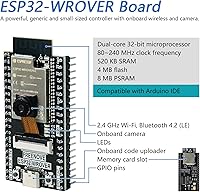
- Microcontroller: The board is powered by an ESP32-WROVER dual-core 32-bit processor running at up to 240 MHz, manufactured by Espressif.
- RAM: 8 MB of PSRAM is available onboard, providing ample memory for handling wireless data streams, image buffers, and real-time sensor processing simultaneously.
- Flash Storage: The microcontroller includes 4 MB of onboard flash storage for program code and persistent data.
- Memory Card: A memory card slot accepts microSD cards and the kit includes a 1 GB card along with a USB card reader for transferring and storing image or data files.
- Wireless: Onboard 2.4 GHz Wi-Fi (802.11n) and Bluetooth 4.2 with Low Energy (LE) support are integrated directly into the ESP32-WROVER module.
- Camera: An onboard camera module is built into the development board, enabling image capture and basic video streaming projects without any additional hardware.
- USB Uploader: A USB code uploader is integrated directly on the board, allowing code to be flashed from a computer without a separate programmer or FTDI adapter.
- Languages: Full project code is provided in three languages: MicroPython, C (Arduino framework), and Processing (Java), with each language covering the same set of guided projects.
- Tutorial: A 795-page tutorial in English is available as a digital download or for online viewing; browser-based translation is supported, but no printed manual is included in the box.
- Projects: The kit includes 122 guided projects progressing from introductory to advanced, each with a schematic, wiring diagram, complete code, and a written explanation.
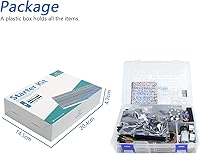
- Components: A total of 240 items are included, covering sensors, modules, displays, passive components, motors, and communication peripherals compatible with the ESP32 platform.
- Package Weight: The complete kit weighs 1.28 pounds as shipped, including all components, the development board, and packaging.
- Package Dimensions: The box measures 8.11 x 5.87 x 1.93 inches, compact enough to store on a desk or shelf without taking up significant workspace.
- Manufacturer: This kit is designed and sold by Freenove, a brand focused on educational electronics kits with active customer support.
- Model Number: The official model identifier for this kit is FNK0047B, which distinguishes it from other Freenove ESP32 kit tiers in the same product line.
- Operating System: The board runs an embedded real-time environment; it is compatible with the Arduino IDE, MicroPython firmware, and the Processing development environment on Windows, macOS, and Linux.
- Bluetooth Version: Bluetooth 4.2 is supported with Low Energy capability, suitable for projects involving wireless peripherals, BLE beacons, and short-range device communication.
- First Available: This specific kit model was first listed for sale in September 2023, making it a relatively recent revision within Freenove's ESP32 product lineup.
Related Reviews
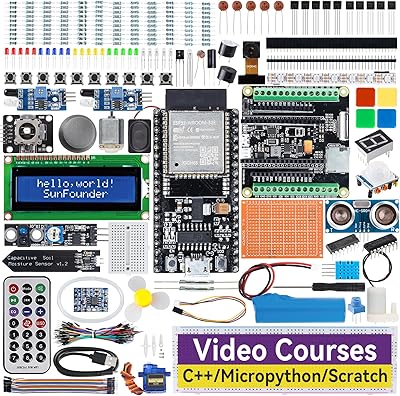
SunFounder ESP32 Ultimate Starter Kit
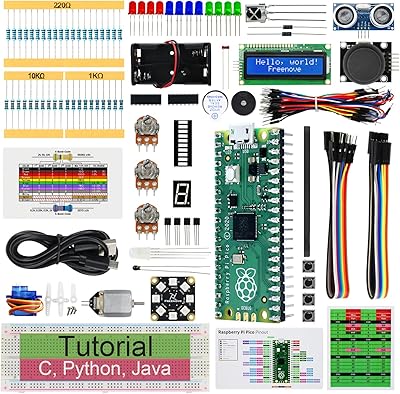
FREENOVE Super Starter Kit for Raspberry Pi Pico
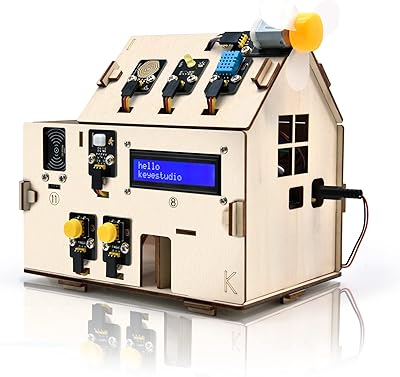
KEYESTUDIO ESP32 Smart Home Starter Kit
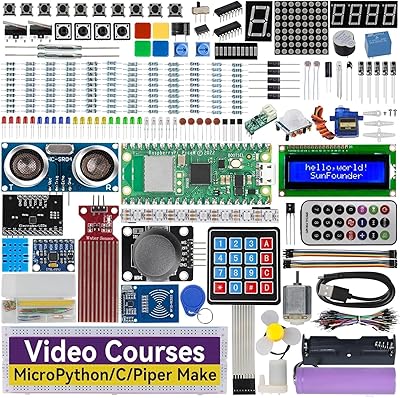
SunFounder Raspberry Pi Pico W Ultimate Starter Kit

Acure Brightening Starter Kit Skincare Set

VOFEL BB Glow 12-Vial Microneedling Serum Kit

Saie SaieGlow Starter 3-Piece Makeup Kit
Baseus N1 2-Cam Kit Wireless Security Camera
MakarttPro Acrylic Starter Kit for Beginners