Overview

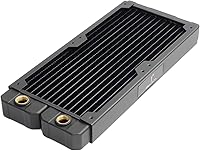
The Dracaena Osprey 240mm Liquid Cooling Radiator is a copper-fin standalone radiator aimed at custom loop builders who want solid thermal hardware without paying flagship prices. Unlike an AIO, this is a bare component — you supply the pump, reservoir, fittings, and fans yourself, which means it attracts a specific kind of builder. The 28mm thickness is worth noting upfront: thick enough to handle reasonable static pressure from standard 120mm fans, but not so bulky that it fights you inside a mid-tower. The matte black oxidation finish looks sharp in dark builds and offers a degree of corrosion resistance. Dracaena is not a household name in cooling circles, but that is not automatically a dealbreaker.
Features & Benefits

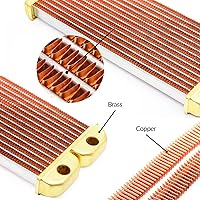
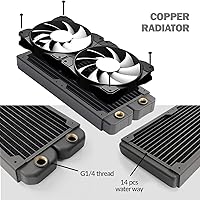
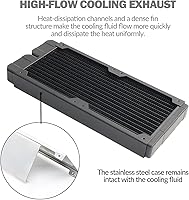
The internal construction leans on copper tubes and brass — fourteen tubes running through a brass water chamber. That combination resists corrosion better than aluminum alternatives and transfers heat efficiently over time. At 28mm thick, this custom loop radiator occupies a practical middle ground: slim radiators around 20mm struggle with dense fin stacks and demand high static pressure fans, while 45mm-plus options often will not clear standard case mounts. Here, a decent mid-range fan does the job. Both ports are G1/4 threaded, the near-universal standard in custom water cooling, so there are no adapter headaches. Fin density is balanced enough that you are not locked into loud, aggressive fans to move air through it.

Best For

This copper radiator makes the most sense for builders putting together their first custom loop on a budget that does not stretch to Alphacool or Hardware Labs territory. If you are cooling a single CPU — not a GPU-inclusive loop — the 240mm surface area is genuinely sufficient for most mainstream processors under typical loads. The all-black finish also makes it a natural fit for builders going for a blacked-out interior. If you already own G1/4 fittings and a pair of 120mm fans, dropping this in is relatively painless. Where it starts to fall short is high-TDP applications or multi-component loops where more radiator surface area and a more established brand name really matter.

User Feedback

Buyers who have picked up the Osprey 240mm tend to land in one of two camps. Those who come in with realistic expectations — a budget custom loop cooler with solid material choices — generally report that thermals hold up fine for single-CPU setups, and the G1/4 threads feel well-machined with no stripping issues reported. Packaging draws some mild criticism for being minimal, and a few users note it ships without fittings or fans, which can catch first-timers off guard. The bigger recurring concern is brand trust: with a lesser-known name handling coolant under pressure, some buyers pressure-tested the unit thoroughly before committing. No widespread leak reports exist, but that hesitation is understandable and worth factoring into your decision.

Pros

  • Copper tube and brass chamber construction resists corrosion better than aluminum alternatives over time.
  • The 28mm thickness works with standard mid-range 120mm fans without demanding noisy, high-static-pressure models.
  • Dual G1/4 threaded ports are machined cleanly and compatible with virtually every fitting on the market.
  • The matte black finish looks genuinely sharp in dark builds and does not attract fingerprints the way glossy coatings do.
  • At under 1.4 pounds, mounting stress on case radiator brackets stays manageable even in side-panel configurations.
  • Fin density is balanced well enough that builders can prioritize quiet fan operation without sacrificing reasonable thermals.
  • The standard 240mm footprint fits most mid-tower and full-tower cases without bracket modifications or adapters.
  • Buyers who pressure-tested the unit before filling reported no leaks at port connections under normal loop pressures.
  • For a CPU-only loop on a moderate build budget, this custom loop radiator delivers a spec sheet that punches above its price tier.

Cons

  • No mounting screws or port plugs are included, which can stall a first-time builder mid-assembly.
  • Brand track record is thin, which is a real concern for a component that holds coolant near expensive hardware.
  • Thermal headroom is limited for high-TDP processors running sustained all-core workloads.
  • Low-static-pressure fans paired with this radiator produce a noticeable drop in cooling efficiency.
  • Cosmetic fin imperfections have been reported on a subset of units, suggesting quality control is not fully consistent.
  • Long-term internal corrosion data is limited given how recently this brand entered the market.
  • The packaging is minimal and offers little protection beyond basic shipping safety — not confidence-inspiring for a precision component.
  • Compact cases with tight front-panel clearance may struggle to fit the 28mm depth without careful pre-purchase measurement.
  • No after-sales support infrastructure comparable to established cooling brands if something goes wrong post-installation.

Ratings

The Dracaena Osprey 240mm Liquid Cooling Radiator has been evaluated by our AI system after analyzing verified purchase reviews from buyers worldwide, with spam, bot-submitted, and incentivized feedback actively filtered out. Scores reflect the honest consensus of real custom loop builders — from first-timers to experienced enthusiasts — and are calibrated to surface both where this copper radiator genuinely delivers and where it falls short. No category has been glossed over in the interest of fairness.
Thermal Performance
78%
22%
For single-CPU cooling loops, buyers consistently report that this custom loop radiator holds temperatures in a competitive range when paired with decent 120mm fans. The copper tube and brass chamber combination transfers heat efficiently, and most users found it handled sustained workloads without throttling issues.
Results vary noticeably depending on fan selection and coolant type, and a handful of users running higher-TDP processors found the 240mm surface area left little thermal headroom. It is not a radiator that forgives a poorly optimized loop.
Build Quality
83%
The copper fin construction feels solid in hand, and the brass water chamber gives the unit a reassuring density that cheaper aluminum radiators simply do not match. Most buyers noted that welds and seams looked clean on inspection, with no obvious manufacturing defects out of the box.
A small but consistent group of buyers flagged that the fin array showed minor cosmetic imperfections on arrival, and the overall finish — while functional — does not feel as refined as radiators from more established brands at a similar price point.
Port & Fitting Quality
81%
19%
The dual G1/4 threaded ports are machined to a standard that impressed most custom loop builders, with fittings threading in smoothly and seating without play. Users who pressure-tested the unit before filling reported no leaks at the port connections under normal loop pressures.
A few buyers noted that the threads felt marginally shallower than on premium-brand radiators, which raised concern during initial installation. While no widespread leak incidents were reported, this is a component where confidence in the machining matters enormously.
Case Compatibility
86%
The standard 240mm footprint and 28mm thickness hit a practical balance for mid-tower and full-tower cases, and most builders reported it dropped in without requiring bracket modifications or fan spacers. The weight at just under 1.4 pounds also keeps mounting stress on case radiator mounts manageable.
The 28mm depth, while versatile, can be tight in compact cases with front-mounted radiator bays that have limited clearance behind the front panel. Builders in smaller cases should measure carefully before ordering.
Fan Compatibility
84%
The fin density is tuned well enough that standard medium-static-pressure 120mm fans move air through it effectively without needing to run at maximum RPM. Buyers using popular fans in the 1200 to 1800 RPM range reported a good balance of cooling and noise levels.
Users who paired this radiator with very low-static-pressure fans — particularly large-frame fans optimized for high airflow over open grilles — found cooling performance dropped off more than expected. The fin stack does require at least moderate static pressure to work properly.
Corrosion Resistance
72%
28%
The black oxidation coating over copper fins offers a meaningful layer of protection against surface corrosion, and the all-copper and brass internal construction avoids the galvanic corrosion risks that come with mixed-metal loops involving aluminum. Buyers using proper coolant additives reported no signs of degradation after extended use.
Long-term corrosion data for this brand is limited given its relatively short market presence, and some users expressed uncertainty about internal tube longevity when using distilled water without corrosion inhibitors. This is not a concern unique to this radiator, but the brand offers less reassurance than an established name would.
Aesthetics
88%
The matte black oxidation finish is one of the more consistently praised aspects of this radiator among buyers building dark-themed systems. It blends cleanly with black fittings, dark tubing, and tinted reservoirs without the glossy plasticky look some cheaper black-coated radiators carry.
The finish is uniform and understated, which is a strength for minimalist builds but leaves enthusiasts who want logo-branded or RGB-compatible radiator options with nothing to work with. There is no visual flair beyond the flat black surface.
Value for Money
82%
18%
Relative to what you get — copper tubes, brass chamber, G1/4 ports, and a solid 28mm thickness — the price sits at a point where it undercuts several well-known brands without obviously cutting corners on the internals that matter. First-time custom loop builders in particular found it an approachable entry point.
The value calculus gets murkier when you factor in brand uncertainty for a leak-sensitive application. Some buyers felt the small price delta between this radiator and a known brand was worth closing, particularly for builds housing expensive hardware.
Packaging & Unboxing
61%
39%
The radiator itself arrives protected adequately for standard shipping conditions, and most buyers reported it reached them without physical damage to the fins or ports. The packaging is functional and gets the unit to you intact.
Multiple buyers flagged that the packaging is quite bare — no port plugs, no mounting screws, and minimal protective foam compared to competitors. First-time builders expecting a more complete unboxing experience were caught off guard by how stripped-back the box contents are.
Included Accessories
47%
53%
The radiator core itself is what you are paying for, and it arrives ready to accept G1/4 fittings without needing any preparation beyond flushing. For experienced builders who already own a hardware kit, the minimal inclusions are a non-issue.
There are no mounting screws, port plugs, or fan hardware included, which is a real gap for first-time builders who may not yet have a spare hardware collection. Compared to radiators that bundle at least basic mounting hardware, this feels notably light on extras.
Brand Reliability
63%
37%
Users who committed to the purchase and completed their builds reported no systemic reliability failures, and the unit functions as described with no documented widespread defect patterns. For builders willing to pressure-test and validate before filling, real-world reliability appears reasonable.
Dracaena has a thin track record compared to brands like Alphacool, Hardware Labs, or EK, and that absence of long-term reputation data is a genuine concern when choosing a component that holds coolant under pressure near expensive hardware. Buyer confidence is lower than the construction specs alone would suggest.
Noise Impact
76%
24%
Because the fin density does not demand ultra-high static pressure fans, builders who prioritized quiet setups found they could run fans at moderate speeds and still maintain reasonable thermals. This radiator does not force you into a loud loop to make it work.
The radiator itself introduces no noise, but users who underestimated the fan requirements and under-specced their fan speed reported that temperatures crept up, forcing them to increase RPM and noise levels more than anticipated. Loop tuning matters here.
Installation Ease
79%
21%
The G1/4 ports are positioned sensibly, and the standard 240mm bolt pattern means no guesswork with case compatibility for builders familiar with the format. Most reviewers completed installation without consulting additional guides beyond their case manual.
The lack of included mounting screws means builders must source their own M3 hardware, which can stall a build unexpectedly. First-time custom loop builders unfamiliar with radiator mounting conventions may find the process less intuitive than anticipated.

Suitable for:

The Dracaena Osprey 240mm Liquid Cooling Radiator is a strong fit for builders putting together their first custom water cooling loop who want copper internals and a proper G1/4 fitting standard without stretching their budget to cover a premium brand. If your loop is CPU-only and your processor sits in the mainstream performance tier — not a high-core-count workstation chip running sustained all-core loads — the 240mm surface area and 28mm thickness give you enough thermal capacity to work with comfortably. Builders going for a blacked-out interior aesthetic will also find the matte black oxidation finish a natural match for dark tubing, black fittings, and tinted side panels. Anyone who already has a pair of 120mm fans and a set of G1/4 fittings on hand will find this copper radiator drops into an existing parts collection without friction. It suits the patient, methodical builder who pressure-tests their loop before filling and understands that performance depends heavily on their fan selection, coolant type, and overall loop configuration — not the radiator alone.
Not suitable for:

The Dracaena Osprey 240mm Liquid Cooling Radiator is the wrong choice if your loop needs to dissipate heat from both a CPU and a discrete GPU, where a 240mm surface area simply runs out of headroom under combined thermal loads. Builders running high-TDP processors — flagship desktop chips or workstation-class hardware that routinely pushes 200W or more — should look at a 360mm radiator or a thicker 45mm-plus 240mm unit from a brand with a longer reliability record. If you are not comfortable pressure-testing a custom loop before filling, or if you plan to skip corrosion inhibitors and run plain distilled water, the uncertainty around long-term internal tube longevity with a lesser-known brand becomes a more meaningful risk. Builders who expect mounting screws, port plugs, or any supplementary hardware in the box will be disappointed — this ships as a bare radiator, full stop. And if brand confidence and long-term after-sales support are non-negotiable factors for a component holding coolant near expensive hardware, the thin track record here is a legitimate reason to spend a little more elsewhere.

Specifications

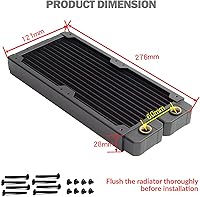
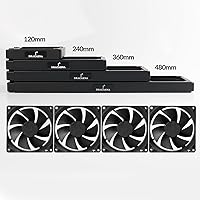
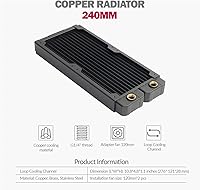
  • Radiator Size: The radiator uses a standard 240mm format, designed to mount two 120mm fans side by side.
  • Thickness: At 28mm thick, the unit sits between slim 20mm and ultra-thick 45mm radiators, offering a practical balance for most case configurations.
  • Tube Count: Fourteen internal copper tubes carry coolant through the radiator core, distributing heat across the fin array.
  • Tube Material: Internal tubes are constructed from copper, chosen for its superior thermal conductivity and long-term corrosion resistance compared to aluminum.
  • Water Chamber: The water inlet and outlet chambers are made from brass, a material that pairs well with copper to minimize galvanic corrosion risk in a mixed-metal loop.
  • Port Threading: Both coolant ports are threaded to the G1/4 standard, which is compatible with the vast majority of custom loop fittings available on the market.
  • Port Configuration: The radiator features dual G1/4 ports, one for coolant inlet and one for outlet, positioned to allow flexible loop routing.
  • Fin Coating: External fins are treated with a black oxidation coating that provides a layer of surface corrosion resistance alongside a matte aesthetic finish.
  • Surface Finish: The overall exterior finish is matte black, achieved through the oxidation treatment applied to the fin stack and outer casing.
  • Fan Compatibility: The radiator accepts two standard 120mm fans, mountable on either face of the unit depending on the desired push, pull, or push-pull configuration.
  • Item Weight: The assembled radiator weighs 1.39 pounds, keeping mounting stress on case brackets within a manageable range.
  • Form Factor: The dual 120mm mount format fits standard radiator bays found in most mid-tower and full-tower ATX cases without modification.
  • Model Number: The official model identifier for this radiator is Osprey-Radiator-240, as designated by the manufacturer Dracaena.
  • Brand: This radiator is manufactured by Dracaena, also listed under the greenDracaena brand name on some retail listings.
  • Coolant Flow: Coolant enters and exits through dedicated inlet and outlet ports, with the internal tube layout designed to distribute flow evenly across all fourteen tubes.
  • Fin Density: The fin stack is optimized for use with fans producing moderate static pressure, meaning high-RPM ultra-pressure fans are not required to achieve adequate airflow through the core.

Related Reviews
DIYhz 240mm Aluminum Water Cooling Radiator
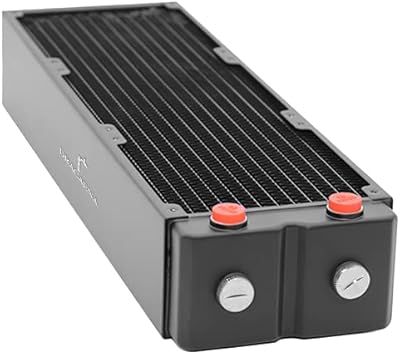
76%
88%
Value for Money
71%
Thermal Performance
79%
Build Quality
74%
Fitment & Compatibility
58%
Tube Barb Quality
More
Dracaena.io Osprey 360mm 64mm Copper Radiator
84%
91%
Cooling Performance
88%
Build Quality & Durability
85%
Ease of Installation
80%
Noise Levels
87%
Design & Aesthetics
More
Dracaena.io 360mm Copper Water Cooling Radiator
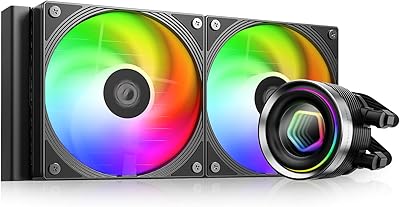
86%
94%
Cooling Performance
91%
Build Quality
85%
Ease of Installation
88%
Aesthetics
89%
Durability
More
ID-COOLING FX240 INF 240mm AIO Liquid Cooler
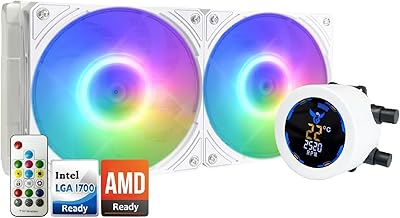
81%
83%
Thermal Performance
81%
Noise Level
91%
Design & Aesthetics
72%
ARGB & Lighting Control
78%
Build Quality & Materials
More
Osprey 240mm AIO CPU Cooler
86%
91%
Cooling Performance
87%
Noise Level
88%
ARGB Lighting Customization
75%
Installation Ease
82%
Software/CSM Utility App
More
ID-COOLING SL240 CPU Liquid Cooler
88%
91%
Cooling Performance
93%
Noise Level
88%
Customization Options (LCD & RGB)
84%
Installation Ease
89%
Build Quality
More
Redragon HL360 AIO CPU Liquid Cooler
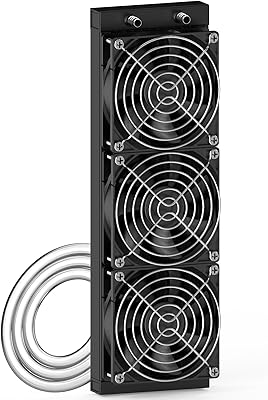
78%
76%
Cooling Performance
69%
Pump Noise
93%
RGB & Aesthetics
88%
Installation & Setup
78%
Fan Performance
More
Clyxgs 360mm Aluminum Water Cooling Radiator
72%
71%
Thermal Performance
78%
Build Quality
63%
Fan Noise Level
74%
Compatibility & Fit
83%
Value for Money
More
ID-COOLING FX240 PRO 240mm AIO CPU Cooler
78%
83%
Thermal Performance
67%
Pump Noise & Vibration
78%
Fan Performance & Noise
74%
Build Quality & Materials
86%
Installation Ease
More
Thermaltake Pacific C360 Copper Radiator
81%
93%
Build Quality
84%
Thermal Performance
91%
Leak Resistance
67%
Fan Compatibility
78%
Value for Money
More

FAQ

No, it ships as a bare radiator only. There are no mounting screws, port plugs, or fan hardware included. You will need to source M3 screws separately, which is worth planning for before your build day.

Yes, both ports are threaded to the G1/4 standard, which is the near-universal thread spec used across custom loop fittings from brands like Barrow, Bitspower, EK, and Alphacool. You should not need any adapters.

It is not recommended for a combined CPU and GPU loop. The 240mm surface area is sized for single-component CPU cooling, and adding a GPU to the same loop will push heat load beyond what this radiator can comfortably handle.

You do not need extreme static pressure fans for this unit. The fin density is moderate enough that fans in the 1.5 to 2.5 mmH2O static pressure range work well. Fans like the be quiet! Silent Wings or Noctua NF-A12x25 are commonly paired with radiators in this thickness class.

It is a fair concern, and one worth taking seriously since coolant near expensive hardware is no trivial matter. The advice most experienced builders would give is the same regardless of brand: always pressure-test your completed loop for at least 30 minutes before adding coolant and powering on. No widespread leak failures have been reported for this radiator, but that testing step should never be skipped.

In most cases, yes. The 240mm footprint and 28mm thickness are within the clearance specs of the majority of popular mid-tower cases. That said, some compact cases with dense front panel structures can have tight clearance behind the fan mount, so it is worth checking your case specifications against the 28mm depth before ordering.

Because the internal construction is copper and brass, you should use a coolant that is compatible with those metals and avoid anything formulated for aluminum-only loops. Distilled water with a dedicated corrosion inhibitor or a pre-mixed coolant from a reputable brand like Mayhems or EK CryoFuel is the standard recommendation. Plain tap water should never be used in any custom loop.

Yes, the radiator supports fan mounting on both faces, so a push-pull configuration using four 120mm fans total is entirely feasible. Push-pull generally improves thermal performance by 5 to 10 percent compared to a single-fan-side setup, which can be worthwhile if you have the case clearance and fan budget for it.

In CPU-only loops with a well-matched fan, real-world users report thermal performance that is competitive for the price tier — not leading the field, but not embarrassing itself either. The gap versus premium radiators from Hardware Labs or Alphacool becomes more apparent at higher heat loads and with more demanding fan configurations. For a moderate-TDP CPU, the difference in practice is often smaller than the spec sheets suggest.

The black oxidation finish is more durable than a painted or powder-coated surface, since it is a chemical treatment applied to the metal itself rather than a coating sitting on top of it. That said, sharp metal edges during installation can still scratch the fin array, so handling it carefully during mounting is worth the effort.