Overview

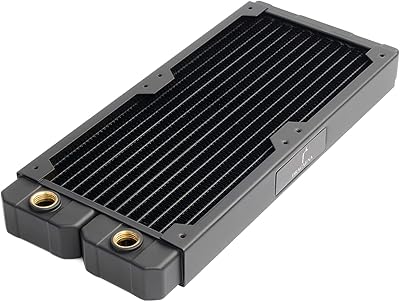
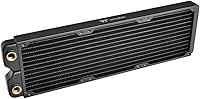
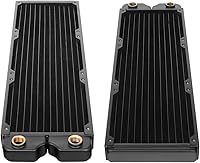
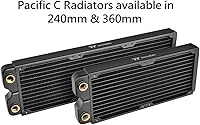
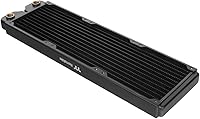
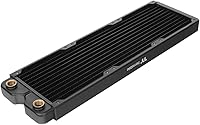
The Thermaltake Pacific C360 Copper Radiator sits comfortably in the mid-range of the custom liquid cooling market, offering full copper construction at a price point that won't require a second mortgage. Launched in early 2019, it has built a quiet but solid reputation among DIY builders who want something more durable than a budget aluminum rad without going full exotic. Pick it up and the first thing you notice is the heft — the brass tank and stainless steel panels give it a dense, reassuring feel. This copper radiator isn't trying to be flashy; it's built to do a job reliably for years.

Features & Benefits

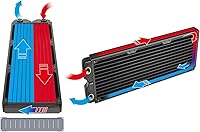
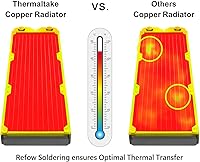
At 27mm thick with a single-row, 12-set flat tube layout, the Pacific C360 packs a meaningful amount of cooling surface into a relatively slim profile. The 14 fins per inch density sits on the higher end, which translates to better heat rejection when paired with the right fans. What really sets it apart from cheaper options is the reflow soldering process, carried out at 250°C, creating tight, consistent joints throughout the core. That matters for long-term reliability in a pressurized loop. The brass tank handles corrosion well in copper-based systems, and the stainless side panels keep overall weight surprisingly manageable at under two pounds.

Best For

This 360mm rad is a natural fit for builders running high-TDP processors or power-hungry GPUs who need serious cooling headroom in a single or dual-loop setup. It's also a smart choice for anyone assembling an all-copper loop — using copper fittings, CPU block, and GPU block — since mixed metals in a loop can trigger galvanic corrosion over time, degrading performance and shortening component life. If you've been running an AIO and are ready to step into custom cooling, this is a strong starting point. Just confirm your case can accommodate a 360mm mount at the top, front, or externally.

User Feedback

With a 4.6-star rating across more than 400 reviews, the Pacific C360 earns consistent praise for build quality and solid thermal performance at low-to-moderate fan speeds. Buyers regularly call out the clean finish and standard G1/4 threading, which plays nicely with virtually any fitting on the market. The most recurring concern is fan pairing — the tight fin spacing genuinely demands high-static-pressure fans to perform well at lower RPMs, so reaching for airflow-style fans will leave results underwhelming. A few users also flag the weight in lighter chassis builds. Long-term owners, though, consistently report zero leaks and no performance drop over time, which speaks volumes.

Pros

  • Full copper fin and tube construction offers better long-term corrosion resistance than aluminum alternatives.
  • Reflow soldering at high temperature produces consistent, reliable joints that hold up under sustained loop pressure.
  • The brass tank pairs naturally with copper fittings and blocks, keeping your loop metallurgically compatible.
  • Standard G1/4 threaded ports fit virtually every fitting and pump-top on the DIY cooling market.
  • Build quality feels genuinely solid — stainless steel side panels add rigidity without adding excessive weight.
  • Thermal performance at moderate-to-high fan speeds is strong enough for high-TDP CPU and GPU cooling.
  • At under two pounds, the Pacific C360 is manageable to mount without needing a second pair of hands.
  • Long-term owners consistently report no leaks and no degradation in cooling performance over extended use.
  • The 2-year warranty provides reasonable peace of mind for a component sitting inside a pressurized loop.
  • A 4.6-star average across hundreds of real buyers reflects genuinely broad and sustained satisfaction.

Cons

  • Tight fin spacing demands high-static-pressure fans — standard airflow fans will noticeably underperform at lower RPMs.
  • Costs more than comparable aluminum radiators, which matters if you're building on a strict budget.
  • Cannot be used in mixed-metal loops with aluminum components without risking accelerated corrosion over time.
  • Only compatible with cases that support a full 360mm mounting location, which rules out many smaller builds.
  • No fans are included, meaning additional purchase cost and compatibility research is required out of the box.
  • The dense copper core means slightly slower warm-up response compared to thinner or lower-density radiators.
  • Sourcing replacement parts or warranty service outside major markets may require going through Thermaltake directly.
  • At 27mm thickness, case clearance needs to be measured carefully before assuming it will fit flush.

Ratings

The scores below reflect our AI-driven analysis of verified global buyer reviews for the Thermaltake Pacific C360 Copper Radiator, with spam, incentivized feedback, and bot activity actively filtered out before any score was calculated. Every category captures what real builders experienced after installing this rad in their custom loops — not what the spec sheet promises. Both the genuine strengths and the frustrating trade-offs are represented here without sugarcoating.

Build Quality
93%
Buyers across multiple markets consistently describe the physical construction as one of the strongest points of this rad. The copper core feels dense and well-finished, the brass tank shows no signs of cheap casting, and the stainless steel side panels add a structural solidity that budget aluminum alternatives simply don't match. Long-term owners report no warping, corrosion, or physical degradation even after years of continuous loop operation.
A small number of buyers noted minor cosmetic imperfections on the fin array out of the box — nothing that affects performance, but noticeable to detail-oriented builders doing showcase builds. At this price tier, a few users expected tighter quality control on surface finishing.
Thermal Performance
84%
Under real-world conditions with properly matched high-static-pressure fans, buyers running high-TDP CPUs report comfortable thermals even during extended workloads or gaming sessions. The dense copper fin array and flat tube design distribute heat evenly across the core, and the performance holds up well at moderate fan speeds when airflow is optimized.
Results vary considerably depending on fan selection, and buyers who paired this rad with standard airflow fans were noticeably underwhelmed. Without explicit guidance on fan pairing at purchase, some first-time custom loop builders found themselves troubleshooting subpar temperatures before identifying the fan type as the culprit.
Leak Resistance
91%
The reflow soldering process used throughout the core appears to genuinely deliver on its promise — long-term owners across multiple review platforms report zero leaks after one, two, and even three-plus years of continuous pressurized loop use. This is one of the most consistently praised aspects of the Pacific C360 among experienced builders who have compared it to cheaper alternatives.
A very small number of early units reportedly arrived with minor surface oxidation near the port threads, which raised concerns about sealing integrity during initial installation. These appear to be isolated manufacturing variance issues rather than a systemic design flaw, but they were noteworthy enough to flag.
Fan Compatibility
67%
33%
The G1/4-standard ports and 120mm fan spacing work with virtually every fitting and fan on the market, giving builders complete freedom to choose their preferred components. Buyers using Noctua NF-F12s, Be Quiet! Silent Wings Pro, or similar static-pressure-optimized fans report excellent compatibility and strong thermal results.
The 14 fins-per-inch density creates a real barrier for builders who don't already know to seek out high-static-pressure fans specifically. This is not a rad that forgives lazy fan selection, and it trips up first-time loop builders frequently enough to be a recurring complaint in negative reviews.
Value for Money
78%
22%
For builders committed to an all-copper loop, the price premium over aluminum radiators makes practical sense — copper lasts longer, resists corrosion better in compatible loops, and maintains thermal performance more consistently over time. Most buyers who understood the copper premium going in rated the value as fair to strong for what they received.
Buyers comparing it purely on upfront cost against aluminum alternatives felt the price gap was harder to justify without a long-term perspective. For someone building a budget loop with no plans to run it for years, the additional spend on copper construction may not translate to a noticeable short-term benefit.
Installation Ease
74%
26%
The chassis-mount design and standard 360mm dimensions mean it drops into compatible cases without any unusual modifications or adapter hardware. Experienced builders generally found the installation process straightforward, and the G1/4 ports align sensibly for tube routing in most mid-tower and full-tower configurations.
Case clearance is tighter than some buyers anticipated, particularly when adding fan thickness to the 27mm radiator body. A handful of reviewers noted that tube routing near the ports required more planning than expected, especially in cases with limited internal space around the top or front mounting zone.
Corrosion Resistance
89%
The all-copper fin and tube construction paired with a brass tank is genuinely well-suited for long-term closed-loop use when matched with the right coolant chemistry. Builders who maintained proper inhibitor levels and avoided mixed-metal setups reported clean, clear coolant even after extended periods between fluid changes.
The corrosion resistance story falls apart entirely if aluminum components are introduced into the loop — galvanic corrosion sets in and the damage is cumulative and irreversible. This is a well-known risk in the enthusiast community, but the product packaging and listing do not make the incompatibility prominent enough for newer builders.
Fin Array Quality
82%
18%
The copper fin array is dense and uniformly constructed, with no significant variation in spacing or fin alignment reported by the majority of buyers. At 14 FPI, the heat rejection surface area is genuinely high, which contributes to the solid thermal results seen when airflow is properly matched.
A few buyers reported minor fin damage on arrival from shipping compression, which is an occupational hazard for high-density fin arrays packed without rigid internal supports. Bent fins near the edges are cosmetically frustrating and, while rarely impactful on overall performance, are annoying on a product at this price point.
Noise Profile
72%
28%
Because this rad transfers heat efficiently at moderate fan speeds when paired correctly, many buyers report being able to run their loops at low-to-mid RPMs without thermal compromise, resulting in a quiet system under typical workloads. The radiator itself contributes no vibration or fluid noise at normal operating pressures.
Achieving quiet operation requires getting the fan pairing right first, and builders using the wrong fan type end up cranking RPMs to compensate — which defeats the point. The rad itself has no noise-dampening features, so fan choice and mounting isolation are entirely the builder's responsibility.
Compatibility
86%
Standard 360mm dimensions, G1/4 threaded ports, and chassis-mount design make this rad compatible with a wide range of cases and nearly every fitting or pump-top on the DIY cooling market. Builders integrating it into Thermaltake Pacific ecosystems find it particularly cohesive, but it works equally well with components from other brands.
The 360mm form factor inherently excludes a meaningful portion of potential buyers whose cases only support 240mm or 280mm radiator mounts. There is no smaller variant included or suggested in the product listing, which leaves some buyers discovering the incompatibility only after purchase.
Finish & Aesthetics
77%
23%
The clean copper and stainless exterior gives this rad a purposeful, industrial aesthetic that fits well in windowed builds where the radiator is partially visible. Buyers running tubing with good contrast against the copper tones frequently highlight the visual appeal in their build logs and reviews.
There is no RGB integration or lighting compatibility, which is increasingly expected in the enthusiast segment at this price tier. Builders prioritizing a highly visual or themed build may find the understated appearance less exciting than competing products with addressable lighting or more polished cosmetic options.
Port Accessibility
83%
Both inlet and outlet ports are positioned in practical locations that accommodate straight, angled, and rotary fittings without forcing awkward tube bends. The G1/4 threads are clean and consistent, engaging fittings smoothly without excessive thread engagement force or cross-threading risk.
In tight case configurations, the port positioning on the end cap can make initial fitting installation slightly cramped, particularly when using rigid tubing with minimal flex. A couple of reviewers noted they had to plan tube routing more carefully than expected to avoid stress on the end-cap area.
Warranty & Support
71%
29%
The 2-year warranty provides reasonable coverage for a pressurized loop component, and Thermaltake has a functional support infrastructure for warranty claims in major markets. Buyers who have dealt with warranty issues generally describe the resolution process as adequate rather than exceptional.
Outside of North America and Western Europe, warranty service access can be inconsistent, with some international buyers reporting slow response times or difficulty getting replacement units processed. For a component as central to a custom loop as a radiator, buyers in smaller markets may want to factor this in before purchasing.

Suitable for:

The Thermaltake Pacific C360 Copper Radiator is purpose-built for PC enthusiasts who are serious about custom liquid cooling and want a radiator that will hold up for years rather than just a season or two. It makes the most sense in an all-copper or copper-and-brass loop, where matching metals keeps galvanic corrosion out of the equation entirely. Builders cooling high-TDP processors or power-hungry graphics cards will appreciate the genuine headroom this 360mm rad provides, particularly when paired with high-static-pressure fans that can push through the dense fin array. It's also a smart pick for anyone transitioning away from an all-in-one cooler who wants to step into a proper custom loop without immediately jumping to the most expensive options on the market. If your case supports a 360mm mount — top, front, or external — and you're planning a build meant to run reliably for three to five years or more, this copper radiator is genuinely well-suited to that goal.

Not suitable for:

The Thermaltake Pacific C360 Copper Radiator is not the right call for builders on a tight budget who just need functional cooling at the lowest possible cost — there are aluminum radiators that cost noticeably less and perform reasonably well in the short term. It's also a poor fit for anyone running a mixed-metal loop with aluminum components, since copper and aluminum together in the same coolant circuit will accelerate corrosion and eventually cause real damage. Builders with cases that only support 240mm or 280mm radiator mounts simply can't use this one at all, so case compatibility needs to be confirmed before purchase. If you're pairing it with standard airflow-style fans rather than high-static-pressure models, you'll likely be disappointed by the thermal results at lower speeds. And if weight is a concern in a small form-factor or lightweight panel build, the dense copper construction adds up — it's not a heavy radiator by enthusiast standards, but it's not featherlight either.

Specifications

  • Radiator Size: This is a full 360mm radiator designed to accommodate three 120mm fans in a standard side-by-side configuration.
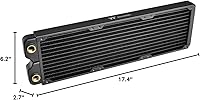
  • Dimensions: The radiator measures 17.4″ in length, 6.2″ in width, and 2.7″ in height, making case clearance planning essential before installation.
  • Thickness: At 27mm thick, the core sits in a slim-to-mid profile range that balances thermal capacity with physical clearance inside most ATX and E-ATX cases.
  • Weight: The assembled unit weighs 1.63 pounds, which is typical for a copper-core radiator and requires secure mounting to avoid chassis stress over time.
  • Fin Material: All cooling fins are made from copper, which offers superior thermal conductivity and long-term corrosion resistance compared to aluminum alternatives.
  • Tube Material: The internal flow tubes are copper with a single-row, 12-set flat tube layout designed to maximize contact surface area with the fin array.
  • Tank Material: The inlet and outlet tanks are constructed from brass, a natural complement to copper in closed-loop systems where galvanic compatibility matters.
  • Side Panels: Outer side panels are made from stainless steel, adding structural rigidity and corrosion resistance while keeping overall weight relatively controlled.
  • Fin Density: The fin array is built at 14 fins per inch, which is on the denser end of the spectrum and calls for high-static-pressure fans for optimal airflow.
  • Soldering Method: All internal joints are produced using a reflow soldering process performed at 250°C, ensuring full-strength bonds throughout the core that resist cracking under sustained loop pressure.
  • Port Threading: Inlet and outlet ports use standard G1/4 threading, which is compatible with the overwhelming majority of fittings, pump tops, and adapters on the DIY cooling market.
  • Mounting Type: The radiator uses a chassis-mount design and is compatible with standard 360mm mounting positions including top, front, or external radiator mounts depending on case support.
  • Fan Compatibility: The radiator supports three 120mm fans and is optimized for high-static-pressure models given the 14 FPI fin density.
  • Warranty: Thermaltake covers this radiator with a 2-year manufacturer warranty against defects in materials and workmanship.
  • Model Number: The official model identifier is CL-W228-CU00BL-A, which should be referenced when contacting Thermaltake support or searching for compatible accessories.
  • Brand: Manufactured by Thermaltake, a Taiwan-based company with an established history in PC thermal management and liquid cooling components.
  • Date Launched: This radiator was first made available in March 2019 and has maintained consistent availability and buyer interest since its release.
  • Market Ranking: As of available data, it holds a position of approximately #260 in the Water Cooling Systems category on Amazon, reflecting steady demand within a competitive segment.

Related Reviews
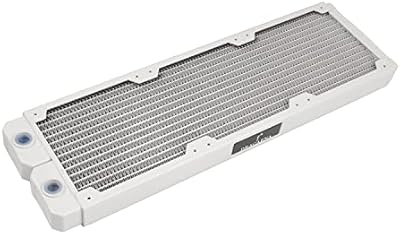
Dracaena.io 360mm Copper Water Cooling Radiator
86%
94%
Cooling Performance
91%
Build Quality
85%
Ease of Installation
88%
Aesthetics
89%
Durability
More
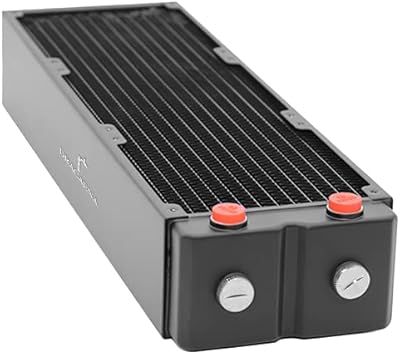
Dracaena.io Osprey 360mm 64mm Copper Radiator
84%
91%
Cooling Performance
88%
Build Quality & Durability
85%
Ease of Installation
80%
Noise Levels
87%
Design & Aesthetics
More
Dracaena Osprey 240mm Liquid Cooling Radiator
75%
78%
Thermal Performance
83%
Build Quality
81%
Port & Fitting Quality
86%
Case Compatibility
84%
Fan Compatibility
More
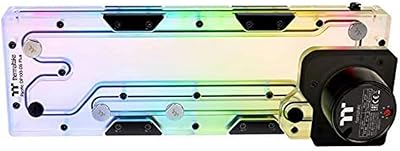
Thermaltake Pacific DP100-D5 Plus 360mm Reservoir Distro Plate Combo
84%
91%
Cooling Performance
88%
RGB Sync & Lighting
85%
Ease of Installation
93%
Build Quality & Durability
60%
Pump Noise at High Speeds
More
Thermaltake Pacific PR32-D5 Plus Pump/Reservoir Combo
80%
91%
Pump Performance
88%
Reservoir Capacity & Stability
93%
Rotary Cap & Port Flexibility
83%
Build Quality & Materials
86%
Installation & Mounting Options
More
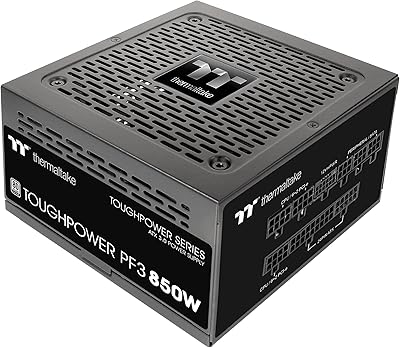
Thermaltake Toughpower PF3 850W
88%
94%
Energy Efficiency
88%
Build Quality
91%
Modular Cable Management
80%
Ease of Installation
93%
Compatibility with High-End GPUs
More
Thermaltake Toughpower GF3 1350W Power Supply
86%
93%
Power Delivery Stability
91%
Compatibility with RTX 40 Series
88%
Noise Level & Fan Behavior
92%
Build & Component Quality
86%
Cable Management & Modularity
More
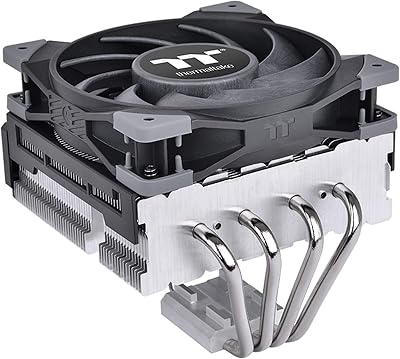
Thermaltake TOUGHAIR 510 CPU Air Cooler
80%
83%
Thermal Performance
78%
Noise Level
67%
Installation Experience
86%
RAM Clearance
81%
Build Quality & Materials
More
Thermaltake Toughpower GT 1000W PSU
87%
94%
Performance and Reliability
88%
Energy Efficiency
85%
Cooling and Noise Control
91%
Ease of Installation and Cable Management
92%
Build Quality and Durability
More
Happy Sol Copper Body Brush
87%
89%
Exfoliation Effectiveness
85%
Ease of Use
93%
Sustainability of Materials
82%
Lymphatic Drainage Results
88%
Skin Smoothness
More

FAQ

No, fans are not included. You will need to source three 120mm fans separately. Given the 14 fins-per-inch density, high-static-pressure models like the Noctua NF-F12 or Be Quiet! Silent Wings Pro are strongly recommended over standard airflow fans.

It is not recommended. Mixing copper, brass, and aluminum in the same loop creates conditions for galvanic corrosion, which degrades components and contaminates coolant over time. This rad is best used in an all-copper or copper-and-brass loop with compatible blocks and fittings.

Use a coolant specifically formulated for copper and brass systems, or distilled water with a corrosion inhibitor designed for copper loops. Avoid coolants marketed for mixed-metal or aluminum systems, as their inhibitor chemistry may not be compatible.

You need at least a 360mm mounting location with enough clearance for the 27mm radiator body plus fan thickness (typically 25mm) and any tube routing space behind it. Check your case manufacturer's specifications for top, front, or external 360mm mount support before purchasing.

Technically yes, but performance will likely disappoint you at lower RPMs. The tight 14 FPI fin spacing restricts airflow more than lower-density rads do, so fans with high static pressure ratings move air through the core far more effectively than high-CFM airflow designs.

The ports use standard G1/4 threading, which is the universal standard in DIY liquid cooling. Virtually every compression fitting, barb fitting, or plug from brands like Bitspower, Barrow, EK, and Thermaltake's own Pacific line will thread in without adapters.

At 27mm with a dense copper core, it handles high-TDP CPUs very well on its own. Running a combined CPU and GPU loop through a single 360mm rad is possible, but thermal headroom will shrink under sustained full load on both components. A second radiator in series is worth considering for demanding dual-component loops.

Flush the radiator with distilled water before connecting it to your loop to remove any manufacturing residue, metal shavings, or flux from the soldering process. Run distilled water through until the output runs completely clear, then drain fully before filling with your chosen coolant.

It adds some weight, yes. At 1.63 pounds the Pacific C360 is denser than a comparable aluminum unit, but it is not unmanageable. Just make sure your case mounting points are solid and use all available screw positions to distribute the load evenly, especially for top-mounted installations.

With proper coolant maintenance and metal-compatible fluid chemistry, copper radiators like this one can last well over five years without meaningful performance degradation. Long-term owners consistently report no leaks and stable cooling over extended periods, which reflects well on both the build quality and the reflow soldering process used in manufacturing.

Where to Buy