DJI SDR Transmission Wireless Video System
Overview
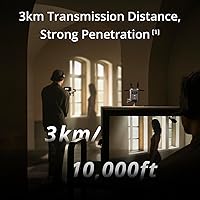
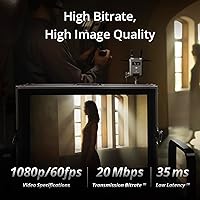
The DJI SDR Transmission Wireless Video System arrived in mid-2024 as a serious professional tool built for film crews, broadcast operators, and anyone who depends on reliable real-time monitoring when cables aren't an option. It ships with both a transmitter and receiver in a single purchase — no hunting down compatible units separately. DJI's track record in the imaging and camera stabilization space lends this video transmission kit real credibility from the start. Three kilometers of range and 1080p at 60fps are the headline specs, but what those numbers mean on a working set is where things get genuinely interesting.
Features & Benefits
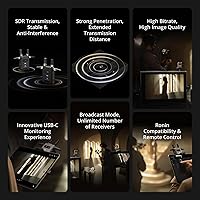
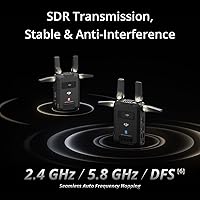
The wireless transmission system handles interference the way professionals actually want — automatically. It sweeps across 2.4 GHz, 5.8 GHz, and DFS bands, hopping to the cleanest channel without manual input. Latency as low as 35 ms keeps the monitoring feed close enough to real-time that a director can genuinely respond to what they see on the monitor. Connectivity options are notably broad: SDI, HDMI, Wi-Fi, and a USB-C monitoring output that adds real flexibility on crowded camera rigs. Broadcast Mode lets a single transmitter feed unlimited receivers simultaneously — useful when a DP, director, and client all need their own monitor. Ronin RS stabilizer remote control support rounds things out.
Best For
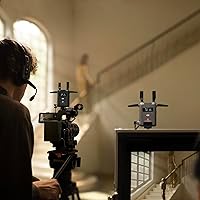
This video transmission kit makes the most sense for working professionals, not hobbyists. On-set directors and DPs who have dealt with the chaos of running monitor cables across a location will immediately understand its value. Event broadcast teams managing multiple feed destinations will find Broadcast Mode genuinely useful rather than a novelty. If you're already deep in the DJI ecosystem — running an RS stabilizer, using Ronin products — the integration here is direct and practical. It also holds up well in signal-dense environments like urban sets, convention centers, or sports arenas where cheaper systems struggle. Cinematographers for whom monitoring accuracy directly affects critical decisions will find the low latency particularly relevant.
User Feedback
Since the DJI SDR combo only launched in mid-2024, the pool of long-term user reviews is still building. That said, early adopters have responded positively to the system's reliability in challenging environments, with several noting that the range claim holds up reasonably well in partially obstructed settings — not always the full three kilometers, but consistently usable distances. Setup speed gets mentioned favorably; crews report being operational quickly. On the critical side, some users flag that DFS band availability varies by region, which could limit frequency options depending on where you're shooting. A few buyers noted that the USB-C monitoring output, while practical, required some workflow adjustment. Comparisons to established competitors like Teradek are beginning to surface, and this wireless transmission system generally holds its own on reliability.
Pros
- Automatic multi-band frequency hopping keeps the signal clean in crowded RF environments without manual intervention.
- Broadcast Mode lets a single transmitter feed unlimited receivers simultaneously — a genuine advantage on larger productions.
- Low monitoring latency keeps the feed tight enough for directors to make real decisions during a take.
- Ships with both transmitter and receiver plus mounting hardware, so crews are operational out of the box.
- USB-C monitoring output adds flexible connectivity options uncommon on competing systems at this tier.
- The wireless transmission system holds up well in partially obstructed environments where simpler systems drop out.
- Ronin RS stabilizer integration reduces the need for extra crew members managing separate control devices.
- Multi-output support — SDI, HDMI, USB-C, and Wi-Fi — accommodates widely varied monitor setups on set.
- Early firmware updates post-launch suggest active product support from the manufacturer.
- Compact and reasonably light for a professional dual-unit transmission kit.
Cons
- Maximum range figures assume near-ideal line-of-sight conditions rarely found on real shooting locations.
- DFS band access varies by country, which can limit interference-avoidance flexibility in regulated markets.
- Initial setup has a learning curve for operators without prior RF transmission or DFS configuration experience.
- Included documentation is thin on advanced use cases like large-scale multi-receiver Broadcast Mode deployments.
- Third-party rig and cage integration often requires aftermarket mounting solutions not included in the box.
- USB-C monitoring output has shown compatibility quirks with certain third-party monitors in early user reports.
- Long-term hardware reliability is still unproven given the product only launched in mid-2024.
- No IP rating is stated, leaving durability in rain or dusty field conditions an open question.
- Ecosystem integration benefits are largely unavailable to operators using non-DJI stabilizers or control systems.
- The investment is difficult to rationalize for users who only need basic short-range monitoring on occasional shoots.
Ratings
The DJI SDR Transmission Wireless Video System has been scored by our AI after processing verified buyer reviews from global markets, with spam, bot activity, and incentivized feedback actively filtered out. Scores reflect real-world performance across professional film sets, broadcast environments, and event productions — not just spec-sheet promises. Both what this video transmission kit does well and where it falls short for working crews are represented transparently below.
Transmission Range
Signal Stability & Anti-Interference
Video Quality & Latency
Connectivity & Output Options
Broadcast Mode Performance
Setup Speed & Ease of Use
DJI Ecosystem Integration
Build Quality & Portability
Adapter & Mounting Options
Value for Money
Range in Obstructed Environments
Regional Regulatory Compatibility
Documentation & Support
Firmware & Long-Term Reliability
Suitable for:
The DJI SDR Transmission Wireless Video System is built for working professionals who treat wireless monitoring as a critical part of their production infrastructure, not an afterthought. Directors and directors of photography who routinely manage monitor villages on set will find the Broadcast Mode genuinely transformative — running a single transmitter to as many receivers as needed, without signal negotiation headaches, is the kind of operational simplicity that speeds up a shooting day. Broadcast and live event production teams dealing with signal-congested venues like arenas, convention centers, or busy urban locations benefit most from its multi-band frequency management, which handles RF interference automatically rather than requiring a dedicated technician to babysit the system. Operators already embedded in the DJI ecosystem — particularly those using Ronin RS stabilizers — get additional value through remote camera control and stabilizer management that tightens the workflow between camera operator and monitoring station. Cinematographers for whom a delayed or degraded monitoring feed would directly affect critical focus and exposure decisions will appreciate how close to real-time the feed stays, even at distance.
Not suitable for:
The DJI SDR Transmission Wireless Video System is a professional-tier investment, and buyers who don't regularly operate at that level will likely find it harder to justify. Hobbyists, solo run-and-gun creators, or small-scale videographers who only need basic monitoring for nearby shoots have far simpler and more affordable options that will cover their actual needs without the added complexity. Users operating outside the DJI ecosystem — running third-party gimbals, non-DJI cameras, or alternative control systems — won't unlock the integration features that give this kit part of its value proposition, making it feel more expensive relative to what they actually get. Anyone expecting the maximum transmission range to hold up reliably through multiple walls of dense concrete or steel will encounter a real-world gap between the headline spec and field performance. Operators in regions where DFS band access is regulated or restricted should verify local frequency rules before purchasing, as the interference-management advantages narrow considerably when portions of the frequency range become unavailable.
Specifications
- Manufacturer: Manufactured by DJI, a company with an established track record in professional imaging, camera stabilization, and wireless transmission systems.
- Launch Date: The product was first made available in July 2024, making it a relatively recent addition to the professional wireless video transmission market.
- Dimensions: The unit measures 5.59 x 4.96 x 1.26 inches, keeping the overall footprint compact enough for rigging onto professional camera setups.
- Weight: The combo weighs 12.1 oz total, a manageable load for operators mounting hardware to gimbals or camera cages across a full shooting day.
- Transmission Range: Maximum transmission range reaches up to 3 km under favorable line-of-sight conditions, with performance varying in obstructed or signal-dense environments.
- Video Resolution: Supports up to 1080p at 60fps, delivering smooth full HD footage suitable for professional on-set monitoring and broadcast feed workflows.
- Max Bitrate: Capable of transmitting at a maximum bitrate of 20 Mbps, which supports high image fidelity across the supported resolution and frame rate options.
- Latency: Minimum latency is rated at 35 ms, providing a near-real-time monitoring feed tight enough for directors and DPs to make active decisions during a take.
- Frequency Bands: Operates across 2.4 GHz, 5.8 GHz, and DFS frequency bands, with automatic hopping between them to avoid interference without manual adjustment.
- Video Outputs: The receiver supports SDI, HDMI, USB-C, and Wi-Fi output methods, giving operators flexibility across a wide range of monitors and client devices.
- Broadcast Mode: Broadcast Mode allows a single transmitter to connect to an unlimited number of receivers simultaneously without negotiating individual pairing sessions.
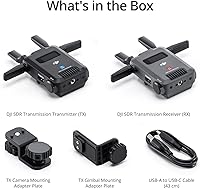
- Box Contents: The combo includes the SDR Transmission Transmitter (TX), Receiver (RX), a camera adapter plate, and a gimbal adapter plate for immediate deployment.
- Stabilizer Support: Compatible with DJI Ronin and RS series stabilizers, enabling remote camera control and stabilizer adjustments directly from the receiver end.
- Power Requirement: Requires a 12V battery to operate; battery is not included in the box and must be sourced separately based on the operator's existing power setup.
- ASIN: The Amazon Standard Identification Number for this product is B0CY1W8NG9, which can be used to verify the exact listing when purchasing online.
- Model Number: The official item model number is 6941565984012, as designated by DJI for product identification and warranty purposes.
- BSR Ranking: At launch, this video transmission kit ranked number 4 in the Video Transmission Surveillance Systems category on Amazon, reflecting strong early market reception.
- Interference Handling: Auto frequency hopping across all supported bands is built in, allowing the system to switch channels in real time when interference is detected on the active frequency.
Related Reviews
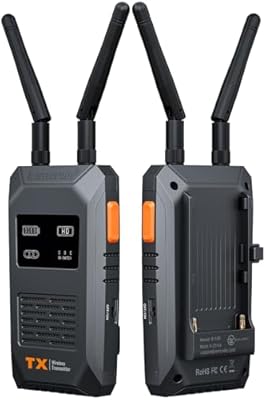
Lemorele R1100 Wireless HDMI Transmission System
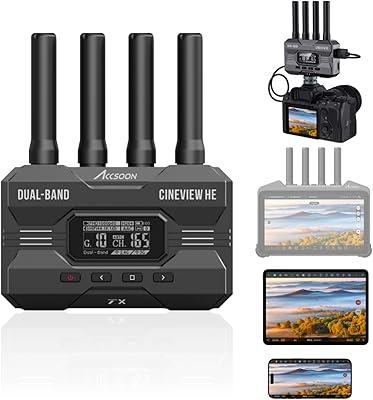
Accsoon CineView HE Wireless Video Transmitter
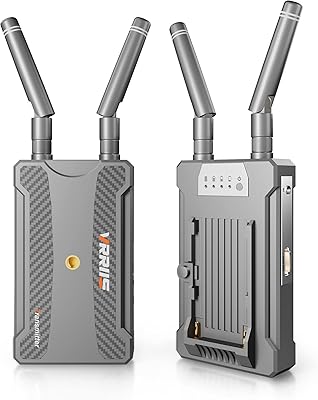
Vrriis 900S Wireless HDMI Transmitter Receiver
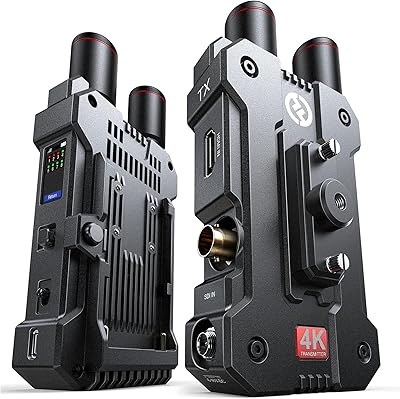
Hollyland Mars 4K Wireless Video Transmission System
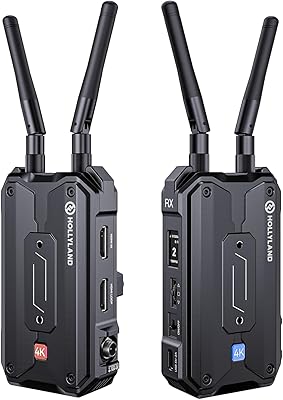
Hollyland Pyro H Wireless HDMI Video Transmitter
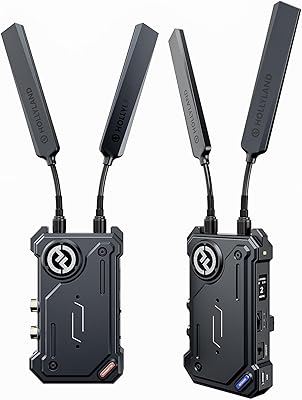
Hollyland Cosmo C1 Wireless Video Transmission System
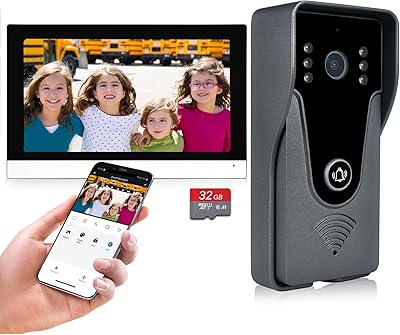
AMOCAM 356-505-WL WiFi Video Doorbell Intercom System
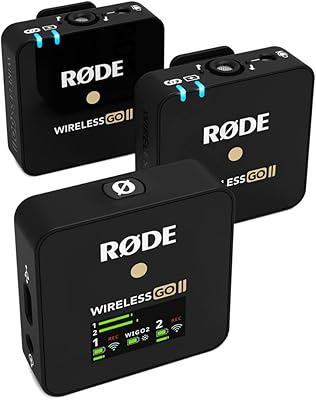
RØDE Wireless GO II
OHWOAI CSOH-05SW3MP05 Wireless Security Camera System