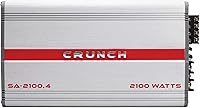
Overview

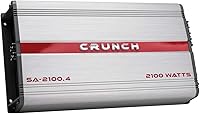
The Crunch SA-2100.4 4-Channel Car Amplifier sits squarely in the entry-level car audio market, and for good reason — Crunch has been building affordable amplifiers for decades, carving out a loyal following among budget-conscious enthusiasts. This is a Class AB amplifier, which means it balances efficiency and audio quality better than older Class A designs while remaining far more accessible than high-end alternatives. One thing worth clarifying upfront: the advertised 2,100-watt figure is a peak rating. Real-world, continuous RMS output lands at 85 watts per channel at 2 ohms — honest numbers that still represent a genuine upgrade over any factory head unit. At under 16 inches long and roughly 5 pounds, it tucks neatly into a trunk or under a rear seat.

Features & Benefits

What makes this Crunch amp genuinely useful is the flexibility built into its wiring options. You can run it as a straight 4-channel stereo setup, bridge pairs of channels into mono blocks, or mix both approaches to power speakers and a subwoofer from a single unit — no need for a second amp. The onboard variable crossover rolls off at 12 dB per octave, letting you filter frequencies to your sub or tweeters without buying a separate component. Rated at 65 watts per channel into 4 ohms, or 130 watts bridged, it delivers real, usable power for most street-level builds. FCC certification and a surface-mount design round out a package that punches well above its asking price.

Best For

The SA-2100.4 is a strong match for anyone tackling their first DIY amp install on a limited budget. If you are replacing a stock head unit and want to properly drive a set of door speakers alongside a compact subwoofer, this 4-channel amplifier handles that job without forcing you into a two-amp setup. The four operating modes give beginners real room to experiment before settling on a final configuration. Keep in mind the unit ships with only the amp and a manual, so plan to pick up a dedicated wiring kit separately. Compact vehicles — hatchbacks, small sedans, crew-cab trucks — are natural fits given how easily the chassis tucks out of sight.

User Feedback

Buyers consistently highlight the easy install process and the noticeable improvement over factory sound as the two biggest wins, with the price-to-performance ratio earning frequent praise from owners who came away pleasantly surprised. That said, a meaningful number of reviews mention the amp running warm during longer drives, so adequate ventilation during mounting is worth taking seriously. Some owners also report a faint hiss at idle through sensitive speakers — not uncommon at this tier, but worth knowing before you buy. The included manual gets mixed marks; wiring-savvy users figure it out, but true beginners may need an online tutorial. Long-term reliability reports are split, with some units performing well past a year and others showing issues sooner.

Pros

  • Genuine Class AB audio quality at a price point most beginners can actually afford
  • Four wiring modes let you power speakers and a sub from one unit, avoiding a second amp purchase
  • The onboard variable crossover removes the need for an external processor in basic builds
  • Compact dimensions make it easy to mount in tight spaces most other amps cannot fit
  • FCC certification provides at least a baseline level of build and safety assurance
  • Noticeable, immediate improvement over factory sound that owners consistently comment on
  • Bridged mode delivers 130 watts into 4 ohms, enough to wake up a small subwoofer
  • Lightweight at just over 5 pounds, which simplifies solo installs considerably

Cons

  • Runs noticeably warm during long drives, requiring careful attention to ventilation during mounting
  • A faint idle hiss is audible through sensitive speakers, which is hard to eliminate at this tier
  • The included manual is too sparse for true beginners and often requires supplementing with online guides
  • No wiring kit is included, adding to the true cost of getting up and running
  • Peak wattage marketing overstates real-world output, which can mislead buyers expecting more headroom
  • Long-term reliability is inconsistent across units, with some failing within the first year
  • Build materials feel cost-conscious up close, reflecting the budget positioning of the product
  • Channel output at 4 ohms is modest, leaving little room to grow into higher-demand speakers

Ratings

The scores below reflect an AI-driven analysis of verified global buyer reviews for the Crunch SA-2100.4 4-Channel Car Amplifier, with spam, bot activity, and incentivized feedback actively filtered out before scoring. Every category captures both what real owners praised and where they ran into frustration, so the picture you get is honest rather than polished. Strengths and shortcomings carry equal weight in these numbers.

Value for Money
88%
Owners repeatedly describe this Crunch amp as one of the better-performing units they have tried at this price tier, with many noting the sound improvement over factory speakers was immediately obvious. For a first build where the budget is tight, the feature set relative to the asking price is genuinely hard to argue with.
A few buyers felt that once they added the cost of a separate wiring kit — which is essential and not included — the true total spend edged closer to what a more reliable mid-range amp would cost, softening the value case slightly.
Sound Quality
74%
26%
For daily driving and casual listening, most owners found the audio noticeably cleaner and fuller after the install compared to running speakers off a head unit alone. The Class AB design contributes a warmer character than budget Class D alternatives at similar prices.
At higher volumes or with sensitive speakers, a background hiss at idle becomes detectable, and some owners noted the soundstage feels flat compared to even modestly priced competing amps. It is not an audiophile performer, and the output ceiling becomes apparent during demanding listening sessions.
Ease of Installation
81%
19%
The surface-mount design and compact dimensions make physical placement straightforward for most vehicles, and experienced DIYers report the wiring terminals are clearly labeled and easy to access. The four operating modes can be configured without special tools, which first-timers appreciate.
The included manual is thin and lacks clear wiring diagrams for beginners, pushing many new installers toward YouTube tutorials to complete the job with confidence. Buyers who expected a plug-and-play experience with detailed guidance were consistently disappointed by the documentation.
Build Quality
62%
38%
The chassis feels solid enough during handling, and the unit passed FCC certification, which at least confirms it meets baseline electrical standards. Owners who mounted it properly in a ventilated location tended to report fewer issues with the physical construction during the first few months.
Up close, the cost-conscious materials are obvious — the housing flexes slightly under pressure and the terminal connectors do not inspire the same confidence as units at higher price points. A portion of buyers noted that the unit felt noticeably cheaper than competing amps they had handled previously.
Thermal Management
53%
47%
Under moderate listening conditions during typical commutes, most owners found the amp stayed warm but functional without triggering protection mode. Buyers who mounted it in a well-ventilated trunk location with adequate airflow reported fewer thermal issues overall.
During extended highway drives or sustained high-volume listening, heat buildup is a recurring complaint across buyer reviews. Several owners reported the amp entering thermal protection mode and cutting audio during longer sessions, particularly in vehicles where mounting space limited airflow around the unit.
Output Power
71%
29%
The real-world RMS output — 65 watts per channel at 4 ohms and 130 watts bridged — is more than sufficient to drive a standard set of coaxial door speakers and a compact sub with authority. Owners upgrading directly from a stock head unit consistently described the difference as dramatic.
The gap between the marketed peak figure and actual sustained output is significant, and buyers who did their research felt the headline wattage was misleading. Anyone running power-hungry component speakers or a large subwoofer will hit the limits of this amp quickly.
Channel Flexibility
83%
The four operating modes — including the ability to run speakers and a bridged mono subwoofer channel simultaneously — give this 4-channel amplifier genuine versatility for a single-amp install. Owners building a full system on a budget consistently highlighted this as the feature that sold them on the unit.
Switching between modes requires physically rewiring the outputs, which is inconvenient if you want to experiment after the initial install. The manual does not clearly explain all configuration combinations, leaving some buyers guessing at the correct approach.
Crossover Functionality
76%
24%
Having a variable crossover built in saves buyers from purchasing an external processor, and owners who used it to roll off low frequencies to their tweeters noted a clear reduction in driver distortion at louder volumes. For a basic two-way or 2.1 system, it does the job competently.
The crossover adjustment range is not documented with enough precision in the manual, making it difficult for beginners to dial in the correct cutoff frequency by ear alone. More experienced installers noted the 12 dB per octave slope is shallower than what dedicated crossover units offer.
Noise Floor
58%
42%
Buyers using standard 4-ohm coaxial speakers in typical install scenarios reported acceptable background noise levels during regular listening. Ensuring a clean ground connection to bare chassis metal significantly reduced idle hiss for a portion of owners who troubleshot the issue post-install.
High-sensitivity speakers reveal a persistent idle hiss that several buyers described as distracting, particularly in quiet passages or when the volume is low. This is a structural limitation of the amplifier design at this price tier rather than an installation error, and it cannot be fully eliminated through grounding alone.
Compact Footprint
86%
At roughly 15.75 x 8.26 x 4.13 inches and just over 5 pounds, the SA-2100.4 fits comfortably in spaces where larger amps simply cannot go, including under rear seats in small sedans and along the side walls of compact hatchback trunks. Owners in tight-space builds rated this as a key reason they chose it.
The relatively tall profile at 4.13 inches can be a limiting factor in the most space-constrained installs, particularly under low-profile seats where horizontal clearance is generous but vertical clearance is not. A handful of buyers had to rethink their mounting location after receiving the unit.
Long-Term Reliability
57%
43%
A meaningful portion of owners reported the amp performing without issues well past the one-year mark, particularly those who prioritized clean grounding and adequate ventilation from the start. Units installed with care in stable thermal environments tended to hold up better in the long run.
Owner reports on reliability beyond twelve months are split enough to raise a flag, with a notable number describing failures — including protection mode lockouts and channel drop-outs — that appeared with regular use over time. For a daily-driver install expected to last several years, the inconsistency is a legitimate concern.
Compatibility
79%
21%
The amp works with standard RCA outputs from any aftermarket head unit and is stable into 2-ohm and 4-ohm speaker loads, covering the vast majority of aftermarket speaker options buyers are likely to pair it with. This broad compatibility makes it easy to fit into an existing or partially upgraded system.
Users with factory head units lacking RCA preamp outputs need an additional line output converter before this amp will work, which adds cost and a wiring step that the product packaging does not clearly communicate upfront. Buyers in this situation were sometimes caught off guard.
Packaging & Unboxing
66%
34%
The unit arrives adequately protected and in good condition in most cases, with the compact box living up to its label. Buyers who ordered for a planned weekend install found everything arrived intact and ready to work with.
Several buyers noted that the packaging communicates little about what accessories are not included, leading to delayed installs when they realized a wiring kit was missing. The absence of even basic mounting hardware was flagged as a frustration in multiple reviews.

Suitable for:

The Crunch SA-2100.4 4-Channel Car Amplifier is built for budget-conscious DIYers who want a meaningful audio upgrade without committing to a complex or expensive install. It fits naturally into builds where a single amp needs to handle both door speakers and a small subwoofer, thanks to its flexible bridging options. First-time installers will appreciate that the operating modes are straightforward enough to experiment with, making it a good learning platform for anyone new to car audio wiring. Compact car owners — think small sedans, hatchbacks, or crew-cab trucks — will find the chassis easy to tuck away under a rear seat or flat against a trunk wall. If your current setup is a stock head unit with factory speakers and you want to hear what real amplification sounds like without spending serious money, this Crunch amp is a sensible starting point.

Not suitable for:

The Crunch SA-2100.4 4-Channel Car Amplifier is not the right choice for listeners who push their system hard for extended periods, since thermal buildup under sustained load is a documented concern and adequate airflow during installation becomes non-negotiable rather than optional. Audiophiles or experienced enthusiasts chasing a low noise floor will likely find the idle hiss through high-sensitivity speakers frustrating, as this is a known limitation at this price tier. Anyone planning to run power-hungry component speaker sets or a high-demand subwoofer should look at amplifiers with higher continuous RMS ratings, since this unit's real-world output headroom is modest. Buyers who expect a plug-and-play experience with a thorough installation guide may be disappointed, as the included manual is minimal and a separate wiring kit is required. If long-term reliability under daily heavy use is a top priority, investing more upfront in a mid-range amp from a brand with a stronger reliability track record would be the wiser call.

Specifications

  • Brand: Manufactured by Crunch, a brand with a long track record in budget and mid-range car audio amplification.
  • Model: The model number is SA-2100.4, part of the Crunch Smash Series lineup.
  • Amp Class: Uses Class AB amplifier topology, which balances thermal efficiency with cleaner audio output compared to Class D designs.
  • Channels: Provides four independent output channels, configurable across multiple wiring modes.
  • Power at 2 Ohms: Delivers 85 watts RMS per channel when all four channels are driven into 2-ohm loads.
  • Power at 4 Ohms: Rated at 65 watts RMS per channel when all four channels are driven into 4-ohm loads.
  • Bridged Power: Produces 130 watts RMS per channel when operating in bridged mono mode at a 4-ohm load.
  • Peak Power: Marketed peak output is 525 watts total, which reflects maximum burst capacity rather than sustained continuous power.
  • Crossover: Includes a variable electronic crossover with a 12 dB per octave slope, adjustable to filter frequencies for speakers or a subwoofer.
  • Operating Modes: Supports four configurations: full 4-channel stereo, dual stereo bridged, stereo plus bridged mono, and dual bridged mono.
  • Dimensions: The unit measures 15.75 x 8.26 x 4.13 inches, making it compact enough for under-seat or trunk mounting.
  • Weight: Weighs 5.22 pounds, light enough for a single person to handle during a DIY install.
  • Mounting Type: Designed for surface mounting, compatible with a wide range of flat install locations inside a vehicle.
  • Certification: Meets FCC requirements, providing a baseline standard of electrical safety and emissions compliance.
  • In the Box: Package includes the amplifier unit and a basic user manual; no wiring kit or hardware is included.

Related Reviews
Soundfy SA 400.4 4-Channel Car Amplifier
71%
78%
Value for Money
72%
Sound Quality
63%
Power Output
58%
Build Quality
81%
Thermal Management
More
Planet Audio AC2400.4 4-Channel Car Amplifier
84%
95%
Power Output
89%
Sound Clarity
87%
Bass Performance
82%
Ease of Installation
65%
Thermals/Heat Management
More
Recoil DI800.4 4-Channel Car Audio Amplifier
83%
88%
Sound Quality
92%
Power Output
65%
Thermal Management
84%
Build Quality
91%
Ease of Installation
More
Planet Audio PL1600.4 4-Channel Car Amplifier
72%
88%
Value for Money
84%
Ease of Installation
74%
Sound Quality
58%
Power Output (Real-World)
61%
Build Quality
More
Crunch PX 1000.4 4-Channel 1000W Amplifier
85%
88%
Sound Quality
85%
Ease of Installation
81%
Build Quality
91%
Power Output
93%
Size & Portability
More
Recoil REA600.4 4-Channel Car Audio Amplifier
84%
89%
Audio Performance
91%
Ease of Installation
85%
Sound Quality at High Volumes
62%
Heat Management
90%
Power Output
More
Recoil DI550.4 4-Channel Car Audio Amplifier
74%
91%
Value for Money
78%
Power Output
86%
Ease of Installation
74%
Sound Quality
67%
Build Quality
More
Planet Audio AC1600.4 Anarchy Series 4-Channel Car Amplifier
82%
94%
Power Output
88%
Sound Quality
70%
Ease of Installation
92%
Value for Money
85%
Build Quality
More
Planet Audio AC1200.4 4-Channel Car Amplifier
73%
88%
Value for Money
67%
Power Output
83%
Installation Ease
74%
Sound Quality
61%
Build Quality
More
Stetsom HL 2000.4 2-Ohm 4-Channel Car Audio Amplifier
87%
93%
Power Output
85%
Cooling System Efficiency
88%
Sound Quality
91%
Ease of Installation
82%
Durability
More

FAQ

Yes, and this is one of the most important things to know before ordering. The box contains only the amplifier and a manual, so you will need a dedicated amp wiring kit covering power cable, ground cable, remote turn-on wire, and RCA cables. Most installers pick up a kit rated for at least 800 watts to give themselves a safe margin.

The 2,100-watt figure is a peak rating, meaning it reflects a brief maximum burst under ideal conditions, not what the amp sustains during normal listening. The real continuous RMS output is 85 watts per channel at 2 ohms or 65 watts per channel at 4 ohms, which is still a solid upgrade over any factory head unit but very different from the headline number.

Absolutely, and that is actually one of the most practical things about this 4-channel amplifier. You can run two channels to your front or rear speakers in stereo mode and bridge the remaining two channels into a single mono output for a subwoofer, all from one unit without needing a second amp.

Make sure the amp has clear airflow around it when you mount it. Avoid enclosing it in a sealed box or pressing it flat against carpet without a gap. Mounting it on a raised bracket or leaving at least a couple of inches of clearance on all sides helps the heat dissipate during longer drives. Some owners also add a small cooling fan in warm climates.

In most cases, yes. As long as your head unit has RCA preamp outputs, you can connect them directly to this amp. If your head unit only has speaker-level outputs, you will need an aftermarket line output converter to step the signal down to the RCA level the amp expects.

Honestly, the manual is pretty sparse and works better as a quick-reference guide than a step-by-step tutorial. Most first-time installers end up supplementing it with YouTube walkthrough videos, which cover wiring diagrams far more clearly. There is a lot of good free content online specifically for entry-level amps like this one.

The amp is stable down to 2 ohms per channel in stereo mode, so both 2-ohm and 4-ohm speakers will work. For most factory replacement coaxial speakers, which are typically 4-ohm, you will get 65 watts per channel, which is plenty of clean power for everyday listening at moderate to high volume.

The amp does include an onboard variable crossover that lets you roll off high or low frequencies, but it does not feature a dedicated bass boost control. If you need bass boost for your subwoofer, you would either look for that feature on your head unit or add an external bass processor inline.

Some owners do report a faint noise floor through sensitive speakers, particularly high-efficiency tweeters. This is not uncommon at this price tier and is often worsened by a poor ground connection. Making sure your ground wire is bolted to bare metal on the vehicle chassis — not painted or coated surfaces — can reduce this significantly.

In bridged mono mode, this 4-channel amplifier puts out 130 watts RMS at 4 ohms, which is enough to drive a single 8-inch or modest 10-inch subwoofer at reasonable levels. For a high-excursion 12-inch sub or any woofer that needs 300 or more watts to perform well, you would want a dedicated mono subwoofer amplifier with more headroom.