Overview

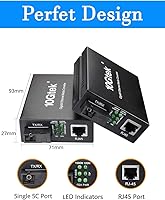
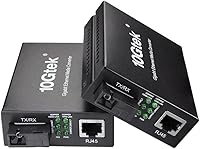
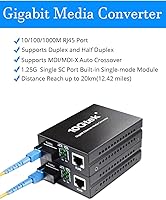
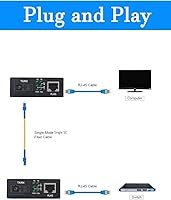
The H!Fiber.com BiDi Gigabit SC Fiber Media Converter is a fiber-to-Ethernet bridge built for small networks that need to push gigabit speeds across distances copper simply cannot handle. BiDi — short for bidirectional — means the device sends and receives over a single fiber strand, cutting cabling costs compared to traditional dual-fiber setups. The built-in fiber module handles single-mode fiber up to 20km, with no separate transceiver to source or budget for. One important detail worth knowing upfront: this BiDi SC converter is sold as a matched pair. Both units ship together because you need one on each end to complete a working fiber link. IT techs, homelab builders, and small businesses extending a LAN to a remote building will find this a practical, no-frills solution.
Features & Benefits

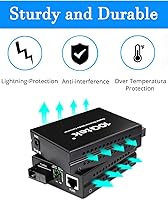
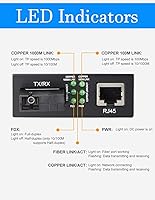
The built-in SC fiber module is one of this fiber media converter's most practical advantages — it operates at 1310nm on one end and 1550nm on the other, which is how both units achieve bidirectional transmission over a single strand. No hunting for compatible SFP modules. The RJ45 Ethernet port auto-negotiates from 10 to 1000 Mbps, so plugging it into an older switch is never a problem. Support for 9K jumbo frames makes it worth considering for NAS or iSCSI environments where throughput matters. The metal enclosure includes cooling vents on both sides and built-in lightning protection — useful if the converter sits in a wiring closet or near exterior cable runs. LED indicators on the front confirm link and activity at a glance.

Best For

This BiDi SC converter is purpose-built for a specific job: extending a gigabit network over single-mode fiber where only one strand is available. That makes it especially useful for connecting a detached garage, outbuilding, or secondary office to a main switch, particularly where SMF conduit is already in place. Homelab users who want a fiber uplink without committing to a managed SFP switch will appreciate the simplicity. Small businesses needing a budget-conscious secondary link on existing fiber infrastructure get solid value here. That said, this is not a solution for multimode fiber or dual-fiber setups — knowing what you have before ordering genuinely matters. IT pros patching a gap in existing SMF runs will find the H!Fiber converter pair a clean fit.

User Feedback

Most buyers report that the H!Fiber converter pair comes up fast, with a link established in minutes and minimal configuration required. The metal build and included power adapters consistently get called out as better than expected for the price. On the downside, a handful of reviewers flagged that mixing these units with converters from other brands can prevent the link from forming — matched wavelengths are non-negotiable. A small number of buyers received a DOA unit, though most found the warranty replacement process resolved without much friction. Technically-minded users who ran iperf3 tests reported near-gigabit throughput, which is reassuring for anyone planning to use this for real workloads rather than light occasional traffic.

Pros

  • Sold as a complete matched pair — no need to separately source compatible units or fiber modules.
  • Built-in BiDi fiber module eliminates the hassle and cost of buying separate SFP transceivers.
  • Near-gigabit real-world throughput confirmed by buyers who ran independent benchmarks.
  • 20km single-mode reach holds up in actual long-distance deployments, not just on spec sheets.
  • Metal enclosure with cooling vents feels significantly more durable than the price suggests.
  • Auto-negotiating RJ45 port works with legacy 10/100 switches as well as modern gigabit infrastructure.
  • 9K jumbo frame support makes this fiber media converter usable for NAS and iSCSI workloads.
  • Universal 100V to 240V power input and included dual power supplies remove a common hidden cost.
  • Lightning protection circuitry adds a practical layer of safety for inter-building fiber runs.
  • Front-panel LED indicators let installers verify link and activity status without any software tools.

Cons

  • Mixing with converters from other brands on the same fiber link is unreliable and effectively unsupported.
  • No rack-mount or DIN rail option makes tidy integration into formal network enclosures awkward.
  • A small number of buyers received a DOA unit, which requires downtime while a replacement ships.
  • Documentation is thin — troubleshooting fiber signal or wavelength issues means searching forums, not the manual.
  • The external power brick adds cable clutter and feels less durable than the converter body itself.
  • No remote management or SNMP support means any link fault requires a physical site visit to diagnose.
  • SC port seating inconsistencies on some units caused intermittent link drops that were slow to trace.
  • Surge protection level is not independently rated or published, limiting confidence for exposed outdoor installs.
  • Buyers near the 20km range limit are vulnerable to connector cleanliness issues most won't anticipate.
  • Support response times are inconsistent — hardware replacements tend to go smoothly, but configuration help varies.

Ratings

The scores below reflect an AI-driven analysis of verified global buyer reviews for the H!Fiber.com BiDi Gigabit SC Fiber Media Converter, with spam, bot-generated, and incentivized feedback actively filtered out before scoring. Ratings span everything from real-world fiber reach to out-of-box setup friction, giving prospective buyers an honest, data-grounded picture. Both the standout strengths and the recurring frustrations are weighted transparently into every number you see here.

Ease of Setup
83%
Most buyers had a live gigabit link running within minutes of unboxing, with no driver installation or software configuration required. The auto-negotiating RJ45 port and auto MDI/MDI-X handling remove two common friction points that trip up less experienced installers.
The matched-pair requirement catches buyers off guard — units from different brands or even different product variants can refuse to link up, which has sent more than a few frustrated users back to the listing page trying to diagnose a non-obvious compatibility issue.
Fiber Reach & Signal Reliability
91%
Buyers who deployed these converters across long outdoor conduit runs consistently report the full 20km spec holding up in practice, not just on paper. Several technically experienced reviewers confirmed stable links with minimal signal degradation across extended real-world distances.
Performance at or near the maximum distance is sensitive to fiber quality and connector cleanliness — a dirty SC connector can introduce errors that are difficult to trace without proper fiber testing equipment, which entry-level buyers rarely have on hand.
Throughput Performance
88%
Users who ran iperf3 benchmarks reported near-gigabit throughput, which holds up well for NAS access, remote office connectivity, and other bandwidth-heavy workloads. The 9K jumbo frame support is a genuine plus for iSCSI and storage-heavy environments where most budget converters fall short.
A small number of reviewers noted throughput inconsistencies during sustained high-load transfers, though it is unclear whether those cases involved marginal fiber infrastructure or the converter itself. No widespread pattern of performance degradation was identified.
Build Quality & Durability
79%
21%
The metal enclosure genuinely surprised buyers who expected a plasticky shell at this price point. Dual-side cooling vents and built-in lightning protection make these converters more suitable for wiring closets and semi-exposed utility installs than many competing units.
While the chassis feels sturdy, the SC port on a small number of units showed inconsistent seating — fiber connectors that were not perfectly aligned caused intermittent link drops that took time to diagnose. The overall construction is solid but not industrial-grade.
Value for Money
86%
Getting a matched, ready-to-deploy gigabit fiber converter pair with built-in modules, metal housings, and universal power supplies at this price tier is genuinely hard to beat. Buyers replacing aging single-port converters or filling a gap in SMF infrastructure view the cost-to-capability ratio favorably.
The value calculation shifts if one unit arrives DOA, which some buyers have experienced. Even with a solid warranty, the time cost of shipping a replacement and re-deploying affects the net value — particularly for businesses that needed the link up quickly.
Compatibility
72%
28%
The RJ45 side plays well with virtually any switch, from legacy 10Mbps hubs to modern gigabit infrastructure, thanks to full auto-negotiation. IEEE 802.3 compliance across multiple standards means the Ethernet side integrates without any configuration on the switch port.
The fiber side is strictly single-mode only — buyers who mistakenly order these for a multimode fiber run will find they simply do not work. Compatibility with non-H!Fiber converters is also unreliable enough that mixing brands on the same link is effectively unsupported.
LED Indicators & Monitoring
77%
23%
The front-panel LEDs covering link status, port speed, and fiber activity are clear and readable even in dimly lit rack environments. For installers doing a quick health check without a laptop, the indicator layout does its job without requiring any interpretation guide.
There is no remote management, SNMP support, or logging of any kind — all monitoring is purely visual and local. For deployments where the converter sits in an inaccessible location, troubleshooting a flapping link means a physical site visit.
Power Supply & Input Range
81%
19%
The universal 100V to 240V AC input means these converters travel and deploy internationally without any adapter concerns. Two power supplies are included in the pair kit, which removes an easy-to-overlook hidden cost that some competing products quietly skip.
The external power brick design adds cable clutter compared to units with inline AC inputs, and the relatively lightweight adapter feels less durable than the converter itself. In tight enclosures, managing two separate power bricks can be a minor but real annoyance.
Packaging & Out-of-Box Experience
74%
26%
Both units, their power supplies, and a product manual arrive together in a single kit, which is the correct way to sell a device that only functions as a pair. Buyers appreciate not having to cross-reference part numbers to ensure they have ordered the right combination.
Documentation is minimal — the included manual covers basic connectivity but offers little guidance for troubleshooting wavelength mismatches or diagnosing fiber signal issues. First-time fiber converter buyers may find themselves relying on forum posts rather than official resources.
Warranty & Customer Support
76%
24%
The three-year warranty and stated lifetime technical support are competitive for this product category, and buyers who reached out for DOA replacements generally report that the process resolved without excessive back-and-forth.
Response times for support inquiries appear inconsistent based on reviewer accounts — some buyers had replacements moving within days while others experienced delays. Support quality can vary depending on the nature of the issue, with hardware faults handled better than configuration questions.
Thermal Management
78%
22%
The dual-side venting on the metal enclosure provides passive airflow that keeps the unit cool during continuous operation. Buyers running these converters in always-on environments report no heat-related instability or unexpected reboots over extended deployment periods.
In confined enclosures with poor ambient airflow, the passive cooling design has limits. A small number of users in high-ambient-temperature environments noted the chassis running noticeably warm, though no thermal failures were widely reported in verified feedback.
Lightning & Surge Protection
73%
27%
The built-in lightning protection circuitry is a practical inclusion for runs that cross between buildings — exactly the use case these converters are designed for. Buyers in rural or storm-prone areas specifically called this out as a reason they chose this over cheaper alternatives.
The rated protection level is not independently certified or published with specific surge ratings, making it difficult to assess how it compares to dedicated surge protection equipment. It should be treated as a basic safeguard, not a substitute for proper grounding and surge arrestors on the fiber run.
Form Factor & Mounting
68%
32%
The compact metal chassis takes up minimal space on a desk or shelf, and the lightweight design makes it easy to tuck into a wiring closet or mount in a utility enclosure without dedicated rack hardware.
There is no rack-mount option or DIN rail support, which limits tidy integration in more formal network installations. The plug-in power brick also means the unit cannot be positioned freely without factoring in where the adapter lands.

Suitable for:

The H!Fiber.com BiDi Gigabit SC Fiber Media Converter is a strong fit for anyone who needs to bridge a gigabit Ethernet network across a distance that copper cabling simply cannot cover — think connecting a detached garage, a barn office, or a secondary building to a main switch over a pre-run single-mode fiber strand. Homelab enthusiasts who want a real fiber uplink without committing to a managed switch with SFP slots will find this converter pair a practical, low-configuration entry point into fiber networking. Small business owners who already have SMF conduit in place between locations will get near-gigabit throughput without needing to invest in more complex infrastructure. IT professionals patching a secondary or backup fiber link into an existing SMF run will appreciate the built-in module and the zero-transceiver-sourcing overhead. The BiDi design is particularly valuable when only a single fiber strand is available — a common reality in older buildings or conduit runs where pulling additional fiber is not an option.
Not suitable for:

The H!Fiber.com BiDi Gigabit SC Fiber Media Converter is explicitly not designed for multimode fiber, so buyers with OM1, OM2, OM3, or OM4 infrastructure in place should stop here and look elsewhere — plugging this into a multimode run will produce no link, no error message, and a lot of head-scratching. Anyone expecting to mix these units with converters from other brands on the same fiber run should also reconsider; the wavelength pairing between the two units is fixed and brand-specific, and mismatched converters are a well-documented source of failed deployments. Network environments that require remote management, SNMP monitoring, or any form of centralized visibility are not a match either, since this device is entirely unmanaged with no software interface of any kind. Buyers who need industrial-grade surge protection with certified ratings will find the built-in lightning protection too basic for high-exposure outdoor installations. Finally, anyone who needs rack-mount integration or DIN rail deployment should note that neither option is supported — this is a standalone desktop unit, and keeping it tidy in a formal rack environment takes some creative cable management.
Specifications

  • Fiber Interface: Each unit features a single SC port operating in BiDi (bidirectional) mode, transmitting and receiving over one fiber strand simultaneously.
  • Fiber Type: Compatible exclusively with single-mode fiber (SMF) cable; multimode fiber infrastructure is not supported.
  • Wavelengths: One unit transmits at 1310nm and receives at 1550nm, while the paired unit operates in reverse — both must be used together to form a working link.
  • Fiber Reach: Maximum supported fiber distance is 20km (approximately 12.42 miles) over single-mode cable under normal operating conditions.
  • Ethernet Port: A single RJ45 port supports 10/100/1000Base-T auto-negotiation, maintaining backward compatibility with legacy and modern Ethernet switches.
  • Jumbo Frames: The converter supports jumbo frames up to 9K bytes, making it suitable for NAS, iSCSI, and other high-throughput network workloads.
  • Duplex Support: Both full and half duplex operation are supported, with automatic duplex detection requiring no manual configuration on the port.
  • Auto MDI/MDI-X: Automatic MDI/MDI-X crossover detection is built in, eliminating the need for crossover cables regardless of the connected device type.
  • Built-in Module: A fiber transceiver module is permanently integrated into each unit — there is no SFP slot, and no separate module needs to be purchased or installed.
  • Power Input: Each unit ships with an external power adapter accepting universal 100V to 240V AC input, making it compatible with power standards worldwide.
  • Operating Voltage: The converter operates internally at 5VDC with a maximum current draw of 1.0A under full load.
  • Enclosure: The housing is a metal chassis with cooling vents on both sides to facilitate passive heat dissipation during continuous operation.
  • Lightning Protection: Built-in lightning protection and electromagnetic interference shielding are integrated into the circuit design to protect the unit in inter-building deployments.
  • LED Indicators: Front-panel LEDs provide real-time visual status for link state, port speed, and fiber activity without requiring any software or management interface.
  • Standards: The converter complies with IEEE 802.3, IEEE 802.3u, IEEE 802.3z, IEEE 802.3ab, and IEEE 802.3x networking standards.
  • Package Contents: Each purchase includes two matched converter units, two external power supply adapters, and one product manual — everything needed to establish a single fiber link.
  • Warranty: H!Fiber.com provides a three-year hardware warranty alongside a stated lifetime technology support commitment for registered buyers.
  • Mounting Type: The unit is designed for freestanding desktop or shelf placement using a plug-in mount; rack-mount and DIN rail options are not available.

Related Reviews
ipolex Gigabit Multi-Mode LC Fiber to Ethernet Media Converter
86%
94%
Ease of Installation
90%
Performance Stability
88%
Transmission Range
85%
Build Quality
92%
Plug-and-Play Functionality
More
Wantek H-USB600-SC USB Headset
79%
83%
Comfort & Wearability
76%
Microphone Clarity
61%
Build Quality
89%
Value for Money
93%
Plug & Play Ease
More
ADnet Fiber to Ethernet Converter with Open SFP Slot
86%
95%
Setup & Installation
88%
Performance & Speed
80%
Build Quality
90%
Compatibility
92%
Ease of Use
More
H!Fiber.com 82576-2T-X1 Dual-Port Gigabit Network Card
81%
93%
Value for Money
91%
Linux Compatibility
78%
Installation Ease
71%
Virtualization Support
74%
Build Quality
More
Koramzi CB-107 ATSC Digital TV Converter Box

73%
88%
Ease of Setup
74%
Channel Reception
91%
Value for Money
61%
USB Recording
63%
Remote Control
More
Equate Daily Fiber Multi-Benefit Fiber Powder, 29 Oz
87%
88%
Effectiveness for Digestion
93%
Ease of Use
91%
Value for Money
95%
Mixability with Drinks
62%
Bloating or Discomfort
More
THICK FIBER Hair Fibers for Thinning Hair & Bald Spots - Auburn, 25g
83%
88%
Ease of Application
92%
Natural Appearance
84%
Longevity/Durability
90%
Sweat and Water Resistance
89%
Effectiveness for Thinning Hair
More
Sherpani Camden Convertible Backpack
84%
88%
Overall Functionality
91%
Design Versatility
76%
Comfort and Ergonomics
84%
Durability and Build Quality
89%
Value for Money
More
VIXLW VHSDC01 VHS to Digital Converter

78%
91%
Ease of Setup
87%
Compatibility
72%
Video Capture Quality
61%
Audio Sync Accuracy
88%
Value for Money
More
Schiit Modi+ Digital-to-Analog Converter
82%
88%
Sound Quality
91%
Build Quality
93%
Value for Money
89%
Input Flexibility
86%
Ease of Setup
More

FAQ

One purchase gives you everything you need — the box ships as a matched pair, meaning both converter units, two power adapters, and a manual are all included. You place one unit at each end of the fiber run and you are ready to go. No need to order separately or mix with other products.

No, it will not. This BiDi SC converter is built specifically for single-mode fiber (SMF). If your existing cabling is multimode — OM1, OM2, OM3, or OM4 — these units will not establish a link, and you will need to look for a multimode-compatible converter instead.

This is one of the most common setup mistakes, and it is worth being direct about: mixing brands is unreliable and generally not recommended. The two units in this pair are wavelength-matched to each other — one transmits at 1310nm and the other at 1550nm. If you pair one of these with a unit from another manufacturer that uses a different wavelength assignment, the link will likely fail to form with no obvious error to troubleshoot.

The rated maximum is 20km, which is about 12.42 miles, and buyers who have deployed these in real long-distance runs consistently report that spec holding up in practice. That said, reaching the maximum distance cleanly depends on fiber quality, cable condition, and keeping those SC connectors clean — a dirty connector can introduce errors well before you hit the distance limit.

The RJ45 port auto-negotiates between 10, 100, and 1000 Mbps and includes automatic MDI/MDI-X detection, so it is compatible with virtually any switch or router you are likely to have. You do not need to configure anything on the switch port — just plug in and let the converter handle the handshake.

There is no management interface of any kind — no web UI, no SNMP, no CLI access. Monitoring is limited to the physical LED indicators on the front panel. If you need to check link status remotely or receive alerts when a connection drops, this converter is not the right fit for that requirement.

The built-in protection adds a meaningful layer of safety for inter-building fiber runs, which is exactly the scenario these converters are designed for. That said, it should be treated as a basic safeguard, not a replacement for proper grounding and dedicated surge arrestors on the fiber run. If your installation is in a lightning-prone area, pairing this with external surge protection on the fiber strand is a smart precaution.

Yes, it supports jumbo frames up to 9K bytes, which is a genuine advantage for NAS access, iSCSI storage traffic, or any workload where larger frame sizes reduce overhead and improve throughput. Not all budget media converters include this, so it is a useful feature for storage-focused deployments.

A small number of buyers have received a DOA unit, so it does happen. The three-year warranty covers this, and most buyers who contacted support report receiving a replacement without excessive difficulty. Reach out to H!Fiber directly with your order details — hardware faults tend to be resolved faster than configuration questions based on reported buyer experiences.

The two units are physically marked and operate on opposite wavelengths — one transmits at 1310nm and receives at 1550nm, and the other does the reverse. The product manual identifies which is which, and the units are typically labeled A and B or with their transmit wavelength. Just make sure you place them at opposite ends of the fiber strand as indicated, and the link will come up automatically.