Overview

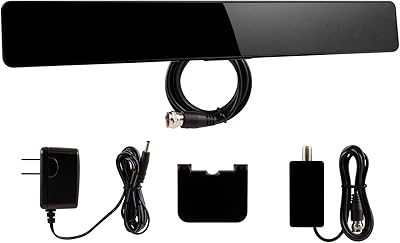
The Amazqi Indoor TV Antenna is a flat, lightweight entry-level option aimed at cord-cutters who want free over-the-air channels without the hassle of a rooftop installation. At just 4.6 ounces and barely a fraction of an inch thick, it tucks neatly behind a TV or sticks to a window without drawing attention. Worth flagging upfront: the product title advertises a range of 380+ miles, while the spec sheet says 250 miles — and real-world performance, as we'll get into, falls well short of either figure. It ships with a 16.4ft coaxial cable, which gives you genuine flexibility in where you position it. Across more than 4,100 Amazon ratings, it holds a 3.8-star average — decent, but not without honest caveats.

Features & Benefits

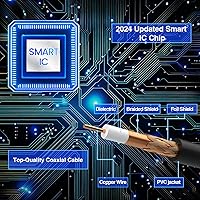
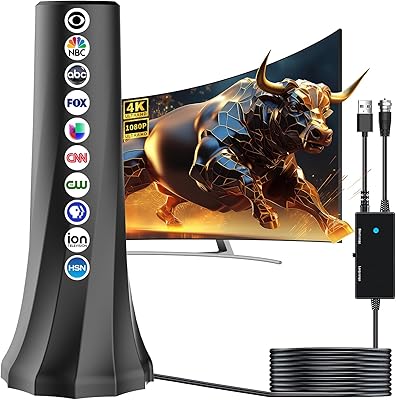
The antenna's built-in signal amplifier uses a smart switch to dial output up or down based on how strong your local broadcast signal is. A companion IC chip works to filter out interference from nearby cell towers and RF sources, which helps keep the picture stable rather than pixelated. It handles both 4K and 1080p content and connects through a standard 75-ohm coaxial input, so there's no adapter hunting involved. The included cable uses a copper core with three-layer aluminum shielding, which holds up better than the flimsy cables bundled with cheaper alternatives. Best of all, there are no monthly fees — just plug in, scan for channels, and start watching ABC, CBS, NBC, Fox, and PBS for free.

Best For

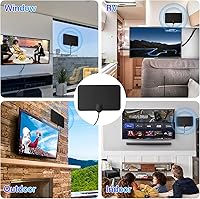
This flat TV antenna makes the most sense for renters and apartment dwellers who can't mount something on an exterior wall or in an attic. If you're within roughly 30 to 60 miles of a broadcast tower cluster and have a window facing the right direction, you stand a solid chance of pulling in a respectable channel lineup. It's also a practical pick for a secondary bedroom TV where a full cable subscription simply isn't worth the cost. First-time cord-cutters can treat it as a low-risk trial run before investing in a more permanent outdoor setup. That said, buyers in rural areas or far from towers should look elsewhere — this antenna won't overcome difficult geography.

User Feedback

Buyers who leave positive reviews tend to live in suburban areas with nearby broadcast towers, and they consistently praise how quick the setup is — plug in, run a channel scan, done. On the flip side, a meaningful share of critical reviews focus on the range claims, with many users finding real-world reach closer to 30 to 50 miles rather than the hundreds advertised. A few experienced signal degradation after switching the amplifier on, which can actually hurt reception when you're already in a strong signal zone. Cable durability at the connection point has also drawn complaints over time. On balance, the Amazqi antenna delivers reasonable value for suburban users, but expectations need to stay firmly grounded.

Pros

  • Setup takes only a few minutes — plug into the coax port, run a channel scan, and you are watching live TV.
  • The 16.4ft coaxial cable gives you real flexibility to find the sweet spot in your room without rearranging furniture.
  • Supports 4K and 1080p signals, so picture quality on compatible TVs looks sharp on major network channels.
  • The built-in amplifier includes a smart switch that adjusts output based on incoming signal strength, which helps in moderate-range locations.
  • No subscription, no contract, and no monthly bill — local news, sports, and primetime TV come completely free.
  • Thin and lightweight design means it sits flat on a shelf, sticks to a window, or hides behind a TV without being noticeable.
  • Compatible with virtually any modern TV through a standard 75-ohm coaxial input — no adapters needed.
  • The IC chip filters out cellular and RF interference, which visibly reduces pixelation in areas with heavy wireless traffic.
  • At its price point, it functions as a low-risk way to test whether over-the-air TV fits your household before spending more.

Cons

  • Advertised range figures are wildly overstated — real-world performance for most buyers lands between 30 and 50 miles.
  • Turning the amplifier on can actually degrade reception if you live close to broadcast towers, which is counterintuitive and frustrating.
  • The coaxial cable connection point has drawn durability complaints, with some users reporting loosening or fraying after extended use.
  • Channel availability is entirely geography-dependent — no antenna, including this one, can overcome poor tower proximity or heavy obstructions.
  • The gap between the 380-mile title claim and the 250-mile spec sheet figure signals inconsistent marketing that erodes trust.
  • Thin flat design limits signal-gathering surface area compared to larger directional or amplified outdoor antennas.
  • No mounting hardware or adhesive strips are included in some reported shipments, making wall or window placement less straightforward.
  • Performance in dense urban buildings with steel framing or thick concrete walls can be unreliable even at short distances from towers.

Ratings

Our editorial team used AI to analyze thousands of verified global reviews for the Amazqi Indoor TV Antenna, actively filtering out incentivized, duplicate, and bot-generated submissions to surface what real buyers actually experienced. The scores below reflect a transparent picture of both where this flat antenna genuinely delivers and where it falls short — no spin, no cherry-picking. Strengths in ease of setup and value are weighed honestly against recurring pain points around range accuracy and amplifier reliability.

Signal Reception Quality
62%
38%
Buyers in suburban areas within 30 to 50 miles of broadcast towers consistently report clean, stable reception on major network channels. In well-positioned locations — near a window facing the tower direction — users pull in ABC, CBS, NBC, and Fox with little to no pixelation during normal weather.
Reception drops off sharply for anyone beyond 50 miles or in areas with physical obstructions like hills, dense tree cover, or multi-story concrete buildings. A noticeable segment of reviewers in fringe zones report inconsistent signal that cuts out mid-broadcast, which is particularly frustrating during live sports or local news.
Advertised Range Accuracy
34%
66%
A small subset of users in flat, open terrain with favorable tower proximity do report getting more channels than they expected, which suggests the hardware itself is not the limiting factor in ideal conditions. The amplifier does add measurable reach compared to completely passive antennas in the same price bracket.
The gap between the marketing claims — which oscillate between 250 and 380 miles depending on where you look — and real-world performance is the single biggest complaint across the review pool. Most users realistically achieve 30 to 55 miles at best, and buyers who purchased based on the headline range figure feel genuinely misled.
Ease of Setup
91%
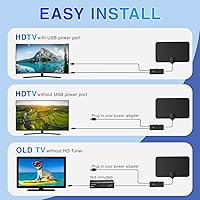
Setup is about as frictionless as it gets for any home electronics product. Buyers consistently describe the process as plug-in-and-scan: connect the coax cable to the TV, power the amplifier via USB, navigate to channel scan, and you are done — usually in under five minutes. No tools, no manuals, no technical knowledge required.
A small number of users ran into trouble when their TV lacked a built-in ATSC digital tuner, requiring an external tuner box that is sold separately. The instructions also do not clearly explain that turning the amplifier off may actually improve reception for people living very close to towers.
Amplifier Performance
57%
43%
The smart switch amplifier does provide a tangible signal boost for users positioned in medium-range locations, helping pull in weaker subchannels that a passive antenna would miss entirely. The IC chip filtering noticeably reduces interference from nearby cell towers in some urban environments, which shows up as fewer dropped frames.
A recurring and well-documented issue is that the amplifier actively degrades reception for users within 10 to 15 miles of broadcast towers, essentially overdriving the signal into the tuner. There is no clear indicator or guidance in the packaging to help buyers determine whether to run amplified or unamplified, which leads to unnecessary frustration.
Build Quality
59%
41%
The antenna panel itself is thin and reasonably rigid, and the flat form factor holds its shape without warping in standard indoor temperatures. The coaxial cable uses a copper core with aluminum shielding, which is a step above the purely foil-wrapped cables found in some competing budget options.
The coaxial connection joint where the cable meets the antenna body is the most consistently criticized durability point across reviews, with some users reporting loosening or intermittent signal loss after a few months of use. The overall feel of the plastic housing is lightweight in a way that reads as fragile rather than minimal.
Cable Quality & Length
77%
23%
The 16.4ft cable length is a genuine practical advantage that most buyers call out positively — it allows real experimentation with antenna placement without being tethered to the immediate vicinity of the TV. The shielded copper construction holds up well against electromagnetic interference in typical home environments.
A few reviewers noted that the cable strain relief at the antenna end is minimal, meaning repeated bending or repositioning can stress the connector over time. The cable is not detachable, so if it is damaged, the whole unit needs replacing rather than just swapping in a new cable.
Value for Money
78%
22%
For buyers who live in a suburban sweet spot — close enough to towers, in a dwelling without heavy signal obstructions — this flat antenna genuinely delivers free network TV at a price that pays for itself within the first month compared to even a basic cable tier. The no-subscription model means the cost-per-use drops continuously over time.
Buyers who purchase based on the inflated range claims and find the antenna does not work in their location feel the value equation collapses quickly. Returning an antenna that simply did not work as advertised is an inconvenience that erodes the perceived savings, and a more expensive but accurately rated antenna might have been the smarter initial choice.
Channel Count
66%
34%
In well-served suburban markets, users report pulling in 40 to 70 channels after scanning, including major network affiliates, PBS subchannels, Spanish-language broadcasters, and digital subchannel networks like MeTV and Comet. That is a legitimately useful free content package for local news, sports, and primetime viewing.
Channel count is almost entirely determined by geography rather than antenna performance, and buyers in smaller markets or rural areas may only receive 10 to 20 channels at best. The listing claims up to 100 channels, but that figure reflects dense urban markets and is not achievable for the majority of buyers.
4K & HD Picture Quality
74%
26%
When the signal is strong and stable, over-the-air broadcast quality through this antenna is genuinely excellent — network HD broadcasts are uncompressed compared to cable or satellite, meaning a solid OTA signal can look sharper than the equivalent channel on a paid service. Users watching NFL games or primetime dramas on network channels report visibly crisp images.
Picture quality is entirely contingent on signal stability, and this antenna does not always deliver a consistently stable feed. Macro-blocking and brief signal dropouts during bad weather or high-interference periods can undercut the HD experience, and there is no way to buffer or recover a live broadcast signal once it drops.
Interference Rejection
63%
37%
The IC chip filtering does show measurable results in areas with dense cellular traffic, helping suburban users maintain a cleaner signal during peak evening hours when RF congestion tends to spike. Several buyers in apartment buildings near commercial corridors noted fewer dropouts compared to cheaper non-filtered antennas they had tried before.
In highly congested urban environments — particularly older apartment buildings with metal structures — the filter does not fully compensate for the sheer volume of competing RF signals. A handful of reviewers in major metro areas with towers physically nearby still reported persistent interference issues even with the amplifier in various configurations.
Placement Flexibility
79%
21%
The combination of a feather-light panel and a 16.4ft cable means buyers have genuine freedom to test window sills, high shelves, and wall positions without committing to anything permanent. The flat profile means it can be tucked flat against a wall or behind a picture frame in situations where aesthetics matter.
The antenna does not ship with reliable adhesive mounting strips in all reported shipments, leaving buyers to improvise their own window or wall attachment solution. Without a secure mounting method, the panel can shift position over time, subtly disrupting a carefully tuned signal alignment.
Compatibility
88%
The standard 75-ohm coaxial output connects directly to the ANT input found on virtually every TV sold in the North American market for the past two decades. Confirmed compatibility with Samsung, LG, Sony, and TCL covers the vast majority of living room setups without any adapter requirements.
TVs without a built-in ATSC digital tuner — which includes some older analog sets and certain smart display panels — require an external tuner box to use this antenna at all, and that requirement is not prominently disclosed on the product page. This has caught a small number of buyers off-guard.
Marketing Transparency
29%
71%
The core product concept — a flat amplified indoor antenna for free over-the-air TV — is a legitimate and useful thing to sell, and the underlying hardware is not fundamentally misrepresented in terms of what it physically does.
The range claim inconsistency between the product title and the specification sheet is a significant trust issue that surfaces repeatedly in critical reviews. Listing 380+ miles in the title while the spec sheet says 250 miles, and real-world performance lands at 30 to 55 miles, creates a credibility gap that undermines confidence in the brand overall.
Long-Term Durability
54%
46%
Users who handle the antenna carefully and leave it in a fixed position report it functioning consistently for a year or more without signal degradation. When placed statically — mounted on a window and left undisturbed — the unit does not appear to develop hardware faults at an unusual rate.
The coaxial junction and cable strain point are the most reported failure modes, and they tend to emerge after several months rather than immediately. Buyers who frequently reposition the antenna or move it between rooms accelerate wear at these weak points, and the lack of a detachable cable means the whole unit must be replaced if the cable fails.

Suitable for:

The Amazqi Indoor TV Antenna is a practical fit for renters, apartment dwellers, and anyone who simply cannot run a cable through a wall or mount hardware on an exterior surface. If you live within roughly 30 to 60 miles of your nearest broadcast tower cluster and have a window or interior wall with a reasonably clear line of sight, this flat antenna has a genuine shot at delivering a solid channel lineup covering the major networks. It works especially well as a low-cost solution for secondary TVs in bedrooms or guest rooms where paying for an additional cable box makes no financial sense. First-time cord-cutters who want to test over-the-air TV before committing to a more permanent setup will find it a sensible, low-stakes starting point. The 16.4ft cable is long enough to experiment with different placement spots, which matters more than most buyers realize when chasing a cleaner signal.
Not suitable for:

Buyers in rural areas, hilly terrain, or locations more than 60 to 70 miles from broadcast towers should look past this antenna and invest in a proper outdoor or attic-mounted unit instead. The range claims printed on the packaging — which fluctuate between 250 and 380 miles depending on where you look — are not grounded in realistic conditions, and buyers who take those numbers at face value are setting themselves up for disappointment. This indoor antenna also struggles in dense urban environments surrounded by concrete, steel framing, or other signal-blocking obstructions that weaker amplifiers cannot overcome. If you are looking for a primary TV antenna in a larger home where multiple rooms need coverage, a single flat indoor unit is not the right tool. Those who have already tried a basic indoor antenna without success are unlikely to find a meaningfully different outcome here.

Specifications

  • Brand: This antenna is sold under the Amazqi brand and manufactured by Andmei.
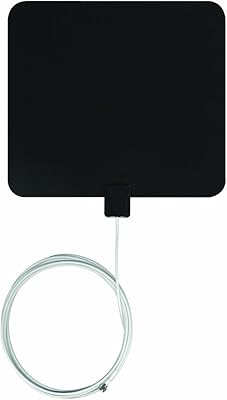
  • Dimensions: The antenna body measures 8.27″ long by 4.72″ wide and just 0.03″ thin, making it one of the flatter indoor options available.
  • Weight: At 4.6 ounces, the unit is light enough to mount on a window or prop behind a TV without any structural concerns.
  • Antenna Type: Flat indoor amplified antenna designed for over-the-air reception of free broadcast television signals.
  • Impedance: Standard 75-ohm impedance, compatible with the coaxial inputs found on virtually all modern HDTVs and digital tuners.
  • Cable Length: Includes a 16.4ft coaxial cable with a copper core conductor and three-layer aluminum shielding for interference resistance.
  • Amplifier: Built-in signal amplifier with a smart switch that adjusts output level based on detected incoming signal strength.
  • Signal Filter: Integrated IC chip filters out cellular frequencies and RF interference to reduce pixelation and signal noise.
  • Resolution Support: Capable of receiving and passing through broadcast signals supporting up to 4K and 1080p HD resolution.
  • Advertised Range: The manufacturer lists a maximum range of 250 miles in the product specifications, though real-world performance is significantly lower.
  • Channel Count: The antenna is rated to receive up to 100 over-the-air channels depending on location and tower proximity.
  • Color: Available in black, which blends discreetly with most TV bezels and wall surfaces.
  • Compatibility: Works with major TV brands including Samsung, LG, Sony, and TCL, as well as any television with a standard coaxial ANT input.
  • Power Source: The amplifier is USB-powered, typically drawing power from a TV USB port or a standard USB wall adapter.
  • Subscription Required: No subscription, contract, or monthly fee is required; all received channels are free over-the-air broadcasts.
  • ASIN: The Amazon Standard Identification Number for this product is B088CY9PRK.
  • Warranty: The manufacturer advertises lifetime after-sales support, though the specific terms of any replacement or repair policy are not formally documented.
  • BSR: Ranked #448 in the TV Antennas category on Amazon at the time of evaluation, indicating moderate but consistent sales volume.

Related Reviews
Antennas Direct ClearStream Eclipse Indoor TV Antenna
77%
74%
Signal Reception
67%
Amplifier Performance
93%
Design & Profile
91%
Ease of Setup
62%
Cable Length
More
Mohu Gateway Indoor TV Antenna
86%
87%
Signal Reception
92%
Setup and Installation
89%
Design and Aesthetics
90%
Value for Money
84%
Durability and Build Quality
More
ANTOP AT-211B Indoor TV Antenna
71%
72%
Signal Reception
67%
Amplifier Performance
91%
Ease of Setup
63%
Build Quality
58%
VHF Channel Support
More
Winegard FlatWave FL-5000 Indoor TV Antenna
79%
78%
Reception Quality
93%
Ease of Setup
72%
Signal Stability
84%
Build Quality
88%
Design & Aesthetics
More
iGENJUN ANT-CS8218 Amplified Indoor Outdoor TV Antenna
72%
73%
Signal Reception Quality
67%
Amplifier Performance
88%
Ease of Installation
48%
Range Accuracy vs. Claimed Specs
71%
Build Quality & Materials
More
UltraPro 47331 Amplified Indoor TV Antenna
77%
74%
Signal Reception Quality
91%
Ease of Setup
88%
Design & Aesthetics
67%
Amplifier Performance
71%
Channel Count
More
YiziAifsion Indoor TV Antenna
70%
67%
Signal Reception
91%
Ease of Setup
88%
Cable Length & Flexibility
41%
Channel Count Accuracy
53%
Build Quality
More
Mohu Leaf Plus Amplified Indoor TV Antenna
75%
72%
Signal Reception
54%
Range Accuracy
68%
Amplifier Performance
89%
Design & Aesthetics
91%
Ease of Setup
More
GE Pro Bar Indoor TV Antenna 33683
83%
85%
Reception Performance
92%
Ease of Installation
88%
Value for Money
90%
Design & Aesthetics
87%
Mounting Options
More
Philips Crystal Amplified Indoor TV Antenna SDV3237N/27
84%
85%
Signal Quality
91%
Setup Ease
82%
Range Performance
89%
Compatibility
84%
Design & Build
More

FAQ

Realistically, most buyers see reliable performance within 30 to 50 miles of their nearest tower cluster. The packaging makes much larger range claims, but those figures assume ideal open-air conditions with zero obstructions — which almost never exists in a real home. Before buying any indoor antenna, it is worth checking a free tool like AntennaWeb or TV Fool to see which towers are within range of your address.

No. Over-the-air TV is completely free once you have the hardware. You will pick up local network affiliates like ABC, CBS, NBC, Fox, and PBS at no ongoing cost. The only thing you are paying for is the antenna itself.

It depends on where you live. If you are 20 to 40 miles from your broadcast towers, the amplifier can genuinely help pull in weaker signals. However, if you are very close to the towers — say, within 10 miles — turning the amplifier on can actually overload the tuner and make reception worse. In that case, try running the antenna without the amplifier switched on.

Yes, as long as your TV has a coaxial ANT input on the back, this flat antenna will connect to it directly. That includes Samsung, LG, Sony, TCL, Vizio, and most other brands sold in North America. Smart TV features or streaming apps are completely separate from over-the-air reception.

As high up and as close to a window as possible is almost always the best starting point — ideally a window facing the direction of your nearest towers. Walls, floors, and large appliances all reduce signal strength. The 16.4ft cable gives you enough length to experiment with different spots without committing to one position immediately.

Not directly. A single antenna outputs one coaxial signal, which goes to one TV. If you want to run multiple TVs from the same antenna, you would need a coaxial splitter, though splitting the signal does reduce strength to each TV and may cause you to lose some weaker channels.

That entirely depends on your location. In most suburban U.S. markets you can expect the major network affiliates plus public broadcasting and several secondary digital subchannels. Use a site like AntennaWeb.org and enter your address to see exactly which channels and towers are realistically within reach before purchasing.

Neither figure is a reliable guide to real-world performance. The Amazqi Indoor TV Antenna, like most amplified flat antennas in this category, is subject to significant marketing inflation on range claims. Think of those numbers as theoretical maximums under laboratory conditions. For practical planning purposes, assume a realistic range of 30 to 60 miles and verify your local tower distances before buying.

User feedback on this point is mixed. The cable itself uses a copper conductor with aluminum shielding, which is reasonable for the price. The connection point where the cable meets the antenna body has drawn some complaints about loosening or wear over extended use. If you move the antenna frequently, handle that junction carefully.

Setup is about as simple as it gets — plug the coaxial cable into the ANT or RF input on the back of your TV, connect the USB power cable for the amplifier, and then navigate to your TV menu to run a channel scan. Most people are up and running in under five minutes. If your TV does not have a built-in tuner, you would need an external digital tuner box, but that is uncommon in TVs sold in the last decade.