Overview

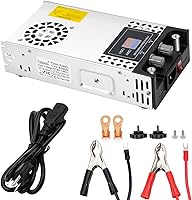
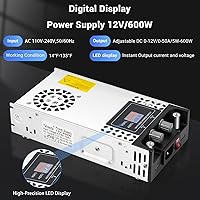
The Yaheeda ER-9812 600W Adjustable DC Power Supply sits in a practical sweet spot for hobbyists and light workshop users who want more control than a basic wall adapter can offer. Unlike fixed-output supplies, this adjustable bench supply includes an LED readout that displays live voltage and current — a genuinely useful feature when working with sensitive components. It accepts dual AC input (110V or 220V), so the same unit works in North America or Europe without modification. Worth noting: the 600W figure is a peak rating, not a continuous guarantee, so plan accordingly for heavier or sustained-duty tasks. Yaheeda occupies the mid-tier converter market, and this model reflects that positioning honestly.
Features & Benefits

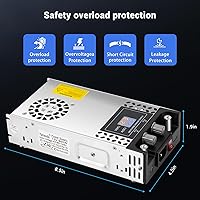
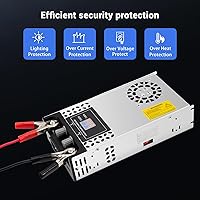
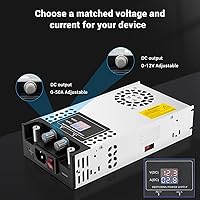
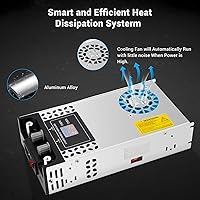
The ER-9812 covers a 0–12V output range with current adjustable up to 50A, giving you enough headroom to power 5V microcontrollers, 9V pedals, or 12V motors from one unit. The 0.1V precision dial lets you fine-tune output without guesswork — useful when a component is spec'd tightly and you cannot afford to overshoot. Both voltage and current appear on the LED screen simultaneously, so you always know what the load is actually drawing. The cooling setup pairs an aluminum heat sink with a fan that only activates above 113°F, keeping the unit quiet during lighter work. At roughly 10.6 x 8.7 x 2.8 inches, this DC power converter takes up minimal bench space.

Best For

This adjustable bench supply works well for DIY electronics hobbyists who prototype regularly and want live feedback on current draw. LED strip installers will find the stable 12V output and adjustable current limiting particularly practical when commissioning a new run. Ham radio builders commonly rely on variable DC supplies as a core bench tool, and the ER-9812 fills that role without overcomplicating things. It also suits small workshop setups where you need to power motors, pumps, or fans on demand. If you are currently swapping between several fixed-voltage adapters and want one unit that covers all of them, this DC power converter is a logical consolidation for a tidier bench.

User Feedback

Buyers consistently point to LED display clarity as a standout feature, and most report that out-of-box voltage readings track closely with a multimeter — within an acceptable margin for typical bench work. A small subset of users has flagged minor calibration drift at the lower end of the voltage range, which is worth checking against an external meter on first use. Fan noise gets mentioned in longer sessions; it is present but not disruptive. Build quality draws mostly positive comments, though some users feel the output terminal connections could be sturdier under sustained high-current loads. Shipping damage complaints exist but appear to be isolated incidents rather than a consistent pattern, and overall buyer sentiment leans favorable for hobbyist use.

Pros

  • Live LED display shows voltage and current simultaneously, removing the need for a separate meter during most bench tasks.
  • Adjustable output from 0 to 12V covers 5V, 9V, and 12V devices — one unit replaces a drawer full of fixed adapters.
  • The 0.1V tuning precision is fine enough for practical electronics work without requiring any external adjustment.
  • Thermally triggered fan stays silent during lighter loads, keeping the workspace quiet during focused work sessions.
  • Dual AC input (110V and 220V) means the ER-9812 works internationally without a separate transformer.
  • Compact ATX12V footprint fits comfortably on a crowded bench without sacrificing meaningful output capability.
  • Independent voltage and current adjustment gives component-level protection during initial power-on testing.
  • Setup is fast and intuitive — most users are running within minutes without consulting documentation.
  • Aluminum heat sink handles moderate sustained loads effectively before the active cooling even activates.

Cons

  • Voltage accuracy near the bottom of the range can drift beyond the stated 0.1V tolerance — verify with a multimeter on first use.
  • Output terminal binding posts feel underdeveloped for sustained high-current draws near the top of the amperage range.
  • The 600W rating is a peak figure, not a continuous guarantee — do not plan workloads around that ceiling.
  • Fan noise during longer high-load sessions is noticeable rather than background-level in a quiet home workshop.
  • No auto-switching AC input — users must manually set the voltage selector, which is easy to overlook.
  • Unit-to-unit calibration variance means some buyers receive supplies that need baseline calibration checks out of the box.
  • Shipping damage reports appear with enough frequency to warrant careful inspection before discarding the packaging.
  • No rubber feet or mounting hardware included, so the unit shifts on smooth bench surfaces during cable changes.
  • Documentation is thin and does not guide first-time users through initial setup checks or calibration verification steps.

Ratings

The Yaheeda ER-9812 600W Adjustable DC Power Supply was evaluated by our AI rating engine after analyzing verified buyer reviews from multiple global markets, with spam, bot-generated, and incentivized feedback actively filtered out. Scores reflect the honest distribution of real user experiences — where the ER-9812 earns genuine praise and where it falls short in practical, everyday bench use. Both strengths and recurring frustrations are represented transparently across every category below.
Voltage Adjustment Accuracy
83%
Most users find the 0.1V incremental adjustment precise enough for standard bench work like powering LED strips or testing microcontroller circuits. When cross-checked against a calibrated multimeter, the ER-9812 typically reads within an acceptable margin across the mid-range of its output.
At the lower end of the voltage dial — below 2V — a handful of users reported readings drifting slightly from actual output, which matters when working with low-voltage sensitive components. It is worth doing a quick multimeter check on first use to establish your baseline.
Current Limiting Control
78%
22%
The adjustable current limiting is one of the more practical features for hobbyists who prototype regularly — being able to cap amperage protects components during initial power-on tests. Users building LED installations particularly appreciated having independent control over both voltage and current from a single unit.
The current control knob can feel slightly coarse when trying to dial in very low amperages with precision. A few users noted the adjustment sensitivity makes fine-tuning below 5A a bit fiddly, which can be frustrating when setting up protection thresholds for delicate circuits.
LED Display Clarity
91%
The dual LED readout showing simultaneous voltage and current is consistently one of the most praised aspects across buyer feedback. Users working in dimly lit workshops noted that the display remains clearly legible at a comfortable viewing distance, removing the need to constantly reach for a separate meter.
A small number of users mentioned the display digits are on the smaller side compared to higher-end bench supplies, making them harder to read quickly from across a workbench. There are no brightness adjustment options, which could be a minor issue in very bright ambient lighting.
Build Quality
69%
31%
The overall enclosure feels reasonably solid for a unit in this price tier, and the aluminum heat sink component is well-integrated rather than feeling like an afterthought. Most users handling it for the first time report it feels appropriately substantial for bench-top stationary use.
Output terminal connections drew some criticism at higher current draws, with users noting the binding posts feel less robust than those found on comparable units from more established brands. A few buyers reported plastic housing flex near the rear panel under moderate physical handling, which raises mild durability questions over time.
Cooling & Thermal Management
86%
The thermally triggered fan design works well in practice — during light-to-moderate loads, the unit runs completely silent, which is a real quality-of-life improvement for extended workbench sessions. The aluminum heat sink does meaningful work keeping component temperatures stable before the fan even needs to kick in.
Once the fan activates above 113°F, some users described the noise level as noticeably present rather than background-quiet, particularly during long continuous-draw sessions. In a quiet home workshop environment, this can become mildly distracting over a multi-hour project.
Dual AC Input Compatibility
88%
Being able to switch between 110V and 220V AC input without a separate transformer is a genuine practical advantage, especially for users who travel between North America and Europe or need to run equipment in varied facility settings. Several international buyers specifically called this out as a deciding factor.
The voltage selection requires manual configuration rather than being auto-switching, so users need to verify the setting before plugging in — an easy step to overlook. There are no prominent warning labels on the unit reminding users to check the input selector, which leaves a small but real margin for user error.
Output Power Consistency
72%
28%
For typical hobbyist loads — powering motors, LED arrays, or radio equipment in the 5V to 12V range — the ER-9812 delivers stable output that users describe as reliable for day-to-day bench tasks. Voltage ripple at moderate loads is reported as low enough not to interfere with standard electronics work.
The 600W specification is a peak figure, and users pushing the unit toward sustained high-current output reported output stability degrading before that ceiling is reached. This is not unusual for a unit at this price point, but buyers expecting true continuous 600W performance may be disappointed.
Ease of Setup
84%
Getting the ER-9812 up and running is straightforward — most users report being operational within minutes without needing to consult any documentation. The knob layout for voltage and current is intuitive enough that hobbyists with basic bench supply experience can orient themselves immediately.
The included documentation is minimal and does not cover edge cases like initial calibration verification or what to check if output readings seem off. First-time power supply users without prior bench experience may find the learning curve slightly steeper than the hardware itself suggests.
Form Factor & Bench Footprint
81%
19%
At just over 10 inches long and under 3 inches tall, this DC power converter sits comfortably on a crowded workbench without demanding prime real estate. The ATX12V form factor also means it fits neatly in standard enclosures or rack-adjacent setups for more organized workshop configurations.
While compact for its output rating, the unit does not include any mounting hardware or feet with anti-slip properties, meaning it can shift during cable connection and disconnection. A few users suggested rubber feet or a simple bracket option would meaningfully improve the everyday handling experience.
Value for Money
77%
23%
Compared to what dedicated lab-grade variable supplies cost, this adjustable bench supply offers a compelling feature set at a fraction of the price — particularly for users who need LED display feedback and dual AC input without committing to professional-tier hardware. For hobbyist and light workshop use, the cost-to-utility ratio holds up well.
Users with more demanding or precision-critical applications may find the build and calibration tolerances fall short of justifying the purchase over slightly pricier competitors. The value proposition weakens if you are regularly working near the unit's current limits or require lab-grade output stability.
Output Terminal Quality
62%
38%
The terminal layout is accessible and reasonably spaced for attaching standard banana plugs or bare wire leads without crowding. For typical bench connections at moderate loads, most users report no functional issues during normal use.
At higher current draws approaching the upper range of the 50A rating, the binding post quality became a recurring concern in user feedback — with some noting looseness developing after repeated connection cycles. For high-current applications specifically, the terminals feel like the weakest physical component of the unit.
Out-of-Box Calibration
74%
26%
The majority of buyers report that out-of-box voltage readings align closely enough with a reference multimeter for immediate use without any manual calibration adjustments. For general hobbyist applications where absolute lab precision is not required, the factory calibration holds up adequately.
A consistent minority of user reports mention units arriving with voltage readings offset from actual output by more than the 0.1V stated precision — sometimes noticeably so. Whether this reflects unit-to-unit variance or shipping-related shifts in calibration is unclear, but a first-use multimeter check is advisable.
Shipping & Packaging Protection
67%
33%
The majority of buyers received their unit in functional condition with no cosmetic or operational damage, suggesting the standard packaging handles typical shipping conditions adequately in most cases.
A recurring thread of shipping damage complaints — dented enclosures, loose internal components — appears in global feedback often enough to be a noted pattern rather than pure outlier noise. Buyers ordering from distant fulfillment centers may want to inspect the unit carefully upon delivery before discarding packaging.

Suitable for:

The Yaheeda ER-9812 600W Adjustable DC Power Supply is a strong fit for DIY electronics hobbyists who prototype regularly and want live voltage and current feedback without spending on lab-grade equipment. If you install LED strip lighting, this adjustable bench supply gives you stable, tunable 12V output and the ability to limit current — a practical safeguard when commissioning a new installation. Amateur radio builders and ham radio operators will find the adjustable DC output covers the range their rigs typically demand, and the compact footprint means it does not crowd out other gear on the bench. Workshop users who currently juggle multiple fixed-voltage wall adapters for motors, fans, or small pumps will appreciate consolidating everything into one unit with a readable display. The dual AC input compatibility also makes this DC power converter a sensible choice for anyone who works across different countries or needs flexibility in varied facility environments.
Not suitable for:

The Yaheeda ER-9812 600W Adjustable DC Power Supply is not the right tool for users who need sustained high-current output approaching its rated ceiling — the 600W figure is a peak specification, and the unit can show instability when pushed hard over extended periods. Engineers or technicians who require lab-grade output precision, traceable calibration, or rigorous voltage regulation for sensitive R&D work should look at purpose-built bench instruments instead. If your projects demand rock-solid terminal connections at 40A or above on a regular basis, the binding post quality on this unit may become a reliability concern over time. It is also not well-suited for industrial or production environments where a power supply runs continuously under heavy load for hours daily — the thermal management is designed for hobbyist-paced use, not duty-cycle-intensive applications. Finally, anyone who expects the output voltage to always exactly match the display without spot-checking against an external meter should be aware that unit-to-unit calibration variance exists, and some buyers have received units requiring adjustment straight out of the box.
Specifications

  • Brand & Model: Manufactured by Yaheeda under model number ER-9812.
  • AC Input Voltage: Accepts AC 110V–120V or AC 220V–240V input, selectable for use in North American and international outlets.
  • DC Output Voltage: Adjustable DC output ranging from 0V to 12V in 0.1V increments.
  • Output Current: Adjustable current output from 0A to a maximum of 50A.
  • Peak Output Power: Rated at a maximum peak output of 600W under optimal load conditions.
  • Voltage Precision: Output voltage can be tuned in steps as fine as 0.1V for close control over sensitive loads.
  • Display: LED screen displays real-time output voltage and current simultaneously during operation.
  • Cooling System: Combines a passive aluminum heat sink with a single active cooling fan that triggers automatically at 113°F (45°C).
  • Fan Count: Unit is equipped with one cooling fan for active thermal management under elevated load conditions.
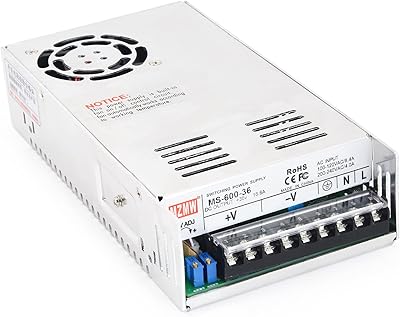
  • Form Factor: Built to the ATX12V form factor for standardized bench and enclosure compatibility.
  • Connector Type: Uses an ATX connector type for output connections.
  • Compatible Voltages: Designed to support devices rated for 5V, 9V, or 12V DC operation.
  • Dimensions: Measures 10.63 x 8.7 x 2.83 inches, giving it a low-profile bench footprint.
  • Weight: Weighs 2.57 pounds, making it light enough to reposition on a workbench without effort.
  • Cooling Method: Uses forced-air cooling via an internal fan combined with passive aluminum heat dissipation.
  • First Available: This model was first listed for sale on June 27, 2023.

Related Reviews
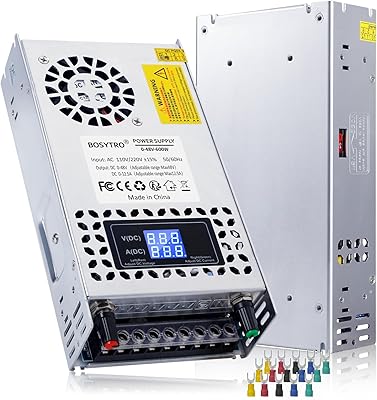
BOSYTRO 48V Adjustable DC Power Supply 600W
83%
88%
Performance
91%
Build Quality
84%
Ease of Use
85%
Safety Features
80%
Cooling Efficiency
More
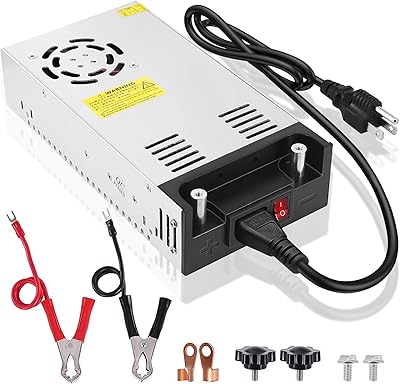
CNCTOPBAOS 600W 36V DC Switching Power Supply
84%
95%
Power Output & Stability
88%
Ease of Use
90%
Cooling Performance
84%
Build Quality & Durability
87%
Size & Compact Design
More
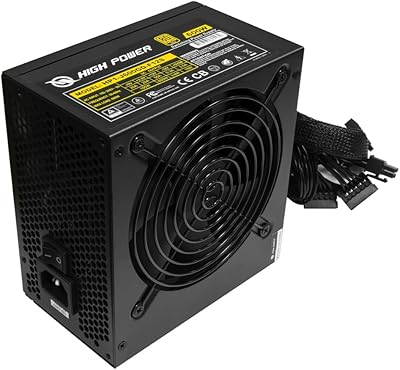
High Power 600W Power Supply, 80 Plus Gold Certified
85%
92%
Energy Efficiency
88%
Noise Level
91%
Build Quality
75%
Installation Process
87%
Value for Money
More
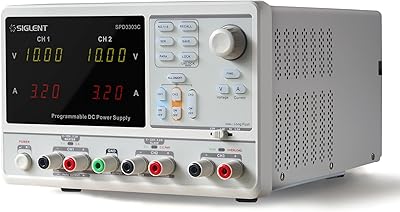
Siglent SPD3303C DC Power Supply
86%
95%
Output Accuracy
93%
Channel Stability
90%
Build Quality
88%
LED Display Clarity
78%
Multi-Channel Programming
More
Eagwell 24V 600W Power Supply
87%
89%
Reliability
94%
Cooling System Performance
80%
Ease of Setup
87%
Power Output Consistency
91%
Safety Features
More
Siglent SPD1305X Programmable DC Power Supply
78%
91%
Output Accuracy & Stability
88%
Display Quality
86%
Build Quality & Construction
79%
Remote Control & Connectivity
63%
Fan Noise
More
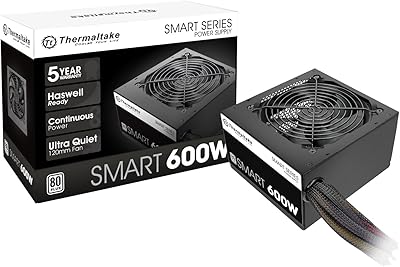
ESGAMING 600W ATX Power Supply PSU
85%
88%
Performance & Reliability
84%
Setup & Installation
92%
Noise Levels
70%
Cable Management
85%
Build Quality
More
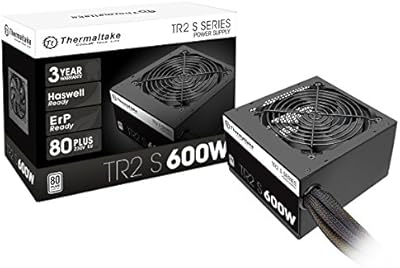
Thermaltake TR2 S 600W ATX Power Supply
76%
88%
Overall Reliability
84%
Value for Money
86%
Noise Level
61%
Cable Management
79%
Energy Efficiency
More
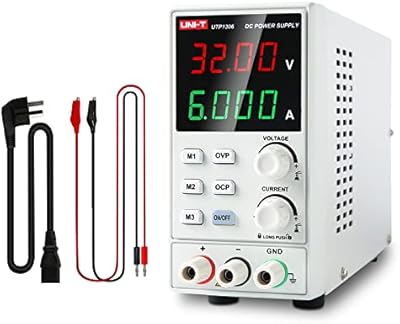
UNI-T UTP1306 Variable Bench Power Supply
79%
88%
Voltage & Current Accuracy
91%
Display Clarity
79%
Build Quality
86%
Output Protection (OVP/OCP/OTP)
71%
Noise & Ripple Performance
More
Hosyond 12V 50A 600W Power Supply
85%
89%
Performance in High-Demand Setups
94%
Voltage Stability
85%
Ease of Installation
88%
Durability and Build Quality
78%
Cooling Efficiency
More

FAQ

You need to set it manually. The ER-9812 is not an auto-switching supply, so before plugging it in, make sure the input voltage selector is correctly set to match your local mains supply. It is a simple but important step to check every time you move the unit between different electrical environments.

The 50A figure is the maximum rated output, and like the 600W power rating, it reflects a peak rather than a guaranteed continuous figure. For sustained high-current work over extended sessions, plan to operate meaningfully below that ceiling to keep thermals stable and avoid stressing the output terminals. This adjustable bench supply is designed for hobbyist-paced use, not industrial duty-cycle applications.

For most bench work, the display is accurate enough to be useful — users generally report readings that track closely with a calibrated multimeter across the mid-range of the output. That said, some units ship with slight calibration offsets, particularly at the low end of the voltage range, so it is a good habit to cross-check with a multimeter when you first set the unit up. After that baseline check, day-to-day use rarely requires constant verification.

Yes, this is actually one of the more common use cases for the ER-9812. You can set it to a stable 12V output and use the current limiting dial to protect your strips during initial commissioning. Just make sure your total strip load stays within a safe operating margin of the unit's sustained output capability.

During light to moderate loads, the fan stays off entirely and the unit runs silently — the fan only activates when internal temperature climbs above 113°F. Once it does kick in, users describe the noise as noticeable rather than disruptive, somewhere between a typical desktop computer fan and a small box fan. If you are doing long high-current sessions, expect to hear it running, but for typical bench use it is unlikely to be a serious distraction.

Technically the voltage range covers 12V output, but this unit is not a dedicated battery charger — it lacks the charging profiles and charge management logic that proper chargers use to safely charge lead-acid batteries through their full charge cycle. Using it as a substitute charger risks overcharging or damaging the battery. For occasional maintenance float charging at a fixed voltage you understand well, some users do it, but for regular battery charging we would recommend a purpose-built charger.

You set the current limit independently using the dedicated dial before applying power to your circuit. If the load tries to draw more than your set threshold, the supply will reduce output voltage to hold the current at the cap — a useful safety net during initial prototyping when you are not yet sure how a circuit will behave. It is not a substitute for proper fusing in permanent installations, but for bench testing it works as expected.

It is not universal, but it is a reported pattern with this unit. A small number of buyers do receive units where the displayed voltage does not exactly match the actual output, particularly below 3V. If your unit shows a consistent offset, check whether the unit has a small trim potentiometer accessible for calibration adjustment — some bench supplies at this tier include one. If the offset is large or inconsistent, contact the seller, as it may indicate a faulty unit rather than a normal calibration tolerance.

Yes, this DC power converter supports 220V–240V AC input, which covers standard European mains voltage. Just make sure you set the input voltage selector to the 220V position before plugging it in, and use an appropriate plug adapter for your country's outlet type since the unit ships with a North American plug configuration.

If your work demands laboratory-grade output precision, traceable calibration, or continuous high-current output over long production runs, this unit will likely leave you wanting more. It is also not ideal for powering anything that requires very low voltages — below about 1.5V — where the adjustment resolution and calibration accuracy of hobbyist-tier supplies tends to be least reliable. For those use cases, a dedicated linear bench supply or a higher-specification unit from a lab equipment brand would be a more appropriate investment.