Overview

The BOSYTRO TYTL-48V600W Adjustable DC Power Supply sits in a practical sweet spot for makers, hobbyists, and anyone setting up a small electronics lab on a real budget. Its headline feature is a wide adjustable output range — dial it anywhere from zero volts up to 48V — paired with a peak capacity that handles most bench workloads comfortably. The compact ATX form factor and aluminum shell make it easy to fit on a cluttered workbench without taking over the space. One thing worth stating clearly upfront: this is an industrial switching supply, not a battery charger. If you need to charge lithium packs or lead-acid cells, look elsewhere. It also comes in several voltage variants, so lower-output options exist in the same family if 48V exceeds your needs.
Features & Benefits

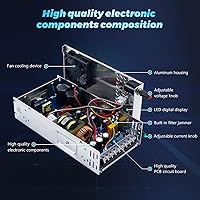
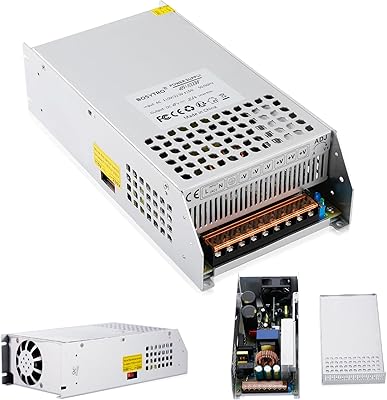
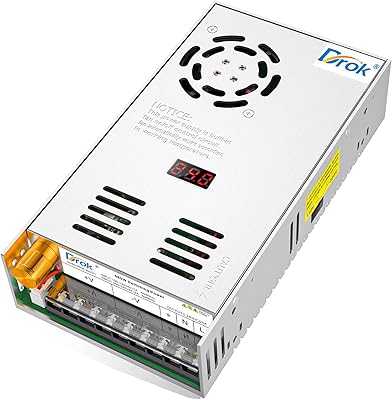
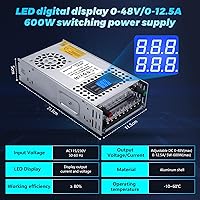
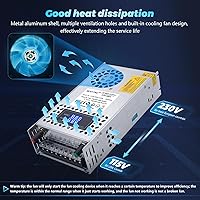
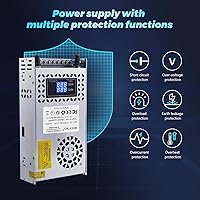
Two independent dials — one for voltage, one for current — let you fine-tune the output without guesswork, and the LED digital readout updates in real time so you always know exactly what your connected device is drawing. The aluminum housing is not just aesthetic; combined with a built-in cooling fan and punched ventilation panels, it keeps temperatures manageable during longer sessions. The unit accepts both 110V and 220V input automatically, which matters if you work across different shop environments. On the safety side, it cuts power if it detects an overload, overvoltage spike, or short circuit — a triple-protection system that adds genuine peace of mind when testing unfamiliar circuits. Build materials are RoHS-compliant and lead-free, with factory insulation and aging tests performed before shipping.

Best For

This adjustable bench supply earns its place on the workbench for a specific kind of user: someone doing hands-on technical work rather than casual tinkering. It is a natural fit for 3D printer builds, where stable, clean DC power over extended print sessions matters more than raw wattage numbers. Electronics students and hobbyists doing component testing will appreciate sweeping the output across a wide range without swapping supplies. LED lighting setups that need dimming control, small automation rigs, CCTV installations, and embedded system prototypes all fall squarely in its wheelhouse. That said, it is not a charger — that distinction genuinely rules out a meaningful slice of potential buyers, so confirming your use case before purchasing is worth the thirty seconds it takes.

User Feedback

Early impressions of the BOSYTRO 48V unit are cautiously positive — sitting at 4.4 stars across a modest pool of reviews, it is encouraging but not yet a large enough sample to treat as a definitive verdict. On the upside, buyers consistently highlight the display accuracy, responsive control dials, and a build quality that feels solid for the price tier. The main friction points are fan noise under heavier loads and a short learning curve for first-time bench supply users who are not familiar with current-limiting setups. A few buyers also flagged that 600W is peak, not a continuous draw — real sustained output runs lower, which is standard for this class of supply but can catch newcomers off guard if they go in with inflated expectations.

Pros

  • Output voltage and current are both independently adjustable, giving precise control over exactly what connected devices receive.
  • The real-time LED display makes it easy to monitor draw without needing separate external meters.
  • Automatic 110V/220V input detection removes the need for manual voltage switching across different power environments.
  • Triple protection against overloads, overvoltage, and short circuits actively safeguards connected components during testing.
  • Aluminum casing with active fan cooling keeps temperatures manageable during moderate sustained sessions.
  • Compact ATX footprint fits comfortably on a standard workbench without consuming excessive space.
  • Multiple voltage variants in the same product family mean you can pick the output range that genuinely matches your project.
  • RoHS-compliant, lead-free construction adds a layer of manufacturing credibility at this mid-range price point.
  • Early buyers consistently highlight display accuracy and the responsive, well-calibrated feel of the control dials.

Cons

  • Fan noise becomes clearly noticeable under heavier loads, which can be disruptive in quieter work environments.
  • The 600W headline is a peak figure, not a continuous rating — real sustained output runs meaningfully lower.
  • First-time bench supply users report a learning curve, particularly around understanding current-limiting behavior from the start.
  • Not suitable for battery charging of any kind, which eliminates it for a common and easily confused use case.
  • The review pool remains small, leaving long-term durability under daily or professional use as an open question.
  • Setup documentation may not be thorough enough for users approaching a bench supply for the very first time.
  • As a relatively new and lesser-known brand, high-frequency professional users may prefer the reassurance of a more established manufacturer.

Ratings

Based on AI analysis of verified global buyer reviews for the BOSYTRO TYTL-48V600W Adjustable DC Power Supply — with spam, bot-generated, and incentivized submissions actively filtered out — the scores below capture what real users experienced across a range of hands-on scenarios. This adjustable bench supply earned consistent praise for its output precision and wide voltage range, but also drew clear criticism around noise levels, documentation, and first-time usability. Both the genuine strengths and the friction points that emerged in day-to-day use are transparently reflected in the ratings that follow.
Value for Money
83%
For the price bracket this unit sits in, buyers across multiple use cases consistently felt they were getting solid performance relative to what they paid. Hobbyists testing circuits and makers powering 3D printers repeatedly noted that comparable features from better-known brands would cost significantly more without delivering proportionally better results.
A handful of buyers felt the value equation was slightly offset by the fan noise and the learning curve involved, both of which add friction that cheaper fixed-output supplies avoid. The peak-versus-sustained power gap also left some users feeling they were not getting the full headroom the headline wattage implied at this price.
Build Quality
79%
21%
The aluminum casing draws consistent positive mentions from users who expected cheap plastic and were pleasantly surprised by the structural feel. On a workbench where supplies get bumped and slid around regularly, the rigidity holds up well, and the LED status indicators add a more polished look than the price tier usually delivers.
Some users noted the finish shows fingerprints and light surface marks with regular handling, and a few questioned whether internal components match the outer shell quality over extended use. For demanding workshop environments, the build feels adequate rather than genuinely rugged.
Output Accuracy
86%
Accurate voltage and current readout is one of the most frequently praised aspects across early buyer feedback. Users doing precise component testing and LED calibration noted that dial adjustments translated reliably to real output, making it easier to dial in exact operating conditions without a separate benchtop multimeter to verify.
A small number of buyers observed minor discrepancies at the very low end of the voltage range, where the display can lag slightly during fine adjustments. This is unlikely to affect most typical use cases but could matter in sensitive measurement or calibration work where precision at near-zero output is critical.
Ease of Use
62%
38%
Users with prior bench supply experience found the independent voltage and current dials intuitive and well-positioned, appreciating the immediate visual feedback from the LED display when adjusting output. For that audience, getting up and running takes only a few minutes with no real surprises.
First-time bench supply users consistently reported confusion around the current-limiting function, which can make the output appear dead or erratic if the current dial is not set correctly before connecting a load. Several buyers wished for a clearer quick-start guide to reduce the initial trial-and-error period that many described as unnecessarily frustrating.
Voltage Range Versatility
91%
The ability to sweep output from essentially zero volts up to 48V in a single unit is one of the strongest arguments for this switching power supply over fixed-voltage alternatives. Electronics hobbyists and embedded systems builders regularly highlighted this range as allowing one supply to cover projects that would otherwise require two or three separate units.
The upper current ceiling is fixed regardless of output voltage, meaning at lower voltage settings the available power is proportionally reduced. Users with high-current applications at 12V or 24V may find the current headroom limiting compared to what a dedicated lower-voltage variant in the same product family would deliver.
Display Readability
81%
19%
The simultaneous voltage and current readout is one of the more practically useful features for everyday bench work, letting users track what a connected device is actually drawing without reaching for a multimeter. Under standard indoor workshop or lab lighting, buyers found the digits clear, well-sized, and easy to read at a normal working distance.
A few users mentioned the display becomes harder to read at an angle or in brightly lit environments, and there is no brightness adjustment to compensate. It is functional and reliable rather than exceptional, and buyers who need precision readability in challenging lighting conditions may want to supplement it with a dedicated meter.
Cooling & Noise
58%
42%
The active cooling system does its job effectively, keeping internal temperatures manageable during moderate sustained loads where a passive-only design would likely struggle. Users running the supply during longer 3D print sessions reported no thermal shutdowns or performance degradation attributable to overheating under typical operating conditions.
Fan noise is the single most recurring complaint across buyer feedback. Under heavier loads the fan becomes clearly audible, which is disruptive in quiet home lab setups or any workspace close to recording equipment. For users who prioritize a quiet working environment, this is a genuine and consistent pain point that does not improve over time.
Safety Features
88%
The triple-protection system covering overload, overvoltage, and short-circuit conditions gives users real confidence when testing unfamiliar circuits or prototyping with components of uncertain tolerances. Buyers noted the protection engaged quickly and reliably without requiring a manual reset in most cases, which is exactly the behavior you want from a bench supply.
The protection thresholds are not user-adjustable, which limits fine-grained control for advanced applications where tighter overvoltage margins might be desirable. The absence of published trigger specifications also makes it harder to predict behavior precisely in edge-case testing scenarios where knowing the exact cutoff point matters.
Power Stability
84%
Buyers running this adjustable bench supply on sustained loads — particularly for 3D printing and LED rig calibration — reported stable, consistent output without noticeable voltage sag or fluctuation under normal operating conditions. This level of output steadiness is one of the more important real-world performance factors for sensitive electronics work.
A small number of users reported minor instability when operating near the upper end of both voltage and current simultaneously, which aligns with the known gap between peak and continuous power ratings. Running the supply at moderate loads rather than pushing its upper limits is the practical workaround most experienced users recommend.
Input Flexibility
87%
Automatic detection of both 110V and 220V input without any manual switching or jumper changes is a genuinely useful feature for anyone working across different shops, lab spaces, or countries. Buyers who travel internationally or maintain mixed-voltage environments flagged this as a practical convenience that removes a common source of costly setup errors.
No significant complaints emerged around input flexibility specifically, though a few buyers noted the included power cord felt shorter than ideal for setups where the wall outlet is not immediately adjacent to the bench. This is a minor logistical inconvenience rather than a meaningful product limitation.
Setup Experience
61%
39%
Users with a technical background found the physical setup quick and logical — the screw terminals are clearly labeled, and the front-panel layout makes sense once you understand what each control does. Experienced makers typically reported being fully operational within minutes of unboxing.
The included documentation appears minimal, and several buyers without prior bench supply experience described an unnecessarily long trial-and-error phase before feeling confident. The absence of a clear quick-start guide is a meaningful gap for a product that regularly attracts first-time bench supply buyers who do not always have the background to self-troubleshoot.
Form Factor
78%
22%
At well under two pounds and with a compact ATX profile, this switching power supply fits easily on a crowded workbench without dominating the available surface area. Users with smaller home lab or study setups appreciated being able to slide it into a shelf or drawer between sessions without significant effort.
While the compact size is a strength for everyday storage and bench use, the unit lacks mounting points or rack hardware, making permanent installation in a structured lab setup a DIY challenge. The lightweight build also means it can shift during dial adjustments if not positioned carefully on a smooth bench surface.
Documentation & Support
54%
46%
The manufacturer provides a customer support contact channel, which a handful of buyers found reasonably responsive when they reached out with technical questions. Having that direct line available is at least a functional baseline for users who hit problems that community forums and online searches cannot quickly resolve.
The in-box documentation is widely considered insufficient by buyers without prior experience, and there is no detailed online manual or manufacturer-produced video guide to fill the gap. For a product that regularly attracts first-time bench supply users, the support infrastructure around setup and troubleshooting falls noticeably and consistently short.
Long-term Reliability
67%
33%
Factory pre-testing covering insulation and aging checks, combined with RoHS-compliant manufacturing, signals a quality-control baseline that goes beyond what budget-tier supplies typically offer. Early buyers who have used the BOSYTRO 48V unit for several months under regular moderate-load conditions reported no significant performance degradation during that window.
With fewer than 60 reviews in the pool and a relatively short time on the market, there is simply not enough long-term data to make strong reliability claims with confidence. Users who need a supply to perform consistently under daily professional use for years should factor this limited track record carefully into their decision.

Suitable for:

The BOSYTRO TYTL-48V600W Adjustable DC Power Supply is built for technically minded users who need a flexible, regulated DC source without paying industrial prices. It is a strong choice for 3D printer enthusiasts who want a dedicated, stable power feed rather than relying on bundled supplies that may struggle over long print cycles. Electronics students and hobbyists doing bench work will find the wide adjustable output range genuinely useful — being able to sweep voltage from near-zero up to 48V in a single unit removes the need for multiple fixed-voltage supplies cluttering the workbench. It also suits small-scale automation builders, LED lighting designers who need adjustable dimming control, and anyone putting together a CCTV or embedded systems project running on a regulated DC rail. If you work across different countries or power environments, the automatic dual-input compatibility makes this switching power supply a practical, travel-friendly lab tool.
Not suitable for:

The BOSYTRO TYTL-48V600W Adjustable DC Power Supply is fundamentally an industrial switching supply, and that single fact rules out a wide category of buyers who might otherwise be drawn in by the specs. If your goal is charging batteries — lithium-ion packs, lead-acid cells, NiMH — stop here; this unit is not designed for charging applications, and attempting it risks damaging both the supply and whatever you connect to it. The 600W rating is a peak figure, not a continuous one, so anyone planning to sustain heavy loads near that ceiling will find real-world headroom lower than the headline number suggests. Buyers with no prior bench supply experience may also encounter a steeper setup curve than expected, particularly around current-limiting behavior. With fewer than 60 reviews at this stage, there is not yet enough long-term data to fully assess durability under daily professional use, so cautious high-frequency users may want to wait for a more established track record.
Specifications

  • Brand: This unit is manufactured by BOSYTRO under the model designation TYTL-48V600W.
  • Model Number: The model number is TYTL-48V600W, part of a broader product family available in multiple voltage and current configurations.
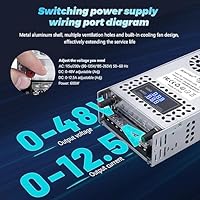
  • Output Voltage: Output voltage is fully adjustable from 0V up to a maximum of 48V via a dedicated front-panel dial.
  • Output Current: Output current is independently adjustable from 0A up to a maximum of 12.5A via its own separate dial.
  • Peak Power: Rated peak output is 600W; actual sustained continuous power will be lower depending on load and thermal conditions.
  • Input Voltage: Accepts AC mains input at both 110V and 220V without requiring any manual voltage selection or jumper changes.
  • Display: An LED digital readout provides simultaneous real-time monitoring of both output voltage and output current during operation.
  • Cooling System: Thermal management combines a built-in active cooling fan with punched ventilation holes distributed across the aluminum housing.
  • Casing Material: The outer enclosure is constructed from aluminum, providing structural rigidity and passive heat-spreading properties alongside the active cooling.
  • Form Factor: Physical layout follows the ATX standard, yielding a compact profile well suited to workbench or small-lab environments.
  • Dimensions: Unit measures 8.46 x 4.53 x 1.97 inches (length x width x height).
  • Weight: The unit weighs 1.65 pounds, making it relatively portable for a switching supply of this output class.
  • Protections: Onboard protection circuits automatically cut output in response to overload, overvoltage, or short-circuit conditions to safeguard connected devices.
  • Compliance: Manufactured under RoHS-compliant, lead-free processes, with factory insulation and aging tests performed on each unit before shipping.

Related Reviews

Siglent SPD3303C DC Power Supply
86%
95%
Output Accuracy
93%
Channel Stability
90%
Build Quality
88%
LED Display Clarity
78%
Multi-Channel Programming
More
Siglent SPD1305X Programmable DC Power Supply
78%
91%
Output Accuracy & Stability
88%
Display Quality
86%
Build Quality & Construction
79%
Remote Control & Connectivity
63%
Fan Noise
More
BOSYTRO 48V 1000W Switching Power Supply
74%
74%
Output Voltage Stability
78%
Build Quality
76%
Thermal Management
83%
Ease of Installation
47%
Documentation & Setup Guidance
More
UNI-T UTP1306 Variable Bench Power Supply
79%
88%
Voltage & Current Accuracy
91%
Display Clarity
79%
Build Quality
86%
Output Protection (OVP/OCP/OTP)
71%
Noise & Ripple Performance
More
SHNITPWR 144W Adjustable Universal DC Power Supply
83%
71%
Voltage Adjustment Accuracy
93%
LCD Display Usefulness
88%
Connector Tip Variety
91%
Safety Protections
67%
Thermal Performance
More
CNCTOPBAOS 600W 36V DC Switching Power Supply
84%
95%
Power Output & Stability
88%
Ease of Use
90%
Cooling Performance
84%
Build Quality & Durability
87%
Size & Compact Design
More
ALITOVE 24V 15A 360W Regulated Switching Power Supply
77%
88%
Voltage Stability
74%
Build Quality
81%
Thermal Management
91%
Protection Features
86%
Value for Money
More
Meiyue Adjustable Power Supply 3V-24V 5A 120W
87%
91%
Value for Money
85%
Ease of Use
94%
Safety Features
88%
Portability
90%
Compatibility
More
Yaheeda ER-9812 600W Adjustable DC Power Supply
78%
83%
Voltage Adjustment Accuracy
78%
Current Limiting Control
91%
LED Display Clarity
69%
Build Quality
86%
Cooling & Thermal Management
More
DROK 48V 480W Adjustable DC Power Supply
81%
86%
Voltage Accuracy
91%
Ease of Use
78%
Build Quality
83%
Thermal Management
67%
Fan Noise Level
More

FAQ

No — the BOSYTRO TYTL-48V600W Adjustable DC Power Supply is strictly an industrial switching supply, not a battery charger. It delivers regulated DC voltage but has no charge-management circuitry, which batteries require for safe and controlled charging cycles. Connecting a battery pack to it risks damaging both the supply and the battery itself.
Not quite. The 600W figure is a peak rating, not a continuous one, meaning the unit can hit that output in short bursts but is not designed to sustain it indefinitely. For extended sessions, plan your actual load well below that ceiling to keep temperatures in check and maintain stable output. Think of it as a headroom indicator rather than a working target.

No manual switching is needed at all. This adjustable bench supply automatically detects whether it is plugged into a 110V or 220V outlet and adjusts internally, so it works straight out of the box in either environment.

There is a moderate learning curve, particularly around the current-limiting function. If the current dial is set too low before you connect a load, the output can appear dead or behave unexpectedly, which confuses a lot of first-timers. Spending fifteen minutes watching a short intro video on how bench supply current limiting works will save you a lot of frustration on your first session.

At lighter loads the fan is relatively unobtrusive, but several buyers have noted it becomes clearly audible when the unit is working harder. It is not unusually loud for a switching supply in this class, but if you record audio nearby or work in a very quiet environment, the noise is worth factoring into your decision.

Yes, this is actually one of the stronger use cases for this switching power supply. It provides stable, regulated DC output suited to the consistent power demands of a 3D printer, and the active cooling helps manage heat across extended sessions. Just confirm that your printer's power draw falls comfortably within the unit's adjustable output range before committing.

If 24V is your maximum requirement, it is worth looking at the lower-voltage variants in the same product family rather than simply dialing this unit down. A supply built around a 24V ceiling will typically give you more usable current headroom at that voltage level, which can be a meaningful practical difference depending on what you are running.

The unit uses screw-terminal output connections, which is standard for switching supplies of this type. You will generally need to prepare your own output wiring or leads to suit your specific device, so check your project’s connector requirements and have appropriate wire on hand before your first session.

Buyers generally report that the display is clear and readable under typical indoor workshop conditions. It shows both voltage and current simultaneously, which is genuinely useful for monitoring draw in real time. In very bright direct sunlight it may wash out somewhat, but for standard bench work under overhead lighting it performs well.

The built-in short-circuit protection should detect the fault and cut the output automatically before damage reaches your connected components or the supply itself. Once you clear the short, you can reset the unit and get back to work. It is one of the more reassuring features for anyone doing exploratory bench testing where accidental shorts are an occupational hazard.