Overview

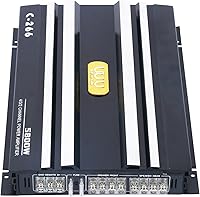
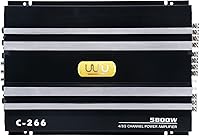
The YaeCCC C-266 4-Channel Car Amplifier is a straightforward, no-frills option built for drivers who want a meaningful audio upgrade without spending a lot. Its aluminum alloy chassis keeps things slim enough to tuck under a seat or fit neatly in a compact trunk, which matters more than it sounds during a real install. Running on standard 12V DC, it works with virtually any vehicle electrical system right out of the box. This is firmly an entry-level unit — it ranks among the top 200 in its Amazon category, which says something, but don't expect audiophile performance. What you're getting is honest value for casual upgraders.
Features & Benefits

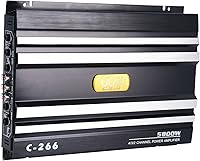
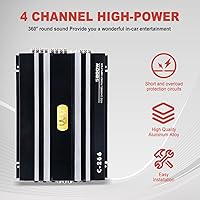
At its core, the C-266 amplifier is rated at 4x100W continuous power — the 3200W figure is a peak ceiling, not what it sustains in daily use, so keep that distinction in mind. The four channels give you real flexibility: run all four to your door speakers, or bridge two channels to feed a subwoofer while the others handle the mids. The aluminum housing acts as a heat sink to keep temperatures in check during longer drives. Built-in short-circuit and thermal overload protection add a layer of safety that cheaper bare-bones amps often skip entirely. The slim profile is a practical win too.

Best For

This car audio amp makes the most sense for someone replacing a stock system for the first time and not looking to spend heavily to do it. Compact vehicle owners will appreciate the slim chassis — it genuinely fits under most seats without much fuss. If your goal is adding some bass kick alongside door speakers without buying a separate mono amp, the bridging capability covers that. It is also a reasonable pick for anyone doing a first-time DIY install — the wiring is not overly complex, though having some basic electrical knowledge before you start will save you real headaches. Casual listening at moderate volumes is where it performs most consistently.

User Feedback

With a 3.8-star rating across over 600 reviews, this 4-channel amp lands in solid-but-not-spectacular territory. Easy installation and a noticeable improvement in bass output are the two things satisfied buyers mention most often. Where it draws criticism is around sustained performance: some users report heat buildup during extended high-volume sessions, and a handful raise concerns about longevity past the one-year mark. The advertised peak wattage also draws skepticism — experienced buyers know the rated 100W per channel is the more relevant figure. Mixed durability feedback is worth noting honestly, but for casual daily listening at reasonable volumes, most buyers seem to walk away satisfied with what they paid for.

Pros

  • Slim aluminum chassis fits cleanly under seats or along trunk walls in compact and mid-size vehicles.
  • Four discrete channels give real routing flexibility, including bridging for a dedicated subwoofer.
  • Built-in short-circuit and thermal overload protection adds a genuine safety net for DIY installers.
  • Noticeable bass improvement over factory head unit output is one of the most consistently praised results.
  • Standard 12V DC operation means it is electrically compatible with virtually any passenger vehicle.
  • Installation is manageable for anyone with basic car audio wiring knowledge and some patience.
  • Ranks among the top 200 in its Amazon category, reflecting meaningful purchase volume and real-world validation.
  • The aluminum alloy casing feels more substantial than the price tier typically delivers.
  • Bridging two channels to power a subwoofer while running door speakers works without needing a second unit.
  • For casual daily listening at moderate volumes, most buyers walk away satisfied with the audio improvement.

Cons

  • The 3200W peak power figure is a marketing ceiling — real continuous output per channel is far more modest.
  • Heat buildup during extended high-volume sessions is a recurring complaint that can trigger protection cutouts mid-drive.
  • Durability concerns in the 6-to-18-month range appear frequently enough in reviews to be taken seriously.
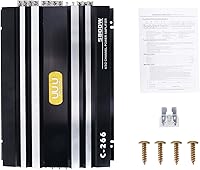
  • Included documentation and accessories are minimal, forcing additional purchases before installation can begin.
  • Signal distortion becomes audible before the amp approaches its limits, a sign of component quality constraints.
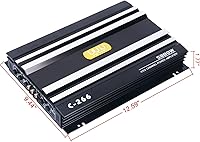
  • The 16.9-inch length may not tuck cleanly under every compact vehicle seat without careful pre-measurement.
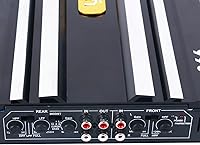
  • No onboard adjustable crossover controls, limiting tuning options for buyers who want more precise audio shaping.
  • Performance at higher volume levels is inconsistent, with output sounding strained rather than controlled.
  • The listed product weight in the specs is clearly erroneous, a small but telling sign of quality-control inattention.
  • Buyers without any electrical background may find the install less straightforward than the product listing implies.

Ratings

The YaeCCC C-266 4-Channel Car Amplifier has been scored using an AI-driven analysis of verified global buyer reviews, with spam, bot activity, and incentivized feedback actively filtered out before scoring. These ratings reflect real-world ownership experiences — from first-time installers to repeat car audio tinkerers — and are designed to surface both where this amp genuinely delivers and where it falls short. Strengths and pain points are weighted equally so you can make a fully informed call before buying.
Value for Money
78%
22%
For the price tier it sits in, most buyers feel they got a fair return on their spend. Drivers upgrading from a stock head unit report a clear, audible improvement in bass and overall volume without having committed to a premium outlay. That context matters a lot when judging this amp fairly.
A portion of buyers feel the value equation weakens once the advertised peak wattage is understood to be a marketing ceiling rather than a real-world figure. If someone paid expecting sustained high-power output comparable to similarly priced competitors, disappointment tends to follow.
Sound Output & Volume
67%
33%
At moderate listening volumes — typical daily commute levels — the C-266 amplifier produces noticeably fuller sound than a factory setup. Bass response in particular draws positive mentions, with drivers noting that even a modest subwoofer feels more controlled and punchy once the amp is in the chain.
Push it toward higher volumes and the performance gap becomes more apparent. Several users report that the amp struggles to maintain clean output at the upper end of its range, and the difference between the claimed max power and what you actually hear at the speaker is a consistent point of frustration.
Build Quality & Materials
71%
29%
The aluminum alloy casing gives this car audio amp a more substantial feel than you might expect at its price point. It does not flex or creak during handling, and the finish looks clean enough that most buyers were pleasantly surprised when it arrived. It feels assembled with at least basic care.
Longer-term durability is where confidence starts to erode. A meaningful slice of reviewers report issues surfacing after several months of regular use, suggesting the internal components may not be as robust as the exterior implies. It holds up fine short-term but raises questions over a full year of ownership.
Heat Management
58%
42%
The aluminum chassis does real work as a passive heat sink during normal driving sessions. For shorter commutes or moderate-volume use, the amp stays cool enough that thermal protection rarely triggers, and the design keeps it from becoming a burn risk in enclosed spaces like under a seat.
Extended high-volume use is where heat management becomes a genuine concern. Multiple buyers describe the unit getting uncomfortably hot during road trips or prolonged sessions, and a subset report the thermal protection cutting the amp out entirely — disruptive when it happens mid-drive on the highway.
Installation Experience
73%
27%
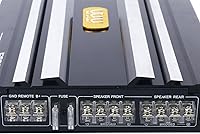
The slim profile is a practical advantage that buyers with limited trunk or under-seat space genuinely appreciate. Most reviewers with at least basic wiring familiarity describe a clean, straightforward install without unusual complications, and the input/output layout is logical enough to follow without much guesswork.
For buyers attempting their first-ever amplifier install with zero electrical background, the process is less forgiving than some listings imply. A handful of one-star reviews trace directly back to wiring errors that could have been avoided with clearer documentation, which the included instructions do not always provide.
Channel Configuration & Flexibility
76%
24%
Having four discrete channels gives this amp genuine routing flexibility. Bridging two channels to drive a subwoofer while keeping the other pair on front speakers is a practical setup that several buyers describe successfully running, essentially getting two-amp functionality from a single unit.
The bridging capability works, but power delivery in bridged mode is modest compared to what dedicated mono amps can achieve at similar price points. Buyers expecting significant subwoofer punch in a bridged configuration may find the output underwhelming relative to their expectations.
Advertised vs. Actual Power
44%
56%
The rated continuous output of 100W per channel is workable for driving standard aftermarket door speakers without clipping at everyday volumes. For casual listening purposes, the real power on tap is enough to notice a clear step up from an unamplified head unit signal.
The 3200W peak figure printed on the product is the single most criticized aspect across the entire review base. Experienced buyers flag it immediately as misleading, and even casual buyers eventually notice the gap. It erodes trust in the brand and colors the overall ownership experience more than almost any other factor.
Protection Circuitry
74%
26%
Short-circuit and DC offset protection are genuinely present and functional, not just marketing copy. Buyers who accidentally wired something incorrectly report the protection circuit catching the fault before damage occurred, which is exactly what it should do and earns real appreciation from DIY installers.
Thermal protection triggering during normal extended use is a double-edged situation — it is working as designed, but frequent cutouts suggest the thermal threshold may be set lower than ideal for real driving conditions. It protects the unit at the cost of your listening experience during longer sessions.
Compatibility with Vehicles
81%
19%
Standard 12V DC operation means this 4-channel amp is plug-compatible with virtually every passenger vehicle on the road. Buyers across a wide range of car makes and model years report no compatibility issues at the electrical level, which removes one common variable from the install equation.
Physical fitment is more situational. While the slim profile helps, the 16.9-inch length means it will not tuck cleanly under every compact seat without some creative mounting. A few buyers in smaller hatchbacks or coupes mention having to rethink placement after the unit arrived.
Bass Performance
72%
28%
Bass improvement is the single most consistently praised outcome in positive reviews. Drivers who added even a basic aftermarket subwoofer to this amp describe a meaningful upgrade in low-end response compared to running the sub directly off a factory head unit. It handles bass frequencies with adequate control at moderate output.
At higher gain settings, bass can become muddy rather than tight, particularly in bridged mode. Buyers with a preference for defined, accurate low end rather than raw thump find the amp less satisfying, and the lack of onboard adjustable crossover controls limits tuning options for more particular listeners.
Form Factor & Dimensions
83%
The low-profile chassis is one of the more legitimate selling points for this car audio amp. Buyers in mid-size sedans and hatchbacks consistently mention fitting it cleanly beneath a seat or along a trunk wall without fabricating a custom mount. It is thin enough to disappear into the install.
The footprint is wider than some competing ultra-slim amps, and the listed weight figure in the product specs is clearly erroneous — a minor but sloppy detail that mildly undermines confidence in the manufacturer's attention to accuracy. Buyers should measure their target space before ordering.
Signal Clarity & Audio Quality
61%
39%
At low-to-mid volume levels, signal clarity is acceptable for a budget-tier unit. Buyers using it to power standard aftermarket coaxial speakers report a clean enough signal that casual listening — podcasts, radio, streaming music at everyday volumes — is perfectly enjoyable during a typical commute.
At higher volumes, distortion becomes audible before the amp reaches its limits, which is a sign that internal component quality has a ceiling. Audiophile-minded buyers who pushed past moderate volumes consistently express dissatisfaction with the clarity, and this amp is simply not designed to satisfy that expectation.
Packaging & Out-of-Box Condition
69%
31%
Most buyers report receiving the unit in acceptable condition with no obvious shipping damage. The box provides enough padding for standard transit, and the amp itself arrives looking as pictured, which at least confirms there are no major quality-control surprises waiting at unboxing.
Included accessories are minimal — some buyers mention receiving little to no wiring hardware or documentation, which forces a separate shopping trip before installation can begin. For a first-time buyer who assumed some basics would be included, this is an annoying and unnecessary friction point.
Long-Term Reliability
53%
47%
For buyers who use the amp within sensible limits — moderate volumes, shorter drives, cooler climates — there are enough accounts of multi-month trouble-free operation to suggest it can hold up adequately when not pushed hard. Light-use scenarios are clearly its most forgiving environment.
The durability picture beyond the six-month mark is genuinely mixed. Enough buyers describe failures or degraded performance in the 6-to-18-month window to make this a real consideration. It is not a universal experience, but it is frequent enough that buyers should factor in a realistic product lifespan expectation.

Suitable for:

The YaeCCC C-266 4-Channel Car Amplifier is a solid match for drivers who are stepping up from a factory audio system for the first time and want a real, audible improvement without a steep financial commitment. If your vehicle has limited installation space — a compact sedan, a small hatchback, a mid-size SUV with a crowded trunk — the slim aluminum chassis makes placement genuinely manageable rather than a puzzle. It suits anyone who wants to run a modest subwoofer alongside a pair of door speakers from a single unit, since the bridging capability handles that setup without needing a second amp. Casual listeners who care most about bass presence during daily commutes rather than reference-grade accuracy will find the performance squarely in line with their expectations. Anyone doing a DIY install for the first time will also appreciate that the wiring layout is logical and the built-in protection circuitry provides a real safety net — provided they bring at least a basic understanding of car audio wiring to the job.

Not suitable for:

The YaeCCC C-266 4-Channel Car Amplifier is not the right tool for anyone who needs sustained, high-volume output or expects the peak wattage figures printed on the unit to reflect real-world performance — they do not, and experienced buyers will notice immediately. Audiophiles or enthusiasts who prioritize clean signal reproduction, tight bass definition, and low distortion at higher listening levels will find this car audio amp falls short in every one of those areas. Drivers who spend long stretches on the road and tend to run their audio at elevated volumes should also look elsewhere, since heat buildup under sustained load is a documented and recurring complaint among owners. If long-term reliability over two or more years is a firm requirement — for a vehicle you plan to hold onto and invest in properly — the mixed durability feedback in the review base warrants genuine caution. This 4-channel amp is best understood as a short-to-medium-term upgrade for light use, not a foundation for a serious, lasting car audio build.
Specifications

  • Brand & Model: Manufactured by YaeCCC (Yae First Trading Co., Ltd) under the model designation C-266.
  • Channels: This amplifier operates as a 4-channel unit, with the option to bridge channel pairs for dedicated subwoofer output.
  • Max Power: Peak power output is rated at 3200W total across all four channels under ideal lab conditions.
  • Rated Power: Continuous (RMS) rated power output is 4x100W per channel, which is the figure that reflects real-world daily listening performance.
  • Operating Voltage: The amplifier is designed to operate on a 12V DC power supply, compatible with the standard electrical systems found in most passenger vehicles.
  • Chassis Material: The outer casing is constructed from aluminum alloy, which serves as a passive heat sink and provides structural durability without adding significant weight.
  • Form Factor: The unit features a low-profile, slim design intended for under-seat or trunk-mounted installation in space-constrained vehicles.
  • Dimensions: Package dimensions are listed as 16.9 x 12.9 x 3.3 inches, reflecting the overall footprint buyers should measure against their intended installation space.
  • Mounting Type: Designed for car mount installation, compatible with standard amplifier mounting hardware and brackets.
  • Thermal Protection: Built-in thermal overload protection automatically cuts power output if internal temperatures exceed safe operating thresholds during prolonged use.
  • Short Circuit Protection: Onboard short-circuit protection circuitry is present and functional, helping prevent component damage in the event of wiring errors during installation.
  • DC Offset Protection: DC offset protection is included, guarding connected speakers against potentially damaging direct current leakage from the amplifier output stage.
  • Sound Coverage: The manufacturer describes the unit as offering 360-degree sound coverage, referring to full-range signal distribution across all four channels rather than spatial audio processing.
  • Amazon Ranking: As of available data, this car audio amp holds a Best Sellers Rank of approximately #173 in the Car Multichannel Amplifiers category on Amazon.
  • Market Availability: The product was first listed for sale in May 2018 and is not listed as discontinued by the manufacturer as of the most recent data available.

Related Reviews
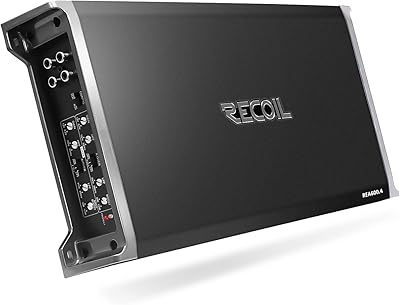
Recoil REA600.4 4-Channel Car Audio Amplifier
84%
89%
Audio Performance
91%
Ease of Installation
85%
Sound Quality at High Volumes
62%
Heat Management
90%
Power Output
More
Recoil DI800.4 4-Channel Car Audio Amplifier
83%
88%
Sound Quality
92%
Power Output
65%
Thermal Management
84%
Build Quality
91%
Ease of Installation
More
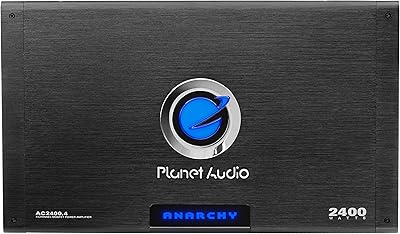
Planet Audio AC2400.4 4-Channel Car Amplifier
84%
95%
Power Output
89%
Sound Clarity
87%
Bass Performance
82%
Ease of Installation
65%
Thermals/Heat Management
More
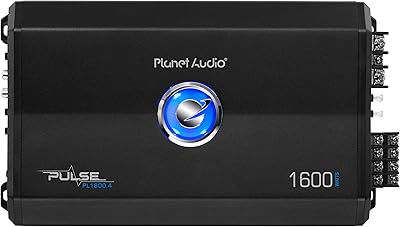
Planet Audio PL1600.4 4-Channel Car Amplifier
72%
88%
Value for Money
84%
Ease of Installation
74%
Sound Quality
58%
Power Output (Real-World)
61%
Build Quality
More
Recoil DI550.4 4-Channel Car Audio Amplifier
74%
91%
Value for Money
78%
Power Output
86%
Ease of Installation
74%
Sound Quality
67%
Build Quality
More
Planet Audio AC1600.4 Anarchy Series 4-Channel Car Amplifier
82%
94%
Power Output
88%
Sound Quality
70%
Ease of Installation
92%
Value for Money
85%
Build Quality
More
Soundfy SA 400.4 4-Channel Car Amplifier
71%
78%
Value for Money
72%
Sound Quality
63%
Power Output
58%
Build Quality
81%
Thermal Management
More
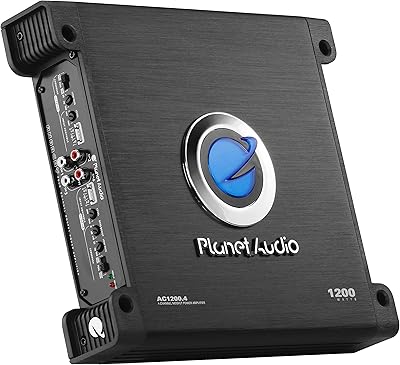
Planet Audio AC1200.4 4-Channel Car Amplifier
73%
88%
Value for Money
67%
Power Output
83%
Installation Ease
74%
Sound Quality
61%
Build Quality
More
Stetsom HL 2000.4 2-Ohm 4-Channel Car Audio Amplifier

87%
93%
Power Output
85%
Cooling System Efficiency
88%
Sound Quality
91%
Ease of Installation
82%
Durability
More
Hifonics BXX800.4 Brutus 800W RMS 4-Channel Car Audio Amplifier
86%
88%
Sound Quality
92%
Power Output
85%
Build Quality
72%
Heat Management
89%
Ease of Installation
More

FAQ

Yes, and this is actually one of the most practical use cases for a 4-channel amp like this one. You bridge two of the channels together to create a higher-output feed for your subwoofer, then run the remaining two channels to your front or rear door speakers. It is a common setup and works well at moderate listening levels without needing a second dedicated mono amp.

That figure represents peak power under ideal conditions and is best treated as a ceiling rather than a target. The more meaningful number for everyday listening is the rated continuous output, which is 100W per channel — and even that assumes optimal conditions. If you go in with realistic expectations around that continuous figure, you are much less likely to feel misled by the amp's actual performance.

Potentially, but measure first. The unit is 16.9 inches long, which is on the wider side for under-seat installation. It fits cleanly under many mid-size sedan seats, but compact hatchbacks and sports cars with lower seat rails can be a tighter call. Check your available clearance before ordering to avoid having to find an alternative mounting location after the fact.

It is a realistic DIY install for anyone who has basic familiarity with car audio wiring — things like understanding power and ground runs, remote turn-on leads, and RCA signal cables. If you have never opened an amp wiring diagram before, it is worth spending an hour reading a beginner install guide first. The built-in protection circuitry does provide a useful safety net if a connection is slightly off, but it is not a substitute for correct wiring practice.

During typical commutes at moderate volumes, heat is generally manageable — the aluminum casing does real work dissipating temperature passively. The concern comes during extended high-volume sessions, like long road trips with the gain cranked up, where multiple owners report the unit getting noticeably hot and occasionally triggering the thermal cutout. For casual daily use, most buyers do not encounter serious heat issues.

The product listing does not specify a minimum impedance rating, which is an important gap in the available technical data. As a general guideline for budget-tier amplifiers in this class, running at 2-ohm loads increases current draw and heat significantly. Until the manufacturer provides confirmed impedance specifications, treating this as a 4-ohm amp is the safer approach to avoid stressing the output stage.

Several buyers note that included accessories are minimal — do not expect a complete wiring kit in the box. You will almost certainly need to purchase a power cable, ground wire, RCA cables, and speaker wire separately before your install can begin. Budget for a basic amp wiring kit when you order the unit to avoid a frustrating delay.

This is genuinely one of the more honest questions to ask. Short-term performance through the first several months tends to draw positive feedback. Beyond six months to a year, the review picture gets more mixed, with a notable subset of buyers describing degraded performance or component failures. It is not a universal experience, but it is frequent enough that buyers should factor in a realistic rather than optimistic lifespan expectation for this price tier.

No, there is no onboard adjustable crossover control on this unit. That means you cannot use the amp itself to high-pass your door speakers or set a low-pass frequency for a subwoofer feed without an external crossover or a head unit that supports those adjustments. It is a meaningful limitation if you want precise tuning control over your system.

This depends on your head unit. If your factory stereo only has speaker-level outputs and no dedicated RCA preamp outs, you would need a line output converter to adapt the signal before it reaches this car audio amp. Line output converters are inexpensive and widely available, so it is a solvable problem — just factor in the extra step and the small additional cost if your vehicle has a stock head unit.

Where to Buy