Overview

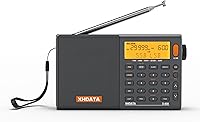
The XHDATA D808 Portable Multiband Radio is not the kind of radio you pick up on a whim — it's built for people who actually know what longwave and airband mean. Compact enough to slip into a day bag, it covers five bands with a range that most radios this size simply don't offer. The DSP chip is a real asset here, pulling in stations cleanly without the static-heavy fumbling you'd get from older analog designs. Add USB-C charging alongside a swappable lithium-ion battery, and it makes practical sense for travel. Just be clear-eyed: this is an enthusiast's tool, not background noise for your kitchen.

Features & Benefits

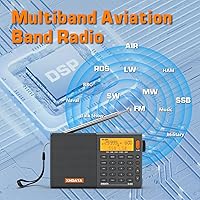
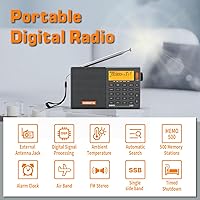
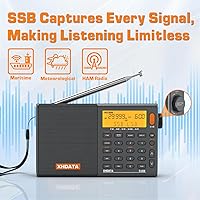
The D808 covers FM, AM, shortwave, longwave, and airband — and it adds SSB reception on top, which opens up ham radio signals and utility broadcasts that typical portables ignore entirely. The DSP chip does the heavy lifting on signal processing, making it noticeably easier to lock onto weak shortwave stations. A 500-station memory with keypad entry means you're not rescanning from scratch every session. The LCD screen earns its place by simultaneously showing signal-to-noise ratio, clock, and temperature at a glance. The bundled external antenna isn't an afterthought either — it makes a tangible difference when chasing distant signals, and the included carrying bag means everything travels together neatly.

Best For

This multiband receiver makes the most sense for shortwave enthusiasts and airband listeners who want real band coverage in a pocketable chassis. If you're a ham radio newcomer curious about SSB listening before investing in a transceiver, the D808 is a reasonable way to explore that territory — though expect a genuine learning curve when fine-tuning SSB signals. Campers and off-grid travelers will appreciate having AM, FM, and shortwave in one unit when live broadcasts are your only outside news source. The alarm clock feature, which wakes you to a live station, is a genuine bonus for bedside use. Less suited for casual listeners who simply want easy FM.

User Feedback

Buyers consistently highlight shortwave sensitivity and airband pickup as genuine strengths — many report pulling in distant stations that comparable radios in this class couldn't manage. The LCD display draws consistent praise, with users noting it stays readable in both bright outdoor light and dim indoor settings. On the critical side, more than a few mention that SSB tuning demands patience, and the menu navigation isn't exactly self-explanatory straight out of the box. Build quality gets a mixed reception: the plastic chassis feels solid enough for travel but won't inspire much confidence if you're rough on gear. Real-world battery life is respectable, though some users find it slightly below the advertised peak under heavy listening sessions.

Pros

  • Five-band coverage including airband and SSB puts it well ahead of most portables in this size class.
  • The DSP chip delivers noticeably cleaner signal acquisition, especially on crowded shortwave frequencies.
  • USB-C charging is a welcome modern touch that works with cables most travelers already carry.
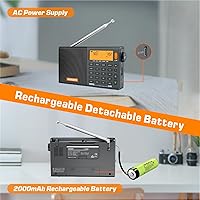
  • The replaceable battery means you're never stranded — just swap in a spare if needed.
  • A 500-station memory with keypad entry makes recalling favorite frequencies fast and practical.
  • The LCD display packs in SNR monitoring, battery level, temperature, and clock without feeling cluttered.
  • The included external antenna genuinely improves reception on weaker shortwave and airband signals.
  • At under 1.15 pounds, this multiband receiver is light enough to pack without second-guessing.
  • The bundled carrying bag keeps the unit and accessories organized for travel right out of the box.
  • Station-linked alarm clock is a genuinely useful feature for listeners who want to wake to a live broadcast.

Cons

  • SSB fine-tuning requires patience and practice — not intuitive for first-time users.
  • Menu navigation has a noticeable learning curve that the included manual only partially addresses.
  • The plastic chassis feels adequate but not particularly reassuring for rough or outdoor-heavy use.
  • Real-world battery life under sustained heavy listening can fall noticeably short of advertised figures.
  • The built-in speaker suits voice formats only — music playback sounds thin and lacks any low-end presence.
  • No weather band (NOAA) support, which is a meaningful omission for emergency-preparedness buyers.
  • The grey plastic finish picks up smudges easily and the overall aesthetic feels utilitarian rather than premium.
  • Direct keypad frequency entry, while useful, requires consulting the manual until the key layout becomes familiar.
  • RDS metadata display on FM is functional but basic compared to dedicated FM receivers at similar price points.
  • No carry strap or belt clip included, which limits quick-access portability during outdoor activities.

Ratings

Our AI rating system analyzed verified global user reviews for the XHDATA D808 Portable Multiband Radio, actively filtering out incentivized, bot-generated, and low-signal feedback to surface what real buyers consistently experience. The scores below reflect both the genuine strengths that keep enthusiasts coming back and the friction points that give some buyers pause. Nothing has been softened — if a category has a real weakness, the score shows it.

Reception Quality
91%
Shortwave and airband sensitivity are consistently the most praised aspects of the D808 across user communities. Listeners report pulling in distant international shortwave stations and clear airband transmissions that comparable portables in this class simply miss, particularly when the bundled external antenna is connected.
A smaller but vocal group of users notes that urban RF interference can overwhelm the receiver without careful antenna positioning. FM sensitivity, while functional, draws slightly less enthusiasm than the shortwave and airband performance relative to dedicated FM portables.
Band Coverage
93%
Five bands plus SSB in a unit this compact is genuinely rare, and buyers upgrading from basic AM/FM radios are often surprised by how much ground this multiband receiver covers. The inclusion of both longwave and airband in a single portable is a specific draw for hobbyists and travelers who previously needed multiple devices.
The absence of NOAA weather band coverage is a recurring point of disappointment, particularly among buyers in North America who assumed weather radio would be included given the breadth of other bands. This is a meaningful gap for emergency-preparedness use cases.
DSP Performance
86%
The DSP chip is a tangible upgrade over analog-tuned competitors, making it noticeably easier to lock onto and hold weaker signals, especially in the shortwave segments. Users who have owned older analog portables frequently comment on how much less manual fiddling is required to get a clean, stable signal.
On heavily congested shortwave bands, DSP filtering can occasionally clip adjacent signals in ways that feel slightly artificial compared to high-end dedicated receivers. A handful of experienced ham radio operators note that the DSP's behavior during SSB fine-tuning requires more deliberate adjustments than they expected.
SSB Usability
67%
33%
For the price tier, SSB reception capability is a genuine value-add that opens up amateur radio listening and utility stations to users who would otherwise need a far more expensive rig. Hobbyists who take time to learn the controls report satisfying results monitoring ham bands and international SSB broadcasts.
SSB fine-tuning is consistently the steepest part of the learning curve, with multiple users describing the BFO adjustment as fiddly and unforgiving for newcomers. The manual provides limited guidance on SSB operation, which leaves beginners frustrated during the first few sessions.
Display & Interface
82%
18%
The LCD display earns consistent praise for its information density — seeing frequency, SNR, battery level, and temperature at a glance is appreciated by users who use this portable shortwave radio in varied conditions, from bright outdoor daylight to dim bedside use. The backlight is effective without being harsh.
Menu navigation logic receives persistent criticism for feeling counterintuitive, particularly when setting alarms or toggling between memory banks. Several buyers note that without regular use, the button sequences are easy to forget, making the manual a recurring reference rather than a one-time read.
Ease of Use
61%
39%
Once the initial learning curve is cleared, everyday tasks like recalling memory presets and switching bands become quick and reliable. Users who invest an hour or two with the manual in hand generally report feeling comfortable with core functions for their regular listening routines.
The initial setup experience is a recurring friction point, especially for buyers coming from simple AM/FM radios. The keypad layout is not immediately logical, and the English manual, while included, is described by many users as covering the basics without enough practical guidance for more advanced features.
Build Quality
71%
29%
The chassis feels solid enough for careful travel and everyday desk or bedside use, and buyers report no flexing or rattling from the cabinet even after extended ownership. The button action is described as positive and deliberate rather than mushy.
The grey plastic finish shows fingerprints easily and the overall material feel does not quite match the mid-range price point — several users expected something that felt more premium given what they paid. It holds up fine under gentle conditions but draws concern from anyone who plans to use it in rougher outdoor environments.
Battery Life
68%
32%
The replaceable lithium-ion battery system is genuinely practical for travelers — being able to carry a spare cell and hot-swap it in the field rather than waiting for a recharge is a frequently cited advantage over sealed-battery competitors.
Real-world battery endurance consistently comes in below what the advertised figures suggest, particularly at moderate-to-high volume or with frequent backlight use. Buyers relying on this portable shortwave radio for all-day camping or emergency listening scenarios are advised to carry a spare battery.
Audio Quality
72%
28%
For voice-format content — news broadcasts, shortwave talk programming, airband monitoring, and amateur radio — the speaker is clear and intelligible at comfortable volumes. Users doing bedside listening or desktop monitoring find the audio quality appropriate for the format.
Music playback is where the speaker notably falls short, producing a thin and midrange-heavy sound with little low-end presence. Buyers expecting a versatile household radio for both broadcast listening and music will likely find the audio quality underwhelming for anything other than spoken-word content.
Portability
88%
At just over one pound and fitting easily in a jacket pocket or day bag, the D808 travels without adding meaningful bulk or weight. The included carrying bag keeps the unit and its accessories together neatly, which frequent travelers particularly appreciate.
The lack of a carry strap, belt clip, or any external attachment point limits quick-access portability during active outdoor use. Users who want to monitor airband signals while moving around an airport or campsite have no hands-free option without adding third-party accessories.
External Antenna
83%
The bundled external antenna delivers a noticeably real improvement on shortwave and airband reception, and the fact that it is included in the box rather than sold separately is consistently acknowledged as a thoughtful decision. Users in rural areas especially report that it makes a significant difference.
The antenna connection can feel slightly loose on some units, and the included cable length limits how far from the radio you can position the antenna for optimal placement. A longer or more flexible antenna cable would expand the practical setup options meaningfully.
Value for Money
78%
22%
For buyers who specifically want five-band coverage with SSB and airband in a compact form, the D808 represents a reasonable value proposition relative to what dedicated multi-band receivers would cost at higher price points. The accessory bundle adds tangible value without inflating the package price.
Buyers who only want FM and AM reception, or who misjudge the learning curve, frequently feel the price is hard to justify in hindsight. The value equation is strong for the target enthusiast user but notably weak for casual listeners who could meet their needs with a much simpler, less expensive device.
Alarm Clock Function
76%
24%
The station-linked alarm is a genuine differentiator for bedside users who want to wake to a specific broadcast rather than a generic beep, and buyers who use it as a clock radio report it working reliably once configured correctly.
Configuring the alarm requires navigating the same menu system that draws criticism elsewhere, and some users report having to re-set the time and alarm after battery swaps due to volatile memory behavior. It works, but the setup process adds friction that a bedside clock radio should not have.
Memory System
79%
21%
Five hundred memory slots with direct keypad frequency entry is a practical and well-implemented feature that shortwave regulars use heavily. Once stations are saved, recalling them is fast and requires no rescanning, which makes the daily listening experience noticeably more convenient.
The memory organization system lacks named labeling for stored stations, so users working with large numbers of saved frequencies must rely on slot numbering alone to stay organized. For listeners spanning multiple bands and dozens of stations, this becomes a minor but recurring inconvenience.

Suitable for:

The XHDATA D808 Portable Multiband Radio is a strong match for hobbyists and enthusiasts who already understand what they're shopping for — people who want legitimate shortwave, longwave, and airband coverage in a unit small enough to travel with. It's a natural fit for campers and off-grid travelers who rely on AM and shortwave broadcasts for news and emergency information when cellular service is gone. Ham radio newcomers who want to explore SSB listening without committing to a full transceiver setup will find it a practical entry point, provided they're prepared to invest time learning the controls. The dual power system — USB-C charging combined with a replaceable lithium-ion battery — makes it genuinely useful on extended trips where access to outlets is unpredictable. Anyone who doubles their bedside clock and radio into one device will also appreciate the station-linked alarm function.

Not suitable for:

The XHDATA D808 Portable Multiband Radio is not the right choice for someone who just wants a simple, grab-and-go FM radio for casual background listening. The interface and feature set assume a certain level of prior radio knowledge — buyers who have never tuned SSB or navigated a multi-band receiver will likely find the learning curve frustrating rather than rewarding. The built-in speaker is designed for voice and talk-format broadcasts, so anyone expecting rich, room-filling music playback will be disappointed. It is also not ideal for buyers who prioritize ruggedness, as the plastic chassis, while acceptable for careful travel, doesn't inspire confidence for rough outdoor handling. Finally, if you have no interest in shortwave, longwave, or airband and only listen to local FM stations, this radio's feature set is overkill and the price premium makes little practical sense.

Specifications

  • FM Band: Covers FM broadcasts from 64 to 108 MHz with RDS (Radio Data System) support for station name display.
  • AM Band: Receives AM signals across 520 to 1710 kHz, suitable for standard medium-wave broadcast stations.
  • Shortwave Band: Tunes shortwave frequencies from 1711 to 29999 kHz, covering the full international shortwave broadcast range.
  • Longwave Band: Receives longwave signals from 153 to 513 kHz at a 9 kHz channel step, standard for European and Asian LW broadcasts.
  • Airband: Monitors aviation communications across 118 to 137 MHz in AM mode, used by pilots and air traffic control.
  • SSB Reception: Supports Single Sideband (SSB) reception for upper and lower sideband signals commonly used by amateur radio operators.
  • Signal Processing: Uses a DSP (Digital Signal Processing) chip to filter interference and improve station lock across all bands.
  • Station Memory: Stores up to 500 station presets, accessible via direct keypad entry for fast recall without rescanning.
  • Display: Backlit LCD screen shows frequency, signal-to-noise ratio, battery level, time, and ambient temperature simultaneously.
  • Power Source: Operates on a single included rechargeable lithium-ion battery and also accepts power via USB-C at 5V DC input.
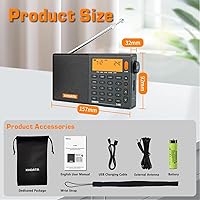
  • Dimensions: Measures 5.9″ long by 2″ wide by 3.4″ tall, making it compact enough to fit in a jacket pocket or day bag.
  • Weight: Weighs 1.14 pounds with battery installed, keeping it light enough for extended carry without fatigue.
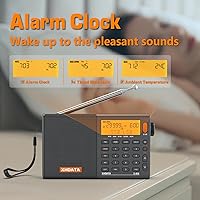
  • Alarm Clock: Built-in alarm clock can wake the user to a pre-set radio station rather than a tone, functioning as a clock radio.
  • External Antenna: Includes a dedicated external antenna port and a bundled antenna to improve signal reception on shortwave and airband.
  • Included Accessories: Ships with a carrying bag, external antenna, USB charging cable, one lithium-ion battery, and an English-language manual.
  • Color: Available in grey with a modern utilitarian design; the chassis is constructed from plastic with a matte finish.
  • Connectivity: Connects to power sources via a USB-C port; no Bluetooth, Wi-Fi, or audio output jack is listed in official specifications.
  • Tuner Technology: Uses a DSP-based AM/FM tuner architecture, which enables digital precision across analog broadcast bands.

Related Reviews
XHDATA D368 Portable Shortwave Radio
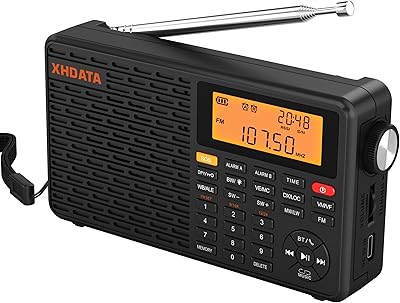
74%
84%
FM Reception Quality
71%
Shortwave Reception
58%
AM Reception Quality
66%
Build Quality & Durability
78%
Battery Life
More
XHDATA D109WB Portable Shortwave Weather Radio
72%
78%
Reception Quality
61%
Build Quality
83%
NOAA Weather Alert
71%
Bluetooth Performance
84%
Value for Money
More
LEOTEC Portable AM FM Bluetooth Radio
77%
91%
Ease of Use
83%
FM Reception Quality
61%
AM Reception Quality
72%
Bluetooth Functionality
68%
Speaker Volume & Clarity
More
ByronStatics AM66 Portable Radio
84%
85%
Reception & Sound Quality
90%
Ease of Use
88%
Portability & Size
80%
Build Quality
92%
Power Options (AC/Battery)
More
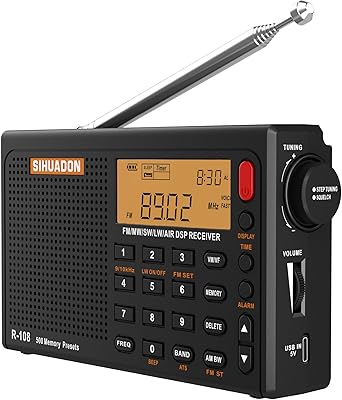
SIHUADON R108 Portable Radio
86%
88%
Reception Performance
93%
Portability
84%
Sound Quality
90%
Ease of Use
78%
Build Quality
More
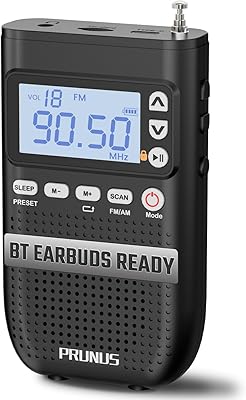
PRUNUS J-130 Portable AM/FM Bluetooth Radio
78%
83%
AM/FM Reception Quality
79%
Bluetooth Connectivity
71%
Battery Life
93%
Ease of Use
76%
Sound Quality
More
Retekess TR629 Portable Shortwave Radio
83%
88%
Reception & Signal Quality
83%
Ease of Use
91%
Portability & Design
85%
Recording Function
80%
Battery Life
More
PRUNUS J-618 Portable AM FM Radio
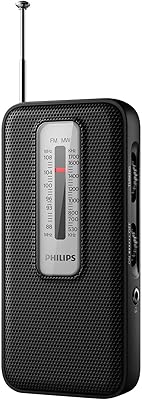
81%
88%
Bluetooth Headphone Connectivity
74%
AM/FM Reception Quality
79%
Battery Life
91%
Value for Money
83%
Ease of Use
More
GPX R602B Portable AM/FM Clock Radio
78%
93%
Ease of Use
88%
AM Reception
58%
FM Reception
86%
Clock Accuracy & Reliability
67%
Build Quality & Durability
More
ONCHEER AM/FM/SW Portable Retro Radio
74%
83%
Value for Money
89%
Design & Aesthetics
86%
Ease of Use
74%
AM/FM Reception
51%
Shortwave Reception
More

FAQ

It depends on what you mean by beginner. If you want to explore FM and AM stations with a better-than-average receiver, you will manage just fine. But if you plan to use SSB or airband features, expect a real learning curve — those modes require some patience and ideally a bit of background reading before they start making sense.

Yes, the D808 receives the civil aviation airband between 118 and 137 MHz, which is where air traffic control and pilot communications live. You will hear transmissions from aircraft and towers in your area, though range and clarity depend heavily on your location relative to the airport and your antenna setup. It is a receive-only function — you cannot transmit.

It can run on USB-C power with the battery installed and charging simultaneously, but it is not confirmed to operate without a battery present. For reliable use, keep the included lithium-ion battery in the unit and treat USB-C as your primary charging method when near an outlet.

Quite noticeable, especially on shortwave and airband. The built-in 360-degree antenna handles FM and strong AM stations reasonably well on its own, but connecting the external antenna when hunting weaker shortwave signals makes a meaningful difference in how cleanly the radio locks on to those frequencies.

Not really — and it is worth being upfront about that. The speaker is sized and tuned for voice content like news, talk radio, and amateur transmissions. It handles those formats clearly and with good intelligibility, but music comes across as thin and flat, lacking any low-end warmth. If music listening is your main goal, this portable shortwave radio is not the right tool.

User experiences vary, but general feedback suggests real-world listening time lands somewhere below the maximum advertised figure, particularly at higher volume levels or when the backlight is active frequently. For casual sessions it holds up well, but for extended travel or camping use, carrying a spare compatible lithium-ion cell is a sensible precaution.

Yes, that is one of the more practical features on this multiband receiver. You can configure the alarm to power on the radio to a pre-selected station at a set time, which works well as a bedside clock radio. The time and alarm settings are handled through the front panel controls and explained in the included manual.

It is reasonable for careful travel — the chassis is sturdy plastic that should survive a bag or backpack without issue under normal conditions. That said, it is not ruggedized or weather-resistant in any way, so it would not be the right companion for genuinely rough outdoor environments. The included carrying bag helps protect it from scratches and minor knocks.

No. NOAA weather radio broadcasts on dedicated frequencies between 162.400 and 162.550 MHz, which fall outside the airband range this radio covers (118 to 137 MHz). If weather band reception is important to you, this is a meaningful gap worth considering before buying.

Once you understand the logic, it is fairly straightforward: you tune to a frequency and assign it to one of the 500 memory slots via the keypad. Direct keypad entry of known frequencies is also supported, which speeds things up considerably once you have your favorite shortwave and FM stations logged. The initial setup takes a little time, but day-to-day recall is quick after that.

Where to Buy