Overview

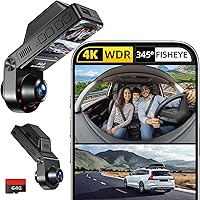
The TUIFAC GT820 Dual-Channel Dash Cam is a relatively new entry from an emerging brand that takes a practical approach: instead of pairing two conventional cameras, it combines a 4K front lens with a wide 185° fisheye pointed into the cabin, covering both road and interior in a single unit. TUIFAC isn't a household name yet — worth acknowledging openly — but the hardware punches above what you'd typically expect at this price tier, with GPS, supercapacitor power, and a 64GB card included right out of the box. It's a compact, windshield-mounted setup that makes a genuinely reasonable case for itself.
Features & Benefits

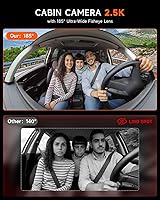
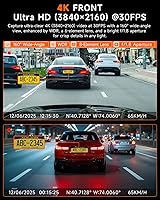
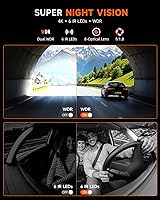
The GT820's most notable combination is its 4K front lens at 160° paired with a 185° fisheye cabin view — together covering a wide swath of your vehicle without requiring a second unit. Both channels use WDR processing alongside six IR LEDs behind an f/1.8 aperture, which makes a real difference when recording a dim parking structure or a poorly lit road at night. Built-in WiFi links to the VEECAR app for reviewing or downloading footage straight from your phone. The onboard GPS logs route, speed, and mileage, while the supercapacitor design keeps the unit reliable across temperature extremes that would shorten the life of a standard battery-based camera.

Best For

This dual-channel dash cam makes the most sense for rideshare and taxi drivers who need documentation of both the road ahead and the passenger compartment. Night-shift delivery drivers will also appreciate the cabin IR night vision — something most single-lens cams skip entirely. If you live somewhere with brutal summers or harsh winters, the supercapacitor handles temperature swings that tend to wear out battery-powered alternatives faster. And for anyone who has dealt with a disputed accident or an insurance claim, having GPS-logged speed and route data alongside the video footage adds real, practical value beyond just ticking a spec box.

User Feedback

With roughly 87 ratings at the time of writing, the feedback pool for this fisheye cabin cam is still fairly limited, so early trends could shift — keep that in mind. Buyers tend to call out video clarity and the relatively painless app setup as standout positives, and rideshare drivers specifically mention cabin night vision performance. On the downside, a handful of users flag edge distortion in the fisheye view, which is an inherent optical trade-off rather than a manufacturing flaw. The VEECAR app draws a few complaints about occasional instability. GPS accuracy reads as reliable in current reports, though long-term durability data for this newer brand is still accumulating.

Pros

  • Single-unit design covers both road and cabin without mounting a second camera
  • Supercapacitor handles temperature extremes that regularly damage battery-powered competitors
  • GPS logging captures real-time speed and route — directly useful for insurance claims
  • Cabin IR night vision is genuinely capable in low-light rideshare conditions
  • 64GB card included means the GT820 is ready to record straight out of the box
  • G-sensor sensitivity is adjustable across 15 levels, reducing false-trigger frustration on rough roads
  • 4K front footage retains enough detail to read license plates in well-lit conditions
  • Feature set — GPS, WiFi, dual channels, supercapacitor — is hard to match at this price tier
  • Electrostatic windshield mount leaves no adhesive residue, important for leased vehicles
  • VEECAR app setup is consistently described as fast and straightforward by early buyers

Cons

  • App stability is inconsistent — disconnections and crashes reported, especially on Android
  • Fisheye edge distortion is visible in cabin footage and cannot be corrected in post
  • WiFi file transfer is too slow for routine review of longer 4K recordings
  • Mount hold can shift in prolonged direct heat, requiring periodic repositioning
  • Default G-sensor sensitivity triggers unnecessary incident locks on speed bumps and rough pavement
  • Cabin IR illumination covers front seats well but leaves rear passengers underlit in longer vehicles
  • No push notification when an incident file is locked, limiting real-time awareness
  • Maximum supported SD card capacity is not clearly documented, causing upgrade confusion
  • Long-term durability data is unavailable given the brand's short market history
  • Audio recording picks up noticeable road drone at highway speeds in louder vehicles

Ratings

The TUIFAC GT820 Dual-Channel Dash Cam has been evaluated by our AI rating system after analyzing verified global buyer reviews, with spam, bot-generated, and incentivized feedback actively filtered out. The scores below reflect an honest cross-section of real-world experiences — strengths and frustrations alike — from rideshare drivers, daily commuters, and fleet users who put this dual-lens camera through its paces. Both the standout capabilities and the genuine pain points are represented without sugarcoating.
Video Clarity (Front Camera)
88%
Buyers consistently note that the 4K front footage holds up well when reviewing accident clips or pulling license plate details from parked footage. In daylight, the 160° view captures lane markings and signage with enough resolution that frames are usable as evidence, not just reference.
A few users report that fine detail softens slightly at the edges of the wide-angle frame — a common optical trade-off at 160° that no software fix fully resolves. Direct sunlight glare occasionally overwhelms the WDR processing, leaving some frames washed out near the horizon.
Cabin Night Vision
83%
Night-shift rideshare drivers specifically call out the cabin IR performance as a standout feature, noting that passenger faces and interior activity are legible even with the dome light off. The six IR LEDs combined with the f/1.8 aperture make a noticeable difference compared to single-lens cams that skip interior lighting entirely.
The IR illumination has a limited throw — roughly covering the front two seats well, but rear passengers in longer vehicles can fall into shadow. A handful of users also mention a faint IR glow visible at night that some passengers find mildly distracting.
Fisheye Cabin Coverage
76%
24%
The 185° fisheye lens covers the cabin in a single shot without requiring a second camera mount, which rideshare and taxi drivers find genuinely convenient for documentation purposes. Getting both front seats and the rear bench in one frame is a real practical advantage over traditional wide-angle cabin lenses.
Edge distortion is an inherent property of fisheye optics, and several reviewers flag that objects near the frame perimeter look noticeably warped — this is physics, not a defect, but it can affect the usability of footage in formal disputes. The camera does not stitch or correct the fisheye distortion digitally, so what you record is what you get.
GPS Accuracy & Logging
81%
19%
Users dealing with insurance claims report that the GPS speed and route logs provided clear, timestamped documentation that held up during disputes. Lock-on time after a cold start is generally described as fast, and speed readings in MPH or KM/H are consistent with phone GPS comparisons in user tests.
A small number of buyers note occasional GPS signal drops in dense urban areas with tall buildings, resulting in brief gaps in route tracking. The GPS data is logged to file but requires the VEECAR app or a compatible viewer to read — there is no standalone display output on the unit itself.
VEECAR App Experience
67%
33%
Initial setup via WiFi is frequently described as straightforward, with most users connecting within a few minutes of mounting the camera. The ability to wirelessly preview and download clips without pulling the SD card is a genuine convenience that buyers coming from older dash cams appreciate right away.
App stability is the most recurring complaint in recent reviews — users report occasional disconnections requiring a full restart of both the app and the camera's WiFi. A few Android users specifically mention the app feeling less polished than iOS, with slower load times and occasional crashes when scrubbing through longer recordings.
Night Vision (Front Road)
79%
21%
WDR processing on the front camera handles mixed lighting scenarios — like a dark highway with oncoming headlights — reasonably well, maintaining readable detail in both bright and shadow zones simultaneously. Streetlit urban driving at night produces footage that reviewers describe as genuinely clear.
On unlit rural roads, the front camera's night performance drops noticeably without ambient light sources to work with. Users expecting the IR system to illuminate the road ahead will be disappointed — the IR LEDs are cabin-facing only, so unlit road footage depends entirely on the lens aperture and WDR processing.
Supercapacitor Reliability
86%
Drivers in hot climates — particularly those parking in direct sun for extended periods — specifically credit the supercapacitor design for keeping the unit functional through conditions that killed their previous battery-based cameras. The temperature tolerance range is broad enough to cover most real-world extremes without any user intervention.
The supercapacitor stores only enough charge to complete a safe file write after power loss — it is not a backup power source for extended recording. A few buyers in extremely cold climates note slightly slower startup times in sub-freezing conditions, though no outright failures were reported.
Installation & Mounting
77%
23%
The electrostatic sticker mount gets positive mentions for leaving no adhesive residue on the windshield, which matters for drivers who lease their vehicles or frequently swap cameras between cars. The included cable clips and crowbar tool are a small but appreciated touch for routing the power cable cleanly along the headliner.
The windshield mount's suction and hold strength receive mixed feedback — some users report the unit shifting position in direct summer heat, requiring periodic repositioning. Cable routing for the power line along the A-pillar is described as fiddly, particularly in vehicles with thicker or harder headliner trim.
G-Sensor & Incident Lock
82%
18%
The 15-level sensitivity adjustment is more granular than most competing units in this price range, and drivers on rough roads appreciate being able to dial down sensitivity to avoid constant false-trigger locks that waste card space. When a real impact occurs, the automatic file lock is consistently reported as working correctly.
Out of the box, the default sensitivity setting triggers incident locks on speed bumps and sharp lane changes for some users, requiring manual adjustment before the feature works cleanly in daily use. There is no push notification to the app when an incident file is locked, which some buyers consider a missed feature.
Loop Recording & Storage
84%
The included 64GB card provides meaningful out-of-box recording time, and loop recording works reliably in user reports — old footage overwrites smoothly without corrupting locked incident files. Buyers upgrading from cams that required manual card management find the automatic storage handling a welcome improvement.
The camera's maximum supported card capacity is not clearly stated in documentation, which has caused confusion among users trying to upgrade beyond 64GB. A small number of buyers report occasional file system errors after extended use, though these appear to be resolved by reformatting the card in-camera.
Build Quality & Durability
73%
27%
The unit feels solid for its size and weight class, and the lens housing on both channels shows no reported play or wobble in early user feedback. The compact dimensions make it unobtrusive once mounted, which rideshare drivers mention as important for not signaling the camera's presence to passengers.
The plastic housing, while functional, does not convey the premium feel of higher-end Japanese or Korean brand competitors. Given that TUIFAC is a newer brand with a limited long-term track record, there is genuine uncertainty about multi-year durability that only time and a larger review pool will answer.
Value for Money
85%
Buyers consistently note that the combination of GPS, supercapacitor, dual-channel recording, and a bundled 64GB card at this price point is difficult to match with established brands. For rideshare drivers especially, the feature-to-cost ratio is described as genuinely favorable compared to buying two separate cameras.
The value calculus depends heavily on the app and long-term firmware support continuing to improve — if TUIFAC does not maintain software updates, the hardware advantage erodes over time. Buyers comparing this unit to established alternatives note that brand trust and after-sales support history still favor the more recognized competition.
Audio Recording
71%
29%
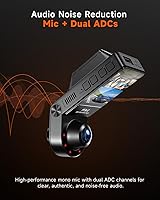
The noise-reducing microphone receives decent marks for capturing clear in-cabin conversation at normal speaking volumes, which is useful context for rideshare incidents where passenger interactions matter. Most users report that road noise is suppressed enough to understand speech in recorded clips.
Engine noise and road drone still bleed through at highway speeds in several user reports, particularly in louder vehicles. The microphone cannot be disabled from the camera body itself in all firmware versions, which is a privacy concern for some drivers who prefer to record video only.
WiFi Connectivity Speed
69%
31%
Connecting to the VEECAR app over WiFi to pull a short clip is fast enough for quick checks after a minor incident, and most users report the initial pairing process as straightforward without needing to consult the manual.
Transferring longer video files over WiFi is slow by modern standards, with several users reporting multi-minute waits for a single 1-minute 4K clip. Buyers who regularly review long recordings recommend removing the card and using a card reader instead of relying on the wireless transfer for anything beyond short clips.

Suitable for:

The TUIFAC GT820 Dual-Channel Dash Cam is built around a specific, practical need: monitoring both the road ahead and the vehicle interior simultaneously without running two separate camera systems. Rideshare and taxi drivers get the most obvious value here — having GPS-logged speed data alongside cabin footage of passenger interactions provides real, usable documentation if a dispute ever arises. Night-shift delivery drivers and gig workers who log long after-dark hours will also find the cabin IR night vision more capable than what most competitors offer in this category. If you live somewhere with extreme seasonal temperatures — brutal summers or hard winters — the supercapacitor design is a legitimate advantage over battery-based cameras that tend to degrade or fail in those conditions. Drivers who have personally dealt with insurance claims or accident disputes will appreciate having timestamped GPS route and speed data baked directly into the footage file rather than relying on memory or phone screenshots.
Not suitable for:

Buyers who prioritize long-term brand reliability and established after-sales support above all else should pause before committing to the GT820 — TUIFAC is a newer manufacturer with a limited track record, and the review pool of roughly 87 ratings is simply too small to draw firm conclusions about multi-year durability. The TUIFAC GT820 Dual-Channel Dash Cam is also not the right pick for drivers who need a rear-facing external camera, since both lenses face forward and inward — the cabin fisheye does not substitute for a dedicated rear road view. Anyone who regularly transfers large video files for review will find the WiFi transfer speed frustratingly slow for 4K footage, and will likely resort to removing the SD card manually more often than the wireless feature suggests. Drivers who want a distortion-free wide-angle cabin view should know upfront that fisheye optics produce noticeable edge warping — this is a physics constraint, not something firmware can fully fix. Finally, buyers expecting a fully stitched 360° view should note that the 345° coverage is two separate feeds, not a unified panoramic recording.
Specifications

  • Model: The GT820 is manufactured by TUIFAC, produced by Shenzhen Jiutong Zhichuang Technology Co., Ltd., and first became available in June 2025.
  • Front Resolution: The front-facing lens records at 4K UHD (2160p) for high-detail road footage.
  • Cabin Resolution: The interior fisheye lens records at 2.5K resolution, balancing wide coverage with usable image quality.
  • Front Field of View: The front camera captures a 160° horizontal angle, covering multiple lanes and roadside detail simultaneously.
  • Cabin Field of View: The cabin lens uses a 185° fisheye angle to cover the vehicle interior in a single frame, with inherent edge distortion typical of fisheye optics.
  • Night Vision: Six built-in IR LEDs paired with an f/1.8 wide-aperture, 8-layer optical lens provide cabin night vision in complete darkness without visible light.
  • Image Processing: Dual WDR (Wide Dynamic Range) processing is applied independently to both channels to balance highlights and shadows in challenging lighting conditions.
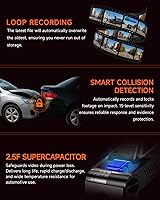
  • Power Source: A 2.5F supercapacitor replaces a traditional lithium battery, enabling safe file writes after sudden power loss and improved thermal durability.
  • Operating Temperature: The unit is rated to operate reliably between -30°C and +70°C, covering most real-world seasonal and geographic extremes.
  • Connectivity: Built-in WiFi allows wireless pairing with the VEECAR app on iOS and Android for video preview, download, and camera settings management.
  • GPS: An integrated GPS logger continuously records location coordinates, travel route, real-time speed (switchable between KM/H and MPH), and total mileage.
  • G-Sensor: The impact sensor offers 15 adjustable sensitivity levels and automatically locks footage files during detected collisions or sharp vibrations.
  • Storage: A 64GB TF (microSD) card is included in the box; the camera uses continuous loop recording to manage storage by overwriting the oldest unlocked files.
  • Mounting Type: The unit mounts to the windshield via an electrostatic sticker that leaves no adhesive residue upon removal.
  • Dimensions: The camera body measures 2 x 3 x 5 inches, making it compact enough to avoid obstructing the driver's sightline when mounted centrally.
  • Weight: The unit weighs 8 ounces, which is within the normal range for a dual-lens windshield-mount camera.
  • Audio: A built-in noise-reducing microphone records in-cabin audio alongside video, with some attenuation of road and engine noise.
  • Warranty: TUIFAC provides a 1-year manufacturer warranty and a 30-day hassle-free return window with 24/7 customer support access.
  • In-Box Contents: The package includes the GT820 camera, a 64GB TF card, a car charger power cable, electrostatic windshield stickers, cable clips, a trim removal crowbar, and a user manual with quick-start guide.
  • Recording Modes: The camera supports continuous loop recording, incident-locked recording via G-sensor, and time-lapse mode for extended parking surveillance.

Related Reviews

TUIFAC GT805 3-Channel 4K Dash Cam
72%
86%
Front Video Clarity
71%
Cabin Night Vision
67%
Rear Camera Quality
63%
App Experience
68%
Installation Ease
More
TUIFAC GT803 Dual Dash Cam
77%
83%
Video Clarity (Front Camera)
88%
Interior Night Vision
71%
Wi-Fi & App Usability
61%
Parking Mode
91%
Value for Money
More
TUIFAC GT806 3 Channel Dash Cam 2.5K+1080P+1080P
83%
89%
Value for Money
92%
Camera Quality (Front)
90%
Ease of Setup
78%
Night Vision Performance
85%
Rear Camera Quality
More
Ecomoment S70 Dual Dash Cam
83%
88%
Video Quality (Front & Rear)
91%
Night Vision Performance
85%
Ease of Installation
89%
Field of View (Wide Angle)
82%
Durability & Build Quality
More
Zengest 3 Channel Dash Cam
86%
88%
Video Quality
85%
Ease of Installation
92%
Night Vision Performance
72%
App Control Experience
90%
Parking Mode Reliability
More
Thinkware Q200 2-Channel Dash Cam
76%
84%
Front Camera Clarity
67%
Rear Camera Clarity
72%
Night Vision Performance
76%
Parking Mode
63%
GPS Alert Accuracy
More
70mai A410 Dual Dash Camera
78%
88%
Daytime Video Clarity
71%
Night Vision Performance
74%
Rear Camera Quality
67%
App & Wi-Fi Experience
84%
GPS Accuracy & Data Logging
More
ORSKEY S800 Dual Dash Cam
73%
88%
Value for Money
82%
Front Camera Video Quality
53%
Rear Camera Video Quality
61%
Night Vision Performance
91%
Ease of Installation
More
Veqotya S16 3-Channel Dash Cam
82%
91%
Video Quality (Resolution)
89%
Field of View
88%
Night Vision Performance
85%
Ease of Use (App Connectivity)
80%
Installation Process
More
Neideso N700 4-Channel Dash Cam
82%
92%
Video Quality
88%
360° Coverage
87%
Voice Control Functionality
85%
Night Vision Performance
90%
Wi-Fi & App Control
More

FAQ

Yes, both channels record simultaneously and continuously. The front lens covers the road ahead while the fisheye lens points into the cabin, and both feeds are stored as separate files on the same SD card. You do not need to switch between modes or choose one over the other.

In most rideshare scenarios it performs well, particularly for the front two seats. The six IR LEDs illuminate the cabin without requiring the dome light to be on, so passenger faces and activity in the front and middle rows are generally legible in recorded footage. Rear passengers in larger vehicles can be underlit depending on the cabin size, so if you drive a minivan or SUV, manage expectations for the far rear.

A supercapacitor stores a small charge — just enough to safely finish writing the current video file if your car's power is suddenly cut. Unlike a lithium battery, it does not degrade significantly from heat cycles, which is why it handles the high temperatures inside a parked car in summer far better than most competitors. It is not a backup power source for extended recording; think of it purely as a data-protection safety net.

The camera accepts TF (microSD) cards and the included 64GB card is a reasonable starting point for most users. The maximum officially supported capacity is not clearly documented, which has caused some confusion among buyers — if you plan to upgrade, it is worth confirming with TUIFAC support before purchasing a high-capacity card to avoid compatibility issues.

Not exactly. The TUIFAC GT820 Dual-Channel Dash Cam covers roughly 345° between its two lenses, but the front and cabin feeds remain separate recordings — there is no stitching or unified panoramic output. You get two distinct wide-angle clips, not a single wraparound video. This is actually common in dual-lens cameras; true optical stitching at this price tier is rare and typically introduces its own quality trade-offs.
Fisheye distortion causes objects near the edges of the frame to appear curved or warped — straight door edges can look bowed, and passengers sitting against the side windows may appear stretched. For simply documenting who was in the vehicle and what occurred, this is usually acceptable. For situations requiring precise spatial geometry, like estimating exact distances or positions, the distortion can be a limitation. It is a physical property of the lens type and not something firmware updates can fully correct.

The camera records and functions completely independently of the app — you do not need a phone connection for normal operation. The VEECAR app is primarily useful for wirelessly previewing or downloading clips without removing the SD card. App stability has drawn some complaints, particularly on Android, with occasional disconnections reported. For routine clip review after a long day, removing the card and using a USB card reader tends to be faster and more reliable for 4K footage.

Most users report the electrostatic sticker mount holds fine under normal conditions, and the advantage over suction cups is that it does not leave adhesive marks. A subset of users in very hot climates have reported the mount shifting during extended parking in direct sunlight, so if you regularly park outdoors in extreme heat, it is worth checking the mount position periodically, especially in the first few weeks of use.

The GPS logger activates automatically when the camera powers on and acquires a satellite fix within the first minute or two of driving under open sky. Speed is logged in real time alongside the video footage, and you can switch between KM/H and MPH in the settings. In dense urban areas with tall buildings, brief signal drops can occur, but for most driving routes the tracking is consistent and accurate enough for insurance documentation purposes.

It is reasonably approachable for a first-time buyer — the included 64GB card means you can mount it and start recording without buying anything extra, and the VEECAR app setup is generally described as quick. The main learning curve is adjusting the G-sensor sensitivity, since the default setting can trigger too many incident locks on rough roads until you dial it in. The user manual and quick-start guide cover the basics, and TUIFAC advertises 24/7 support if you run into setup questions.