Overview

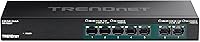
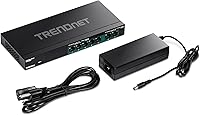
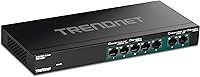
The TRENDnet TPE-TG327 7-Port Multi-Gig PoE+ Switch is a compact, no-frills option for anyone ready to step up from standard gigabit networking without spending a fortune or rewiring their entire setup. It offers a practical seven-port layout — five Gigabit PoE+ ports and two faster 2.5G PoE+ ports — all packed into a solid metal chassis that sits quietly on a desk or shelf. This is an unmanaged switch: you plug it in, and it works. No configuration menus, no CLI. For home labs, small offices, or government-adjacent buyers who need NDAA and TAA compliance, that plug-and-play simplicity is genuinely refreshing at this price tier.
Features & Benefits

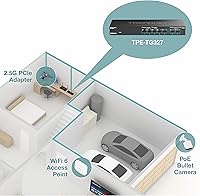
The 2.5GBASE-T ports are probably the most talked-about feature here — they let you pull up to 2.5Gbps over existing Cat5e or better cabling, which means connecting a Wi-Fi 6 access point or a NAS without pulling new cable. All seven ports carry PoE+, drawing from a shared 70W power budget, so you can run IP cameras, VoIP phones, or small access points without a separate injector. Just keep in mind that 70W spread across seven ports doesn't leave much headroom if you stack high-draw devices. The 20Gbps switching fabric keeps traffic moving without bottlenecks, and the fanless design keeps things completely silent — a real advantage in any open-plan or home environment.

Best For

This multi-gig PoE+ switch hits a sweet spot for a specific kind of buyer. If you're building out a home lab and want faster-than-gigabit links to a NAS or Wi-Fi 6 router without committing to a full managed switch, this fits well. Small businesses running a handful of IP cameras or wireless access points will find the PoE+ delivery reliable and the setup refreshingly simple. It's also a practical pick for government contractors or IT managers who need NDAA/TAA-compliant hardware — that compliance isn't just a badge; it's a real procurement requirement in many public-sector projects. What it isn't suited for is large-scale deployments or any environment where VLAN segmentation or traffic shaping is essential.

User Feedback

With a 4.6-star average across over 200 reviews, the TRENDnet 7-port switch has earned solid marks from buyers who appreciate how little effort it takes to get running. The most consistent praise centers on quiet fanless operation and the sturdy feel of the metal enclosure — people genuinely notice the build quality at this price point. The 2.5G ports get specific callouts from users who connected NAS units or Wi-Fi 6 access points and immediately saw a real throughput improvement. The main gripe that surfaces repeatedly is the 70W power budget: buyers who loaded all seven ports with higher-draw PoE devices found it constraining. A handful of reviewers also noted that TRENDnet's English-speaking support team was responsive when questions came up.

Pros

  • All seven ports support PoE+, so you can power cameras, phones, and access points without any injectors.
  • The two 2.5G ports offer a practical speed boost for NAS units or Wi-Fi 6 APs over existing cabling.
  • Completely fanless operation means zero noise — genuinely silent in any room or office setting.
  • Solid metal chassis feels built to last and holds up well compared to plastic alternatives at similar prices.
  • Plug-and-play setup requires no configuration whatsoever — out of the box and running in under a minute.
  • NDAA and TAA compliance makes this multi-gig PoE+ switch viable for government and public-sector procurement.
  • Lifetime manufacturer warranty in the U.S. and Canada is a rare and meaningful commitment at this price tier.
  • 20Gbps switching capacity means no internal bottleneck even when all ports are active simultaneously.
  • Compact footprint fits easily on a desk, shelf, or wall mount without taking up much real estate.
  • English-speaking tech support during business hours is a genuine differentiator for buyers who need occasional help.

Cons

  • The 70W shared PoE budget runs thin fast if you stack multiple high-draw devices across all seven ports.
  • No management features at all — no VLANs, no QoS, no traffic stats, and no web interface.
  • Only two ports run at 2.5G; the remaining five are capped at standard gigabit speeds.
  • The lifetime warranty applies only to U.S. and Canada buyers, leaving international users without that coverage.
  • The included power brick is bulky and can block adjacent outlets depending on your power strip layout.
  • No mounting hardware is included in the box, so wall or rack installation requires sourcing your own solution.
  • With just a 2K MAC address table, this switch is not well suited for environments with large numbers of network devices.
  • No link aggregation support, which limits redundancy or bandwidth bonding options for more advanced setups.

Ratings

The TRENDnet TPE-TG327 7-Port Multi-Gig PoE+ Switch has been evaluated by our AI system after parsing verified buyer reviews from multiple global markets, with spam, incentivized, and bot-generated feedback actively filtered out before scoring. The result is a transparent, balanced scorecard that reflects what real home lab builders, small business owners, and IT managers actually experienced — including both the genuinely impressive strengths and the practical limitations that showed up consistently in honest user accounts.
Ease of Setup
96%
Reviewers across skill levels — from first-time home lab builders to seasoned IT managers — consistently noted that setup takes under two minutes: unbox, plug in power, connect devices, done. There is no firmware to update, no login page to find, and no configuration decisions to make, which makes it genuinely stress-free.
The simplicity that makes setup so easy also means there is absolutely no room to customize behavior after the fact. Users who later discovered they needed port isolation or traffic prioritization had no path forward other than replacing the switch entirely.
Build Quality
89%
The all-metal chassis consistently surprised buyers who expected plasticky construction at this price point. Several reviewers noted it feels more like a mid-range managed switch than a budget unmanaged unit, and the compact footprint means it tucks cleanly onto a desk or shelf without looking cheap.
A small number of buyers flagged that the port labels on the front panel are faint and difficult to read under typical desk lighting, which is a minor but recurring annoyance during initial cable runs. The rubber feet have also been noted as slightly undersized for the chassis weight.
PoE Reliability
91%
Users powering IP cameras, VoIP phones, and Wi-Fi access points reported consistent, stable power delivery with no unexpected reboots or brownouts on connected devices. The IEEE 802.3at compliance means it negotiates correctly with both older 802.3af devices and newer higher-draw PoE+ equipment without any manual intervention.
The 70W shared budget is the one consistent source of frustration — buyers who loaded all seven ports with access points or PTZ cameras pushing 20W or more found themselves hitting the ceiling and having to prioritize which devices received power. TRENDnet does not include a port-level power allocation tool since the switch is unmanaged.
PoE Power Budget
67%
33%
For moderate setups — three or four cameras alongside a couple of VoIP phones — the 70W budget is entirely adequate and buyers in those scenarios rarely encountered any issues. It handles typical home security and small office deployments comfortably when device counts stay within reason.
The shared 70W becomes a genuine constraint the moment users try to run five or more PoE+ devices simultaneously, particularly anything with a higher power profile like PTZ cameras or dual-radio access points. Multiple reviewers specifically wished TRENDnet had pushed the budget to 100W or offered per-port power monitoring, even on an unmanaged unit.
2.5G Port Performance
83%
Buyers connecting a NAS or a Wi-Fi 6 access point to one of the two 2.5GBASE-T ports reported a clear and measurable throughput improvement over their previous gigabit setups, with no need to upgrade cabling from Cat5e. The auto-negotiation between 1G and 2.5G speeds worked reliably across a variety of connected devices.
With only two 2.5G ports available, users who wanted faster uplinks to more than two devices had to make tradeoffs. A few reviewers also noted that the 2.5G ports are not 10G capable, which limits the switch's future-proofing potential for buyers whose infrastructure is moving toward higher speeds.
Noise Level
97%
The fanless design delivers on its promise completely — this multi-gig PoE+ switch is genuinely inaudible in any environment, and reviewers placed in living rooms, recording studios, and open-plan offices universally praised the silence. It runs warm to the touch under load but never disruptively hot.
Because there is no active cooling, placement in a poorly ventilated cabinet or enclosed rack shelf could theoretically cause thermal stress over the long run, though no reviewers reported heat-related failures in practice.
Value for Money
86%
Buyers consistently flagged that getting NDAA and TAA compliance, a lifetime warranty, a metal chassis, 2.5G ports, and PoE+ on all seven ports in a single unmanaged switch at this price tier is genuinely difficult to match from competing brands. The package feels punching above its weight for home lab and SMB buyers.
Users with more demanding needs — particularly those who needed VLAN support or a larger PoE budget — felt the value proposition weakened quickly once they started comparing against entry-level managed switches that cost only modestly more and deliver significantly more control.
NDAA / TAA Compliance
88%
Government contractors and public-sector IT buyers highlighted this as a decisive purchasing factor, noting that finding a compliant unmanaged switch with multi-gig capability at this price range is genuinely uncommon. For those buyers, it is not a nice-to-have — it is the reason they chose this switch over otherwise comparable alternatives.
For the majority of home and small business buyers, the compliance certifications carry no practical relevance, meaning they are paying for a feature they will never use. There is no way to opt out of that embedded cost.
Port Count & Layout
74%
26%
Seven ports is enough for a focused home lab or a small branch office running a handful of PoE devices, and the physical spacing between ports is generous enough to accommodate slightly bulky RJ-45 connectors or short patch cables without crowding.
Several reviewers found themselves outgrowing the seven-port layout sooner than expected as they added devices, and there is no obvious upgrade path within the TRENDnet unmanaged lineup that offers more ports with the same 2.5G and PoE+ combination.
Switching Performance
92%
The 20Gbps non-blocking switching fabric means that even with all seven ports active simultaneously — a mix of gigabit and 2.5G links — buyers reported no noticeable latency or congestion in real-world usage including NAS backups running alongside active IP camera streams.
In practice, the unmanaged nature of the switch means there is no way to verify or measure actual throughput performance without third-party testing equipment, and the relatively modest 384KB data buffer could theoretically cause packet drops during extreme simultaneous burst traffic scenarios.
Warranty & Support
82%
18%
The lifetime manufacturer protection is a tangible and rare commitment for a switch at this tier, and buyers who did need to contact TRENDnet support reported that English-speaking advisors were knowledgeable and responsive during normal business hours.
The lifetime warranty applies exclusively to buyers in the U.S. and Canada, which is a meaningful exclusion for international purchasers. Support hours are also limited to business hours, which can be frustrating for buyers dealing with network issues outside that window.
Compatibility
87%
Users connected a wide range of PoE devices — from older 802.3af cameras to newer 802.3at access points — and reported consistent auto-detection and power negotiation with no manual intervention. The switch played well with equipment from multiple major networking brands in mixed environments.
Because this is an unmanaged switch, there is no 802.1Q VLAN tagging, which can create compatibility headaches when integrating into networks where certain devices expect tagged traffic. Buyers discovered this limitation only after purchase in a few documented cases.
Physical Footprint
88%
At under 9.5 inches long and just over an inch tall, the TRENDnet 7-port switch fits comfortably on a desk corner, a media shelf, or alongside other compact networking gear without demanding significant space. Its low profile makes it easy to tuck out of sight in finished living spaces.
The included power brick is external and somewhat bulky relative to the switch itself, which adds cable clutter around the installation area and can block adjacent outlets on a standard power strip depending on its orientation.
Long-Term Reliability
84%
With a rated MTBF of over 830,000 hours and a fanless design that eliminates one of the most common failure points in networking hardware, long-term durability appears strong — and the absence of reported early failures in the review pool supports that projection.
The switch has not been on the market long enough to generate a substantial pool of multi-year reliability data, so the high MTBF figure remains largely theoretical for now. Buyers considering this for mission-critical deployments may want to factor in that caveat.

Suitable for:

The TRENDnet TPE-TG327 7-Port Multi-Gig PoE+ Switch is a strong fit for home lab builders who want to push beyond standard gigabit speeds without committing to a costly managed switch or rewiring their space — existing Cat5e cabling is all you need. Small business owners running a mix of IP cameras, VoIP handsets, and wireless access points will appreciate having PoE+ on every single port, eliminating the need for separate power injectors. The two 2.5G ports are particularly useful if you have a Wi-Fi 6 access point or a NAS that can actually saturate a gigabit link, giving you a real and noticeable throughput improvement. IT managers and government contractors will find the NDAA and TAA compliance genuinely useful — this is not a marketing footnote but a hard procurement requirement in many federal and state projects, and having it on a switch at this price point is uncommon. Anyone who needs a completely silent, desktop-friendly network switch for a studio, open-plan office, or living room media setup will also feel right at home here.
Not suitable for:

The TRENDnet TPE-TG327 7-Port Multi-Gig PoE+ Switch is not the right tool if your environment demands any form of network management — there are no VLANs, no QoS controls, no traffic monitoring, and no web interface whatsoever. If you plan to run several high-draw PoE devices simultaneously, the 70W shared power budget will become a ceiling fast; a single PTZ camera or a power-hungry access point can consume 25W or more, so doing the math before buying is important. Buyers who need more than seven ports, or who expect to scale their network significantly over the next few years, will likely outgrow this switch sooner than they would like. It is also not a fit for users outside the U.S. and Canada who are counting on the lifetime warranty, as that protection does not extend internationally. Enterprise IT teams or anyone managing a multi-VLAN environment should look at a proper managed Layer 2 switch instead.
Specifications

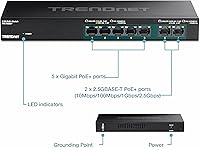
  • Port Layout: The switch includes 5 Gigabit PoE+ RJ-45 ports and 2 x 2.5GBASE-T PoE+ RJ-45 ports, giving you seven total copper connections.
  • PoE Standard: All ports support IEEE 802.3af and 802.3at (PoE+), enabling compatibility with a wide range of powered devices including cameras, access points, and VoIP phones.
  • PoE Power Budget: The total shared PoE power budget across all seven ports is 70W, which must be distributed among all connected powered devices.
  • Switching Capacity: The switch fabric operates at 20Gbps non-blocking capacity, meaning traffic between ports does not create an internal bottleneck under normal load.
  • 2.5G Speed: The two 2.5GBASE-T ports support both 1Gbps and 2.5Gbps link speeds and work over existing Cat5e or better cabling without any rewiring.
  • MAC Table: The switch maintains a MAC address table of up to 2,000 entries, suitable for small office and home lab environments.
  • Jumbo Frames: Jumbo frame support extends up to 15KB, which can improve throughput efficiency for large file transfers on compatible devices.
  • Data Buffer: The switch is equipped with 384KB of data buffer memory to help manage short traffic bursts across active ports.
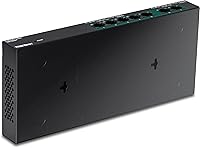
  • Dimensions: The unit measures 9.44″ long by 4.13″ wide by 1.04″ tall, making it well suited for desktop placement or compact rack shelves.
  • Weight: At 2 pounds, the switch is lightweight enough to relocate easily while still feeling substantive in hand due to its metal enclosure.
  • Case Material: The outer chassis is constructed from metal, providing better heat dissipation and physical durability than plastic-bodied alternatives at this price tier.
  • Cooling: The switch uses a fully passive fanless design, producing zero operating noise and consuming less energy than fan-cooled equivalents.
  • Power Supply: A 55V, 1.67A external power brick and a 1.8m power cord are included in the box, so no additional power accessories are needed.
  • MTBF: The rated mean time between failures is 830,917 hours, indicating a high projected reliability over the product's operational lifespan.
  • Operating Temp: The switch is rated to operate in ambient temperatures ranging from 32°F to 122°F (0°C to 50°C).
  • Operating Humidity: Relative humidity during operation should not exceed 90% non-condensing to ensure reliable performance and component longevity.
  • Compliance: The switch is both NDAA and TAA compliant, meeting federal procurement requirements for U.S. government and government-adjacent network deployments.
  • Warranty: TRENDnet backs this switch with a lifetime manufacturer warranty for customers in the United States and Canada.

Related Reviews
TRENDnet TPE-S50 6-Port PoE+ Network Switch
81%
93%
Ease of Setup
78%
PoE Performance
88%
Build Quality
97%
Noise Level
41%
Port Speed & Throughput
More
TRENDnet TPE-TG44G 8-Port PoE+ Gigabit Switch
82%
94%
Ease of Setup
88%
PoE Reliability
86%
Build Quality
97%
Noise Level
62%
Thermal Performance
More
TRENDnet TPE-TG80G 8-Port Gigabit PoE+ Switch
85%
91%
Build Quality
88%
PoE Reliability
97%
Noise Level
94%
Ease of Setup
67%
Thermal Management
More
TRENDnet TPE-TG82G 8-Port Gigabit PoE+ Switch
78%
93%
Plug-and-Play Setup
78%
PoE Power Delivery
88%
Build Quality
61%
Thermal Management
91%
Network Performance
More
TRENDnet TEG-S591 9-Port Multi-Gig Switch
84%
93%
Throughput Performance
97%
Ease of Setup
96%
Noise Level
88%
Value for Money
86%
10G Uplink Utility
More
TRENDnet TEG-S562 6-Port Multi-Gig Switch
85%
91%
Throughput Performance
88%
Build Quality
94%
Ease of Setup
97%
Fanless Noise Level
86%
Value for Money
More
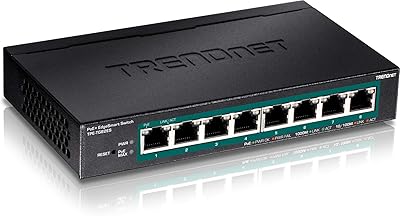
TRENDnet TPE-TG82ES 8-Port Gigabit PoE+ Switch
79%
83%
Value for Money
81%
Ease of Setup
67%
PoE Power Delivery
88%
Build Quality
72%
Management Interface
More
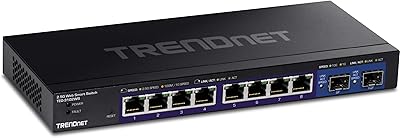
TRENDnet TEG-3102WS Multi-Gig Web Smart Switch
86%
91%
Port Speed & Multi-Gig Performance
88%
Build Quality & Hardware Design
94%
Fanless & Noise Level
71%
Web Management Interface
83%
10G SFP+ Uplink Capability
More
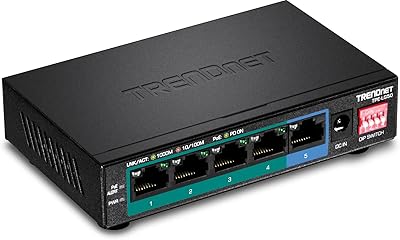
TRENDnet TPE-LG50 5-Port Gigabit Long Range PoE+ Switch
86%
91%
PoE+ Performance
88%
Range/Distance
94%
Ease of Setup
85%
Build Quality
90%
Reliability
More
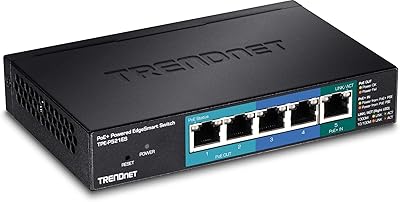
TRENDnet TPE-P521ES 5-Port PoE+ Switch
77%
88%
PoE Pass-Through Reliability
58%
PoE Power Budget
84%
Ease of Setup
67%
EdgeSmart Management Interface
83%
Build Quality
More

FAQ

No configuration is required at all. This is a fully unmanaged switch, so you simply plug in your devices and the network starts working immediately. There is no web interface, no login page, and no setup wizard — it is entirely plug-and-play.

Yes, the two 2.5GBASE-T ports are specifically designed to run at 2.5Gbps over Cat5e or better copper cabling. You do not need to upgrade to Cat6 or rewire anything to take advantage of the faster speeds on those two ports.

The 70W is shared across all powered devices connected simultaneously, so it is worth adding up the power draw of each device before buying. A typical IP camera might draw 8 to 15W, while a higher-end Wi-Fi 6 access point can pull 20 to 25W. If you are running five or more power-hungry devices at once, you could hit that ceiling, so mapping out your power needs ahead of time is a good idea.

Yes, as long as your access point is IEEE 802.3at (PoE+) compatible and draws within the available power budget, this fanless network switch will power it without any issues. If your access point supports 2.5G uplink speeds, plugging it into one of the two 2.5GBASE-T ports will give you the best throughput.

Not at all — it is completely silent. The fanless design means there are no moving parts and no airflow noise whatsoever. Plenty of buyers specifically mention this as a reason they chose it for living rooms, studios, and open-plan spaces where a humming fan would be noticeable.

NDAA compliance means the switch does not use components from manufacturers flagged under U.S. federal defense legislation — this is a hard requirement for many government contracts and public-sector IT purchases. TAA compliance means the product is manufactured or substantially transformed in a TAA-designated country, which is required for purchases under the General Services Administration schedule. If you are buying for a government agency or a contractor subject to these rules, this compliance designation is not optional — it is a real procurement gate.

TRENDnet's lifetime protection covers manufacturing defects for the original purchaser in the U.S. and Canada for as long as they own the product. It does not cover physical damage, misuse, or buyers outside the U.S. and Canada. For most home lab and small business buyers in North America, it is a genuinely strong warranty commitment for a switch in this price range.

Yes, you can daisy-chain it to another switch by connecting one of its ports to a port on an upstream switch. Keep in mind that this is an unmanaged switch, so there is no support for spanning tree protocol (STP) — you should avoid creating network loops in your topology.

The metal chassis helps dissipate heat passively, and under typical home lab or small office loads the switch stays comfortably warm rather than hot. As long as you place it in a reasonably ventilated spot and keep it within the rated 32°F to 122°F operating range, thermal performance is not a concern that buyers commonly raise.

No — because this is an unmanaged switch, there is no traffic monitoring, port statistics, or device discovery interface of any kind. If you need visibility into your network traffic or want to assign VLANs, you would need to step up to a managed switch. For straightforward connectivity with no administration overhead, the TRENDnet 7-port switch does exactly what it is designed to do.

Where to Buy