Overview

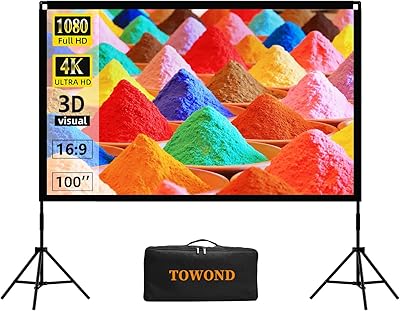
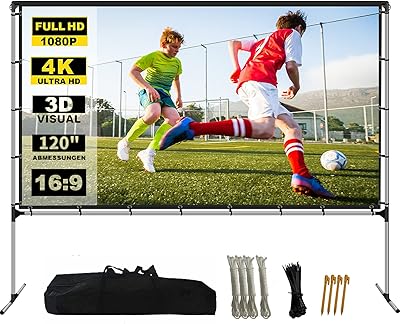
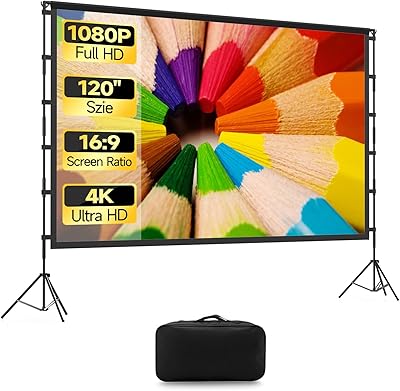
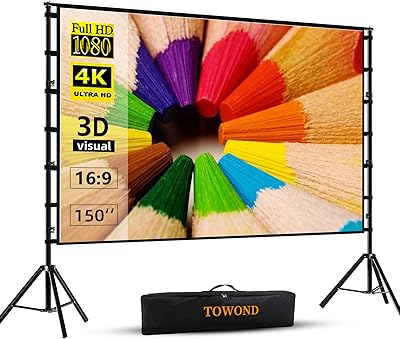
The TOWOND 180-Inch Portable Projector Screen with Stand is a large-format outdoor screen built for people who want a genuinely big picture without committing to a permanent installation. At 180 inches diagonal, you're looking at a surface that stretches roughly 152 inches wide — wider than most living room walls — which makes a real difference when you're hosting a crowd in the backyard. Unlike inflatable screens that need a pump and a dedicated bin, or wall-mount options that lock you into one location, this outdoor screen uses a tripod-based stand that breaks down and packs into a carry bag you can sling over your shoulder. It's a practical, standalone outdoor setup rather than a premium theater system.
Features & Benefits

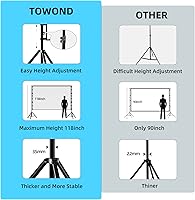
The viewing surface spans a widescreen 16:9 ratio and handles both front and rear projection, which opens up placement options depending on your venue. The polyester fiber material is compatible with 4K and 3D content, though the actual image quality you get depends heavily on the projector you pair it with — the screen itself is a passive surface. What stands out on the hardware side is the reinforced stand system: the tubing is noticeably thick, and the package includes ground nails and six windproof ropes to help anchor the whole structure outdoors. The packed bundle weighs just under 20 pounds and fits into a bag compact enough to slide into a car trunk without rearranging your gear.

Best For

This portable projection setup makes the most sense for people who entertain outdoors a few times a year and need a large, temporary screen they can actually move between locations. Think backyard movie nights, tailgate setups, camping trips, or a neighborhood sports watch party — situations where the screen needs to go up fast, look impressive, and come down without drama. It works equally well for groups that want flexibility in how they project, since the surface handles light from either side. Where it fits less naturally is in any scenario demanding precise image calibration or permanent installation — this is gear built around convenience and scale, not fine-tuned performance.

User Feedback

Buyers who have set this outdoor screen up tend to agree on two things: the sheer size is impressive in person, and assembly is genuinely straightforward once you have worked through the instructions once. That said, a few consistent complaints surface. Some users notice that the screen fabric retains faint wrinkles after being unpacked, which usually flatten out with a bit of time but can be noticeable during the first use. Wind stability gets mixed marks — the ground nails and ropes help, but on a breezy evening you will want to use all of them. The carry bag gets praised for convenience but flagged as thin over repeated trips. Overall, most buyers feel the size-to-price ratio is fair for occasional outdoor use.

Pros

  • At 180 inches diagonal, the screen delivers a genuinely cinematic viewing scale that impresses first-time users.
  • The tripod stand system sets up without any tools, which most buyers find faster than expected after the first attempt.
  • Front and rear projection compatibility gives you real flexibility in how you position your projector relative to the crowd.
  • The whole package fits into a carry bag and slides into a standard car trunk, making transport practical.
  • Six windproof ropes and ground nail anchors meaningfully improve stability compared to lighter freestanding screens.
  • The polyester surface is compatible with 4K and 3D content when paired with a capable projector.
  • Most buyers feel the size-to-price ratio is fair for occasional outdoor or seasonal use.
  • The wide viewing angle means guests seated off to the sides still get a decent picture.

Cons

  • Screen fabric can retain noticeable wrinkles after unpacking, which may take time or light tension to flatten out.
  • Stand stability in wind is manageable but not guaranteed — breezy evenings require all anchoring hardware to be fully deployed.
  • The included carry bag is thin and shows wear relatively quickly with repeated loading and unloading.
  • Assembly is straightforward once learned, but first-time setup can be confusing without a clearer instruction guide.
  • Image brightness and clarity depend entirely on your projector — the screen surface cannot compensate for a weak light source.
  • At nearly 20 pounds, portability is reasonable but not effortless for solo setup, especially on uneven ground.
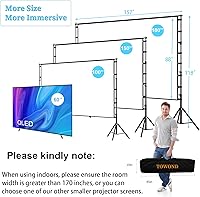
  • The screen is sized for wide open spaces; indoor rooms need to be exceptionally large to accommodate it safely.

Ratings

The scores below reflect our AI-driven analysis of verified global buyer reviews for the TOWOND 180-Inch Portable Projector Screen with Stand, with spam, incentivized, and bot-generated feedback actively filtered out before scoring. Each category captures both what users genuinely loved and the friction points that came up repeatedly across thousands of real-world purchases. Nothing has been softened — the numbers reflect the honest spread of experience, good and bad.

Screen Size Impact
91%
Buyers consistently describe the image as far larger than they anticipated in person, which is a genuine differentiator for group viewing. Families hosting backyard movie nights frequently mention that guests seated 20 or more feet away still felt immersed rather than squinting at a small picture.
A handful of buyers in smaller yards note that 180 inches is almost too large for tight spaces, with some reporting the screen dominated the viewing area uncomfortably. Matching the screen to the actual throw distance of their projector was a learning curve some did not expect.
Ease of Assembly
78%
22%
Most users report completing setup in under 30 minutes once they had worked through the process once, and many noted that the tool-free design made the whole experience far less stressful than expected for an outdoor product this large. First-timers with a helper found the process particularly manageable.
The instruction guide drew consistent criticism for being vague, and a notable number of buyers spent extra time figuring out crossbar orientation on the first attempt. Solo assembly was described as awkward, particularly when lifting the frame upright and tensioning the fabric at the same time.
Outdoor Stability
69%
31%
When all six windproof ropes and ground nails are fully deployed, the screen holds its ground well in calm to light-breeze conditions, which covers most backyard movie nights realistically. The thicker stand tubing gives the overall structure a noticeably more planted feeling than lighter alternatives.
In moderate to strong wind, users report the frame flexing and occasionally tipping despite anchoring, which is a real concern for anyone in an open outdoor setting. Several buyers wished for additional guy-wire attachment points or a heavier base option to improve confidence on windier evenings.
Screen Surface Quality
74%
26%
The polyester fabric diffuses light evenly across the wide surface, and buyers pairing this screen with mid-range to high-output projectors were generally pleased with the image clarity they achieved. The material also handles both front and rear projection without obvious hot-spotting, which gives setup flexibility.
Initial wrinkles after unpacking are a recurring complaint, and while most flatten out over time, some buyers reported visible creasing during their first use that affected image uniformity. Image performance is also entirely projector-dependent, which means underpowered light sources will expose the screen's limitations immediately.
Portability
83%
At under 20 pounds packed into a single carry bag, this outdoor screen fits in the trunk of a standard sedan, which buyers repeatedly highlighted as a practical win for camping trips and tailgate setups. The shoulder bag design made it manageable to carry across a campsite or from a parking lot without assistance.
While the packed size is impressive for 180 inches of screen, the weight does add up during longer carries, and solo users hauling it across uneven terrain found it tiring. The bag itself does not distribute weight as evenly as a backpack-style carrier would.
Carry Bag Durability
57%
43%
For buyers using the screen a few times per season, the included bag performs its basic function without issue, keeping all components organized and protected during a typical car trip to a campsite or friend's backyard. The shoulder strap made short-distance transport convenient.
Multiple users reported stitching failures and zipper wear after just a season of regular use, suggesting the bag is treated as an afterthought rather than a core component. Frequent travelers or anyone packing and unpacking more than a dozen times per year should expect to replace or supplement it.
Value for Money
81%
19%
For the screen area you get relative to the price paid, buyers broadly agree this portable projection setup punches above its weight in terms of sheer visual impact per dollar. Compared to inflatable alternatives of similar size that cost significantly more, the value proposition resonated strongly with budget-conscious buyers.
A small but vocal segment felt that durability gaps in the bag and stand anchoring undermined the overall value over time, particularly for buyers who expected the product to last several years of active outdoor use. The price feels justified for seasonal use but less so if replacement parts become necessary.
Image Brightness & Clarity
66%
34%
Buyers pairing this screen with higher-lumen projectors in low-ambient-light settings reported crisp, punchy images that held up well even at the edges of the wide viewing angle. The polyester surface handled fast-moving content like sports and action films without notable blur or dullness.
Under any residual ambient light, buyers with lower-output projectors found the image washed out noticeably, and some mistakenly attributed this to the screen material rather than their projector. Managing expectations around projector lumens is critical — this screen cannot correct for an underpowered light source.
Build Quality
71%
29%
The thicker stand tubing and reinforced crossbar connections give the assembled frame a sturdy feel that buyers frequently compared favorably against cheaper tripod screens they had used previously. The ground nails in particular were praised as a thoughtful inclusion that competitors often omit.
Some buyers noted minor inconsistencies in crossbar fit, with certain connections feeling looser than others straight out of the box, which added wobble at the top of the frame. The frame material, while functional, does not feel engineered for long-term repeated assembly and disassembly.
Setup Speed
73%
27%
Experienced users who had set the screen up two or three times reported being fully assembled and viewing-ready in around 15 minutes, which is genuinely competitive for a screen of this size. The modular crossbar system snaps together in a logical sequence once the pattern is memorized.
First-time setup regularly took buyers 30 to 45 minutes, and a few reported needing to disassemble and restart after misidentifying crossbar orientation from the unclear instructions. The learning curve is real and should not be underestimated for buyers expecting instant plug-and-play convenience.
Wind Resistance Hardware
64%
36%
Including six windproof ropes and matching ground nails as standard equipment is a legitimate advantage over competing screens that sell anchoring accessories separately, and buyers in moderately breezy climates appreciated having everything in one box. When fully staked out on grass, the setup feels meaningfully more grounded.
The ropes themselves are thin and the attachment points on the frame are minimal, meaning the anchoring system works best as a supplement to favorable weather rather than a substitute for it. Buyers in consistently windy regions reported that the hardware alone was insufficient to prevent movement on gusty evenings.
Rear Projection Performance
68%
32%
For buyers who specifically wanted to hide their projector behind the screen to keep the audience-facing area clean, the fabric performed acceptably, delivering a recognizable and usable image from the rear in darkened outdoor conditions. This flexibility was cited as a genuine purchase driver for event hosts.
Rear projection noticeably reduces brightness compared to front projection on this surface, which means buyers need a higher-lumen projector to compensate when using the rear mode. This limitation was not well-communicated upfront and caught some buyers off guard after purchase.
Storage Convenience
76%
24%
The compact packed footprint — roughly the length of a golf bag and narrow enough to stand in a corner — made storage between seasonal uses straightforward for buyers with limited garage or closet space. Multiple buyers noted it slid under a bed or behind a door without taking up meaningful square footage.
While the packed dimensions are impressive given the screen size, the elongated shape of the bag can be awkward to store upright in spaces without a clear vertical corner, and laying it flat requires a full 45-inch floor run. Buyers in very small apartments or studios may still find it a storage challenge.

Suitable for:

The TOWOND 180-Inch Portable Projector Screen with Stand is a strong fit for anyone who wants a genuinely large shared viewing experience outdoors without committing to a permanent structure. Homeowners who host seasonal backyard gatherings — whether that's summer movie nights, football watch parties, or holiday events — will appreciate how much visual impact this screen delivers for occasional use. Campers and tailgaters who haul gear in a car trunk will find the packed size and carry bag surprisingly manageable given how large the screen actually deploys. Families with kids who want a big communal screen for gaming sessions or outdoor events will get real value here. It also suits buyers who need rear projection flexibility, since the surface handles light from both sides, giving you more control over where your projector sits relative to the audience.
Not suitable for:

Buyers who need a screen for frequent, high-stakes presentations or permanent outdoor installs will likely find this portable projection setup falls short of their expectations. The stand, while reinforced, is not engineered for consistently windy environments — on gusty evenings, even with the ground nails and ropes deployed, some wobble is realistic. People who care deeply about image accuracy and color fidelity should also note that screen performance is only as good as the projector paired with it; the surface alone cannot compensate for an underpowered light source. The carry bag, while convenient initially, has drawn criticism for durability over repeated trips, making this a questionable choice for buyers who plan to transport it weekly. Anyone expecting a tool-free setup to mean effortless assembly on the very first attempt may need to budget some extra time until they learn the system.

Specifications

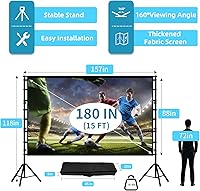
  • Screen Size: The viewable diagonal measures 180 inches, producing an active image area approximately 152″ wide by 86″ tall in standard widescreen format.
  • Aspect Ratio: The screen is built for a 16:9 widescreen aspect ratio, matching the native format of most modern projectors, streaming content, and gaming consoles.
  • Viewing Angle: The manufacturer rates the viewing angle at 160 degrees, allowing guests seated well off to either side to still receive a usable image.
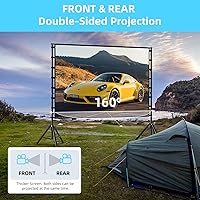
  • Projection Type: The screen surface supports both front and rear projection, giving users flexibility in projector placement relative to the audience.
  • Resolution Support: The polyester surface is compatible with 4K Ultra HD and 3D projection signals, though output quality depends on the paired projector.
  • Material: The screen fabric is constructed from natural polyester fiber chosen for its light-diffusing properties and resistance to persistent creasing after unpacking.
  • Stand Tubing: The upright stand components use 35mm-diameter tubing, which is thicker than entry-level freestanding screens and contributes to overall rigidity.
  • Mounting Type: The screen attaches to a two-leg tripod base secured with included ground nails for outdoor use on grass or soft terrain.
  • Anchoring Hardware: Six windproof ropes are included to anchor the assembled screen frame to the ground, reducing movement in light to moderate outdoor wind.
  • Assembly Parts: The package contains six upper crossbars, two tripod legs, six ground nails, one screen, six windproof ropes, and one carry bag.
  • Packed Dimensions: When disassembled and bagged, the kit measures approximately 45″ long by 10″ wide by 5″ deep, compact enough for most car trunks.
  • Package Weight: The complete kit including carry bag weighs approximately 19.76 lbs, making solo carry manageable for short distances.
  • Carry Bag: A dedicated shoulder carry bag is included for storing and transporting all components as a single unit.
  • Tool Requirement: No tools are required for assembly; the frame connects using friction-fit or push-lock joints between the crossbars and tripod legs.
  • Brand: This screen is manufactured and sold under the TOWOND brand, which specializes in portable projection screen systems.
  • First Available: This model was first listed for sale in March 2023, making it a relatively recent entry in the portable outdoor screen category.
  • Indoor Space Note: For indoor use, the manufacturer advises that the room must be at least 157″ wide and 118″ tall to safely accommodate the fully assembled screen.

Related Reviews

Towond 100-inch Portable Projector Screen with Stand
74%
91%
Portability & Pack-Down Size
88%
Assembly & Setup Speed
74%
Screen Surface & Image Quality
67%
Wrinkle Resistance
63%
Outdoor Wind Stability
More
TOWOND 150-inch Projector Screen with Stand
76%
93%
Ease of Setup
88%
Portability & Storage
91%
Screen Size & Image Scale
74%
Screen Material & Fabric Quality
72%
Image Brightness & Clarity
More
excelimage 50-inch Portable Projector Screen with Stand
77%
91%
Ease of Setup
88%
Portability
79%
Image Quality
72%
Build Quality
84%
Screen Surface Flatness
More
HOIN 80-inch Portable Projector Screen Stand
78%
91%
Ease of Assembly
88%
Portability & Transport
84%
Screen Fabric Flatness
82%
Frame Stability — Calm Conditions
56%
Wind Resistance
More
Pyle PRJTP72 72-Inch Portable Projector Screen
73%
88%
Portability & Transport
86%
Setup Speed & Ease
74%
Image Surface Quality
58%
Aspect Ratio Compatibility
67%
Build Quality & Frame Rigidity
More
Elite Screens QuickStand 180-inch Portable Projector Screen
77%
91%
Setup Speed
88%
Screen Image Quality
86%
Build Quality
58%
Portability
67%
Value for Money
More
Elite Screens Yard Master Sport 110-inch Screen
78%
88%
Ease of Setup
83%
Portability & Storage
79%
Image Clarity & Screen Performance
71%
Outdoor Stability
58%
Aspect Ratio Suitability
More
Elite Screens Spectrum RC1 180-inch Motorized Projector Screen
78%
88%
Build Quality
91%
Image Quality
79%
Motor Performance
86%
Remote Control System
53%
Installation Experience
More
VISULAPEX 100-Inch Portable Projector Screen with Stand
79%
88%
Portability & Packability
91%
Ease of Assembly
72%
Screen Flatness
74%
Image Clarity & Brightness
78%
Build Quality
More
KSAN ST120 120″ Projector Screen with Stand
76%
91%
Ease of Assembly
88%
Portability & Storage
74%
Screen Image Quality
67%
Wind & Outdoor Stability
78%
Screen Wrinkle Resistance
More

FAQ

Most buyers report getting through assembly in roughly 15 to 30 minutes the first time, and faster once they are familiar with the order the crossbars connect. There are no tools involved, but the sheer number of parts means it helps to lay everything out before you start. Having a second person on hand makes raising and tensioning the screen noticeably easier.

It holds up reasonably well in calm to light-wind conditions, especially if you use all six of the included ground nails and windproof ropes. In a genuine gust, no freestanding tripod screen this large is going to feel rock-solid, so plan accordingly. If your area gets regular evening wind, it is worth staking the ropes at wide angles for maximum resistance.

Yes, some creasing after unpacking is common and is mentioned by a number of buyers. The fabric is designed to relax over time, and most wrinkles flatten out within an hour or two of the screen being stretched and tensioned on the frame. Running a fan-forced heater near the surface can speed that process up if you are in a hurry.

At that screen size, you generally want a projector with at least 3,000 lumens for outdoor evening use, and more if there is any ambient light around. The screen itself is a passive surface — it does not boost or correct the image — so brightness and clarity come entirely from your projector. A high-lumen short-throw or standard projector positioned correctly will give you the best results.

You can, but the assembled screen is wider than most rooms can comfortably handle. The manufacturer notes that your space needs to be at least 157 inches wide and 118 inches tall. Most living rooms and garages fall short of that, so indoor use is really only practical in large open spaces like event halls or very spacious basements.

Yes, the screen fabric supports rear projection, which means you can position your projector behind the screen and out of the audience's sightline. This is a useful feature for events where you want a cleaner setup without a projector visible in the middle of the viewing area. Image brightness does reduce slightly with rear projection compared to front, so factor that into your projector choice.

The bag does its job well for occasional use, but several buyers have noted that the material and stitching are on the thinner side. If you are packing and unpacking this screen a couple of times per season, it should hold up fine. For frequent transport, it is worth considering a heavier aftermarket bag or wrapping the frame sections separately for added protection.

Technically one person can manage it, but it is genuinely easier with two, particularly when lifting the assembled frame upright and tensioning the screen fabric across the top crossbars. Solo setup is doable if you are comfortable with a bit of trial and error, but budget extra time for it.

Yes, the screen surface does not filter or limit resolution — it will display whatever your projector sends to it. So if your projector outputs a true 4K signal, the screen will reflect that image without degrading it. Whether you actually perceive a 4K difference at viewing distances typical for outdoor setups is another question, but there is no technical barrier here.

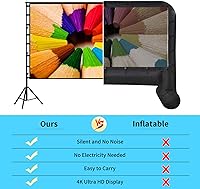
The main advantages of this tripod-based setup are that it does not require a blower motor running continuously and packs down into a much smaller bag. Inflatable screens can feel more stable in very light wind because they are tensioned from within, but they are bulkier to store and noisier to operate. This portable projection setup is a better fit if silence, compact storage, and faster pack-down are priorities.