Overview

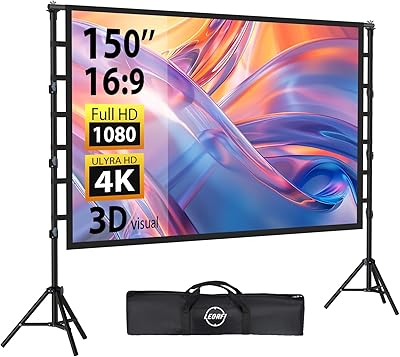
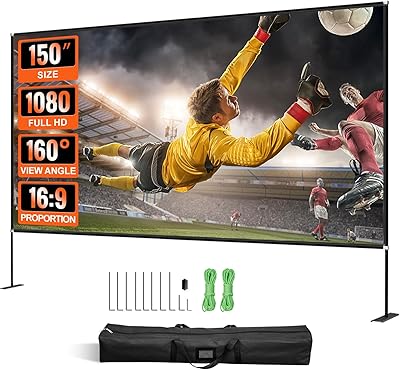
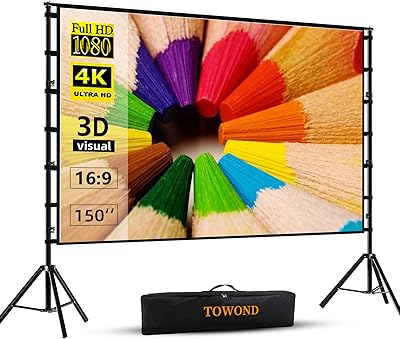
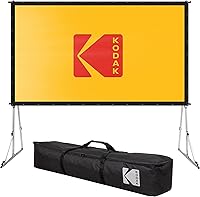
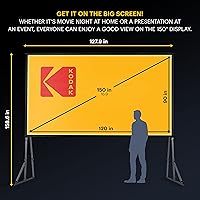
The KODAK 150-inch Portable Projector Screen with Stand is a large-format display solution built for anyone who wants serious screen real estate without committing to a permanent wall installation. KODAK's name carries some weight here — it signals consumer-friendly design backed by a recognizable brand rather than a no-name import. What sets this screen apart from inflatable alternatives or basic tripod setups is its fast-fold metal frame, which locks into a rigid, flat structure rather than relying on air pressure or a single wobbly pole. At 150 inches diagonal, you are looking at a viewing surface wide enough to comfortably seat a dozen or more people, making it genuinely suited for group events rather than just casual solo use.
Features & Benefits

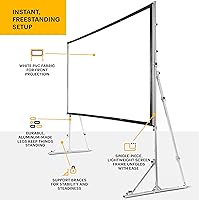
The screen surface is a blend of PVC and Terylene fabric, which in practical terms means it stays taut, resists wrinkling, and holds color reasonably well in a darkened space. With a 1.0 gain rating, it reflects light evenly rather than boosting brightness artificially, so image quality stays consistent across the wide 140-degree viewing angle — handy when your audience is spread out. The locking frame snaps together quickly and the height is adjustable, which matters more than it sounds when you are setting up on uneven ground. An outdoor stability kit is included to help anchor things, though it works best in calm conditions. At 28.7 pounds, this is not something you sling over one shoulder — plan for a car trunk.

Best For

This portable projection screen hits a sweet spot for people who host outdoor movie nights regularly and want a setup that actually looks professional. Teachers, trainers, and small-event presenters will appreciate the large format without the cost of commercial AV rental. DIY wedding planners and backyard party organizers also make a natural fit — this is the kind of screen that makes a real impression on guests. It pairs logically with KODAK's own projector line, though it works with most standard projectors. That said, if you need something truly lightweight and packable, or a high-gain surface for a brightly lit room, this 150-inch screen and stand combo may not be the right call.

User Feedback

Buyers consistently praise how straightforward the assembly is — most report getting the KODAK fast-fold screen up and running in under ten minutes without any tools. The carry case earns specific mention; reviewers appreciate that it feels well-built and actually protects the frame during transport. On the other side, wind is a recurring sticking point. Outdoor stability in gusts remains a genuine issue even with the included kit, and several users recommend adding extra ground stakes beyond what is provided. A handful of long-term owners have noted some joint loosening after repeated assembly cycles. The general sentiment on value is positive — most feel the size and build quality justify the price when compared to cheaper inflatable options.

Pros

  • The fast-fold frame assembles in under ten minutes without tools, making repeated setup genuinely practical.
  • A 150-inch diagonal surface comfortably accommodates audiences of a dozen or more people.
  • The PVC and Terylene fabric surface stays taut and resists wrinkling even after multiple pack-and-unpack cycles.
  • The included carry case is weather-resistant and well-constructed, which buyers consistently single out as a standout feature.
  • A 140-degree viewing angle means people seated off to the sides still get a clean, undistorted image.
  • Adjustable height on the stand adds useful flexibility for uneven outdoor terrain or varying room setups.
  • Compatible with LED, LCD, and DLP projectors, so it works with virtually any projector you already own.
  • The 16:9 aspect ratio aligns perfectly with streaming content, gaming, and standard presentation formats.
  • This portable projection screen offers significantly better rigidity and longevity than inflatable screens at a comparable price point.
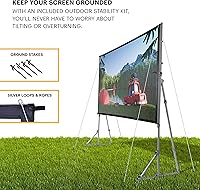
  • The outdoor stability kit is a useful inclusion that at least partially addresses wind concerns without requiring a separate purchase.

Cons

  • At nearly 29 pounds, this is a two-handed carry — not a one-person toss-in-the-car situation.
  • Wind stability remains a genuine issue in gusty conditions, even with the outdoor stability kit deployed.
  • Frame joints on some units have shown loosening after many repeated assembly and disassembly cycles.
  • The 1.0 gain surface is not ideal for environments with significant ambient light leaking in from the sides.
  • The large footprint of the stand requires a fair amount of clear floor space, which can be a constraint in smaller rooms.
  • Some buyers report the locking connectors feel less robust than expected given the overall price of the setup.
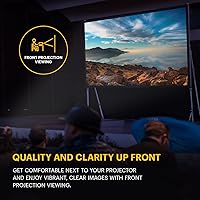
  • The screen is not designed for rear projection, which limits flexibility for certain event or stage configurations.
  • Supplemental ground stakes beyond those included are often necessary for reliable outdoor use in anything but calm weather.

Ratings

The scores below for the KODAK 150-inch Portable Projector Screen with Stand were generated by our AI system after analyzing thousands of verified buyer reviews from global marketplaces, with spam, bot activity, and incentivized feedback actively filtered out. Every category reflects the honest distribution of real user experiences — not just the highlights. Where buyers consistently flagged trade-offs or frustrations, those are reflected in the scores just as transparently as the genuine strengths.
Ease of Setup
88%
Buyers across multiple use cases — from backyard movie nights to classroom presentations — repeatedly highlight how quickly the fast-fold frame comes together. Most report a confident solo setup within fifteen minutes after the first run-through, with the locking mechanism snapping into place reliably each time.
A handful of users note that the initial learning curve on the frame sequence can be frustrating, especially without a second person to hold panels steady while tensioning the screen fabric. The instructions included in the box are considered adequate but not particularly intuitive.
Screen Image Quality
79%
21%
In a properly darkened environment, the PVC and Terylene surface produces clean, color-accurate images that look noticeably sharper than inflatable alternatives. Buyers using modern 4K projectors report that the surface handles fine detail well at normal group viewing distances.
The 1.0 gain rating means the screen adds nothing to brightness — what your projector puts out is what you get. In settings with any meaningful ambient light leaking in, image contrast drops off quickly, which frustrates buyers who hoped to use this in semi-lit spaces.
Build Quality
74%
26%
The metal frame poles feel solid on first assembly, and the overall rigidity of the locked structure is noticeably better than comparably priced tripod-style or inflatable screens. Most buyers are satisfied with the quality relative to the price tier.
Longer-term owners have flagged that connector joints can develop looseness after many repeated assembly cycles, which introduces minor wobble in the frame over time. A subset of buyers consider the locking clips less robust than the rest of the build suggests they should be.
Portability
63%
37%
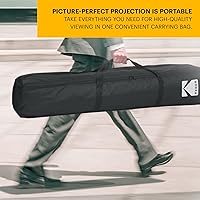
The carry case is genuinely well-made — weather-resistant, structured, and fitted closely enough to protect components during car transport. For buyers moving gear between a home and a regular venue, the suitcase-style collapse makes loading and unloading practical.
At 28.7 pounds, this is firmly in the category of equipment you load into a trunk rather than carry by hand for any distance. Buyers who purchased expecting something closer to a backpack-friendly travel screen often express disappointment when they realize the reality of hauling it.
Outdoor Wind Stability
51%
49%
On calm or lightly breezy evenings the included outdoor stability kit and nonslip feet do their job, keeping the frame planted well enough for a full outdoor screening. Buyers in sheltered backyard setups with fencing or natural windbreaks report far fewer issues.
Wind is the single most recurring complaint in verified user feedback. Even with the stability kit deployed, a moderate gust can shift or tip the frame, and several buyers note that supplemental ground stakes beyond the included hardware are essentially mandatory for reliable outdoor use.
Carry Case Quality
91%
The carry case consistently earns its own praise in reviews, independent of opinions about the screen itself. Buyers appreciate the weather-resistant fabric, the snug fit of the components inside, and the sturdy handle, which holds up well under the load of nearly 30 pounds.
The case does not have wheels or a shoulder strap option, which becomes a noticeable inconvenience when covering any real distance on foot. A few buyers noted that fitting everything back in neatly after the first few uses takes some practice.
Frame Rigidity
77%
23%
When fully locked, the frame holds a flat, taut surface that stays stable under normal indoor conditions and calm outdoor evenings. The rigidity is meaningfully better than inflatable alternatives and holds up well for projection without visible sag in the center.
Over an extended period of use, the frame joints are the weak link — repeated assembly introduces wear that most fixed-frame alternatives simply avoid by design. Buyers who set up and break down frequently are more likely to encounter this issue than occasional users.
Value for Money
82%
18%
Most buyers land on a positive value assessment, particularly when comparing the screen size and build quality against what commercial AV rentals would cost for a single event. For families or small organizations that will use it regularly, the math works out favorably.
Buyers comparing this directly against premium fixed-frame home theater screens find the price harder to justify, since those options outperform on long-term surface quality and rigidity. For very infrequent users, the cost-per-use calculation is less favorable.
Viewing Angle Coverage
86%
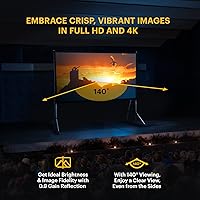
The 140-degree viewing angle is wide enough to cover spread-out groups without visible color shift or brightness falloff at the edges. Buyers hosting parties where guests are seated casually in a broad arc find this genuinely useful in practice.
At the extreme edges of that viewing angle the image quality does degrade slightly, and buyers with very wide seating arrangements note it is not perfectly consistent all the way to the margins. For standard frontal seating it is a non-issue.
Compatibility
93%
Working with LED, LCD, and DLP projectors across a wide range of brands, this screen essentially plugs into whatever setup the buyer already owns. Buyers who switched projectors or lent the screen to friends with different gear report zero compatibility issues.
The front-projection-only design is a genuine limitation for buyers who later discover they want rear-projection flexibility for a stage or event setup. It is not a flaw exactly, but the product description does not emphasize this constraint as clearly as it could.
Screen Surface Durability
76%
24%
The fabric holds up well to regular use — resisting wrinkles, maintaining tension, and avoiding the pinhole or seam issues that plague cheaper screens. Buyers who store it properly in the carry case consistently report the surface staying in good shape across months of use.
The surface is not impervious to damage from sharp contact or rough handling during transport outside the case, and a few users have reported minor scuffing from casual storage. It is durable for its category but not indestructible.
Assembly Instructions
58%
42%
The included documentation covers the basic setup sequence, and most mechanically confident buyers find it sufficient for a first assembly. Video walkthroughs available from the brand help fill in the gaps for users who prefer visual guidance.
Multiple buyers describe the printed instructions as sparse and somewhat unclear on the frame sequencing, leading to initial frustration and at least one incorrect assembly attempt before getting it right. For a product at this price point, clearer documentation would meaningfully improve the out-of-box experience.
Indoor Performance
84%
In a darkened living room or controlled classroom environment, this portable projection screen performs very well — the taut surface, wide viewing angle, and clean fabric response make it a legitimate upgrade from projecting onto a bare wall or a bedsheet.
Buyers using it in office or classroom settings where blinds do not fully block daylight find the 1.0 gain surface struggles more than expected, requiring a significantly brighter projector than they may already own to maintain a watchable image.
Height Adjustability
81%
19%
The adjustable stand height is a practical feature that buyers in varied environments genuinely appreciate — particularly outdoors where ground level is rarely perfectly flat, or indoors where projector throw distance affects the ideal screen position.
The range of height adjustment is adequate but not expansive, and a few taller users setting up for elevated audiences note they wished the upper limit extended a bit further. It covers the common use cases but does not offer fine-grain control.

Suitable for:

The KODAK 150-inch Portable Projector Screen with Stand is a strong match for anyone who regularly hosts group viewing events and wants a setup that looks intentional rather than improvised. Families with a backyard and a habit of organizing movie nights will find the fast-fold frame and carry case make the whole process repeatable without becoming a chore. Educators and corporate trainers who move between rooms or venues will appreciate having a large, stable display that does not require wall access or permanent mounting hardware. Event organizers working weddings, block parties, or community screenings on a budget will find this a practical alternative to renting commercial AV equipment. It also makes a natural companion for anyone already invested in the KODAK projector ecosystem, offering a matched surface that is sized for real group audiences rather than just a couple of people on a couch.
Not suitable for:

The KODAK 150-inch Portable Projector Screen with Stand is not the right choice for buyers who genuinely need a lightweight, backpack-friendly travel screen — at nearly 29 pounds, it travels best in a car trunk, not on foot or through an airport. Anyone planning to use this screen frequently in open, windy conditions should go in with realistic expectations, as the outdoor stability kit provides only moderate anchoring and gusty evenings can still cause problems without supplemental staking. Buyers with a high-lumen projector in a partially lit room may also find the 1.0 gain surface underwhelming, since it does not boost brightness the way higher-gain screens do. If you need a fixed home theater installation with a taut, perfectly flat surface night after night, a fixed-frame wall-mount screen will outperform this portable design over time. Finally, buyers on a tight budget who only plan to use a screen once or twice a year may find the investment difficult to justify compared to cheaper inflatable alternatives.
Specifications

  • Screen Size: The viewable diagonal measures 150 inches, producing a display surface approximately 127.9″ wide by 158.6″ tall in a 16:9 configuration.
  • Aspect Ratio: The screen is formatted in a 16:9 widescreen ratio, which aligns with the standard output of most modern projectors, streaming platforms, and presentation software.
  • Surface Material: The projection surface is constructed from a blend of PVC and Terylene fabric, chosen for its resistance to wrinkling and its ability to maintain a flat, even texture across repeated use.
  • Gain Rating: The screen has a 1.0 gain, meaning it reflects light evenly in all directions without amplifying brightness, which is best suited for controlled or low-ambient-light environments.
  • Viewing Angle: The rated viewing angle is 140 degrees, allowing audiences seated well off-center to still receive a clear, color-accurate image.
  • Frame Type: The support structure uses fast-fold locking metal poles that snap into a rigid frame configuration without requiring tools or complex assembly steps.
  • Mounting Type: The screen is a floor-standing unit supported by a freestanding metal stand with nonslip feet and adjustable height, requiring no wall attachment.
  • Product Weight: The complete unit weighs 28.7 pounds, which is manageable for car transport but should not be considered a lightweight carry-on option.
  • Carry Case: A weather-resistant black carry case with a built-in handle is included, designed to house the folded screen and all stand components for transit.
  • Stability Kit: An outdoor stability kit is included to help anchor the stand on grass or uneven surfaces, though supplemental staking may be necessary in windy conditions.
  • Projector Compatibility: The screen is compatible with LED, LCD, and DLP front-projection formats, covering the vast majority of consumer and prosumer projectors currently available.
  • Resolution Support: The surface is rated to support front-projected content up to 4K and 8K Ultra HD resolution without introducing visible degradation or pixelation at normal viewing distances.
  • Projection Type: This screen is designed exclusively for front projection and is not compatible with rear-projection setups.
  • Model Number: The manufacturer model number is RODPJSFFSW150, which can be used when sourcing replacement parts or contacting support.
  • Brand: The screen is manufactured and sold under the KODAK brand, a consumer imaging company that licenses its name across a range of photography and display products.
  • Availability Date: This product was first listed for sale in September 2022, indicating it is a relatively recent release with active marketplace support.

Related Reviews

SKERELL Portable Projector Screen 150-inch
87%
91%
Ease of Setup
87%
Portability
94%
Display Quality
80%
Durability
85%
Outdoor Performance
More
VEVOR Projector Screen with Stand 150″
70%
88%
Screen Size Impact
82%
Ease of Assembly
79%
Portability & Storage
67%
Screen Material Quality
71%
Stand Stability
More
TOWOND 150-inch Projector Screen with Stand
76%
93%
Ease of Setup
88%
Portability & Storage
91%
Screen Size & Image Scale
74%
Screen Material & Fabric Quality
72%
Image Brightness & Clarity
More
LEORFI 150″ Portable Projector Screen with Stand
76%
88%
Value for Money
79%
Screen Image Quality
82%
Build Quality & Frame Durability
86%
Ease of Assembly
83%
Portability & Transport
More
Towond 100-inch Portable Projector Screen with Stand
74%
91%
Portability & Pack-Down Size
88%
Assembly & Setup Speed
74%
Screen Surface & Image Quality
67%
Wrinkle Resistance
63%
Outdoor Wind Stability
More
excelimage 50-inch Portable Projector Screen with Stand
77%
91%
Ease of Setup
88%
Portability
79%
Image Quality
72%
Build Quality
84%
Screen Surface Flatness
More
HOIN 80-inch Portable Projector Screen Stand
78%
91%
Ease of Assembly
88%
Portability & Transport
84%
Screen Fabric Flatness
82%
Frame Stability — Calm Conditions
56%
Wind Resistance
More
Pyle PRJTP72 72-Inch Portable Projector Screen
73%
88%
Portability & Transport
86%
Setup Speed & Ease
74%
Image Surface Quality
58%
Aspect Ratio Compatibility
67%
Build Quality & Frame Rigidity
More
AWOL Vision MW-150 150″ Projector Screen
77%
88%
Image Flatness
83%
Build Quality
61%
Shipping & Packaging
67%
Assembly Experience
79%
Matte White Performance
More
Elite Screens Yard Master Sport 110-inch Screen
78%
88%
Ease of Setup
83%
Portability & Storage
79%
Image Clarity & Screen Performance
71%
Outdoor Stability
58%
Aspect Ratio Suitability
More

FAQ

Most users report being fully set up in around ten to fifteen minutes the first time, and faster once you know the order of steps. The locking frame snaps together without tools, so there is no hardware to manage. Having a second person around for the initial setup makes tensioning the screen fabric easier, but it is manageable solo.

Like most 1.0 gain screens, this one really needs a dark or near-dark environment to produce a strong image. Outdoor daytime use will wash out the picture significantly regardless of your projector's brightness. Dusk or nighttime is where this setup shines — literally and practically.

The included outdoor stability kit helps, but wind is the most common complaint among real-world users. In light breezes it holds up reasonably well, especially with the nonslip feet on firm ground. In gusty or unpredictable conditions, you will want to add extra ground stakes or guy lines beyond what is provided in the box.

The PVC and Terylene blend is specifically chosen to resist wrinkling, and most buyers report the surface staying acceptably smooth after regular pack-and-unpack cycles. Some minor creasing can appear initially but tends to relax once the screen is tensioned on the frame. Storing it properly in the carry case rather than folding it loosely helps maintain the surface over time.

It works with any standard front-projection setup — LED, LCD, or DLP. You do not need a KODAK projector to use this screen. As long as your projector outputs a 16:9 image and has enough lumen output for your environment, you are good to go.

It is portable in the sense that it breaks down, fits in a carry case, and moves from location to location without a truck or van. That said, at just under 29 pounds, you will want a car for transport rather than carrying it on foot for any distance. Think of it as gear you load into a trunk, not something you hike with.

The carry case gets consistently positive remarks from buyers — it is described as weather-resistant, sturdy, and well-fitted to the screen and stand components. It is not a hard shell case, but it offers meaningfully more protection than a simple drawstring bag and holds up well to regular use.

No, this screen is designed for front projection only. The surface material is not translucent, so placing a projector behind the screen will not produce a usable image. If rear projection is a requirement, you will need a purpose-built rear projection screen with a translucent gray or white surface.

Some long-term users have flagged that the connector joints can develop a bit of play after many assembly cycles. It does not appear to be a universal problem, but if you are planning to set this up and break it down weekly for months on end, it is worth keeping an eye on and having spare connectors available if the manufacturer offers them.

For a good image in a darkened room, a projector in the 2000 to 3000 lumen range is a reasonable starting point for a screen this large. The 1.0 gain surface does not add brightness, so the projected lumens are what you get. For larger groups or environments where you cannot fully control ambient light, a brighter projector — 3500 lumens or more — will give you noticeably better results.