
Overview

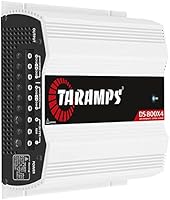
The Taramps DS 800x4 4-Channel Car Amplifier comes from a Brazilian brand that has built a loyal following by delivering serious output without the serious price tag. Taramps targets buyers who want real power in their car, not just impressive numbers on a box. This 4-channel amp lands squarely in the mid-range segment, where wattage-per-dollar matters more than audiophile refinement. Class D topology keeps the chassis compact and relatively cool, a genuine advantage when trunk or under-seat space is limited. One detail worth noting: the white finish is a visual oddity in a category where virtually everything ships in black, making it easy to spot and surprisingly sharp-looking on a clean install.

Features & Benefits

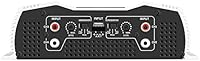
At 1 ohm, this 4-channel amp delivers 800 watts RMS across four channels — real, usable power for a full speaker array. Bridge it down to two channels and you get a pair of 400-watt outputs, handy if you want to run a subwoofer alongside component speakers without adding a second amp. The high-level input is a practical inclusion: factory head units with no RCA preouts can wire directly to speaker leads, and auto turn-on handles activation without a remote wire. The signal-to-noise ratio clears 88dB, keeping background hiss from being noticeable at normal listening volumes. The fixed crossover at 90Hz simplifies the install — no guesswork with knobs — though it does mean you commit to that frequency split regardless of your speaker setup.

Best For

This Taramps unit makes the most sense for a few specific buyer types. If you are building your first real car audio system and want a single amp to handle four speakers cleanly, it fits the brief well. It is also a strong pick for anyone running 1-ohm stable drivers who needs headroom without a steep outlay. Vehicles with factory head units and no RCA outputs get outsized value from the high-level input — that feature alone eliminates a common wiring obstacle. It also earns its place as a secondary amplifier in larger multi-amp setups, covering the mid and high channels cost-efficiently while a separate dedicated amp handles the subwoofer duties.

User Feedback

Buyers consistently note that the DS 800x4 hits harder than expected — that sentiment shows up repeatedly and seems genuine rather than exaggerated. Long-term durability also gets mentioned favorably, with several owners reporting solid performance well past the one-year mark. The fixed crossover draws the most criticism; enthusiasts who want precise system tuning find the locked 90Hz split point limiting, which is a fair complaint for experienced builders. A handful of installers flag that auto turn-on can behave inconsistently with low-output factory radios, requiring some experimentation. Overall build quality impressions lean positive — the chassis feels solid for the price — though a few buyers mention the terminal connectors could be sturdier given the vibration environment of a moving vehicle.

Pros

  • Delivers noticeably strong output for its price tier — buyers consistently report it sounds louder than expected.
  • Stable at 1 ohm, giving it real-world headroom that cheaper 4-channel amps often cannot match.
  • High-level input makes it compatible with factory head units that lack RCA outputs.
  • Auto turn-on activation removes the need to run a dedicated remote wire from the head unit.
  • Bridgeable design lets you repurpose two channels as a single high-power output for a subwoofer.
  • Class D efficiency keeps the chassis cool during normal use, reducing thermal throttling concerns.
  • Full-range frequency response means one amp can handle tweeters, midrange drivers, and subs simultaneously.
  • Compact footprint fits under seats or in tight trunk corners where larger amps simply will not go.
  • Signal-to-noise ratio above 88dB keeps background hiss out of the picture at everyday listening levels.
  • Long-term reliability reports from owners past the one-year mark are generally encouraging for the price point.

Cons

  • Fixed 90Hz crossover offers no adjustment, forcing a one-size-fits-all frequency split regardless of your speaker setup.
  • Auto turn-on can behave inconsistently when paired with low-output factory radios, requiring troubleshooting.
  • Terminal connectors feel less robust than expected given the vibration stress of a moving vehicle environment.
  • No variable LPF or HPF control limits how precisely you can blend speakers and subwoofers in a mixed system.
  • The 60A fuse rating demands a properly sized dedicated circuit; shortcuts in the wiring run create real risks.
  • White chassis, while distinctive, may look out of place in trunk builds where most surrounding components are black.
  • Musical current draw at 12.6V is substantial — older or smaller vehicle alternators may struggle under sustained load.
  • Input sensitivity starting at 250mV leaves limited fine-tuning range for sources with non-standard output levels.

Ratings

The scores below reflect an AI-driven analysis of verified global buyer reviews for the Taramps DS 800x4 4-Channel Car Amplifier, with spam, bot activity, and incentivized feedback actively filtered out before scoring. Each category is evaluated on real-world performance patterns drawn from owners across a wide range of install types and vehicle setups. Both the strengths that keep buyers recommending this unit and the friction points that drive criticism are represented transparently in every scorecard.

Value for Money
92%
Owners consistently describe this 4-channel amp as one of the better-performing units at its price tier, with many noting it outperforms rivals they previously ran at similar cost. For budget-conscious builders trying to power a full speaker setup without breaking the bank, the output-to-dollar ratio stands out as the single biggest reason to buy.
A small segment of buyers who expected audiophile refinement felt the value proposition weakened once they compared it against slightly pricier amps with adjustable crossovers and cleaner noise floors. At the top of the budget segment, competition is real, and a few extra dollars can unlock meaningfully more flexibility.
Power Output
89%
The most frequently praised aspect across the entire review pool is how hard this unit drives speakers relative to what buyers anticipated. Running at 1 ohm, the DS 800x4 delivers output that consistently surprises owners used to inflated wattage claims from cheaper competitors, making it a genuine performer in real-world daily listening.
At sustained maximum volume over long sessions, some owners report the amp pulling back slightly, which is consistent with thermal protection behavior rather than a true power deficiency. Those running heavily loaded 1-ohm setups in poorly ventilated spaces are more likely to encounter this ceiling than average users.
Installation Ease
84%
The high-level input and auto turn-on feature remove two of the most common friction points in a DIY install — the need for RCA cables and a remote wire. Buyers with factory stereos repeatedly mention this as the feature that made the whole project approachable without professional help.
The auto turn-on sensitivity causes inconsistent behavior for some owners, particularly those with low-output factory radios where the signal sensing circuit struggles to trigger reliably. A handful of installers also noted the terminal block layout requires careful cable routing in tighter mounting locations.
Crossover Flexibility
51%
49%
For straightforward builds where the owner just wants clean separation between bass and full-range channels, the fixed 90Hz crossover point works without any fuss. It removes one decision from the setup process entirely, which less experienced installers often appreciate.
The fixed crossover is the single most criticized limitation across the review pool. Buyers who own component speakers with specific crossover requirements, or who want to fine-tune the blend between a subwoofer and door speakers, find the locked 90Hz point genuinely restrictive. There is no workaround short of adding an external DSP or line driver.
Build Quality
74%
26%
The chassis earns generally positive marks for feeling solid and well-assembled given the price range, with most owners noting it does not feel flimsy or hollow when handling it during install. The white finish is also consistently described as looking cleaner and more distinctive than expected in a trunk or under-seat setup.
The terminal connectors draw the most consistent build-quality criticism, with multiple owners describing them as the weakest point on an otherwise acceptable unit. In a high-vibration environment like a car, connector rigidity matters more than it would on home audio gear, and this is where the cost-cutting shows most clearly.
Thermal Management
77%
23%
Class D operation genuinely keeps this Taramps unit running cooler than Class A/B amps of similar output ratings, and most owners report it stays warm but stable during daily commutes and average listening sessions. The compact chassis dissipates heat reasonably well when mounted with adequate airflow around it.
Extended high-volume use in enclosed or poorly ventilated spaces pushes the amp into thermal protection more readily than some owners expect. Buyers who run the amp at near-maximum load for long stretches — during road trips or outdoor audio events — report occasional shutdowns that resolve after a cool-down period.
Signal Clarity
78%
22%
An above-88dB signal-to-noise ratio translates to a quiet background at normal listening volumes, and the majority of owners report no audible hiss or interference during typical use. For a full-range amp at this price, the noise floor is better controlled than competing units in the same bracket.
At higher gain settings or when paired with a noisy high-level input signal from an older factory radio, some owners notice a faint background hiss that becomes apparent during quiet passages. It is not a dealbreaker for most, but buyers running sensitive tweeters in a quiet cabin may notice it more than others.
Compatibility
83%
The 1-ohm and 2-ohm stability, combined with full-range frequency response, gives this 4-channel amp broad compatibility across speaker types — from 4-ohm component sets to lower-impedance coaxials and even compact subwoofers in bridged mode. Most standard car audio wiring configurations work without any adaptation.
Four-ohm-only speaker systems do not get the full rated output from this unit, and buyers who did not read the impedance spec carefully before purchasing occasionally report disappointment when their standard 4-ohm door speakers produce less volume than expected. Compatibility is wide but not universal.
Bridging Performance
81%
19%
Owners who bridge the amp to drive a compact subwoofer alongside two channels of door speakers report strong, clean bass output that holds together well at moderate to high volumes. The bridgeable design makes the DS 800x4 a legitimate single-amp solution for a complete starter system.
Bridging both channel pairs simultaneously while running demanding loads on both outputs pushes the amp harder thermally, and some owners note reduced headroom in this configuration compared to running all four channels independently. It works, but the margin for sustained peak performance is narrower when fully bridged.
Reliability Over Time
79%
21%
A meaningful portion of the long-term review pool — owners past the six-month and one-year marks — report the unit still performing without issues, which speaks well for a product at this price point where early failures are not uncommon in the category. Taramps has enough of a track record in the Brazilian and North American markets that durability confidence is reasonable.
There is a smaller but notable group of buyers who report failures within the first three to six months, typically described as the amp going into protection mode and not recovering. Whether these cases reflect defective units or improper installs is difficult to determine, but they appear consistently enough to factor into a long-term reliability assessment.
Wiring Simplicity
82%
18%
The 7 AWG power cable spec and clearly rated 60A fuse requirement make it straightforward for a DIY installer to plan and purchase the right wiring kit in one trip. Having these specifications clearly documented reduces guesswork and helps avoid the undersized wiring mistakes that damage amps and vehicles alike.
The substantial current draw at musical listening levels means the wiring run needs to be done correctly — cheap connectors or too-thin cable will cause voltage drop that visibly affects output. Buyers who cut corners on the wiring occasionally blame the amp for problems that originate in their own install.
Size & Fitment
87%
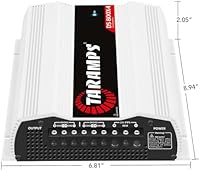
At under 9 inches long and just over 2 inches tall, the DS 800x4 fits under most bench seats and in compact trunk corners where larger amps simply cannot go. Owners working with limited space consistently mention the footprint as a genuine advantage, especially those installing in smaller hatchbacks or sedans.
While the chassis is compact, the connection points add real-world length once cables are attached, which can catch out buyers who measured only the amplifier body when planning their mounting location. A few owners had to reposition the unit after discovering the wiring did not have enough clearance in their original install spot.
Auto Turn-On Reliability
63%
37%
For the majority of buyers pairing this unit with a modern aftermarket head unit or a factory radio with reasonable output, the auto turn-on works reliably and removes a meaningful installation step. It is a feature that genuinely earns its keep in straightforward installs where a remote wire is inconvenient to run.
The consistency complaints around auto turn-on are specific but frequent enough to take seriously. Low-output factory radios, particularly in older vehicles, do not always produce a signal strong enough to trigger the sensing circuit, leading to the amp failing to power up or cycling unpredictably. This is a fixable issue but requires additional hardware.

Suitable for:

The Taramps DS 800x4 4-Channel Car Amplifier is a strong fit for budget-minded builders who want to power a full four-speaker setup from a single unit without stretching their finances thin. It works especially well in vehicles where the factory head unit lacks RCA preouts, since the high-level input removes what is normally a frustrating wiring obstacle. Drivers running 1-ohm stable speakers will appreciate the headroom this 4-channel amp offers at that impedance — it punches well above what the price suggests. The bridgeable design also makes it a smart choice for someone who wants to split duties: run two channels to door speakers and bridge the other two into a compact subwoofer. If your priority is getting real, audible power into your car without a complicated install or a second amp, this Taramps unit delivers a practical, no-fuss solution.

Not suitable for:

The Taramps DS 800x4 4-Channel Car Amplifier is not the right tool for enthusiasts who want precise, adjustable signal control over their system. The crossover is fixed at 90Hz for both high-pass and low-pass filtering, which means you cannot tailor the frequency split to match your specific speaker combination — a real limitation if you have invested in quality component speakers with particular crossover requirements. Audiophiles focused on soundstage accuracy, detailed imaging, or flat frequency reproduction will find the DS 800x4 falls short of their expectations; this amp was built for output and value, not surgical audio refinement. Installers who need variable gain across a wide range, or who rely on low-noise RCA chains from a dedicated head unit, may also find the fixed sensitivity and high-level input less accommodating than a more configurable alternative. If your build demands fine-tuned DSP control or you are feeding high-efficiency, high-impedance speakers in a critical listening setup, a different amp category is worth the additional cost.

Specifications

  • Total RMS Power: The amp delivers 800W RMS total output across four channels when loaded at 1 ohm.
  • Per-Channel Power: Each of the four channels produces 200W RMS at 1 ohm under continuous rated conditions.
  • Bridged Output: When bridged to two channels, each bridged pair outputs 400W RMS for driving higher-demand loads.
  • Impedance: The unit is stable at 1 ohm and 2 ohms; 4-ohm operation in 4-channel mode is not rated by the manufacturer.
  • Amplifier Class: Class D topology is used throughout, prioritizing energy efficiency and reduced heat generation relative to Class A/B designs.
  • Crossover: A fixed crossover filters both high-pass and low-pass signals at 90Hz with a steep 12dB per octave slope; no adjustment is available.
  • Frequency Response: The amplifier reproduces audio across the full range from 10Hz to 22kHz at the -3dB points.
  • Signal-to-Noise Ratio: The signal-to-noise ratio is rated above 88dB, keeping audible background noise at an acceptable level for this price tier.
  • Input Sensitivity: Input sensitivity at 100% level control is 250mV, which suits most aftermarket and high-level source signals.
  • High-Level Input: A high-level speaker input is included, enabling direct connection to vehicles with no RCA preout on the head unit.
  • Auto Turn-On: The amplifier activates automatically via signal sensing on the high-level input, eliminating the need for a remote turn-on wire.
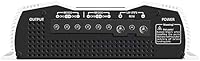
  • Power Cable Gauge: The manufacturer specifies a 7 AWG positive and negative power cable for proper current delivery to the unit.
  • Fuse Rating: A 60A circuit breaker or fuse is required in the power supply line to protect the vehicle wiring and the amp.
  • Current Draw: Musical current consumption at 12.6V DC is rated at 51A, with a maximum draw of 102A at peak power.
  • Operating Voltage: The amplifier operates between a minimum of 9V DC and a maximum of 16V DC supply voltage.
  • Dimensions: The chassis measures 6.81″ wide by 2.05″ tall by 8.94″ long, making it compact enough for under-seat or trunk installs.
  • Weight: The unit weighs 3.15 lb, which is notably light for an 800W-rated 4-channel amplifier.
  • Channels: The amplifier has four independent full-range channels that can be run individually or bridged in pairs.
  • Finish: The chassis ships in white, which is uncommon in the car amplifier category where black is the near-universal standard.
  • Idle Consumption: At idle with no audio signal present, the amplifier draws only 1.0A, minimizing battery drain when the system is on standby.

Related Reviews
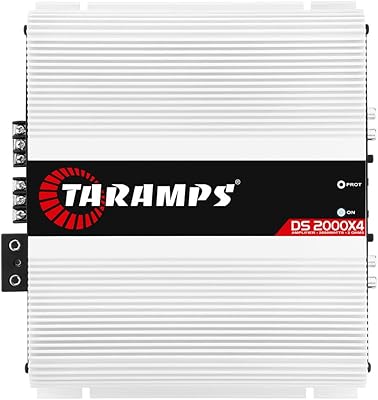
Taramp's DS 2000x4 4-Channel Car Audio Amplifier
85%
95%
Power Output
92%
Sound Quality
88%
Installation Ease
65%
Cooling Requirements
91%
Build Quality
More
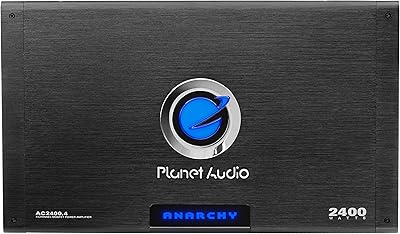
Planet Audio AC2400.4 4-Channel Car Amplifier
84%
95%
Power Output
89%
Sound Clarity
87%
Bass Performance
82%
Ease of Installation
65%
Thermals/Heat Management
More
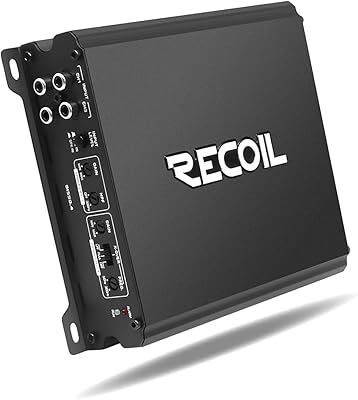
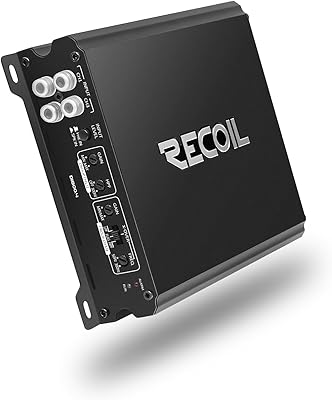
Recoil DI800.4 4-Channel Car Amplifier
75%
88%
Value for Money
51%
Power Accuracy
63%
Build Quality
79%
Thermal Management
86%
Ease of Installation
More
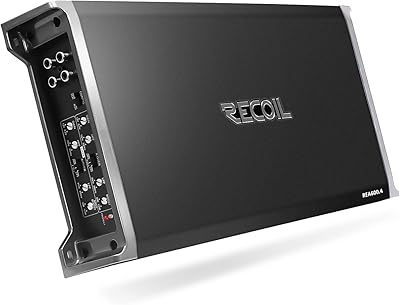
Recoil REA600.4 4-Channel Car Audio Amplifier
84%
89%
Audio Performance
91%
Ease of Installation
85%
Sound Quality at High Volumes
62%
Heat Management
90%
Power Output
More
Recoil DI550.4 4-Channel Car Audio Amplifier
74%
91%
Value for Money
78%
Power Output
86%
Ease of Installation
74%
Sound Quality
67%
Build Quality
More
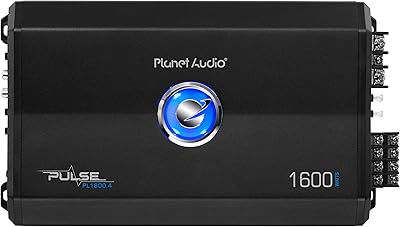
Planet Audio PL1600.4 4-Channel Car Amplifier
72%
88%
Value for Money
84%
Ease of Installation
74%
Sound Quality
58%
Power Output (Real-World)
61%
Build Quality
More
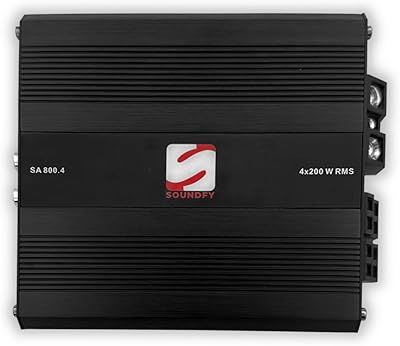
Soundfy SA 400.4 4-Channel Car Amplifier
71%
78%
Value for Money
72%
Sound Quality
63%
Power Output
58%
Build Quality
81%
Thermal Management
More
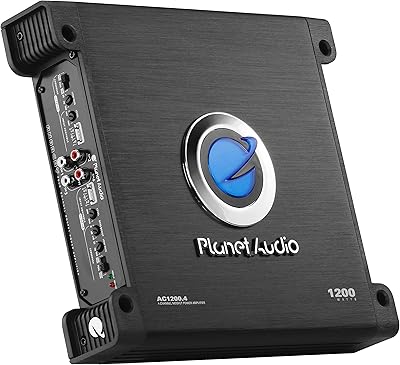
Planet Audio AC1200.4 4-Channel Car Amplifier
73%
88%
Value for Money
67%
Power Output
83%
Installation Ease
74%
Sound Quality
61%
Build Quality
More
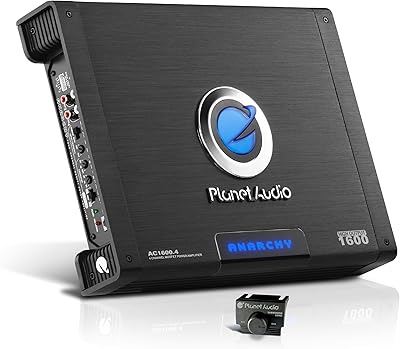
Planet Audio AC1600.4 Anarchy Series 4-Channel Car Amplifier
82%
94%
Power Output
88%
Sound Quality
70%
Ease of Installation
92%
Value for Money
85%
Build Quality
More
Stetsom HL 2000.4 2-Ohm 4-Channel Car Audio Amplifier
87%
93%
Power Output
85%
Cooling System Efficiency
88%
Sound Quality
91%
Ease of Installation
82%
Durability
More

FAQ

Yes, that is actually one of the more practical features on this unit. The high-level input lets you connect directly to the speaker wire outputs from your factory head unit, so you do not need to replace the stereo just to add amplification. The auto turn-on function will also detect the signal and power the amp up without needing a remote wire, which simplifies the install considerably.

The manufacturer specifies 7 AWG for the main power and ground cables. You will also want a 60A inline fuse placed as close to the battery as possible — within 18 inches is the standard recommendation. Skipping or undersizing the fuse is not worth the risk given the current this amp can pull under heavy use.

It is genuinely rated for 1-ohm operation, and real-world owner feedback supports that claim. Buyers running 1-ohm loads report the amp stays functional and does not go into thermal protection under normal listening conditions. That said, keep your power and ground wiring clean and your ground connection solid — at 1 ohm, any resistance in the wiring chain will cost you both power and stability.

Yes, the amp is bridgeable. You can bridge channels 1 and 2 together and channels 3 and 4 together, giving you two bridged outputs at 400W RMS each. That makes it feasible to run a subwoofer off one pair and front speakers off the other, all from a single amp.

It depends on your system. The crossover is locked at 90Hz for both the high-pass and low-pass filters, and you cannot adjust that point. For most casual builds where you are just adding more output to a standard speaker setup, 90Hz is a reasonable split. If you have specific component speakers that need a different crossover frequency to sound their best, you will find the lack of adjustment limiting.

Class D amps run cooler than older Class A/B designs, and this one is no exception under normal conditions. Most owners report it stays warm but manageable during regular listening. If you are running it at maximum power for extended periods in a poorly ventilated space, some thermal protection may kick in — so make sure there is airflow around the unit and avoid mounting it in a completely sealed enclosure.

It works reliably with most aftermarket and factory head units, but some lower-output factory radios produce a signal level that is too weak for the sensing circuit to detect consistently. If you find the amp not turning on or cycling on and off, the simplest fix is to run a dedicated remote turn-on wire from the head unit or add an aftermarket line output converter that provides a clean signal.

Technically yes, since the frequency response covers the full audible range. However, keep the fixed 90Hz crossover in mind — the high-pass filter at 90Hz means signals below that frequency are rolled off on channels used for tweeters or midrange drivers, and the low-pass mirrors that same point for a subwoofer channel. It is workable for a straightforward system, but a dedicated subwoofer amp with an adjustable crossover will give you more control over the bass blend.

The general owner consensus is that the chassis feels solid and the overall construction is better than you might expect at this price point. The one area where some buyers note concern is the terminal connectors, which are functional but feel less robust than connectors found on higher-priced amps. Given the vibration environment in a car, using quality ring terminals and securing wiring properly is a good habit regardless of what amp you are running.

It is actually well suited for that role. The DS 800x4 is compact, runs cool, and delivers genuine output for the size and cost — qualities that matter when it is one of several amps in a trunk build. Using it to handle mid and high-frequency channels while a dedicated mono amp covers the subwoofer is a common and effective pairing strategy.

Where to Buy