

Overview

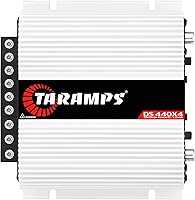
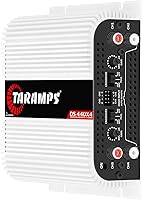
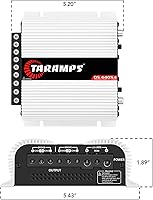
The Taramps DS 440x4 4-Channel Car Amplifier is one of the few genuinely capable 4-channel amps you can find at this price point — and that matters more than most buyers realize. Taramps is a Brazilian brand with a solid following in competitive car audio circles, though it flies under the radar in North America. What sets this compact 4-channel amplifier apart isn't just price; it's that the RMS power ratings are honest. The aluminum chassis is notably small — barely over 5 inches in any direction — and it accepts both RCA and high-level speaker wire inputs, meaning you can wire it directly to a factory head unit without any extra adapters.

Features & Benefits

Running on Class D architecture, this Taramps amp stays surprisingly cool even during longer drives — a real advantage when you're tucking it behind a seat or under a dashboard. You get 110 watts RMS per channel at 2 ohms, totaling 440 watts across all four, and you can bridge channel pairs if you want to push more power to specific speakers. The fixed 90Hz crossover handles basic speaker protection without requiring you to dial anything in manually. Throw in a signal-to-noise ratio north of 90dB and automatic turn-on via the high-level input, and the install process becomes refreshingly straightforward for most everyday builds.

Best For

This compact 4-channel amplifier makes the most sense for anyone doing a factory system upgrade without swapping out the head unit. If your car came with a stock radio lacking RCA outputs, the high-level input solves that problem directly. It's also a smart pick for smaller vehicles — compact sedans or hatchbacks — where mounting space is tight and you still want clean power reaching all four speakers. People who prefer a no-fuss setup with minimal tuning will appreciate the fixed crossover; plug it in, set the input sensitivity, and you're done. For custom builds requiring independent crossover control per channel, look elsewhere — but for a clean daily-driver upgrade, it's hard to beat.

User Feedback

Buyers consistently highlight how easy the DS 440x4 is to install, particularly those coming from a stock setup who expected more complexity. The power output accuracy is a frequent talking point — most users report the amp genuinely delivers close to its rated figures, which isn't always guaranteed at this price tier. On the downside, the fixed crossover draws criticism from experienced enthusiasts who want per-channel tuning flexibility. A handful of users also mention the unit running warm during sustained high-volume listening, so planning for adequate ventilation during install is worth considering. Overall, Taramps earns consistent credibility from buyers who assumed an unfamiliar brand meant compromised quality.

Pros

  • Honest RMS power ratings that hold up in real-world use, unlike many budget competitors.
  • Accepts both RCA and speaker-level inputs, making it compatible with virtually any head unit.
  • Extremely compact chassis fits in tight spaces where larger amps simply won't go.
  • Class D design keeps the unit running efficiently and relatively cool during normal use.
  • Automatic turn-on via high-level input eliminates the need to run a separate remote wire.
  • Signal-to-noise ratio above 90dB keeps the audio clean at everyday listening volumes.
  • Bridgeable channels add flexibility if you later decide to prioritize two speakers over four.
  • Lightweight aluminum build makes mounting easier and adds no meaningful weight to the vehicle.
  • Taramps has a proven track record in competitive audio markets, lending credibility to the specs.
  • Fixed crossover simplifies setup for users who just want clean sound without deep tuning.

Cons

  • Fixed crossover frequency cannot be adjusted, limiting flexibility for advanced or component speaker builds.
  • No 1-ohm stable operation, which rules it out for certain subwoofer or low-impedance applications.
  • Sustained high-volume use in poorly ventilated installs can lead to noticeable heat buildup.
  • Taramps is still an unfamiliar name to many North American buyers, making pre-purchase research harder.
  • The 9 AWG power cable requirement means you may need to purchase wiring separately if your kit uses thicker gauge.
  • No adjustable bass boost or EQ controls, so you rely entirely on your head unit for tone shaping.
  • Four channels only — no dedicated subwoofer channel output for a dedicated low-frequency run.
  • Sensitivity adjustment range is narrow, which can complicate matching with very high or very low output head units.

Ratings

The Taramps DS 440x4 4-Channel Car Amplifier scores below were generated by AI after analyzing verified global buyer reviews, with spam, incentivized, and bot-flagged submissions actively filtered out. Across thousands of real-world install reports, both the genuine strengths and the honest frustrations of this compact amp are reflected in every category. Nothing has been softened — if buyers ran into a recurring issue, it shows up in the numbers.

Value for Money
93%
For buyers comparing real RMS figures rather than inflated peak claims, this amp consistently punches well above its price tier. Installers who have spent time in the budget amp space repeatedly note that getting legitimate 4-channel power at this cost is genuinely uncommon, and that credibility drives strong satisfaction scores.
A small number of buyers feel the accessories included in the box do not match the quality of the amp itself, and some note that sourcing a compatible wiring kit adds to the total spend in ways they did not anticipate upfront.
Power Accuracy
89%
One of the most consistent themes in buyer feedback is that the DS 440x4 actually delivers close to its rated figures in use — something many budget amps fail to do. Installers who tested output independently reported figures that aligned reasonably well with the 110 watts RMS per channel spec at 2 ohms.
At 4 ohms the per-channel output drops to around 70 watts, which surprises some buyers who run 4-ohm speakers and expected closer to the headline 440-watt figure. Clearer spec communication at the point of purchase would prevent this confusion.
Ease of Installation
88%
The high-level input with automatic turn-on is a genuine time-saver for anyone working with a factory radio. DIYers consistently report getting the amp up and running without needing to consult a professional, and the compact chassis makes placement in tight spots far less stressful than with full-size amps.
A few installers noted that the input sensitivity adjustment range is narrow, which caused minor matching issues with certain head units. The fixed crossover also means some buyers had to compensate through head unit EQ settings rather than the amp itself.
Build Quality
81%
19%
The machined aluminum housing feels noticeably more solid than what you typically find on amps at this price. The chassis does not flex under pressure, and the terminal connections are snug enough that buyers report confidence in long-term reliability after the initial install.
The overall finish, while clean, does not have the premium tactile feel of mid-range or high-end amps. A couple of buyers noted minor inconsistencies in the labeling or connector tolerance, though these were cosmetic rather than functional complaints.
Thermal Management
71%
29%
Under typical daily driving conditions at moderate volumes, the Class D design keeps heat generation impressively low. Buyers running the amp for short to medium commutes report the chassis stays warm but never alarmingly hot, even in enclosed under-seat installs.
Extended high-volume use is where this amp draws the most criticism. Users running it close to full output for prolonged periods — particularly in summer heat or poorly ventilated enclosures — report significant warmth that occasionally triggers thermal protection and causes brief audio cutouts.
Crossover Flexibility
54%
46%
For buyers running a straightforward four-speaker full-range setup, the fixed 90Hz crossover does its job without any intervention required. Basic high-pass protection for door speakers and low-pass shaping for simpler configs is handled automatically, which many casual upgraders actually prefer.
The fixed crossover is the single most cited limitation among experienced car audio enthusiasts. There is no way to adjust the crossover point for component speaker setups, tweeters requiring a higher HPF, or subwoofer applications that need a lower LPF — and that genuinely limits the amp's versatility for advanced builds.
Compact Footprint
94%
At barely over 5 inches in any direction and weighing well under 2 lbs, this Taramps amp fits in spaces that would reject most competitors outright. Installers working in small sedans, hatchbacks, or motorcycles cite the size as a deciding factor, and the surface-mount design makes placement flexible.
The compact chassis, while an advantage in most installs, does limit internal component size and heatsink surface area. Buyers should not expect the same sustained thermal headroom that a physically larger amp with a bigger heat dissipation surface could offer.
Signal Clarity
83%
The signal-to-noise ratio above 90dB translates into noticeably clean audio at everyday listening volumes. Buyers replacing factory systems consistently report that background hiss and interference are not issues, even when using the high-level input alongside a stock head unit.
At higher output levels with the gain pushed, a small number of buyers noticed a subtle noise floor increase, particularly when using the high-level input with lower-quality factory wiring as the signal source. This is more a system-level issue than an amp defect, but it is worth noting.
Compatibility
87%
The dual input system makes this compact 4-channel amplifier compatible with an unusually wide range of vehicle setups. RCA-equipped aftermarket head units and factory radios with no RCA outputs are both fully supported, which is a practical advantage that expands the potential install base significantly.
The amp is not 1-ohm stable, which cuts it off from certain speaker configurations and makes it a non-starter for users wanting to bridge into lower-impedance loads. Buyers running 4-ohm speakers in bridged mode also see a significant power reduction compared to the headline spec.
Brand Credibility
78%
22%
Among buyers who did their research before purchasing, Taramps earns genuine respect — the brand's background in competitive Brazilian car audio markets carries weight with those who know the industry. Post-purchase satisfaction around brand trust tends to rise after buyers confirm the specs hold up in practice.
North American buyers unfamiliar with Taramps often approach the purchase with skepticism, and the brand's limited retail presence outside of online channels means there is little opportunity for pre-purchase hands-on evaluation. Customer support accessibility for North American buyers also comes up as a minor concern.
Wiring & Accessories
62%
38%
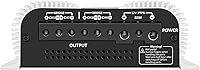
The amp's power and fusing requirements are stated clearly — 9 AWG cable and a 50-amp fuse — which makes sourcing a compatible wiring kit straightforward for anyone with basic install knowledge. The remote cable and output wiring gauges are also specified, reducing guesswork during the build.
The box does not include a complete wiring kit, which catches some first-time buyers off guard. For inexperienced installers, having to separately source a correctly-specced wiring harness adds friction to what is otherwise a simple install process, and lower-quality kits can affect performance.
Channel Configuration
76%
24%
Having four independent full-range channels gives enough flexibility for a complete front and rear speaker upgrade in a single amp. The bridging option adds some versatility for buyers who later decide to consolidate channels for a specific speaker setup.
There is no dedicated subwoofer output channel, which means adding a sub to the system requires either a separate mono amp or sacrificing two of the four channels to a bridged configuration — a real limitation for buyers hoping to run a full five-speaker system from one unit.
Weight & Portability
91%
At approximately 1.39 lbs, the DS 440x4 is light enough to mount in unconventional locations without worrying about panel stress or extra hardware reinforcement. Buyers doing seasonal installs across multiple vehicles also appreciate how little effort is involved in swapping the unit between setups.
The lightweight build, while practical, leads some buyers to question long-term durability before they have had time with the unit. It is not a founded concern based on failure reports, but the perception gap between light weight and perceived durability does affect initial buyer confidence.

Suitable for:

The Taramps DS 440x4 4-Channel Car Amplifier is a strong fit for everyday drivers who want a real, measurable improvement over their factory speakers without committing to a full head unit swap. If your car came with a stock stereo and no RCA outputs, the high-level input on this amp solves that problem cleanly, no adapter required. It's particularly well-suited for owners of compact vehicles — sedans, hatchbacks, small SUVs — where mounting real estate is limited and a physically small amp is a practical necessity rather than just a preference. Budget-conscious enthusiasts who have been burned by inflated peak wattage claims on cheaper amps will find the honest RMS figures here refreshing. DIYers tackling their first amplifier install will also appreciate that the fixed crossover removes one major variable from the setup process, keeping the learning curve manageable.

Not suitable for:

The Taramps DS 440x4 4-Channel Car Amplifier is not the right tool for builders who need granular control over their system tuning. The fixed 90Hz crossover works fine for basic full-range speaker setups, but if you're running component speakers with separate tweeters and woofers that demand individually adjusted crossover points, this amp will frustrate you quickly. Anyone planning to push the amp at high volume for extended periods — long highway drives at near-maximum output, for example — should plan their install carefully around ventilation, as thermal buildup has been noted under those conditions. Audiophiles chasing the cleanest possible signal chain at high output levels may find that an amp in a higher price bracket offers more headroom and refinement. It's also not a practical choice if you need 1-ohm stability, as this unit is rated down to 2 ohms only.

Specifications

  • Amplifier Class: This amp runs Class D topology, which prioritizes power efficiency and keeps heat generation low compared to older Class AB designs.
  • Total Output Power: Total RMS output is 440 watts at 2 ohms, split evenly across four channels at 110 watts RMS each.
  • 4-Ohm Output: At 4 ohms per channel, the amp delivers 70 watts RMS per channel, totaling 280 watts RMS across all four channels.
  • Bridged Output: When bridged into two channels, the amp produces 220 watts RMS per channel into a 4-ohm load.
  • Number of Channels: The unit has four independent full-range channels, each capable of driving a single speaker or tweeter configuration.
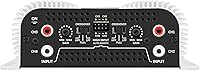
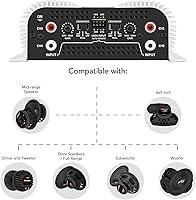
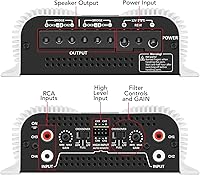
  • Input Types: Accepts both RCA line-level inputs and high-level speaker wire inputs, covering aftermarket and factory head unit installations.
  • High-Pass Filter: A fixed HPF is set at 90Hz with a -12dB per octave slope, protecting smaller speakers from low-frequency overload.
  • Low-Pass Filter: A fixed LPF is also set at 90Hz at -12dB per octave, suitable for directing bass frequencies in basic setups.
  • Signal-to-Noise Ratio: Rated at greater than 90dB, which is sufficient to keep background hiss inaudible at normal listening volumes.
  • Frequency Response: The amp reproduces audio across a range of 8Hz to 25kHz at -3dB, covering the full audible spectrum.
  • Operating Voltage: Operates within a supply voltage range of 9V to 16V DC, compatible with standard 12V automotive electrical systems.
  • Power Cable Gauge: The manufacturer specifies a 9 AWG positive and negative power cable for the main supply connection.
  • Fuse Rating: A 50-amp fuse or circuit breaker is required in the power line, reflecting the amp's maximum current draw under load.
  • Idle Current Draw: At rest with no audio signal, the amp draws just 0.7 amps, making it efficient when the system is on but not playing.
  • Dimensions: The chassis measures 5.43″ wide, 1.89″ tall, and 5.20″ long, making it one of the more compact 4-channel amps in its class.
  • Weight: The unit weighs approximately 1.39 lb, light enough for flexible mounting without significant structural reinforcement.
  • Housing Material: The outer enclosure is machined aluminum, which aids in passive heat dissipation and keeps the overall build rigid.
  • Mounting Type: Designed for surface mounting, with standard screw-point placement suitable for most common install locations.
  • Safety Certification: Carries Inmetro certification, the Brazilian national standards body equivalent, confirming compliance with defined safety benchmarks.
  • Automatic Turn-On: When using the high-level input, the amp detects signal presence and powers on automatically without needing a dedicated remote wire.

Related Reviews
Taramp's DS 2000x4 4-Channel Car Audio Amplifier
85%
95%
Power Output
92%
Sound Quality
88%
Installation Ease
65%
Cooling Requirements
91%
Build Quality
More
Planet Audio AC2400.4 4-Channel Car Amplifier
84%
95%
Power Output
89%
Sound Clarity
87%
Bass Performance
82%
Ease of Installation
65%
Thermals/Heat Management
More
Planet Audio PL1600.4 4-Channel Car Amplifier
72%
88%
Value for Money
84%
Ease of Installation
74%
Sound Quality
58%
Power Output (Real-World)
61%
Build Quality
More
Recoil DI800.4 4-Channel Car Audio Amplifier
83%
88%
Sound Quality
92%
Power Output
65%
Thermal Management
84%
Build Quality
91%
Ease of Installation
More
Recoil DI550.4 4-Channel Car Audio Amplifier
74%
91%
Value for Money
78%
Power Output
86%
Ease of Installation
74%
Sound Quality
67%
Build Quality
More
Recoil REA600.4 4-Channel Car Audio Amplifier
84%
89%
Audio Performance
91%
Ease of Installation
85%
Sound Quality at High Volumes
62%
Heat Management
90%
Power Output
More
Planet Audio AC1600.4 Anarchy Series 4-Channel Car Amplifier
82%
94%
Power Output
88%
Sound Quality
70%
Ease of Installation
92%
Value for Money
85%
Build Quality
More
Soundfy SA 400.4 4-Channel Car Amplifier
71%
78%
Value for Money
72%
Sound Quality
63%
Power Output
58%
Build Quality
81%
Thermal Management
More
Planet Audio AC1200.4 4-Channel Car Amplifier

73%
88%
Value for Money
67%
Power Output
83%
Installation Ease
74%
Sound Quality
61%
Build Quality
More
Hifonics BXX800.4 Brutus 800W RMS 4-Channel Car Audio Amplifier
86%
88%
Sound Quality
92%
Power Output
85%
Build Quality
72%
Heat Management
89%
Ease of Installation
More
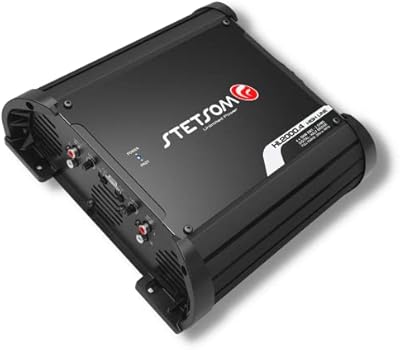
Stetsom HL 2000.4 2-Ohm 4-Channel Car Audio Amplifier
87%
93%
Power Output
85%
Cooling System Efficiency
88%
Sound Quality
91%
Ease of Installation
82%
Durability
More

FAQ

Yes, and that is actually one of the more practical features of the DS 440x4. The high-level input lets you tap directly into your existing speaker wires coming from the stock radio, so you do not need an aftermarket head unit or a line output converter to get it working.

When wired through the high-level input, the automatic turn-on function detects the audio signal and powers the amp on without a separate remote wire. Most installers report it works consistently, though the amp may power on briefly whenever there is any audio signal present, including navigation prompts or notification sounds from your phone.

Absolutely, assuming your factory speakers can handle it. Stock OEM amplifiers typically push somewhere between 10 and 20 watts RMS per channel, so jumping to 110 watts RMS is a substantial real-world increase in headroom and dynamic range. Just make sure your replacement speakers are rated to handle the power, or you will risk damaging them.

Not ideally in a traditional setup. This compact 4-channel amplifier does not have a dedicated subwoofer output channel, and the fixed crossover is set at 90Hz, which limits your control over bass management. You could bridge two channels to push more power toward a sub, but you would be giving up two of your four speaker channels to do so.

Under normal daily driving conditions at moderate volumes, thermal buildup is not a major concern. However, if you tend to push the system hard for extended stretches, giving the amp at least a couple of inches of clearance around the sides and top is worth doing. A few users running it near full tilt for long periods have noted it gets noticeably warm.

Taramps is a legitimate Brazilian audio brand with a real following in the competitive car audio scene, particularly in South America. They are not a household name in North America, which is why some buyers approach them with skepticism, but their power ratings have generally held up under independent testing. This is not the same category as the unbranded budget amps that routinely misrepresent their output.

The Taramps DS 440x4 4-Channel Car Amplifier uses 15 AWG output wiring as specified from the factory. For most standard installs running full-range speakers, that gauge is adequate, but if you are running longer wire runs, stepping up to 14 AWG on your own speaker cables is a reasonable precaution to minimize resistance.

Yes, you can bridge the four channels down to two channels. When bridged, each pair delivers 220 watts RMS, but the speakers connected in that configuration need to be 4-ohm loads. Do not attempt to bridge into 2-ohm speakers — the amp is not rated for that and you risk overheating or shutting it down.

At minimum you will need a wiring kit that includes 9 AWG power and ground cables, a 50-amp inline fuse or circuit breaker for the power run, RCA cables or speaker wire for signal input depending on your head unit, and speaker wire for the outputs. Many off-the-shelf 4-channel amp wiring kits will cover these requirements, but double-check the AWG rating before buying.

It is genuinely one of the better options for tight installs. The chassis is just over 5 inches in length and width and under 2 inches tall, so it can fit under seats, in side panels, or in trunk corners where a full-size amp would never go. The light weight means you are not adding meaningful mass to the vehicle either, which matters in smaller builds.

Where to Buy