Overview

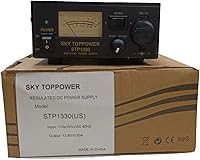
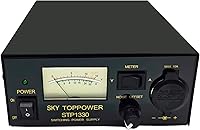
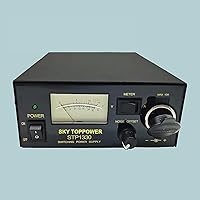
The SKY TOPPOWER STP1330 Ham Radio Power Supply sits in a practical middle ground — capable enough for serious amateur radio work, yet priced well below dedicated professional bench units. It converts standard 110V AC mains to a stable 13.8V DC output, delivering up to 30A at peak and 20A continuously — an important distinction worth understanding before you buy. The metal chassis is compact and reasonably sturdy, with rubber feet that keep it planted on a workbench or shack shelf. At roughly 1.5 kg, it moves around easily. This isn't a flashy unit, but that's kind of the point — it's built to do a specific job reliably.
Features & Benefits

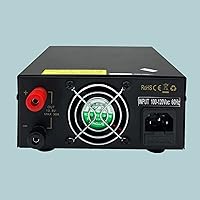
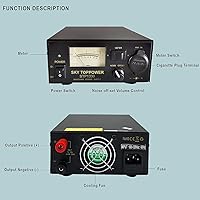
One of the more practical touches on the STP1330 is the noise-offset adjustment knob. For radio operators, RF interference from a power supply isn't just annoying — it can bury a weak signal entirely. Being able to dial that pulse noise down from the front panel is a real operational advantage. The auto-start cooling fan only kicks in when internal temperatures climb above 55°C, which means light to moderate sessions run nearly silent. A front-panel cigarette lighter socket handles up to 10A for powering portable accessories, and the hardwired terminal block uses color-coded connections to simplify direct radio hookup. Protection circuitry and a replaceable 8A fuse round things out sensibly.

Best For

This ham radio power supply makes most sense for amateur radio operators running HF, VHF, or UHF transceivers from a fixed shack location. CB radio users and scanner hobbyists will find it equally capable as a clean, regulated DC source. It also works well for technicians and hobbyists who need a compact bench supply for testing or running 12V devices — the front-panel socket adds useful flexibility there. One group that'll appreciate it particularly is anyone stepping up from an unregulated wall adapter or cheap switching supply. Cleaner power means less noise on the receive end, which matters more than most beginners realize.

User Feedback

With a 4.7-star average across several hundred reviews, this regulated DC supply clearly resonates with its intended audience. Buyers consistently highlight the quiet fan operation at lower loads and the stable output voltage as standout qualities. The analog meters draw mixed reactions — easy to glance at during a session, but some users wish they offered more precision. A few technically minded reviewers measured ripple voltage directly and found it comfortably within rated spec, which is reassuring for sensitive radio gear. The one recurring criticism worth noting: the 30A peak rating can mislead buyers whose radios draw closer to 20A continuously — so read the specs carefully before purchasing.

Pros

  • Voltage stays rock-solid at 13.8V DC even during sustained transmit cycles on typical 100W rigs.
  • The noise-offset knob genuinely cleans up RFI on crowded HF bands — not just a checkbox feature.
  • Fan stays completely silent during light or receive-only operation, making shack life noticeably quieter.
  • Built-in short-circuit and over-current protection means accidental wiring mistakes rarely result in permanent damage.
  • Front-panel cigarette socket adds practical 10A output for powering accessories without extra wiring runs.
  • At roughly 1.5 kg, this ham radio power supply is light enough to take to field day events without hassle.
  • Ripple voltage tests by users consistently land well under the rated 80mV p-p spec — reassuring for sensitive receivers.
  • Color-coded hardwire terminals make initial radio hookup straightforward, even for less experienced operators.
  • User-replaceable 8A fuse means a blown fuse doesn't turn into a warranty call or a shipping delay.
  • Solid real-world satisfaction rate backed by a large pool of verified buyer feedback.

Cons

  • The 20A continuous versus 30A peak distinction is not clearly communicated and regularly misleads buyers.
  • Analog meters lack the precision that bench technicians or technically demanding users genuinely need.
  • The manual reads like a translation and omits useful guidance on grounding and output cable gauge selection.
  • Brand longevity is unproven — long-term reliability data is thinner than for established competitors.
  • The chassis depth exceeds what product photos suggest, which can create surprise shelf-fitting problems.
  • Fan audibility increases noticeably under heavy thermal load, which may bother users in quiet environments.
  • No per-output fusing on the DC side means advanced users may need to add external protection for safety.
  • The cigarette socket placement on the front panel makes bulkier 12V adapters awkward to plug in without blocking the meter view.
  • No USB charging port is included, which feels like a missed convenience given the front-panel real estate available.

Ratings

The SKY TOPPOWER STP1330 Ham Radio Power Supply scores here reflect AI-driven analysis of verified global buyer reviews, with spam, bot-generated, and incentivized feedback actively filtered out before scoring. Across hundreds of real-world accounts — from licensed amateur radio operators to workbench hobbyists — both the genuine strengths and the honest friction points shaped every number you see below. Nothing has been smoothed over to flatter the product.
Voltage Regulation Stability
91%
Buyers running HF transceivers report rock-solid 13.8V output even during extended transmit cycles. The regulated design keeps voltage consistent under load shifts, which matters significantly when you're mid-QSO and don't want your rig browning out or surging.
A small number of users noticed minor voltage sag when simultaneously loading the terminal block and cigarette socket near their respective limits. It's an edge-case scenario, but worth noting if you plan to run multiple high-draw accessories at once.
Noise & RFI Performance
88%
The front-panel noise-offset knob is genuinely useful — not just a marketing checkbox. Radio operators report that dialing it in noticeably cleans up receive audio, particularly on busy HF bands where power supply interference can mask weak signals.
It doesn't eliminate all interference in every setup. Users with longer unshielded DC leads or radios already sensitive to switching noise found the knob helpful but not a complete fix. Some shielding and proper cable routing is still advisable.
Continuous Current Headroom
74%
26%
For most typical ham radio transceivers drawing under 20A on transmit peaks, this supply handles sustained operation without complaint. Casual operators running 100W rigs at moderate duty cycles rarely push it anywhere near its limits.
The 30A peak versus 20A continuous distinction trips up a meaningful number of buyers. If your transceiver is rated to draw 22–25A continuously, this supply is undersized for safe daily use — a fact that isn't emphasized clearly enough on the product page.
Fan Noise & Thermal Management
89%
The temperature-triggered fan is one of this unit's better practical traits. During light receive-only sessions or low-duty operation, the supply runs completely silent — a genuine comfort in a quiet home shack or shared workspace.
When the fan does spin up under heavier loads, it's audible but not disruptive. A handful of users described it as louder than expected at full thermal load, though no reports of overheating emerged in normal operating conditions.
Build Quality & Chassis
78%
22%
The metal enclosure feels appropriately solid for a mid-range unit, and the rubber feet keep it stable on smooth surfaces. It doesn't rattle or flex when handled, and the front panel components are mounted cleanly without obvious quality-control issues.
It's not a premium-feeling chassis — the metal is thin enough that it dents if mishandled, and the finish is functional rather than refined. A few buyers noted the overall construction feels more workbench-utilitarian than shack-proud, which may or may not matter to you.
Analog Meter Readability
71%
29%
The backlit volt and current meters are easy to read at a glance from across a desk, and the single-key switching between displays works smoothly. For quick checks during operation, they're entirely adequate for most users' needs.
Technically minded buyers — particularly those who measure ripple or want precise current readings — find the analog meters frustratingly imprecise. A digital readout would serve this audience far better, and it's a noticeable omission at this price tier.
Ripple Voltage Performance
86%
Users who actually measured ripple with an oscilloscope reported results comfortably under the 80mV p-p rated spec, even under load. For sensitive radios or receivers that struggle with switching supply hash, this level of ripple cleanliness is a genuine advantage.
The spec itself — 80mV p-p — is acceptable rather than exceptional. Competing linear supplies can achieve significantly lower ripple figures, so audiophile-grade or SDR users chasing the absolute quietest DC source may want to look at higher-spec alternatives.
Cigarette Lighter Socket Utility
76%
24%
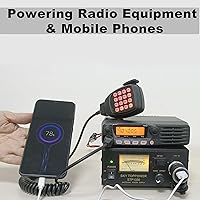
Having a front-panel 12V socket rated to 10A is a thoughtful addition. Operators who keep a GPS unit, LED desk lamp, or phone charger adapter on their desk can power them directly without running additional wiring — a small but genuinely appreciated convenience.
The 10A cap limits what you can run from it simultaneously with the main radio. A few users also noted the socket placement on the front panel feels a little close to the meter display, making it slightly awkward to plug in bulkier adapters without obstructing the view.
Safety & Protection Features
83%
Short-circuit and over-current protection circuits function as advertised — multiple buyers who accidentally shorted test leads during bench work reported the supply shut down cleanly and recovered without damage. The user-replaceable fuse is a practical detail that saves hassle.
The 8A fuse on the AC input side is a standard inclusion, but protection on the DC output side isn't as granular as some competing units. Advanced users wanting per-output fusing or remote sensing would need to add their own external protection.
Setup & Installation Ease
87%
Color-coded terminals and a clear manual mean most buyers have this supply connected and operational within minutes of unboxing. The included US power cord is a appreciated touch that removes one immediate friction point for new users.
The operation manual, while functional, is clearly translated and lacks the depth experienced operators sometimes want — particularly around grounding best practices and optimal cable gauge recommendations for the output terminals.
Value for Money
82%
18%
Positioned between budget hobby units and full professional bench supplies, the STP1330 strikes a reasonable balance for operators who need reliable regulated DC without spending significantly more on a brand-name alternative. Most buyers feel the capability justifies the cost.
If your needs are modest — say, a single low-power VHF radio — there are cheaper options that would serve just as well. The price makes most sense when you're actually leveraging the noise control, the socket, and the higher current capacity together.
Portability & Footprint
81%
19%
At under 1.5 kg and a compact rectangular footprint, this supply fits on crowded shack shelves or travels to field day events without being a burden. The rubber feet prevent sliding, and the unit's proportions make it easy to stack other gear nearby.
The depth of the unit — just over 220mm — may catch some buyers off guard when planning a tight shelf layout. It's not large by any measure, but it's deeper than it looks in product photos, so measure your available space before assuming it fits.
Long-Term Reliability
77%
23%
Several buyers report running the STP1330 as their primary shack supply for over a year without issues. The thermal management system appears to do its job, and no widespread reports of early failures emerged across the review pool analyzed.
SKY TOPPOWER is a newer brand without a decades-long track record, and long-term reliability data is still relatively thin compared to established names. Buyers who prioritize brand legacy and long warranty support may feel some uncertainty here.

Suitable for:

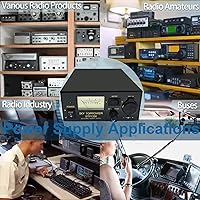
The SKY TOPPOWER STP1330 Ham Radio Power Supply is a strong fit for licensed amateur radio operators who run HF, VHF, or UHF transceivers from a fixed home shack and need a stable, low-noise DC source without paying professional-grade prices. It works especially well for operators whose rigs draw at or under 20A continuously — think typical 100W transceivers — where the supply runs comfortably within its sustained output rating. CB radio hobbyists and scanner enthusiasts will find it equally capable, as the clean regulated output reduces the background noise floor that cheaper unregulated adapters tend to introduce. Technicians and makers who need a compact 12V bench supply for testing accessories, running mobile electronics, or powering multiple devices via the front cigarette socket will also get solid mileage out of it. If you're currently fighting interference from a switching wall adapter and suspect your power supply is the culprit, this regulated DC supply with its built-in noise-offset control is a meaningful upgrade worth seriously considering.
Not suitable for:

The SKY TOPPOWER STP1330 Ham Radio Power Supply is not the right choice for operators running high-duty-cycle amplifiers or transceivers that sustain current draws above 20A for extended periods — the 30A figure is a peak rating, not a continuous one, and conflating the two is the single most common source of buyer disappointment with this unit. Users who want precise digital readouts for voltage and current monitoring — say, for bench testing or electroforming work — will find the analog meters too imprecise for that level of scrutiny. This regulated DC supply is also not a substitute for a true linear bench supply if ultra-low ripple is a hard requirement; while it performs well within its own spec, competing linear-topology units can achieve significantly quieter DC output for SDR enthusiasts or audio-adjacent applications. Buyers who need a long-established brand with a decades-long warranty track record may feel uncertain with a relatively newer manufacturer, regardless of how well the unit currently performs. And if your power requirements are genuinely modest — a single low-power VHF handheld on a charger cradle, for instance — this supply is more capability than you need and cheaper alternatives would serve just fine.
Specifications

  • Brand: Manufactured by SKY TOPPOWER, a brand specializing in regulated DC power solutions for radio and hobby electronics.
  • Model Number: The unit carries the model designation STP1330.
  • Input Power: Accepts 110V AC at ±10% tolerance, 60Hz — standard North American mains power.
  • Output Voltage: Delivers a fixed 13.8V DC output, the standard operating voltage for ham radio transceivers and most 12V mobile equipment.
  • Peak Current: Rated to handle up to 30A at peak draw for short-duration bursts.
  • Continuous Current: Sustained continuous output is rated at 20A — the figure that matters most for daily shack operation.
  • Ripple Voltage: Output ripple is specified at under 80mV peak-to-peak at rated load, suitable for most radio and 12V accessory applications.
  • Fuse: Fitted with a user-replaceable 8A fuse on the AC input side for overcurrent protection.
  • Socket Output: Front-panel cigarette lighter socket supports up to 10A for powering portable 12V accessories.
  • Dimensions: The chassis measures approximately 150 x 70 x 220 mm (roughly 5.9 x 2.8 x 8.7 inches).
  • Weight: Unit weighs approximately 1.5 kg (about 2.2 lbs), making it practical for field day transport.
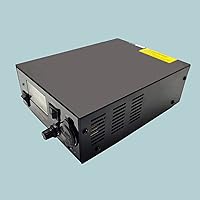
  • Casing: Metal enclosure with rubber feet to prevent sliding on workbench or shack shelf surfaces.
  • Display: Features backlit analog voltage and current meters with single-key switching between readout modes.
  • Cooling: Auto-start cooling fan activates only when internal temperature reaches 55°C, enabling silent operation under light loads.
  • Protection: Integrated short-circuit and over-current protection circuits safeguard both the supply and connected equipment.
  • Terminals: Hard-wired output terminal block with color-coded connectors — red for positive, black for negative.
  • Noise Control: Front-panel noise-offset adjustment knob allows users to suppress pulse interference on the DC output.
  • Package Contents: Box includes the power supply unit, a US-standard AC power cord, and a printed operation manual.

Related Reviews

be quiet! Straight Power 12 1000W Power Supply
88%
94%
Quiet Operation
92%
Energy Efficiency
89%
Build Quality
90%
Modular Design and Cable Management
88%
Stability Under Load
More
be quiet! Pure Power 13 M 850W Power Supply
89%
92%
Performance
94%
Efficiency
88%
Noise Level
91%
Modular Design
89%
Build Quality
More
LC-Power LC1200P 1200W Gaming PC Power Supply
85%
89%
Performance
91%
Energy Efficiency
85%
Cable Management
87%
Noise Level
88%
Reliability
More
be quiet! Straight Power 12 1500W PSU
86%
96%
Noise Level
93%
Efficiency & Heat Management
91%
Power Stability & Transient Response
88%
Cable Quality & Modularity
94%
PCIe 5.0 & Modern GPU Compatibility
More
be quiet! Pure Power 13 750W PSU
86%
93%
Noise Level
88%
Build Quality
86%
Value for Money
74%
Wattage & Power Headroom
84%
Cable Quality & Modularity
More
be quiet! Dark Power Pro 13 PSU
84%
96%
Voltage Stability & Regulation
93%
Noise Level
94%
Efficiency (80 Plus Titanium)
91%
PCIe 5.0 & 12VHPWR Compatibility
83%
Rail Configuration Flexibility
More
be quiet! Pure Power 13 M 1000W Power Supply
89%
92%
Performance
94%
Noise Level
89%
Build Quality
90%
Power Delivery Stability
88%
Cable Management
More
High Power 600W Power Supply, 80 Plus Gold Certified
85%
92%
Energy Efficiency
88%
Noise Level
91%
Build Quality
75%
Installation Process
87%
Value for Money
More
be quiet! Pure Power 12 M 1200W Modular Power Supply
88%
95%
Noise Level Under Load
91%
Power Delivery Stability
87%
Build Quality
93%
Cable Management
94%
Compatibility with High-End GPUs
More
be quiet! Pure Power 12 M 1000W
85%
93%
Noise Level
89%
Efficiency & Power Delivery
91%
Build Quality
86%
Cable Quality & Flexibility
88%
Modular System Usability
More

FAQ

Yes, for most 100W transceivers this is a comfortable fit. Radios like the Icom IC-7300 or Yaesu FT-891 typically draw around 20A at full transmit power, which sits right at the continuous rating of this regulated DC supply. Just avoid sustained key-down operation at maximum power for extended periods — that's when the 20A continuous ceiling becomes relevant.

The 30A figure is a peak rating — it's what the supply can handle in short bursts, like the brief spike at the start of a transmit cycle. The 20A rating is the continuous figure, meaning what it can safely sustain over time without thermal stress. If your radio draws 22A or more continuously during long transmissions, this unit is undersized for that use case and you should look at a higher-rated supply.

It only kicks in when the internal temperature hits 55°C. During receive-only operation or light-duty use, the supply runs completely silently — which is a genuine plus if you're in a quiet room or sharing a workspace. The fan does become audible under heavy sustained loads, but it's doing its job correctly in that situation.

It lets you dial down pulse interference — essentially RFI that the power supply itself can introduce onto the DC line. This matters for ham radio because that interference can show up as hash or noise on your receive audio, particularly on crowded HF bands. Adjusting the knob lets you find a sweet spot that minimizes that interference for your specific radio and cable setup.

Yes, but pay attention to the combined current draw. The cigarette socket handles up to 10A independently, and the main terminals carry your radio load. Both draw from the same 20A continuous output, so if your radio is pulling 18A on transmit and you have a 5A device on the socket, you're exceeding the continuous limit. Plan your total load before running both simultaneously.

No — the SKY TOPPOWER STP1330 Ham Radio Power Supply is designed for 110V AC input at 60Hz, which is the North American standard. It is not dual-voltage and should not be used on 220-240V mains without a step-down transformer. Using it directly on 220V AC will damage the unit.
The 8A fuse is user-replaceable and a standard type you can find at most electronics or hardware stores. The operation manual covers the replacement procedure, and no special tools are required. If fuses are blowing repeatedly, that's a signal to check your wiring and connected load rather than just swapping fuses repeatedly.

They're useful for at-a-glance monitoring during normal operation — you can easily see if voltage is where it should be and get a rough sense of current draw. What they're not suited for is precise measurement. If you need to read current to within a fraction of an amp for bench testing or diagnostics, you'll want a digital multimeter in the circuit alongside this supply.

Under light or moderate loads, it's quieter than most desktop PC power supplies because the fan simply isn't running. When the fan does spin up under heavier sustained load, it's roughly comparable to a mid-range PC fan — audible but not intrusive. It won't disrupt a conversation or interfere with listening to weak signals through headphones.

For loads approaching 20A, 12 AWG stranded copper wire is a safe and common choice for short runs, and 10 AWG gives you additional headroom and lower voltage drop if your cable run is longer than a couple of feet. The manual is light on this detail, so it's worth applying standard 12V automotive wiring practices — keep runs short, use ring terminals, and secure connections firmly at the terminal block.