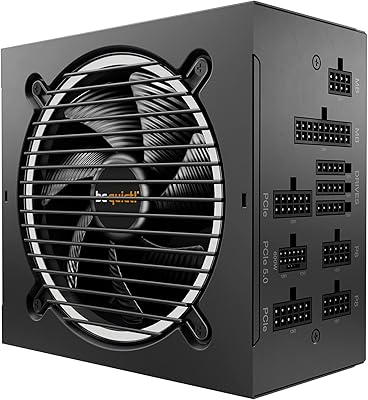
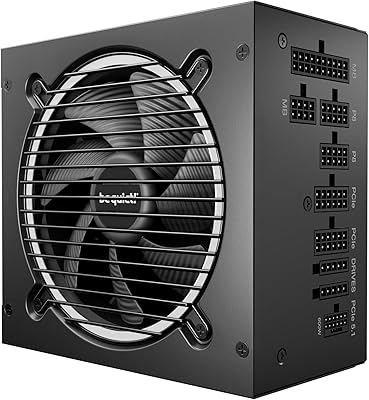
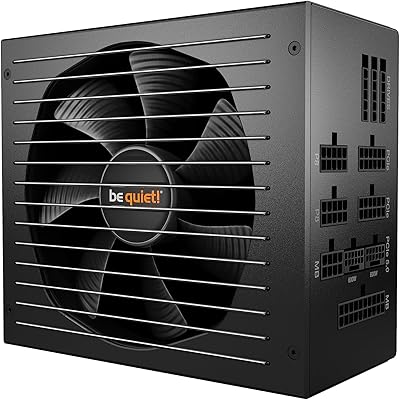
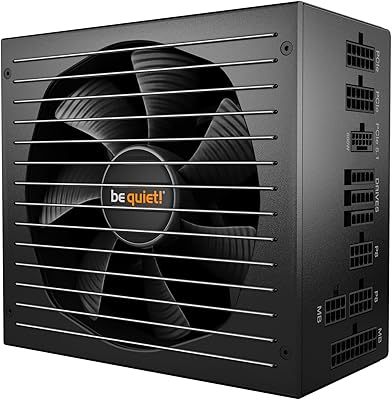
Overview

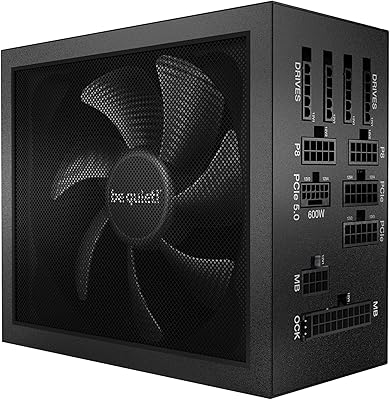
The be quiet! Pure Power 12 M 1200W PSU enters a crowded market carrying one of the stronger brand reputations in PC power delivery — be quiet! has spent years building credibility through quiet, dependable components, and this unit sits near the top of their consumer lineup. Not everyone needs 1200 watts, but if you're running a flagship GPU alongside a high-core-count CPU in 2024 or 2025, headroom matters more than it used to. The ATX 3.1 standard isn't just a version bump; it introduces tighter transient load specifications that older PSU designs genuinely struggle with. A 10-year warranty also sets it apart from competitors offering five, and its #2 bestseller rank in the category suggests it's resonating with builders who've done their homework.
Features & Benefits

At 80 Plus Gold efficiency, this 1200W power supply converts up to 93% of drawn power into usable output, which means less electricity turned into heat inside your case — a real difference over long gaming sessions. The native 12V-2x6 connector (not the older 12VHPWR) delivers up to 600W to a single GPU, making it ready for RTX 5000-series cards without adapters or compatibility guesswork. That matters because modern flagships don't just draw steady power; they spike hard and fast. The Pure Power 12 M handles transient loads up to 2000W, absorbing those bursts without flinching. Fully modular cabling keeps unused cables out of your case entirely, and the temperature-controlled 120mm fan stays near-silent during light and moderate workloads.

Best For

This be quiet! unit makes the most sense for builders putting together high-end rigs around RTX 4090 or RTX 5090-class GPUs, where power delivery margins actually matter. If you're the type to build once and not open your case again for years, long-term reliability becomes a deciding factor — and a decade-long warranty backs that up in a way few competitors do. Content creators and home office users running sustained rendering or simulation workloads will appreciate how quiet this 1200W power supply stays under pressure; it won't add to an already noisy environment. It's also a sensible buy for anyone planning ahead for next-gen GPUs, since the native PCIe 5.0 connector removes any need for adapters down the road.

User Feedback

Owners of this be quiet! unit consistently highlight two things: installation ease and how quietly it runs during everyday use. The modular connectors snap in cleanly, and most builders find the overall setup straightforward. A smaller number of users have noted that some cables feel stiff out of the box, which can make routing in tighter cases mildly frustrating on the first build. Fan behavior appears to match the advertised spec for most — it stays largely inaudible at low-to-mid loads — though noise tolerance is always personal. Since the Pure Power 12 M is a relatively recent release, long-term failure data is still thin, so durability impressions remain largely positive but not yet fully proven over time.

Pros

  • Native 12V-2x6 connector means no adapters needed for current and next-gen high-power GPUs.
  • Handles transient power spikes up to 2000W, protecting components during intense GPU burst loads.
  • 80 Plus Gold efficiency at up to 93% keeps electricity costs and internal heat genuinely lower over time.
  • Fully modular design means zero unused cables cluttering your case or blocking airflow.
  • The 10-year warranty is one of the longest in the category and covers a full decade of use.
  • Temperature-controlled fan stays near-silent during light and moderate workloads.
  • ATX 3.1 compliance future-proofs the build for upcoming GPU generations without extra hardware.
  • Dual 12V rails provide stable, consistent power delivery under simultaneous CPU and GPU load.
  • Strong brand reputation backed by years of consistent performance across be quiet! product lines.
  • Top-ranked bestseller status reflects broad builder confidence, not just marketing reach.

Cons

  • 1200W capacity is overkill for mid-range builds, meaning many buyers pay for unused headroom.
  • Some users report stiff cables out of the box, which can complicate routing in compact cases.
  • Higher price point is difficult to justify if noise reduction and long warranties are not priorities.
  • Long-term reliability data is still limited given the product's relatively recent release date.
  • Connector fit can feel tight for some users, requiring firm seating that occasionally causes concern.
  • Heavier than lighter competitors at nearly 7 pounds, which can matter in smaller or portable builds.
  • Budget builders will find comparable Gold-rated units at lower wattages for significantly less money.
  • Frequent system rebuilders may not benefit enough from the long warranty to offset the cost premium.

Ratings

Our AI rating engine analyzed thousands of verified global user reviews for the be quiet! Pure Power 12 M 1200W PSU, actively filtering out incentivized submissions, duplicate accounts, and bot-generated feedback to surface what real builders actually experienced. The scores below reflect a transparent synthesis of both enthusiastic praise and recurring frustrations, weighted by review depth and verified purchase status. Strengths and pain points are represented equally — nothing has been softened to flatter the product.

Noise Level
91%
This is the category where the Pure Power 12 M earns its brand name most convincingly. Builders consistently report that during everyday gaming and light workstation use, the fan is essentially a non-presence — you have to be sitting in silence to notice it at all. Content creators running long renders found it significantly quieter than the Corsair and EVGA units they replaced.
Under sustained full-load stress testing or extended compute sessions, the fan does spin up audibly, and a small number of users in open-bench setups found it louder than expected. Noise perception also varies by case; a well-dampened mid-tower masks it better than an open-panel chassis.
Power Stability
93%
Users pairing this 1200W power supply with RTX 4090-class GPUs consistently praised the rock-steady voltage delivery even during prolonged gaming marathons and benchmark loops. The dual 12V rail configuration drew specific compliments from workstation builders running simultaneous CPU and GPU rendering, where voltage sag from a weaker PSU can cause outright crashes.
A small cohort of users running extremely aggressive CPU and GPU overclocks simultaneously noted minor voltage fluctuations at the absolute ceiling of load, though these cases were outside typical real-world usage and did not result in reported hardware damage.
Cable Quality & Flexibility
67%
33%
The modular connectors themselves are well-made and seat securely — builders noted the 12V-2x6 GPU connector in particular clicks in with satisfying confidence. The cable selection is comprehensive, covering SATA, Molex, CPU, and PCIe needs without requiring aftermarket additions for most standard builds.
Cable stiffness is the most consistently repeated complaint across user reviews. The thicker GPU and CPU cables in particular resist bending, which makes cable management behind a modular tray genuinely frustrating in compact mid-tower cases. Several users recommended pre-bending cables a day before the build to make routing more manageable.
Efficiency & Heat Output
88%
The 80 Plus Gold certification translates into tangible real-world benefits that users actually notice: lower case temperatures during extended sessions and measurably reduced electricity draw compared to Bronze-rated units they previously owned. In regions with higher electricity costs, several users calculated a meaningful reduction in monthly power bills after switching.
At very high continuous loads, efficiency dips slightly from its peak 93% figure, which is expected behavior but not always clearly communicated in marketing materials. Users expecting peak efficiency numbers across all load levels may find the real-world average under heavy use closer to 89-91%.
Installation Experience
84%
First-time builders and experienced system integrators alike praised the straightforward installation process, citing clear labeling on the modular ports and a logical cable layout. The fully modular design means you only connect exactly what your build needs, which simplifies the process considerably compared to semi-modular alternatives.
The stiff cables create friction during the final stages of installation, particularly when tucking excess cable behind the PSU shroud. A few users also noted the unit's 6.3-inch depth required careful case measurement beforehand, as shorter PSU bays can create a snug fit.
PCIe 5.0 Compatibility
89%
Builders targeting RTX 5000-series and next-gen AMD GPUs appreciated having a native 12V-2x6 connector rather than relying on an adapter from a 12VHPWR cable. This removes a documented point of failure from the equation and gives future-oriented buyers genuine peace of mind when pairing the unit with upcoming GPU releases.
Users with older GPUs using standard 8-pin connectors found the 12V-2x6 cable unnecessary for their current build, though the four included 6+2 pin PCIe cables covered their needs adequately. The benefit is entirely forward-looking, which may not justify the cost for buyers with no near-term GPU upgrade plans.
Value for Money
74%
26%
For high-end builders who plan to keep their system running for many years, the 10-year warranty reframes the cost as a long-term investment rather than a one-time purchase. Compared to competitors offering similar specs with a 5-year coverage window, the extended protection meaningfully changes the cost-per-year calculation for reliability-focused buyers.
Builders with mid-range GPUs drawing under 300W find the 1200W capacity hard to justify at this price point when well-reviewed 850W Gold units cost significantly less. The value proposition only clicks for builders who genuinely need the headroom and plan to hold the system long enough to benefit from the warranty span.
Transient Load Handling
92%
Users running power-hungry GPUs that spike hard during shader compilation or during the first frames of a graphically intense scene praised the stability this unit maintained without the system crashing or throttling. The 2000W transient ceiling gave overclockers in particular a level of confidence that cheaper ATX 2.x units simply could not match.
This capability is largely invisible during normal use, meaning many buyers will never directly experience or validate the benefit. It is a real engineering advantage, but one that is difficult for average users to test or appreciate without specialized monitoring hardware.
Build & Component Quality
86%
The unit feels dense and well-assembled out of the box, and users noted the chassis finish holds up cleanly during handling. Internal component quality, inferred from voltage stability reports and low failure rates in early ownership, aligns with be quiet!'s broader reputation for using quality capacitors and clean PCB layouts.
Since the product is relatively new to market, longer-term component aging data is not yet available. A few users noted slight cosmetic imperfections in the painted finish on arrival, though these were reported as aesthetic rather than functional concerns.
Fan Behavior & Control
87%
The temperature-driven fan curve behaved as advertised for the majority of users, staying at very low RPM through typical gaming sessions and only ramping perceptibly under sustained stress. Builders who had previously owned PSUs with aggressive fan curves specifically called out how gradual and non-intrusive the ramp-up felt on this unit.
Unlike some competing premium units, there is no zero-RPM or fanless mode at low loads. For builders who demand true silence during light desktop use, the faint hum of the fan spinning at minimum speed remains audible in an otherwise quiet room.
Warranty & Brand Support
91%
A 10-year warranty is rare enough in the PSU market that it genuinely influences buyer confidence, and be quiet!'s customer support reputation holds up across European and North American markets. Users who had warranty interactions with the brand on other products reported straightforward processes and responsive handling.
Warranty registration requires proactive action from the buyer through be quiet!'s website, and a handful of users noted the process could be clearer. International buyers outside major markets occasionally reported longer support response times, though outright claim denials were not a common complaint.
Modular Port Labeling
82%
18%
Port labels on the unit are clear and well-positioned, making it easy to identify the correct socket for each cable type without consulting the manual repeatedly. Builders tackling their first fully modular PSU found the labeling reduced errors during assembly compared to units with smaller or poorly contrasted text.
In low-light environments — which is realistically how most people are working inside a case — the labels can be harder to read quickly. A few users suggested brighter or backlit port labeling would improve the experience, especially for builders working without a dedicated lighting setup.
Packaging & Unboxing
78%
22%
The unit arrives well-protected with dense foam inserts, and cables are organized in a labeled carry pouch that keeps everything tidy before installation. Users appreciated the included documentation being concise and accurate rather than padded with marketing material.
Some buyers found the cable pouch itself slightly too tight, making it awkward to retrieve individual cables without pulling out the entire bundle. The manual, while accurate, is fairly minimal and does not include cable routing suggestions for common case types, which would benefit newer builders.

Suitable for:

The be quiet! Pure Power 12 M 1200W PSU is built for a specific kind of builder: someone putting together a serious high-end system and wanting to get the power foundation right the first time. If your GPU is an RTX 4090, RTX 5090, or an AMD equivalent that draws hard and fast under load, the native 12V-2x6 connector and 2000W transient handling mean you are not relying on adapters or hoping your PSU keeps up during burst spikes. Content creators and workstation users who run the CPU and GPU hard simultaneously will appreciate both the dual-rail stability and how quiet this unit stays during sustained work sessions. Noise-sensitive home office builders will find that the temperature-controlled fan rarely becomes noticeable at anything below a full stress load. Perhaps most compellingly, anyone who plans to skip a PSU upgrade cycle entirely will find the 10-year warranty a genuinely reassuring backstop — it is one of the longer coverage periods you will find in this category.
Not suitable for:

The be quiet! Pure Power 12 M 1200W PSU is straightforwardly the wrong choice if your build does not actually need this much power. Mid-range systems built around a single GPU in the 200–300W range are paying a real premium for headroom they will never use, and there are more cost-efficient options at lower wattages from both be quiet! and competitors. Budget-focused builders will also find this unit sits at a price point that is hard to justify unless long-term reliability and noise levels are genuine priorities rather than nice-to-haves. If your case has a tight PSU bay or restrictive cable routing, the somewhat stiff modular cables reported by some users could add frustration to an otherwise smooth build. Finally, buyers who frequently repurpose PSUs across multiple short-cycle builds may not extract enough value from the decade-long warranty to justify the cost over more affordable alternatives.
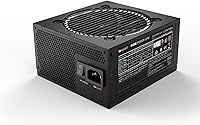
Specifications

  • Output Wattage: Delivers 1200W of continuous power, with enough overhead for flagship GPUs and high-core-count processors running simultaneously.
  • Efficiency Rating: 80 Plus Gold certified with up to 93% efficiency, meaning less power is wasted as heat compared to Bronze or unlabeled alternatives.
  • ATX Standard: Fully compliant with the ATX 3.1 specification, which introduces tighter transient load tolerances than the older ATX 2.x standard.
  • GPU Connector: Includes one 12V-2x6 connector rated at 600W, designed natively for PCIe 5.0 graphics cards without requiring an adapter.
  • PCIe Connectors: Provides four additional 6+2 pin PCIe connectors for compatibility with a wide range of current and legacy graphics cards.
  • Transient Handling: Rated to handle transient power spikes up to 2000W, protecting components during the short, intense load bursts that modern GPUs produce.
  • Rail Design: Uses a dual 12V rail configuration to deliver stable, split-load power delivery suited to systems with both high-draw CPUs and GPUs.
  • Fan Size: Equipped with a 120mm fan developed in-house by be quiet!, optimized for airflow efficiency and low acoustic output.
  • Fan Control: Fan speed adjusts automatically based on internal temperature, staying near-silent at low-to-moderate loads and ramping up only when necessary.
  • Cable Design: Fully modular cabling allows unused cables to be removed entirely, reducing clutter and improving airflow inside the chassis.
  • Form Factor: Standard ATX form factor measuring 6.3 x 3.39 x 5.91 inches, compatible with the vast majority of mid-tower and full-tower PC cases.
  • Weight: Weighs 6.98 pounds, which is typical for a high-capacity fully modular PSU in this wattage class.
  • Warranty: Backed by a 10-year manufacturer warranty, one of the longest coverage periods available in the consumer PSU market.
  • Model Number: Sold under model number BN513, which can be used to verify compatibility documentation and register the warranty directly with be quiet!.
  • Cooling Method: Uses active air cooling via the 120mm fan, with no passive or fanless mode at any load level.

Related Reviews

be quiet! Pure Power 12 M 1000W
85%
93%
Noise Level
89%
Efficiency & Power Delivery
91%
Build Quality
86%
Cable Quality & Flexibility
88%
Modular System Usability
More
be quiet! Pure Power 12 M 850W Modular Power Supply
88%
94%
Quiet Operation
88%
Ease of Installation
89%
Build Quality
92%
Power Delivery Stability
90%
Energy Efficiency
More
be quiet! Pure Power 13M 850W PSU
85%
93%
Acoustic Performance
88%
Build Quality
91%
Voltage Stability
94%
Future Compatibility
79%
Value for Money
More
be quiet! Pure Power 13 750W PSU
86%
93%
Noise Level
88%
Build Quality
86%
Value for Money
74%
Wattage & Power Headroom
84%
Cable Quality & Modularity
More
be quiet! Pure Power 13 M 1000W PSU
84%
93%
Acoustic Performance
89%
Build Quality
88%
Efficiency & Heat Output
91%
PCIe 5.1 Compatibility
87%
Voltage Stability
More
be quiet! BN517 Straight Power 12-1200W
87%
94%
Quiet Operation Under Load
91%
Build Quality and Durability
89%
Energy Efficiency
88%
Modular Cable System Flexibility
87%
Cooling Performance
More
be quiet! Straight Power 12 1000W PSU
84%
91%
Acoustic Performance
89%
Build Quality
68%
Cable Quality
93%
Connector Compatibility
71%
Value for Money
More
be quiet! Straight Power 12 1500W PSU
86%
96%
Noise Level
93%
Efficiency & Heat Management
91%
Power Stability & Transient Response
88%
Cable Quality & Modularity
94%
PCIe 5.0 & Modern GPU Compatibility
More
be quiet! Dark Power 13 1000W PSU
84%
94%
Acoustic Performance
91%
Build Quality
89%
Efficiency & Heat Output
88%
Cable Quality & Management
92%
Power Delivery Stability
More
be quiet! Power Zone 2 1000W PSU
85%
93%
Noise Level
88%
Efficiency & Thermals
91%
Build Quality
82%
Connector & Cable Design
94%
ATX 3.1 & PCIe 5.1 Compatibility
More

FAQ

For most mid-range systems, 1200W is more than you need. Where it makes sense is a high-end build with a flagship GPU — think RTX 4090 or RTX 5090 class — paired with a power-hungry CPU. Those combinations can push 700–900W under real load, and having clean headroom above that reduces stress on the unit over time. If your GPU is a mid-tier card drawing 200W or less, a 750W or 850W unit will serve you better for less money.

The 12V-2x6 is the updated standard introduced with ATX 3.1 and PCIe 5.0, replacing the earlier 12VHPWR connector used on some RTX 4000-series cards. The key improvement is a more secure locking mechanism that reduces the risk of the connector seating incorrectly, which was a concern with 12VHPWR. If your GPU uses the new 12V-2x6 port, this PSU connects directly without an adapter. If your card uses 12VHPWR, check manufacturer guidance before connecting.

At idle and light loads the fan is barely perceptible, and most users report the same during moderate gaming. Under a full stress test or extended rendering session, the fan does spin up and becomes audible — but it stays controlled rather than ramping aggressively. That said, noise perception is personal and case-dependent; an open bench will sound different from a closed mid-tower with good sound dampening. It is quieter than most competitors at equivalent loads, but do not expect it to be completely silent at full tilt.

Yes. The be quiet! Pure Power 12 M 1200W PSU includes a native 12V-2x6 connector rated at 600W, which is the standard connector for current and upcoming PCIe 5.0 graphics cards. Combined with the ATX 3.1 transient load support, it is designed to handle exactly the power delivery profile those GPUs require without needing a third-party adapter cable.
It follows the standard ATX form factor, so it will not physically fit in cases that require SFX or SFX-L power supplies. Most full-size mid-tower and full-tower cases will accommodate it without issue, but always check your case specifications against the 6.3-inch length before purchasing.

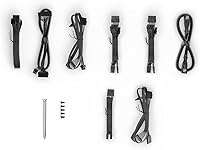
The modular cable set includes the 12V-2x6 GPU cable, four 6+2 pin PCIe cables, CPU power cables (4+4 pin and 8 pin), SATA power cables, and a Molex cable. The exact count of each varies, so check the official be quiet! product page for the full cable inventory if you are planning a complex multi-drive or multi-GPU setup.

be quiet! handles warranty claims directly, and you register through their website using the model number BN513 and proof of purchase. The 10-year term runs from your original purchase date and covers manufacturing defects. It is worth registering promptly after buying rather than leaving it until something goes wrong.

A subset of users have mentioned the cables feel firmer than expected out of the box, particularly the thicker GPU and CPU cables. For most standard mid-tower builds this is a non-issue, but if you are building in a compact case with tight cable channels or routing behind a modular tray, you may need to pre-bend them slightly. It is not a widespread complaint, but it is worth factoring in if your build is especially space-constrained.

No, this unit does not include a dedicated fanless or zero-RPM mode. The fan spins at all times but adjusts to very low speeds under light loads, which keeps it nearly inaudible in practice. If a completely silent zero-RPM mode is a firm requirement, you will need to look at specific models that advertise that feature explicitly.

Over a long ownership period, yes. The efficiency gap between Gold and Bronze is roughly 4–6 percentage points at typical loads, which translates into real electricity savings if your system runs for many hours a day. The bigger practical benefit is less heat generated inside the case, which helps every component around it run cooler. For a build you plan to run for several years, the efficiency difference often pays back part of the cost difference, especially in regions with higher electricity rates.

Where to Buy