Overview

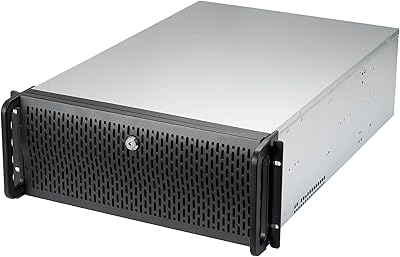
The SilverStone RM400 4U Rackmount Server Case is SilverStone's answer to a real gap in the market: a well-built, rack-compatible chassis that doesn't demand enterprise-scale budgets or lock you into a single motherboard standard. SilverStone has long built its reputation on engineering over aesthetics, and this server enclosure reflects exactly that — grey steel, utilitarian lines, no RGB anywhere in sight. It's aimed squarely at IT professionals and serious homelab builders who need standardized rack deployment done right. Since its late 2018 release, it has accumulated a solid following and consistently earns high marks. One critical note upfront: it's chassis only — budget separately for a power supply, drives, and rack rails.
Features & Benefits

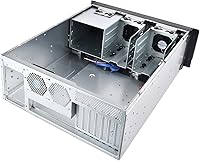
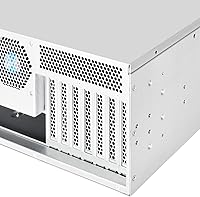
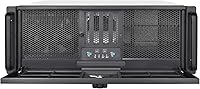
What makes the RM400 genuinely useful rather than just adequate is its broad motherboard compatibility. Supporting SSI-CEB, ATX, mATX, and mITX standards in a single rackmount chassis is uncommon — it means you can reuse existing hardware rather than sourcing purpose-built server boards. The three 5.25-inch front bays accommodate hot-swap drive cages, fan controllers, or optical drives depending on what your build actually demands. A key-locked front door is a practical feature for shared server rooms where physical access control matters. Power supply options cover most ATX and mini redundant units up to 160mm deep, and seven expansion slots give you room for NICs, HBAs, or other add-in cards without compromise.

Best For

This rackmount chassis is the right fit for IT administrators setting up small office server rooms or branch location racks where standardized 4U form factor sizing matters. Homelab enthusiasts will appreciate being able to drop in an existing ATX board rather than hunting for a pricier server-grade alternative. It shines as a storage server platform, too — populate the three 5.25-inch bays with hot-swap drive adapters and you have a capable NAS foundation. Anywhere physical access control is a real concern, the keyed front door earns its place. Just plan for nearly 24 pounds when installing into a rack — this thing isn't light.

User Feedback

Across more than 340 ratings, this server enclosure averages 4.5 stars — a signal that most buyers are genuinely satisfied, not just posting politely. Common praise centers on build quality and the chassis's flexibility across different board sizes. That said, a few recurring concerns are worth knowing. Cable management space inside can get tight, particularly when pairing a full ATX board with a deeper PSU. Several reviewers note that rack rails are not included, which is an easy thing to miss when budgeting your build. The front door hinge draws occasional criticism for feeling less substantial than the rest of the enclosure. Overall, the feedback reflects a reliable, well-engineered product with a few real-world rough edges to plan around.

Pros

  • Supports four motherboard standards — SSI-CEB, ATX, mATX, and mITX — rare for a rackmount chassis at this tier.
  • Three 5.25-inch front bays give genuine flexibility for hot-swap cages, fan controllers, or optical drives.
  • Key-locked front door provides real access control in shared server rooms, not just a cosmetic touch.
  • Seven full-height expansion slots handle demanding multi-NIC, HBA, or multi-GPU configurations without compromise.
  • ATX and mini redundant PSU support means most builders can use a power supply they already own.
  • Steel construction feels solid and durable — no concerning flex when handling or populating the chassis.
  • A 4.5-star average across 340-plus ratings reflects consistent, long-term buyer satisfaction.
  • Front-panel USB 3.1 Gen 1 access makes connecting peripherals or a flash drive quick without hunting for rear ports.
  • Utilitarian grey steel finish looks appropriate and professional in a business server room environment.
  • Competitive pricing compared to purpose-built enterprise chassis with similar motherboard flexibility.

Cons

  • Rack rails are not included — an easy oversight when budgeting that adds real cost before the build is complete.
  • At nearly 24 pounds empty, rack installation is physically demanding and difficult to manage alone.
  • Internal cable management space is tight, especially with a full ATX board and a deeper power supply installed.
  • Only one USB 3.1 port and one USB 2.0 port on the front panel feels limited for an actively managed server.
  • The front door hinge appears as a recurring weak point in user feedback and feels less solid than the chassis body.
  • A single 120mm rear fan may prove insufficient cooling for thermally dense storage or multi-card configurations.
  • No power supply is bundled, and buyers must verify PSU depth clearance independently before purchasing.
  • The investment is hard to justify if you do not already own or plan to buy a proper 19-inch rack to mount it in.
  • Included hardware — screws, standoffs — is inconsistently reported by buyers, so verify contents before assuming completeness.

Ratings

Our scores for the SilverStone RM400 4U Rackmount Server Case are generated by AI after systematically analyzing verified buyer reviews from global markets, with active filtering applied to remove spam, bot submissions, and incentivized feedback. Every rating reflects a calibrated synthesis of real-world deployment experiences from IT professionals, homelab builders, and small business administrators. Both the genuine strengths and the recurring pain points of this server enclosure are transparently represented in the categories below.
Build Quality
88%
The steel chassis body earns consistent praise for its rigidity and resistance to flex, even when fully populated with drives, cards, and a heavy power supply. Builders who have handled comparable enclosures in this price tier frequently note that the RM400 feels noticeably sturdier during servicing and rack installation — a meaningful advantage for a unit opened and closed regularly.
The front door hinge is a recurring weak point in user feedback, feeling noticeably lighter and less refined than the main chassis body. A smaller number of buyers also report minor sharp interior edges encountered during component installation, suggesting fit and finish is strong overall but not entirely flawless at the sub-assembly level.
Motherboard Compatibility
93%
Supporting SSI-CEB, ATX, mATX, and mITX in a single rackmount chassis is genuinely rare at this price point, and buyers consistently highlight it as the primary reason they chose the RM400 over alternatives. For builders reusing an existing ATX workstation board in a rack environment, this flexibility alone often justifies the purchase decision.
A small number of buyers with non-standard mATX board layouts report that screw hole alignment does not cooperate with every variant, requiring minor improvisation with standoff placement. The SSI-CEB support, while listed, receives far less real-world validation in public reviews than the ATX and mATX compatibility claims.
Rack Integration
91%
The chassis slides cleanly into standard 19-inch equipment racks and occupies exactly 4U of vertical space without fitment surprises, which professionals deploying multiple units in a shared rack genuinely appreciate. Exterior dimensions match what rack diagrams show, making capacity planning and rack layout design straightforward from the start.
Rack rails are not included in the box, which catches a frustrating number of first-time buyers off guard and adds meaningful cost and lead time to the build. Compatible rail kits are not universally stocked, so sourcing the right pair for specific rack post spacing requires additional research before the chassis is actually mountable.
Value for Money
76%
24%
Compared to purpose-built enterprise chassis with similar motherboard flexibility, the RM400 sits at a noticeably more accessible price point while still delivering steel construction and a legitimate physical security feature. Homelab builders and small business IT teams who need real rack discipline without a procurement-level budget generally find the investment defensible.
The chassis-only nature means the true cost of a finished build is substantially higher than the sticker price once rails, a compatible power supply, and drive accessories are factored in. Buyers comparing it against a standard mid-tower on a straight spec basis will find the value proposition difficult to defend.
Accessories & Inclusions
54%
46%
The chassis typically ships with a basic assortment of motherboard standoffs and mounting screws sufficient to get started on a standard ATX build, and the included front-panel cables reach most motherboard header positions without extensions. For a straightforward single-board deployment, the included hardware covers the basics.
Rack rails, a power supply, and drive mounting hardware are all sold separately, which meaningfully expands the total cost beyond what the chassis price alone implies. Buyer reports on hardware completeness vary enough to suggest packing inconsistency — having a spare metric and imperial screw assortment on hand before starting the build is genuinely advisable.
Front Bay Versatility
84%
Three externally accessible 5.25″ bays give builders real configurability — hot-swap drive cages, fan controllers, and panel-mount accessories all fit without modification. NAS and storage server builders benefit particularly from being able to outfit all three bays with drive adapters and swap disks without opening the chassis body.
The bays require compatible cage adapters to hold 3.5-inch or 2.5-inch drives, adding cost and planning steps that new builders sometimes overlook at purchase time. Sourcing hot-swap cages that fit cleanly without excessive play in the 5.25″ opening occasionally requires trial and error across a few different brands.
Expansion Slot Access
86%
Seven full-height expansion slots give builders meaningful headroom for multi-NIC configurations, RAID HBAs, PCIe storage controllers, and other add-in cards without compromise. IT professionals building out small office servers consistently single out the slot count as exceeding expectations relative to the chassis price point.
Standard breakaway slot covers on some units mean careless card removal can permanently damage the cover, leaving an untidy gap. Cable routing from a fully populated expansion area to the motherboard grows congested quickly, compounding the internal cable management limitations that experienced builders already flag in this chassis.
Cooling Performance
71%
29%
Under moderate workloads — a single-CPU server, light NAS duty, or a modest storage array — the single 120mm rear fan manages thermals adequately and keeps noise tolerable for a server room environment. Buyers running undemanding, low-heat configurations generally have no thermal complaints worth reporting.
A single 120mm exhaust fan is genuinely undersized for thermally dense configurations involving high-core-count processors, multiple HBAs, or fully populated drive cages under sustained read-write load. There are no built-in provisions for additional fan mounting without either modifying the chassis or consuming a 5.25″ bay with a third-party fan controller.
Ease of Installation
67%
33%
Experienced builders familiar with rackmount conventions generally find the internal layout logical and accessible once panels are removed, with the motherboard tray orientation following standards that most ATX builders recognize immediately. The seven expansion slot covers are individually removable, which simplifies iterative card swaps during a build.
At close to 24 lbs empty, positioning the chassis in a rack mid-installation is physically demanding and genuinely risky as a solo task at upper rack heights. Documentation is minimal, which is typical for the category but still leaves less experienced builders relying on external forums and video guides to work through setup.
Physical Security
82%
18%
The key-locked front door provides reliable access control for shared server rooms and lightly staffed environments where opportunistic tampering with drives or front-panel controls is a realistic concern. Buyers who specifically needed this feature report the lock mechanism functions consistently without sticking or misalignment under normal use.
The standard cam-style lock mechanism is a deterrent layer, not a hardened security solution — a determined person with basic tools can bypass it. A minority of buyers note the supplied key feels lightweight and raise concerns about long-term wear if the door is locked and unlocked multiple times daily.
Cable Management
63%
37%
For a compact mATX build with a modest cable count and a modular PSU, the internal space is manageable enough that an experienced builder can achieve a reasonably tidy result with careful planning. Using only the PSU cables actually needed eliminates a significant share of the clutter problem before it starts.
Fully populated builds exhaust usable internal routing space quickly, with buyers describing cluttered interiors that restrict airflow and complicate future servicing significantly. There are no dedicated cable management channels, grommets, or built-in tie-down points anywhere in the chassis to anchor or guide cable runs.
Front Panel Connectivity
59%
41%
The USB 3.1 Gen 1 port at 5Gbps handles practical front-panel tasks — booting from a flash drive, pushing a firmware update, or copying diagnostic logs — without hunting for rear panel access. Backward compatibility with USB 2.0 devices means legacy peripherals connect without adapters.
Two front USB ports total is a thin offering for an actively managed server where multiple peripherals or diagnostic tools may need simultaneous front-panel access. Buyers accustomed to more generously equipped server chassis consistently flag the port count as a genuine daily-use limitation rather than an acceptable minor compromise.
PSU Compatibility
78%
22%
ATX PS2 and mini redundant support covers the vast majority of power supplies a small business or homelab builder is likely to already own or be shopping for, reducing the risk of a costly post-purchase compatibility problem. Most standard high-wattage modular units from mainstream brands land comfortably within the depth limit.
Buyers running extended or high-wattage modular PSUs with bulky cable combs near the connector block find the depth ceiling closer than expected, requiring deliberate PSU selection rather than a safe grab-and-go choice. Redundant PSU configurations are theoretically possible but require a separate backplane that does not come with the chassis.
Noise Level
68%
32%
Under idle or light workloads, the 120mm rear fan produces a consistent, low-frequency hum that blends into the ambient noise of a properly equipped server room without standing out. Buyers running the chassis in a dedicated rack environment alongside other gear rarely raise noise as a meaningful complaint.
As thermal load climbs, the single fan ramps audibly to a level that most buyers describe as clearly noticeable in the same room — unsuitable for an open office or a quiet home workspace without supplementary acoustic treatment. There is no built-in fan speed control in the chassis itself, leaving thermal noise management entirely to the PSU or add-on controllers.

Suitable for:

The SilverStone RM400 4U Rackmount Server Case is built for IT professionals and technically experienced builders who want genuine rack-compatible hardware without committing to enterprise-grade pricing. Small business owners setting up a proper equipment rack at an office or branch location will find this enclosure slots naturally into a standard 19-inch rack deployment. Homelab enthusiasts who have outgrown desktop towers stacked on shelves — and want the discipline and structure of a properly racked system — will get real value from this chassis. It is particularly well-suited to storage-heavy projects, where the three 5.25-inch front bays can be configured with hot-swap drive cages for NAS or media server builds. Builders reusing existing ATX or mATX hardware will also benefit significantly, since the broad motherboard compatibility means you're not forced to source pricier server-specific boards. Anyone operating in a shared or lightly staffed server room where physical access control matters will appreciate the keyed front door as a practical, not cosmetic, security feature.
Not suitable for:

The SilverStone RM400 4U Rackmount Server Case is a poor choice for anyone who doesn't already own — or plan to buy — a proper 19-inch equipment rack, since it's designed around rack deployment and not well-suited to freestanding use. At close to 24 pounds before any components are installed, it is heavy enough that solo rack mounting becomes genuinely awkward and potentially risky without a second pair of hands. Budget-focused buyers need to go in with their eyes open: rack rails, a compatible power supply, and all drives must be purchased separately, and those additions can meaningfully increase the total cost of the build. Anyone expecting a turnkey server solution out of the box will be quickly disappointed. It is also not ideal for noise-sensitive environments like home offices or open workspaces, since the cooling configuration prioritizes airflow over acoustic comfort. If your actual workload only needs a compact, low-expansion server with a small mATX or mITX board, the 4U footprint simply delivers more chassis than the build requires.
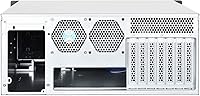
Specifications

  • Form Factor: The chassis uses a standard 4U rackmount form factor designed to install into any 19-inch equipment rack.
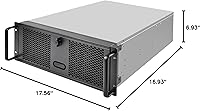
  • Dimensions: External measurements are 16.93 inches long, 17.56 inches wide, and 6.93 inches tall.
  • Weight: The empty chassis weighs 23.8 lbs, making solo rack installation physically demanding and best approached with assistance.
  • Motherboard Support: Accepts SSI-CEB, ATX, mATX, and mITX motherboards, offering broader compatibility than most rackmount enclosures at this price tier.
  • Front Drive Bays: Three externally accessible 5.25″ bays accommodate optical drives, hot-swap drive cages, fan controllers, or similar panel devices.
  • PSU Compatibility: Supports ATX PS2 and mini redundant power supplies, provided the unit does not exceed 160mm in depth.
  • Expansion Slots: Seven full-height PCI and PCIe expansion slots allow for demanding multi-NIC, HBA, or multi-card configurations.
  • Front USB Ports: The front panel provides one USB 3.1 Gen 1 port at 5Gbps and one USB 2.0 port for accessible peripheral connectivity.
  • USB Compatibility: The USB 3.1 Gen 1 front port is backward compatible with USB 2.0 and USB 1.1 devices without any adapter required.
  • Rear Cooling: A single 120mm fan positioned at the rear manages chassis airflow and heat exhaust under normal operating loads.
  • Front Security: A key-locked front door restricts physical access to drive bays and front-panel controls in shared or semi-public server environments.
  • Color: The chassis ships in a professional grey finish with no decorative lighting or consumer-oriented styling elements.
  • Construction: Built primarily from steel for structural rigidity suited to populated rack deployments and repeated servicing over time.
  • Model Number: The official model designation is SST-RM400, produced by SilverStone Technology.

Related Reviews
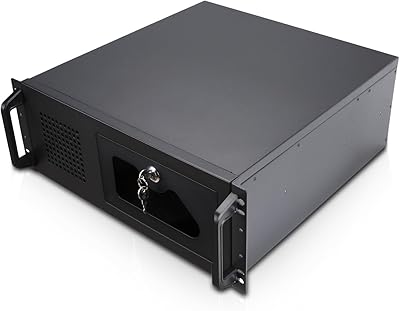
Rosewill RSV-R4100U 4U Server Chassis Rackmount Case
85%
89%
Cooling Efficiency
91%
Build Quality
85%
Ease of Setup
88%
Expansion Options
92%
Security Features
More
SilverStone SST-RM44 4U Rackmount Server Chassis
79%
93%
Build Quality
91%
Liquid Cooling Support
89%
Motherboard Compatibility
88%
Expansion Slot Count
86%
Rail Installation
More
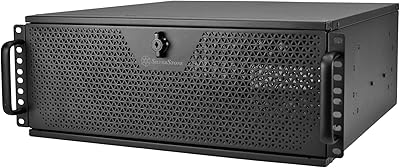
RackChoice N4058 4U Rackmount Server Chassis
84%
90%
Build Quality
85%
Cooling Performance
80%
Storage Capacity
88%
Ease of Maintenance
83%
Security Features
More
Chenbro RM42300-F 4U Rackmount Server Chassis
86%
93%
Build Quality & Durability
91%
Expansion Slot Flexibility
75%
Cooling Performance
88%
Ease of Installation & Setup
90%
Space Optimization
More
SilverStone CS380 ATX Tower Case
79%
90%
Build quality
94%
Drive bay system
68%
Thermal performance
72%
Noise levels
88%
Ease of maintenance
More
Rosewill RSV-L4412U 4U Server Chassis
85%
91%
Build Quality
93%
Cooling Performance
85%
Ease of Installation
88%
Storage Flexibility
89%
Expandability
More
SilverStone Technology SG13P Mini-ITX Case
85%
89%
Build Quality
87%
Cooling Performance
91%
Storage Flexibility
95%
Size & Portability
65%
Cable Management
More
SilverStone RM600 6U Rackmount Chassis
77%
93%
Build Quality
91%
Cooling Flexibility
89%
Drive Bay System
88%
PSU Redundancy Support
87%
Motherboard Compatibility
More
SilverStone GD10B ATX HTPC Case
75%
88%
Build Quality
83%
Cabinet Fit
77%
Cooling Performance
52%
CPU Cooler Compatibility
86%
Aesthetic Design
More
Rosewill RSV-L4500U 4U Rackmount Server Case
76%
94%
Drive Bay Capacity
88%
Cooling Performance
51%
Noise Level
78%
Build Quality
83%
Value for Money
More

FAQ

No, rack rails are not included in the box. You will need to source compatible rails separately — check SilverStone's own accessory lineup or look into universal rail kits matched to your rack post spacing. This is one of the most common budget surprises for first-time buyers, so factor it in before you order.

Yes, full-size ATX boards fit without issue. The chassis also accommodates mATX, mITX, and SSI-CEB boards, which is genuinely unusual flexibility for a rackmount enclosure. Just confirm your board's I/O cutout aligns with the included I/O shield before you commit.

You need either an ATX PS2 or a mini redundant PSU that is no deeper than 160mm. Most standard consumer ATX units fall comfortably within that limit, but double-check your PSU spec sheet if you are running a high-wattage modular unit, since some of those push past 160mm and will not seat properly.

The three 5.25″ front bays do not natively hold 3.5-inch drives on their own — you will need hot-swap cage adapters sized to the 5.25″ opening. Depending on the cage design you choose, each bay can hold two or more 3.5-inch drives, so total storage capacity depends entirely on the adapters you install.

It is a standard cam-style lock, which is typical across server chassis in this class. It will not deter someone with tools and determination, but it does reliably prevent casual unauthorized access to drives and front-panel controls — exactly what it is designed for in shared office server rooms or co-location closets.

The single 120mm rear exhaust fan is reasonably quiet at idle but becomes clearly audible as temperatures rise. In a dedicated server room this is entirely normal, but it would be noticeable in a quiet home office. There is no built-in fan speed controller, so managing noise would require a separate fan controller installed in one of the 5.25″ bays.

The chassis becomes oversized relative to a small board, but there are legitimate reasons to do it — reusing existing compact hardware, maintaining visual rack uniformity, or planning for future expansion. The 5.25″ bays and seven expansion slots remain fully usable regardless of how small the motherboard is, so the space rarely goes entirely to waste.

The chassis typically ships with a basic assortment of screws and motherboard standoffs, but buyer reports on completeness vary. It is worth having a spare pack of M3 and 6-32 server screws on hand before you start, particularly if you are populating all seven expansion slots and multiple drive cages at once.

At nearly 24 lbs empty — and noticeably heavier once components are installed — solo rack mounting is awkward and risky, especially at mid-to-upper rack height. A second person makes the job significantly safer. If you regularly work alone on rack builds, a proper rack shelf or lift makes solo installation much more manageable.

It is actually one of the strongest use cases for this enclosure. The three 5.25″ bays pair naturally with hot-swap drive cage adapters for easy drive management, and compatibility with standard ATX motherboards opens up a wide range of NAS-capable boards. The result is a solid, rack-integrated storage server without the cost of a purpose-built NAS appliance.

Where to Buy