Overview

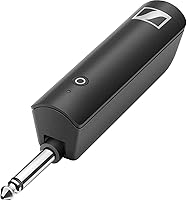
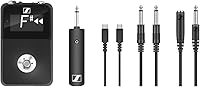
The Sennheiser XSW-D Pedalboard Wireless Instrument System is purpose-built for one thing: getting your guitar or bass signal to your pedalboard without a cable in sight. Unlike general wireless mic systems retrofitted for instruments, this pedalboard wireless system was designed around the pedalboard workflow from the start. It operates on the 2.4 GHz digital band, meaning no frequency licenses, no regional restrictions — you can pull it out of the bag in Tokyo or Toronto and it works. The plug-on transmitter and receiver connect directly to your instrument and board, and since the units arrive pre-paired, you're up and running in minutes. This is not a budget buy, but it's not pretending to be one either.
Features & Benefits

What makes this plug-on wireless unit stand out on stage comes down to a few well-executed details. The system continuously scans the 2.4 GHz spectrum and auto-selects a clean channel without you touching a menu — useful when you're soundchecking fast in a noisy RF environment. Range reaches around 250 feet, which comfortably covers most club and theatre stages. Battery life sits at five hours per charge, and critically, you can top it up via USB while it's still in use, so a quick charging hit during a support slot or break keeps you covered. The 110 dB signal-to-noise ratio means your instrument's natural character comes through intact — no audible noise floor creeping in.

Best For

This pedalboard wireless system makes most sense for gigging guitarists and bassists who are done fighting with cables mid-set. It's a strong fit for international touring musicians — the license-free 2.4 GHz band means no paperwork and no surprises crossing borders. Players who've tried cheaper wireless options and noticed their tone going slightly flat or bright will appreciate the transparency here. If you run a compact pedalboard rig and need a low-profile unit that tucks onto your board without adding chaos, the lightweight plug-on design handles that well. It's less suited to players doing marathon back-to-back sets without any break, where the five-hour ceiling becomes a real constraint rather than a theoretical one.

User Feedback

Owners who've gigged with the XSW-D Pedalboard set consistently praise how transparent it sounds — the recurring comment is that it simply doesn't sound wireless, which is the best thing you can say about a unit like this. Range holds up reliably in normal venue conditions, and setup speed gets mentioned often as a genuine selling point. The criticisms that surface most are the price — some feel it's steep for a single-channel system — and the five-hour battery limit, which can feel tight for players doing two full sets plus an encore with no break. There's also an honest note worth flagging: in very congested Wi-Fi environments, like large festivals, some users report occasional interference dropouts, though most describe these as rare rather than chronic.

Pros

  • Audio transparency is excellent — most players report the sound is indistinguishable from a direct cable connection.
  • The license-free 2.4 GHz band works in any country with zero frequency registration or regional restrictions.
  • Automatic channel allocation scans and locks onto a clean frequency without any manual input from the player.
  • Units ship pre-paired out of the box, so you are up and running in minutes with no configuration hassle.
  • USB charging during operation means a quick top-up between sets can extend your night without powering down.
  • The low-profile plug-on design integrates cleanly onto a pedalboard without adding visible bulk or extra cable runs.
  • Estimated 250-foot range covers the vast majority of club stages, theatres, and rehearsal spaces with room to spare.
  • Build quality is sturdy and consistent with Sennheiser's well-established reputation in professional audio gear.
  • One hour of charge gets you to roughly 50% battery — useful for a fast turnaround during a support slot.

Cons

  • The asking price is steep for a single-channel system, making it hard to recommend for casual or low-frequency gigging.
  • Five hours of battery life can fall short during back-to-back long sets where no charging break is available.
  • Crowded 2.4 GHz environments with heavy Wi-Fi traffic — such as large festivals — can produce occasional signal dropouts.
  • There is no manual channel override, so if automatic selection lands on a problematic frequency, your options are limited.
  • Running as a single-channel unit only, multi-instrument setups require purchasing multiple systems at considerable added expense.
  • This pedalboard wireless system is purpose-specific and offers no compatibility with vocal, bodypack, or handheld wireless applications.
  • Charging during a set requires a powered USB source physically accessible on or near your board at all times.
  • The combined system weight of approximately 1 kg may be a consideration for players managing a weight-sensitive pedalboard build.

Ratings

Our AI-generated ratings for the Sennheiser XSW-D Pedalboard Wireless Instrument System were produced by analyzing verified buyer reviews across multiple global markets, with spam, bot-generated, and incentivized feedback actively filtered out before any scores were calculated. Every category reflects what real players have reported through direct ownership experience — both the aspects that earn strong loyalty and the friction points that give some buyers genuine pause. Nothing here has been smoothed over to protect a brand image.
Audio Transparency
92%
Players consistently report that switching to this plug-on wireless unit requires no tonal adjustment whatsoever — the signal arriving at the pedalboard sounds virtually identical to a direct cable connection in a live mix. That level of transparency is rare at any price point, and it is the single most frequently praised aspect across real user reviews.
In controlled studio listening tests against premium cables, a small number of players with highly trained ears report a subtle reduction in high-end air and transient detail. This is unlikely to matter in a live performance context, but studio-focused musicians comparing this system against top-tier cables will notice the difference under close scrutiny.
Ease of Setup
94%
The pre-paired factory setup means there is nothing to configure before playing — plug the transmitter into your guitar, plug the receiver into your board, power both on, and the system handles the rest. Players rushing through a fast soundcheck or setting up in an unfamiliar venue consistently cite this zero-friction startup as one of the strongest practical advantages of this system.
There is no way to manually override the automatic channel selection if the system locks onto a problematic frequency in a given venue. For most players this is never an issue, but experienced RF technicians or players who prefer hands-on control over their wireless chain may find the absence of a manual frequency option genuinely limiting.
Live Reliability
79%
21%
For the overwhelming majority of gig scenarios — club shows, theatre performances, rehearsal rooms, and typical outdoor stages — this XSW-D Pedalboard set performs consistently without dropouts or signal hiccups. Players report that after a few gigs, they stop thinking about the wireless link entirely, which is exactly what reliable live gear should feel like.
The score reflects a meaningful minority of reports from players performing at major festivals where dozens of competing 2.4 GHz devices crowd the spectrum simultaneously. In those specific high-traffic scenarios, brief dropouts have been documented, and for players whose reputation depends on zero signal loss at a high-stakes show, that unpredictability is a real concern.
Battery Life
67%
33%
Five hours per charge is sufficient for most single-night gigs, and the ability to USB charge while in active use provides a practical safety net — a quick top-up during a support band's set or a long soundcheck can meaningfully extend available runtime before your turn on stage.
For players running back-to-back shows or doing two full sets plus an encore with no charging break, five hours can become a real problem rather than a theoretical one. The battery limitation is the most frequently cited practical complaint across user reviews, and it grows more noticeable on longer touring schedules where daily recharging access is not always guaranteed.
Value for Money
56%
44%
Players who use this pedalboard wireless system regularly on professional gigs find the investment justified by the combination of audio transparency, worldwide license-free operation, and build quality that holds up over years of daily use. The total cost of ownership argument works in its favor once durability and zero licensing overhead are factored into the equation.
The price is steep for a single-channel system, and players who need wireless for multiple instruments find the cost scales painfully fast. A portion of buyers report that the premium feels difficult to fully justify on feature count alone, particularly when mid-range competitors offer comparable basic functionality for considerably less outlay.
Build Quality
84%
The plug-on units have a reassuringly solid feel for components designed to be connected and disconnected repeatedly during live performance. Players report that after extended regular use, both transmitter and receiver hold up without the connector wobble or casing fatigue that tends to surface on cheaper wireless units after a few months of consistent gigging.
Some users note that the plastic housing, while sturdy, does not feel as premium as the price tag implies when compared directly against all-metal competitors. A small number of players on heavy touring schedules have flagged connector durability as something worth monitoring, particularly on systems that travel loose in a gig bag without dedicated protective cases.
Interference Resistance
71%
29%
The automatic channel management works well in the majority of real venue environments — typical club stages, rehearsal spaces, and moderate-size theatre gigs see very few interference-related issues. Players who do not regularly perform in high-density wireless environments often report trouble-free operation across entire extended tours without a single dropout.
The shared 2.4 GHz band with consumer Wi-Fi is the system's clearest technical vulnerability, showing up most in reviews from players who have performed at large outdoor festivals with heavy wireless traffic. The absence of manual frequency control leaves players without an easy workaround when automatic channel selection struggles in a contested RF environment.
Pedalboard Integration
91%
The plug-on design was built specifically for the instrument-to-pedalboard use case, and it shows clearly in practice. Guitarists and bassists with compact, tidy rigs consistently praise how the receiver plugs directly into the board input without needing a dedicated mounting spot, a separate housing unit, or additional cables running across the board surface.
Players who use locking instrument jacks or recessed input sockets on their pedalboard may find that the plug-on receiver does not fit as cleanly as expected, requiring an extension cable or adapter to bridge the gap. It is a niche compatibility issue, but one worth checking against your specific board configuration before committing to a purchase.
Wireless Range
83%
An estimated 250 ft of operating range covers the performance area of most real venues — pub stages, mid-size theatres, rehearsal rooms, and typical outdoor festival stages all fall comfortably within reach. Players report moving freely across a stage without signal anxiety, which is ultimately what effective range performance is supposed to deliver in practice.
The 250 ft estimate assumes line-of-sight conditions, and real-world range can degrade in cluttered stage environments with multiple bodies, equipment stacks, and competing wireless signals between the transmitter and receiver. Players on very large stages or in physically complex venues with significant obstructions should test range carefully before a high-stakes performance.
Worldwide Usability
96%
The license-free 2.4 GHz band removes a real operational headache for internationally touring musicians — no frequency licensing applications, no country-specific restrictions, and no customs paperwork required for the wireless components. Players based across Europe, North America, Asia, and Australia all report using this plug-on wireless unit without any regulatory friction on arrival in a new country.
While the license-free status covers the vast majority of markets, rare edge cases exist in specific venues with their own RF management policies, particularly government facilities or broadcast-regulated event spaces. Those working in such environments should verify local RF rules in advance, though this scenario affects a very small fraction of real-world users.
Charging Convenience
76%
24%
USB charging is a practical standard that most players already have cables for, and the ability to charge both units during active operation means the system never has to go fully offline for a recharge. The roughly one-hour-to-50% charge speed is fast enough for a useful top-up during a typical support band changeover or a long pre-show window.
Charging during use requires a live USB power source physically accessible on your pedalboard at all times, which is not always a logistical reality in every venue or festival setup. Players who run power-constrained boards or compact rigs without a power conditioner often report that the mid-gig charging option is less practical in the real world than it sounds on paper.
Form Factor
88%
The low-profile plug-on design tucks onto a pedalboard without claiming real estate the way a conventional receiver with a floor-standing housing would. Guitarists with compact, organized boards specifically praise how the XSW-D Pedalboard set disappears into the rig rather than becoming a focal point on an already crowded surface.
Despite the compact profile, the transmitter hanging from the guitar's output jack can feel slightly awkward during heavy stage movement — it protrudes more than a traditional cable plug would. For players with older guitars that have worn or loose output jack plates, the added weight of the plug-on transmitter is occasionally flagged as a minor but real concern.
Multi-Instrument Scalability
48%
52%
Multiple units can operate simultaneously in the same physical space with automatic channel coordination, so bands wanting wireless for several players can technically deploy them without cross-interference. The automatic channel management is specifically designed to handle multi-unit scenarios without requiring manual frequency planning or RF expertise from the user.
Each instrument requires its own separate transmitter and receiver set, and the cost scales rapidly — equipping a full three-piece band with wireless quickly becomes a very significant financial commitment. For bands comparing against dedicated multi-channel wireless systems from competing manufacturers, the per-channel cost of this single-channel approach often does not hold up favorably at scale.

Suitable for:

The Sennheiser XSW-D Pedalboard Wireless Instrument System is the right call for gigging guitarists and bassists who want a clean, cable-free connection between their instrument and pedalboard without sacrificing tone or wrestling with frequency licensing paperwork. If you travel internationally for shows, the license-free 2.4 GHz band removes a real logistical headache — no regional registrations, no restrictions, just plug in and play wherever you land. Tone-conscious players who have been let down by the slightly colored or degraded sound of cheaper wireless options will notice the difference here; the 110 dB signal-to-noise ratio preserves your instrument's natural character in a way that budget alternatives simply don't. Players running compact, organized pedalboard rigs will also appreciate how discreetly the low-profile plug-on units integrate without adding clutter or bulk. If your priority is fast, repeatable, dependable performance night after night — and you treat your gear as a professional investment rather than an afterthought — this plug-on wireless unit is built precisely for that mindset.
Not suitable for:

If you're on a tight budget or play only the occasional weekend gig, the Sennheiser XSW-D Pedalboard Wireless Instrument System is genuinely difficult to justify financially — there are capable wireless systems at a considerably lower cost that will serve casual use without issue. Players who regularly power through back-to-back long sets without any break between them should pay close attention to the five-hour battery ceiling; while USB charging during operation is possible, it demands a power source accessible on or near your board, which is not always a given in every venue or festival setup. Performers who frequently play large outdoor events or festivals with extremely dense Wi-Fi traffic in the 2.4 GHz band should know that occasional interference is a real, if uncommon, possibility. It is also a single-channel system, meaning a band that needs wireless for several instruments simultaneously will require multiple units, pushing the total outlay well beyond what many players anticipate. And if you need a wireless solution for vocals, a bodypack transmitter, or anything beyond the instrument-to-pedalboard signal path, this is simply not the right tool for the job.
Specifications

  • Frequency Band: Operates on the license-free 2.4 GHz digital band, requiring no regional frequency authorization for worldwide use.
  • Wireless Range: Estimated operating range reaches up to 250 ft (approximately 76 m) under typical line-of-sight stage conditions.
  • Battery Life: Each fully charged unit provides up to 5 hours of continuous operation per charge cycle.
  • Charging Speed: Approximately 1 hour of charging delivers around 50% battery capacity, enabling fast top-ups between sets or during breaks.
  • Charge During Use: Both the transmitter and receiver support active USB charging while in operation, eliminating forced downtime for recharging.
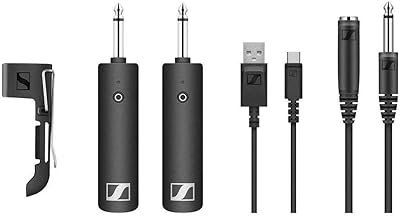
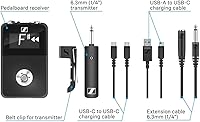
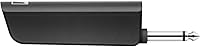
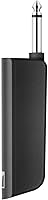
  • Transmitter Type: The transmitter is a plug-on unit with a 6.3 mm (1/4-inch) jack designed to insert directly into an instrument output.
  • Receiver Type: The receiver is a matching plug-on unit with a 6.3 mm (1/4-inch) jack designed to connect directly into a pedalboard or amplifier input.
  • Channel Setup: Frequency allocation is fully automatic; the system scans the 2.4 GHz spectrum and selects the cleanest available channel without any manual input required.
  • Signal-to-Noise: The system delivers a signal-to-noise ratio of 110 dB, preserving the instrument's tonal character with a minimal noise floor.
  • Channels: This is a single-channel system, pairing one transmitter with one receiver per set for a dedicated signal path.
  • Factory Pairing: The transmitter and receiver ship pre-paired from the factory, so no manual pairing procedure is required before first use.
  • Item Weight: The complete set weighs approximately 1,000 g (2.2 lb), accounting for both plug-on units and included accessories.
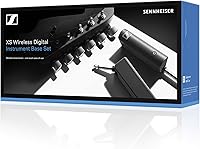
  • Dimensions: The packaged unit measures 9.4 x 8.9 x 2.8 inches (approximately 239 x 226 x 71 mm).
  • Compatibility: Compatible with guitar, bass, and any instrument equipped with a standard 6.3 mm (1/4-inch) output jack.
  • Power Source: Both units are powered by integrated rechargeable lithium-ion batteries, with one lithium-ion battery included in the set.

Related Reviews

Sennheiser XSW-D Vocal Set Wireless Microphone
76%
91%
Ease of Setup
78%
Audio Quality
58%
Battery Life
71%
Wireless Reliability
67%
Wireless Range
More
Sennheiser XSW-D Instrument Base Set
79%
93%
Ease of Setup
88%
Signal Quality
61%
Battery Life
74%
Wireless Range
71%
Build Quality & Durability
More
Sennheiser XSW-D Lavalier Set
87%
98%
Setup Speed
96%
Portability
91%
Audio Fidelity
64%
Battery Endurance
82%
Signal Stability
More
Sennheiser AVX Digital Wireless Microphone System
81%
94%
Ease of Setup
89%
Audio Quality
91%
Interference Resistance
83%
Build & Portability
72%
Receiver Fit & Compatibility
More
Sennheiser RS 195
Sennheiser RS 195
79%
93%
Speech Clarity & Dialogue Boost
78%
Wireless Range & Stability
61%
Comfort & Long-Session Wearability
89%
Setup & Ease of Use
72%
Audio Quality for Music & Movies
More
Sennheiser RS 175 RF Wireless Headphone System
85%
88%
Audio Quality
91%
Wireless Range
89%
Comfort & Fit
87%
Ease of Setup
85%
Bass Performance
More
Sennheiser EW 112P G4 Wireless Lavalier Microphone
80%
91%
Audio Clarity
93%
Build Quality
86%
RF Performance
74%
Ease of Setup
67%
Value for Money
More
Samson Airline 88 Wireless Fitness Headset System
71%
78%
Wireless Reliability
84%
Ease of Setup
63%
Audio Clarity
57%
Build Quality
74%
Comfort & Fit
More
RØDE Wireless GO II
RØDE Wireless GO II
84%
92%
Audio Clarity
86%
Signal Reliability
97%
Internal Backup Recording
94%
Portability & Weight
91%
Setup Speed & Ease of Use
More
Sennheiser ACCENTUM Plus Wireless Over-Ear Headphones
79%
94%
Battery Life
71%
Active Noise Cancellation
83%
Sound Quality
88%
Comfort & Fit
74%
Call Quality
More

FAQ

The Sennheiser XSW-D Pedalboard Wireless Instrument System works with any instrument that has a standard 6.3 mm (1/4-inch) output jack, which covers virtually all electric guitars, basses, and acoustic-electric instruments. It handles both active and passive pickups without any additional configuration — you just plug in and go.
No, and that is genuinely one of the most practical things about this system. The 2.4 GHz digital band is license-free in most countries around the world, meaning you can land in a new country for a tour date and use this plug-on wireless unit straight out of your bag without registering frequencies or checking local wireless regulations.

Setup is about as straightforward as wireless gets. The transmitter and receiver arrive pre-paired from the factory, so you plug the transmitter into your guitar's output, plug the receiver into your pedalboard input, power both units on, and the system automatically finds a clean channel. There's no pairing procedure to follow, no frequency menu to dig through, and no firmware to update before your first gig.

It's a fair thing to think about. The 2.4 GHz band is shared with Wi-Fi routers and other consumer devices, so in environments with an exceptionally dense concentration of active wireless networks, a small number of users have reported occasional brief dropouts. In practice, most players describe this as rare rather than a consistent issue, and the automatic channel management actively works to avoid interference. For club shows, theatres, and most festival stages, it is rarely a problem at all.

Yes, both units support USB charging during active use, which is a practical advantage. If you notice the battery getting low during a break between sets, you can plug in via USB and top up without shutting anything down. You will need a USB power source nearby — a compact USB power bank works well if your venue setup does not have one handy on or near your board.

Most players who use this pedalboard wireless system in live settings report that the difference is essentially inaudible. The 110 dB signal-to-noise ratio keeps the noise floor out of the picture, and the digital transmission preserves your instrument's frequency response cleanly. In a controlled studio environment with a high-end cable, a trained ear might detect subtle differences, but on a live stage, the overwhelming consensus from real users is that it sounds transparent enough to stop thinking about.

Yes, multiple units can operate in the same physical space simultaneously. The automatic channel allocation is designed to detect and avoid frequency conflicts between nearby XSW-D systems, so running one for guitar and one for bass in the same band is a well-supported and commonly reported use case. Just bear in mind that each additional instrument requires its own separate transmitter and receiver set, which adds to the overall cost.

The receiver plugs directly into your pedalboard's input jack as a plug-on unit, so in many cases no additional mounting hardware is needed at all. For extra security during transport or high-movement performances, a strip of Velcro or a small cable tie works well. The low-profile form factor was specifically designed with pedalboard integration in mind, so it fits neatly alongside your pedals without blocking adjacent units.

If you fully charge both units before your set, five hours of runtime should comfortably cover most single-night shows. That said, it is worth making USB charging part of your pre-show routine — plug both units in while you run your soundcheck or set up your gear. If you do run low mid-gig, connecting a USB cable during a break will get you back to roughly 50% charge in around an hour.

That honestly depends on what you need from a wireless system. If you play occasional local gigs and slight tone coloration or periodic dropouts would not bother you much, there are cheaper options that get the job done. Where this XSW-D Pedalboard set earns its price is in audio transparency, consistent reliability across different venues, worldwide license-free operation, and the kind of build quality that holds up under regular gigging pressure. Players who have moved up from budget wireless after dealing with tone loss or unpredictable interference tend to find the price difference makes sense once they experience the step up in day-to-day dependability.

Where to Buy