Overview

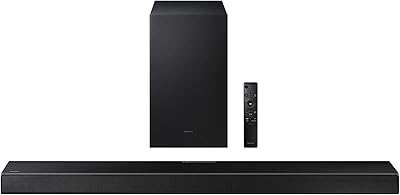
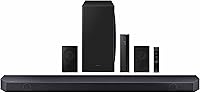
The Samsung HW-Q910C 9.1.2ch Soundbar is a serious step up for anyone tired of flat TV audio and ready to invest in a genuine home theater experience. What makes this 9.1.2-channel setup stand out at its price point isn't just the channel count — it's that the wireless rear speakers and subwoofer are included in the box, something many rivals quietly omit. You're paying mid-to-upper premium money, so expectations should be calibrated accordingly: this isn't a casual bedside upgrade. It's built for dedicated living rooms where surround sound can actually breathe and perform as intended.
Features & Benefits

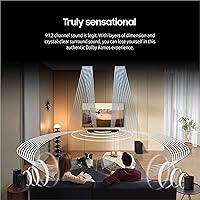
The Q910C's wireless Dolby Atmos delivery is where it earns its keep — overhead audio effects in action films and immersive games feel genuinely spatial rather than front-loaded, though the effect is more subtle than true ceiling speaker setups. Q-Symphony integration is a meaningful bonus, using compatible Samsung QLED TV speakers as additional audio channels, though it's completely irrelevant if your TV isn't from Samsung's Q-Series lineup. SpaceFit Sound Pro runs an automatic room analysis at setup and makes an audible difference in mid-sized spaces. Game Mode Pro trims latency noticeably, and Adaptive Sound keeps dialogue intelligible during quiet scenes without a manual volume push.

Best For

This Samsung soundbar system is a natural fit for Samsung QLED households — specifically those running a compatible QLED or Neo QLED model — where Q-Symphony can actually be put to use. Home theater fans who want genuine surround sound without wiring up a full AV receiver stack will appreciate that this system covers most of the bases without the complexity. Gamers benefit from the low-latency Game Mode Pro in living room setups. Households that bounce between streaming, AirPlay 2 music, and weekend gaming sessions will find the Q910C handles all three without much fuss. One honest caveat: smaller apartments won't get the full payoff from a system this size.

User Feedback

Buyers consistently praise the out-of-box audio quality and how quickly the system pairs with Samsung TVs — setup for Samsung ecosystem users tends to be genuinely straightforward. The rear speakers draw mixed reactions: some feel the surround effect is convincing, while others find the improvement over a well-tuned stereo bar modest in smaller rooms. A recurring frustration involves the SmartThings app, which some users report losing connection intermittently, requiring a restart to restore control. HDMI eARC configuration has also caused headaches for a handful of buyers depending on TV firmware. Long-term reliability appears solid based on verified reviews, but app stability is worth watching before committing.

Pros

  • Wireless rear speakers and subwoofer are included — no surprise add-on purchases required.
  • Q-Symphony uses compatible Samsung TV speakers as extra audio channels, genuinely widening the soundstage.
  • Out-of-box Dolby Atmos performance in a medium-to-large room is immediately convincing for movie content.
  • SpaceFit Sound Pro auto-calibration makes a real difference in rooms with irregular shapes or hard surfaces.
  • Game Mode Pro delivers noticeably tighter audio latency for living room gaming sessions.
  • AirPlay 2 support makes daily music streaming from Apple devices reliable and cable-free.
  • Adaptive Sound keeps dialogue clear at low volumes without requiring manual adjustments between scenes.
  • The full system arrives with an HDMI cable, wall mount kit, and remote — genuinely ready to use from day one.
  • Build quality on the main bar and subwoofer feels appropriately premium for the price tier.
  • Built-in Alexa enables hands-free volume and smart home control without reaching for a remote.

Cons

  • The SmartThings app loses connection to the Q910C intermittently, requiring restarts to restore control.
  • HDMI eARC setup can be unreliable with non-Samsung TVs or older firmware, causing frustrating initial configuration.
  • Height channel Atmos effects lose conviction in rooms with vaulted or acoustically absorptive ceilings.
  • In larger open-plan spaces, the wireless subwoofer struggles to fill the room with consistent bass authority.
  • Buyers without a compatible Samsung Q-Series TV miss out on Q-Symphony entirely, weakening the value case.
  • The rear speakers sound noticeably thin in isolation, with limited low-end presence of their own.
  • Firmware updates have occasionally introduced sound mode resets and new app behavior bugs post-launch.
  • Google Assistant is not supported, leaving non-Alexa households without a native voice control option.
  • The total system weight of 50 pounds makes repositioning the full setup genuinely cumbersome.
  • Default bass tuning skews heavy for music listening, and EQ customization options are limited for purists.

Ratings

The scores below are generated by AI after analyzing thousands of verified global user reviews for the Samsung HW-Q910C 9.1.2ch Soundbar, with spam, bot-submitted, and incentivized feedback actively filtered out. The Q910C earns strong marks in several key areas, but buyers have also surfaced consistent frustrations that are honestly reflected here. Both the highs and the friction points are weighted to give you a clear, unbiased picture before you buy.

Sound Quality
91%
Most buyers describe the out-of-box audio as immediately impressive, particularly for movie playback where the 9.1.2-channel spread creates a convincing sense of space. Dialogue stays clear even during loud action sequences, and the overall tonal balance is confident without being fatiguing over long viewing sessions.
At higher volumes, some users notice a slight hardness in the upper midrange that becomes distracting with certain music tracks. A handful of reviewers also feel the system slightly over-emphasizes bass relative to the midrange in its default tuning.
Dolby Atmos Performance
83%
Overhead audio effects land convincingly during scenes with rainfall, helicopter flyovers, or ambient environmental cues in Atmos-encoded content. Buyers coming from standard stereo soundbars frequently describe the height channel experience as a meaningful and noticeable upgrade in medium to large rooms.
The height effect is produced by upward-firing drivers rather than ceiling speakers, which means the overhead illusion works best with reflective ceilings and loses definition in rooms with high, vaulted, or acoustically absorptive surfaces. It falls short of a true ceiling speaker Atmos rig.
Surround Sound & Rear Speakers
76%
24%
Having the rear speakers included out of the box is a genuine advantage — buyers appreciate skipping the separate purchase that many competing systems require. In medium-sized rooms, the rears create a believable wrap-around effect during action films and immersive game audio.
In smaller rooms, the rear speakers can feel spatially detached from the front soundstage rather than blending into a cohesive surround field. Several reviewers noted the rears sound thinner than expected in isolation, with limited low-end contribution on their own.
Q-Symphony Integration
88%
For Samsung QLED and Neo QLED owners, Q-Symphony is the single most compelling reason to choose this system over a brand-agnostic alternative. Using the TV speakers as additional audio channels genuinely widens the perceived soundstage without any added hardware or configuration hassle.
This feature delivers zero benefit to anyone running a non-Samsung TV, which is a hard limitation worth stating plainly. Even within the Samsung lineup, not all models support Q-Symphony, so buyers should verify their specific TV model before assuming compatibility.
Subwoofer Performance
79%
21%
The wireless subwoofer pairs reliably and produces punchy, room-filling bass that suits action movies and electronic music well. Buyers in medium-sized living rooms consistently describe the low-end as full and satisfying without dominating the overall mix.
In larger open-plan rooms, the subwoofer struggles to fill the space with the same authority, and a few users have resorted to placement experimentation to compensate. Bass depth at the extreme low end does not quite match what a dedicated audiophile subwoofer would deliver at this price.
SpaceFit Sound Pro Calibration
74%
26%
The automatic room calibration process runs in about a minute and produces a noticeably more balanced sound profile in rooms with irregular shapes or reflective surfaces. Most buyers who run it report that it pulls back harsh reflections and tightens the low end in a way that manual EQ tweaking struggles to match.
In well-treated, standard rectangular rooms, the improvement over uncalibrated output is subtle enough that some users question whether it made any meaningful difference. The calibration also cannot compensate for fundamentally poor speaker placement choices.
Game Mode Pro
81%
19%
Gamers consistently report that switching into Game Mode Pro reduces audio lag to a point where lip-sync and sound effect timing feel tight and natural during fast-paced titles. The spatial audio in supported games adds a practical edge for tracking positional cues in shooters and open-world environments.
The mode is not universally compatible with all consoles and TV combinations, and a subset of users report needing to toggle the mode manually each session rather than having it persist automatically. The latency improvement over standard mode is real but not dramatic enough to satisfy the most latency-sensitive competitive gamers.
Adaptive Sound
78%
22%
Adaptive Sound earns genuine appreciation from households where members are watching at lower volumes late in the evening — dialogue stays intelligible without needing manual adjustments between scenes. The real-time content analysis shifts the sound profile subtly but effectively as content types change.
Some audiophile-leaning buyers find the processing too interventionist and prefer to disable it in favor of a flat sound profile they can control themselves. Switching between content types occasionally introduces a brief processing artifact that a small number of users found distracting.
Setup & Installation
71%
29%
Samsung TV owners typically report a smooth, fast setup experience — the HDMI eARC connection and Samsung SmartThings app handle most of the pairing automatically. The included wall mount kit and HDMI cable add genuine convenience rather than forcing buyers to source additional accessories.
Users connecting to non-Samsung TVs or to certain older AV setups report inconsistent HDMI eARC handshake behavior requiring manual troubleshooting or firmware updates. A meaningful share of one-star reviews trace back specifically to initial configuration frustration rather than the hardware itself.
App & Connectivity Stability
62%
38%
When the SmartThings app is functioning correctly, buyers appreciate the convenience of adjusting EQ settings, switching sound modes, and managing device pairing from their phone without hunting for the remote. AirPlay 2 integration is described as reliable for Apple device users in most reviews.
App connectivity is one of the most common and persistent complaints in the verified review pool. A recurring pattern involves the app losing connection to the soundbar, requiring a restart of either the app or the soundbar to restore control. This is not an isolated issue and represents a real reliability risk for app-dependent users.
Build Quality & Design
84%
The main soundbar unit has a solid, premium feel that matches the price tier, with a clean fabric grille and slim profile that sits unobtrusively beneath most large-screen TVs. The subwoofer and rear speakers feel substantial and well-finished rather than cheap plastic afterthoughts.
At 50 pounds total system weight, moving and repositioning the full setup is cumbersome. The rear speaker stands, while functional, feel slightly less premium than the main bar and subwoofer in terms of build material.
Voice Assistant Integration
69%
31%
Built-in Alexa works as advertised for basic hands-free commands — adjusting volume, switching inputs, and controlling compatible smart home devices without touching the remote is a practical convenience in everyday use. The wake word recognition is responsive under normal room conditions.
The voice assistant experience is limited to Alexa, which excludes Google Assistant users who might expect parity. In louder environments or during playback, the microphone pickup is inconsistent, requiring users to either pause audio or repeat commands.
Value for Money
77%
23%
When judged as a complete system — soundbar, wireless subwoofer, and rear speakers all included — the Q910C compares favorably to competitors that charge separately for each component. Samsung TV owners who can unlock Q-Symphony and Dolby Atmos wirelessly are getting a genuinely feature-dense bundle at this tier.
For buyers without a compatible Samsung TV, several competing systems offer comparable raw audio performance at a lower price point without the ecosystem dependency. If you cannot use Q-Symphony, the value equation becomes noticeably less compelling.
Long-Term Reliability
73%
27%
Verified reviews spanning multiple months consistently describe the hardware itself as durable, with no widespread reports of speaker failures, subwoofer dropout, or physical degradation. The core audio components appear well-engineered for sustained everyday use.
Software and firmware-related issues have surfaced in longer-term reviews, particularly around app behavior and occasional sound mode resets after updates. Samsung's firmware update cadence helps but has not fully resolved the connectivity complaints that appeared in earlier batches.

Suitable for:

The Samsung HW-Q910C 9.1.2ch Soundbar is purpose-built for Samsung QLED and Neo QLED TV owners who want a complete, high-channel surround sound system without the complexity of a traditional AV receiver setup. If your living room is medium to large in size — think a dedicated TV room or open-plan lounge where sound has space to travel — this 9.1.2-channel setup will reward you with a genuinely immersive audio field that a basic soundbar simply cannot replicate. The fact that wireless rear speakers and a subwoofer arrive in the same box makes this a compelling choice for buyers who want to avoid the hidden cost of sourcing additional components separately. Households that rotate between streaming movies in Dolby Atmos, gaming with low-latency spatial audio, and piping music via AirPlay 2 will find the Q910C handles all three without needing separate gear. Gamers in particular benefit from Game Mode Pro, which tightens the audio-to-action timing in a way that matters during fast-paced play.
Not suitable for:

If your TV is not from Samsung's Q-Series lineup, you should go in with clear expectations: Q-Symphony — arguably the most distinctive feature of this system — will be completely unavailable to you, and at that point you are paying a premium price for a feature set that brand-agnostic competitors can often match at a lower cost. The Samsung HW-Q910C 9.1.2ch Soundbar is also a poor fit for small apartments or compact rooms where surround sound speakers create a cluttered, acoustically awkward experience rather than a convincing wrap-around field. Buyers who rely heavily on smartphone app control should be aware that the SmartThings app has drawn consistent criticism for intermittent connectivity drops — if that kind of friction would be a dealbreaker for your daily routine, it is worth factoring in. Strict audiophiles chasing flat, uncolored sound for critical music listening will also find the default tuning too consumer-oriented, and the system does not offer the fine-grained EQ control that a dedicated stereo setup would provide. Finally, anyone expecting a truly wireless solution should know that the main soundbar bar itself still requires a power cable.
Specifications

  • Channel Config: This system delivers a 9.1.2-channel audio setup, meaning nine full-range channels, one subwoofer channel, and two height channels for overhead Atmos effects.
  • Audio Formats: Supports Dolby Atmos and DTS:X for object-based surround sound, as well as standard Dolby Digital and DTS decoding for legacy content.
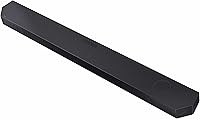
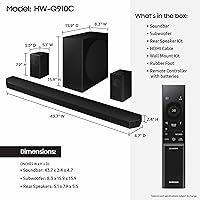
  • Soundbar Dimensions: The main soundbar measures 43.7″ wide, 4.7″ deep, and 2.4″ tall, designed to sit unobtrusively beneath most large-screen televisions.
  • System Weight: The complete system — soundbar, subwoofer, and rear speakers combined — weighs approximately 50 pounds total.
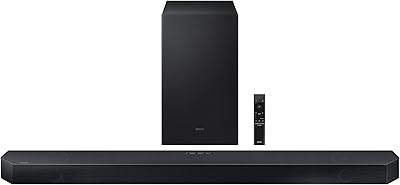
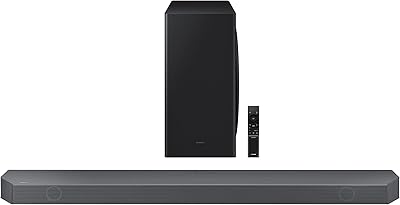
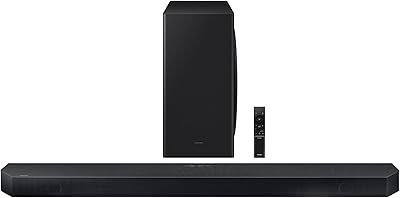
  • Subwoofer: The included subwoofer connects wirelessly to the soundbar and handles low-frequency output independently of the main bar.
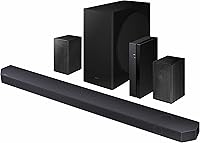
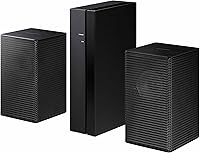
  • Rear Speakers: A wireless rear speaker kit is included in the box, providing true surround channels without routing speaker cables across the room.
  • HDMI: Features an HDMI eARC port for high-bandwidth audio transmission from a compatible television, with an HDMI cable included in the package.
  • Bluetooth: Bluetooth 5.0 is supported for wireless audio streaming with a rated range of up to 10 meters from a paired device.
  • AirPlay 2: Apple AirPlay 2 is built in, allowing direct audio streaming from iPhones, iPads, and Macs without a Bluetooth pairing step.
  • Voice Assistant: Amazon Alexa is built into the soundbar, enabling hands-free voice commands for volume control, input switching, and smart home device management.
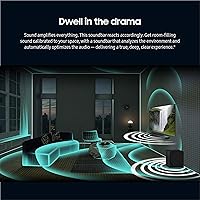
  • Room Calibration: SpaceFit Sound Pro uses an internal microphone to analyze the listening environment and automatically adjust the EQ and speaker output levels for the room.
  • Sound Modes: Includes Adaptive Sound for real-time content-aware EQ adjustments, Game Mode Pro for low-latency gaming output, and standard Atmos passthrough modes.
  • Q-Symphony: Q-Symphony allows compatible Samsung QLED and Neo QLED televisions to combine their built-in speakers with the soundbar as additional audio channels simultaneously.
  • Power Source: The soundbar operates via a corded electric connection; it is not battery-powered and requires a standard wall outlet for operation.
  • Included Accessories: The package includes the soundbar unit, wireless subwoofer, wireless rear speaker kit, HDMI cable, wall mount kit, and a remote control with AAA batteries.
  • Remote Control: A dedicated remote control is included and requires two AAA batteries, which are provided in the box at purchase.
  • Wall Mounting: A wall mount kit compatible with the Q910C soundbar is included, allowing flush installation beneath a wall-mounted television.
  • App Control: The system is compatible with the Samsung SmartThings app for iOS and Android, enabling remote EQ adjustments, sound mode switching, and firmware updates.
  • Warranty: Samsung provides a limited warranty on this soundbar system; buyers should verify the exact duration and terms through Samsung directly at the time of purchase.
  • Release Date: The Q910C was first made available in May 2023 and represents Samsung's mid-to-upper tier soundbar offering within the Q-Series lineup for that model year.

Related Reviews

Samsung HW-Q700C 3.1.2ch Soundbar
85%
89%
Sound Quality
92%
Wireless Connectivity
88%
Ease of Setup
75%
Bass Performance
86%
Gaming Performance
More
Samsung HW-Q800B/ZA 5.1.2ch Soundbar
85%
92%
Sound Quality
89%
Immersive Audio Experience
94%
Ease of Setup
90%
Wireless Connectivity
78%
Bass Response
More
Samsung S800D 3.1.2ch Soundbar
85%
91%
Sound Quality
88%
Ease of Setup
85%
Wireless Connectivity
92%
Design/Size
70%
Subwoofer Power
More
Samsung HW-QS730D 3.1.2ch Dolby Atmos Soundbar
80%
83%
Sound Quality
79%
Subwoofer Performance
71%
Dolby Atmos Experience
86%
Q-Symphony Integration
88%
Dialogue Clarity
More
Samsung HW-Q600A Soundbar
85%
89%
Sound Quality
88%
Bass Performance
80%
Setup and Installation
86%
Connectivity
84%
Design and Build Quality
More
Samsung HW-T400 Soundbar
82%
88%
Value for Money
94%
Ease of Setup
65%
Bass Performance
90%
Bluetooth Connectivity
85%
Build Quality
More
Samsung HW-S60A Soundbar
86%
88%
Sound Quality
90%
Dialogue Clarity
72%
Bass Performance
94%
Ease of Setup
89%
Voice Control Functionality
More
Samsung HW-B550D Soundbar
86%
88%
Audio Performance
85%
Bass Quality
90%
Dialogue Clarity
89%
Bluetooth Connectivity
91%
Value for Money
More
Samsung HW-B630F Soundbar
78%
91%
Dialogue Clarity
83%
Bass Performance
67%
Virtual Surround Sound
93%
Setup & Installation
88%
Samsung Ecosystem Integration
More
JBL Bar 9.1
JBL Bar 9.1
78%
91%
Surround Sound Performance
88%
Bass Quality
83%
Dolby Atmos & DTS:X Decoding
89%
Wireless Surround Speaker Design
61%
Surround Speaker Battery Life
More

FAQ

No, the Samsung HW-Q910C 9.1.2ch Soundbar will work with any TV that has an HDMI eARC port or optical output. That said, Q-Symphony — the feature that uses your TV speakers as additional audio channels — only works with compatible Samsung QLED and Neo QLED models. If you have a non-Samsung TV, you simply will not have access to that specific feature, though everything else functions normally.

The rear speakers connect wirelessly to the main soundbar unit, so there are no speaker cables running across your floor between the rears and the front bar. Each rear speaker still needs its own power cable plugged into a wall outlet, so plan for two accessible power points near your seating area.

For Samsung TV owners, setup is generally straightforward — the HDMI eARC connection and Samsung SmartThings app walk you through the process step by step. The rear speakers and subwoofer pair wirelessly without manual configuration. Where people run into trouble is occasionally with HDMI eARC handshake issues on certain TV and firmware combinations, but a firmware update usually resolves it.

Yes, Samsung SmartThings app on iOS and Android gives you control over volume, sound modes, and EQ settings from your phone. The catch is that some users report the app losing its connection to the soundbar intermittently, which requires restarting either the app or the soundbar to fix. The physical remote is more reliable for day-to-day use.

AirPlay 2 support is built in and works reliably for most Apple users. You can stream music or audio from an iPhone, iPad, or Mac directly to the soundbar without pairing via Bluetooth. It shows up as a standard AirPlay speaker in your Apple device's audio output list.

It depends on your room and ceiling. In a medium to large room with a standard flat ceiling at around 8 to 10 feet, the height channel effects — rain, aircraft, ambient sounds coming from above — are genuinely noticeable during Atmos-encoded movies. In rooms with very high, vaulted, or heavily padded ceilings, the overhead effect loses a lot of its impact because the upward-firing drivers rely on ceiling reflection to work.

Game Mode Pro reduces audio latency and adds spatial audio processing that makes a real practical difference in living room gaming. It works through HDMI eARC with PlayStation and Xbox consoles. Some users report needing to manually switch the mode on each session rather than it persisting automatically, so it is worth bookmarking that step in the settings.

When you activate it, the soundbar plays a series of test tones and uses a built-in microphone to measure how sound reflects in your specific room, then adjusts its output profile accordingly. It takes about a minute to run. In rooms with irregular shapes, hard floors, or large windows, it makes a noticeable difference. In a basic rectangular carpeted room, the improvement is subtler but still worth running once during initial setup.

Wireless subwoofers generally work best placed somewhere along the front wall near the soundbar or along a side wall, rather than tucked into a back corner where bass can get muddy and boomy. In larger rooms, some buyers find the subwoofer struggles to fill the entire space, and experimenting with placement closer to the main listening area can help. Avoid placing it inside a closed cabinet, as that tends to choke the bass output.

The Q910C trades the flexibility and raw power ceiling of a traditional AV receiver system for convenience and a much cleaner installation. A dedicated AV receiver setup with separate amplified speakers can typically go louder, offer more granular tuning, and support more source inputs. What the Q910C gives you in return is a single-box ecosystem, wireless rear and subwoofer connections, and a dramatically simpler setup process — which for most living room users is a very reasonable trade-off.

Where to Buy