Overview

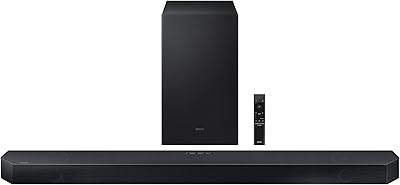
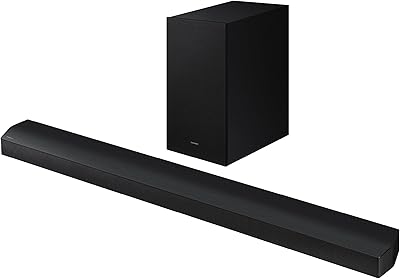
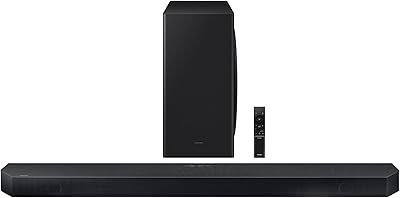
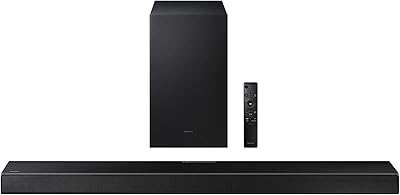
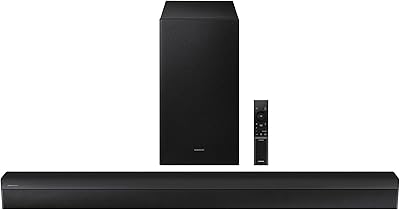
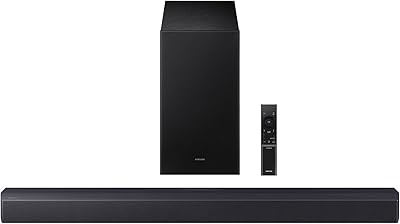
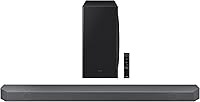
The Samsung HW-Q800B 5.1.2ch Soundbar is a 2022 release aimed squarely at home theater fans and Samsung TV owners who want serious audio without running wires across the room. Its 5.1.2 channel configuration puts it well above standard 2.1 or 3.1 bars, adding two upward-firing drivers that create a real sense of overhead sound. Important to know before buying: the subwoofer uses a wired cable, not a wireless connection, so some cable management is required. For a bar-and-sub system, the HW-Q800B is a genuinely strong performer, though it is not a replacement for a fully discrete speaker setup.
Features & Benefits

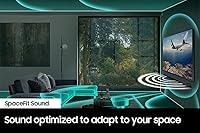
The headline feature is wireless Dolby Atmos, which means audio objects can be placed and moved in three-dimensional space around you — the upward-firing channels bounce sound off the ceiling to simulate overhead effects. In practice, the results are noticeable on Atmos-encoded content, though they are subtler than what dedicated ceiling speakers would deliver. Q-Symphony is a genuine bonus for Samsung TV owners: it activates the TV's own speakers as part of the soundstage, adding width and presence without extra hardware. SpaceFit Sound analyzes the room and adjusts the high-frequency response automatically, which actually works — no manual EQ tweaking needed. Game Pro Mode adds 3D audio positioning useful for action games, and AirPlay 2 covers Apple users for music streaming.

Best For

This Samsung soundbar is the most logical upgrade for anyone already using a Samsung TV — Q-Symphony alone makes the pairing worth it, turning the TV into part of the audio system rather than a passive display. It also suits people moving up from a 2.1 setup who want Atmos height effects without ceiling mounts or receiver complexity. Gamers benefit from Game Pro Mode on supported content, and Apple users get clean AirPlay 2 streaming for music. Apartment and mid-size living rooms are ideal; the 300W output fills those spaces confidently. In very large rooms, though, you may find yourself wanting rear speakers.

User Feedback

With a 4.5-star rating across nearly 300 reviews, buyer sentiment for this 5.1.2 system is broadly positive. The most consistent praise centers on sound clarity and bass response, with many noting that Samsung TV owners get strong out-of-box performance thanks to automatic pairing. On the flip side, the most repeated complaints involve subwoofer cable length — some find it restrictive depending on room layout — and occasional connectivity issues with the SmartThings app. A handful of non-Samsung TV users note that setup feels less intuitive without Q-Symphony to anchor the experience. Long-term reliability reports are mostly solid, though customer support feedback is mixed.

Pros

  • Q-Symphony integration with compatible Samsung TVs creates a genuinely wider, more immersive soundstage with no extra hardware.
  • Wireless Dolby Atmos and DTS:X deliver real height and directionality on supported streaming and disc content.
  • SpaceFit Sound automatically calibrates audio to your room, eliminating the need for manual EQ adjustments.
  • The 300W output handles mid-size rooms confidently, with bass response that feels full without being muddy.
  • Built-in Alexa lets you control playback and smart home devices hands-free without reaching for the remote.
  • AirPlay 2 makes it easy to stream music directly from iPhone or iPad with no app required.
  • Game Pro Mode adds 3D positional audio that works noticeably well in supported action and open-world titles.
  • Setup with a Samsung TV is fast and largely automatic, with SmartThings handling most of the configuration.
  • The included wall mount kit, HDMI cable, and remote mean you have everything needed to get started out of the box.
  • At this price tier, the feature set is hard to match in a single soundbar package.

Cons

  • The subwoofer uses a wired cable connection, which can restrict placement options depending on your room layout.
  • Q-Symphony only works with compatible Samsung TVs, so buyers with other brands miss out on a key selling point.
  • Atmos height effects, while noticeable, are subtler than what dedicated ceiling-mounted speakers would produce.
  • Game Pro Mode performs best on Atmos-encoded game audio; older or compressed game audio sees less benefit.
  • Some users report intermittent connectivity issues with the SmartThings app, requiring restarts to resolve.
  • Non-Samsung TV users may find the initial setup less intuitive and the overall experience less cohesive.
  • The subwoofer cable supplied is not especially long, which some buyers find limiting in larger or oddly shaped rooms.
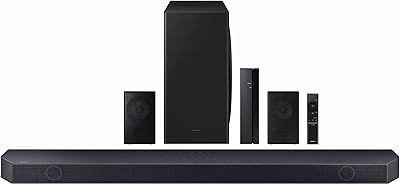
  • There are no rear satellite speakers included, so true surround immersion still requires additional purchase.
  • Customer support experiences reported by buyers are inconsistent, with some noting slow resolution times.
  • The soundbar chassis is plastic, which looks fine on a shelf but feels less premium than the price might suggest.

Ratings

The scores below were generated by AI after analyzing verified global user reviews for the Samsung HW-Q800B 5.1.2ch Soundbar, with spam, bot submissions, and incentivized feedback actively filtered out before scoring. Each category reflects the full spread of real buyer sentiment — not just the highlights — so both consistent strengths and recurring frustrations are represented honestly. Where scores dip, the reasons are explained in plain terms so you can judge whether those trade-offs matter for your specific setup.

Sound Quality
88%
Across hundreds of verified reviews, buyers consistently describe the overall sound as clear, full, and significantly better than built-in TV speakers. Dialogue is especially praised for its clarity, and the system handles a wide dynamic range well — from quiet scenes to loud action sequences — without distortion at moderate-to-high volumes.
A portion of listeners note that at very high volume levels, some compression becomes audible in the upper-mid frequencies. The system also slightly favors a mid-bass emphasis that not everyone prefers for music listening, where more neutral tuning would be welcome.
Dolby Atmos Performance
74%
26%
Height effects are genuinely perceivable on well-encoded Atmos content — rain, aircraft, and environmental sounds overhead come through with real spatial distinction rather than just sounding louder. For a soundbar system, the overhead impression holds up well in rooms with standard 8 to 9-foot ceilings.
Buyers who have experienced dedicated in-ceiling speakers or high-end discrete Atmos setups consistently note the height channel performance is a noticeable step down from those benchmarks. On compressed streaming Atmos tracks, the height effect can become fairly subtle and easy to miss without active listening.
Bass Performance
86%
The wired subwoofer delivers tight, controlled bass that works well for both cinematic content and casual music playback. Most buyers report that it hits hard enough to feel impact in action sequences without the loose, one-note thump that plagues cheaper subs in this category.
The subwoofer cable is a recurring complaint — buyers in larger rooms or with unconventional furniture layouts find the cable length restrictive for optimal sub placement. A small group of buyers also note the sub can occasionally boom on bass-heavy music if the level is not manually dialed back.
Samsung Ecosystem Integration
93%
For Samsung TV owners, Q-Symphony is the standout feature: it activates the TV speakers as part of the soundstage rather than muting them, creating noticeably wider audio spread with zero additional hardware. SmartThings pairing is fast, and the whole system behaves like a single unit once configured.
This integration is entirely exclusive to compatible Samsung TVs, which means buyers with any other brand receive none of these benefits. The SmartThings app also sees occasional connectivity drops that require a manual reconnect — a minor but persistent annoyance flagged by multiple users.
Gaming Performance
79%
21%
Game Pro Mode adds a worthwhile layer of directional audio in supported titles — footsteps, environmental cues, and explosions have more spatial separation than standard stereo or basic surround modes. Console gamers using HDMI eARC report strong sync between on-screen action and audio response with minimal lag.
The improvement is noticeably content-dependent: games with dedicated 3D audio or Atmos output benefit clearly, while older titles or compressed audio formats show minimal difference. PC gamers using optical or Bluetooth connections may also find the feature less effective than HDMI-connected console users.
Setup & Installation
81%
19%
Samsung TV owners report a largely painless setup experience, with the SmartThings app walking through pairing and calibration in a few minutes. SpaceFit Sound runs automatically and requires no external microphone — buyers appreciate that it just works without a manual configuration session.
Non-Samsung TV owners describe a noticeably less guided experience, with some trial and error required to get eARC working correctly depending on TV brand and firmware. The subwoofer cable also adds a routing step that can complicate clean installations in wall-mounted or built-in entertainment setups.
SpaceFit Sound Calibration
82%
18%
Buyers who tested SpaceFit Sound before and after consistently note it makes a real, audible difference — particularly in rooms with hard floors or asymmetrical layouts where high frequencies can sound harsh or uneven. The automatic nature of the process is widely praised as genuinely useful rather than a checkbox feature.
SpaceFit Sound only adjusts high-frequency response, not the full frequency spectrum, so bass tuning still requires manual adjustment via the sub level control. A handful of users in unusually shaped or very large rooms report the calibration result sounded worse than the default setting.
Voice Assistant (Alexa)
76%
24%
Built-in Alexa works reliably for basic playback commands, volume control, and smart home device management without needing a separate Echo device nearby. Buyers in Alexa-heavy households appreciate the hands-free convenience, especially when the TV remote is out of reach.
Wake word detection is occasionally sluggish when the soundbar is playing at moderate to high volumes, requiring repeated commands. Users who do not use Alexa find the microphone array difficult to disable cleanly, and there is no option to substitute Google Assistant or other platforms.
AirPlay 2 & Wireless Streaming
84%
AirPlay 2 performs reliably for music and podcast streaming from Apple devices, with no audible lag or dropout in typical home Wi-Fi conditions. iPhone and iPad users particularly appreciate not needing a third-party app or Bluetooth pairing — it just shows up as an AirPlay target.
Bluetooth performance is rated lower than AirPlay by most buyers, with some noting occasional dropouts when other devices are connected to the same network. Android users without NFC-capable devices also get less seamless streaming options compared to the AirPlay experience available to Apple users.
Build Quality & Design
71%
29%
The soundbar has a clean, low-profile aesthetic that disappears neatly below most TVs without visual clutter. The fabric grille and matte black finish look presentable in a living room setting, and the unit does not feel flimsy when handled or wall-mounted.
The plastic chassis construction is a noticeable mismatch with the price tier — buyers who have owned premium soundbars from other manufacturers point out that the material feel does not match what they expect at this price. The remote also feels lightweight in a way that reads as budget relative to the overall system cost.
Value for Money
77%
23%
For Samsung TV owners specifically, the feature-to-price ratio is strong: Q-Symphony, SpaceFit Sound, Atmos, and a wired sub together represent a full audio upgrade in a single purchase. The included HDMI cable and wall mount kit add practical value that competitors at similar prices do not always include.
For buyers who do not own a compatible Samsung TV, the value calculation shifts considerably — several premium features become irrelevant, and competing soundbars with comparable Atmos performance may represent a better deal. Some buyers also feel the plastic construction does not fully justify the price.
App & Smart Features
68%
32%
SmartThings provides meaningful added control beyond the remote, including per-mode EQ adjustments, firmware updates, and multi-room audio configuration for households already invested in Samsung smart devices. The app interface is clear and reasonably easy to navigate for first-time users.
The app's stability is its biggest weakness — a recurring theme in reviews is the soundbar periodically disappearing from the SmartThings device list and requiring a reconnect or reboot. This is not a universal issue, but it is consistent enough across reviews to be treated as a known limitation rather than an isolated one.
Dialogue Clarity
89%
The dedicated center channel handles speech reproduction particularly well — buyers transitioning from TV speakers or basic soundbars frequently single out improved dialogue intelligibility as one of the first and most obvious improvements. This holds up across genres including drama, news, and sports commentary.
At very high volume levels, some listeners detect a slight thinning of vocal texture, particularly in compressed streaming audio. Buyers who frequently watch content with heavy accents or low-mix dialogue tracks may still want to manually boost the center channel level beyond the default setting.
Long-Term Reliability
73%
27%
The majority of buyers who have owned the HW-Q800B for over six months report no hardware failures, and the unit maintains consistent audio performance over time without degradation. Firmware updates have addressed several early software complaints, which signals ongoing product support.
A smaller but notable group of buyers report Wi-Fi connectivity issues that persist across firmware versions, and a few describe Alexa responsiveness degrading over time without a clear fix. Customer support experiences are inconsistent, with some buyers noting difficulty getting resolution for software-related issues.

Suitable for:

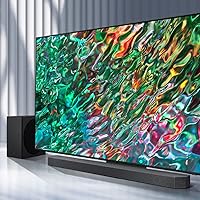
The Samsung HW-Q800B 5.1.2ch Soundbar is an excellent fit for Samsung TV owners who want to get significantly more out of their existing display — Q-Symphony turns compatible Samsung TVs into active participants in the soundstage, which is a real and meaningful upgrade that requires zero extra hardware. Home theater enthusiasts stepping up from a basic 2.1 or 3.1 system will find the 5.1.2 channel layout a noticeable improvement, particularly on Dolby Atmos and DTS:X content like action films and nature documentaries where height and directionality matter. Gamers using a console or streaming box will appreciate Game Pro Mode, which adds positional depth to supported titles without needing a dedicated gaming DAC or headset. Apple users benefit from built-in AirPlay 2, making casual music listening or podcast playback straightforward from any iPhone or iPad. This system also suits apartment dwellers and those with mid-size living rooms where a full receiver-based surround setup would be overkill or physically impractical.
Not suitable for:

The Samsung HW-Q800B 5.1.2ch Soundbar is a harder sell for buyers who do not own a compatible Samsung TV, since Q-Symphony — one of its most compelling features — simply will not apply to them, and the value proposition weakens accordingly. Audiophiles or dedicated home cinema builders expecting performance comparable to a discrete 5.1 speaker system with a receiver will likely find the Atmos height effects underwhelming; upward-firing drivers are a reasonable approximation, not a true overhead sound replacement. Anyone with a large, open-plan living space may find the 300W output starts to feel insufficient at higher volumes, especially without rear satellite speakers to fill the back of the room. Buyers who are sensitive to cable management should know the subwoofer connects via a physical wire, not wirelessly, which can be limiting depending on furniture layout. If budget is tight and the goal is simply louder TV audio, a simpler 2.1 system would deliver better value without the complexity.

Specifications

  • Channel Config: This system runs a 5.1.2 channel layout, meaning 5 main channels, 1 subwoofer channel, and 2 upward-firing height channels for overhead audio effects.
  • Max Output: Total system output reaches 300W, distributed across the soundbar and the included wired subwoofer.
  • Dimensions: The soundbar unit measures 8″ deep, 30″ wide, and 10″ tall, making it a good fit for most TV stands accommodating displays from 55 inches upward.
  • Weight: The full system weighs 32.8 lbs, which includes the soundbar bar unit and the wireless subwoofer enclosure.
  • Dolby Atmos: Dolby Atmos is supported wirelessly via HDMI eARC, meaning no dedicated Atmos cable is required between the TV and soundbar.
  • DTS Support: DTS:X object-based audio is fully supported, providing three-dimensional sound placement on compatible DTS:X encoded content.
  • Connectivity: The HW-Q800B connects via HDMI (eARC), Bluetooth, and Wi-Fi, giving flexible options for both TV passthrough and wireless audio streaming.
  • Subwoofer Link: Despite the soundbar itself being wireless-capable, the subwoofer connects to the soundbar unit via a physical wired cable, not wirelessly.
  • Voice Assistant: Amazon Alexa is built directly into the soundbar, enabling hands-free voice control for playback, smart home devices, and compatible Samsung TV functions.
  • AirPlay 2: AirPlay 2 is natively supported, allowing direct audio streaming from any compatible iPhone, iPad, or Mac without a third-party app or adapter.
  • Q-Symphony: Q-Symphony synchronizes the soundbar with compatible Samsung TV speakers to create a unified, wider soundstage using both devices simultaneously.
  • SpaceFit Sound: SpaceFit Sound automatically analyzes the acoustic characteristics of the room and adjusts high-frequency calibration to optimize playback for that specific space.
  • Game Pro Mode: Game Pro Mode activates enhanced 3D positional audio and syncs the upward-firing and Acoustic Beam channels to on-screen action for gaming sessions.
  • Tweeter: The soundbar uses 1-inch dynamic driver tweeters to handle high-frequency detail and contribute to the overhead Atmos height effects.
  • App Control: The Samsung SmartThings app provides additional control over sound modes, EQ settings, and firmware updates beyond what the physical remote offers.
  • Tap Sound: Tap Sound allows NFC-compatible Android devices to instantly connect and stream audio by tapping the phone to the soundbar.
  • Power Source: The soundbar is corded electric and requires a standard AC wall outlet; no battery operation is available.
  • Included Items: The box includes the soundbar unit, subwoofer, a wired subwoofer cable, an HDMI cable, a remote controller, batteries for the remote, and a wall mount kit.
  • Control Methods: The soundbar can be operated via the included physical remote, built-in Alexa voice commands, or the Samsung SmartThings smartphone app.
  • Warranty: Samsung provides a limited warranty with the HW-Q800B; buyers should confirm the specific term and coverage details with Samsung directly at time of purchase.

Related Reviews

Samsung HW-Q700C 3.1.2ch Dolby Atmos Soundbar
78%
83%
Sound Quality
86%
Bass Performance
67%
Dolby Atmos Height
88%
Dialogue Clarity
81%
Gaming Performance
More
Samsung HW-Q910C 9.1.2ch Soundbar
78%
91%
Sound Quality
83%
Dolby Atmos Performance
76%
Surround Sound & Rear Speakers
88%
Q-Symphony Integration
79%
Subwoofer Performance
More
Samsung S800D 3.1.2ch Soundbar
85%
91%
Sound Quality
88%
Ease of Setup
85%
Wireless Connectivity
92%
Design/Size
70%
Subwoofer Power
More
Samsung HW-B750D 5.1 Channel Soundbar
74%
91%
Dialogue Clarity
67%
Surround Sound Realism
78%
Bass Performance
93%
Setup & Installation
74%
TV Compatibility
More
Samsung HW-QS730D 3.1.2ch Dolby Atmos Soundbar
80%
83%
Sound Quality
79%
Subwoofer Performance
71%
Dolby Atmos Experience
86%
Q-Symphony Integration
88%
Dialogue Clarity
More
Samsung HW-T400 2.0 Channel Soundbar
73%
78%
Audio Clarity
54%
Bass Performance
93%
Ease of Setup
81%
Value for Money
84%
Bluetooth Connectivity
More
Samsung HW-Q600A Soundbar
85%
89%
Sound Quality
88%
Bass Performance
80%
Setup and Installation
86%
Connectivity
84%
Design and Build Quality
More
Samsung HW-B550D 3.1ch Soundbar
76%
91%
Dialogue Clarity
78%
Bass Performance
93%
Setup & Installation
67%
Virtual Surround Sound
84%
Value for Money
More
Samsung HW-S60A 5.0ch Soundbar
75%
91%
Dialogue Clarity
86%
Soundstage Width
47%
Bass Performance
93%
Setup Experience
83%
Build Quality
More
Samsung HW-S60B 3.1ch Soundbar
76%
82%
Audio Quality
76%
Bass Performance
91%
Setup & Installation
84%
Build Quality & Design
79%
Smart Features & Connectivity
More

FAQ

The subwoofer requires a physical wired cable to connect to the soundbar — it is not wireless. This is a common point of confusion, so factor in cable routing when deciding where to place the sub relative to your TV stand or entertainment unit.

Q-Symphony only works with compatible Samsung TVs. If you have a Sony, LG, or any other brand, this feature simply will not activate. It is one of the most compelling reasons to buy this soundbar if you already own a Samsung TV, but it adds nothing for everyone else.

The Samsung HW-Q800B 5.1.2ch Soundbar delivers Atmos effects that are real and noticeable — particularly on film soundtracks with active overhead elements like rain, helicopters, or falling debris. That said, upward-firing drivers bouncing sound off the ceiling is an approximation of true overhead audio, not the same experience as dedicated in-ceiling speakers. For a soundbar system at this level, it is genuinely good, just not a substitute for a full ceiling-mounted setup.

Yes, and Game Pro Mode is worth enabling when you do. It adjusts the audio processing to prioritize positional cues and syncs the height channels to in-game action. It works best with titles that support 3D audio or Atmos output, so the improvement is more obvious in some games than others.

It is mostly automatic. When you run SpaceFit Sound, the soundbar emits test tones and uses internal sensors to measure how the sound behaves in your room. It then adjusts the high-frequency output to compensate for the space. You trigger it once through the settings menu, and it runs on its own from there — no microphone stand or manual EQ needed.

AirPlay 2 is an Apple protocol, so anything that supports AirPlay on your iPhone, iPad, or Mac will stream to the soundbar — Spotify, Apple Music, podcasts, YouTube audio, and more. You do not need a dedicated app; just select the soundbar as an AirPlay output from your device.

Setup is straightforward in terms of the physical connections — HDMI to your TV, subwoofer cable plugged in, power on. Where it gets slightly less polished for non-Samsung TV owners is the software side: the SmartThings app is designed with Samsung devices in mind, so some features and auto-configuration steps simply will not apply. It still works fine as a soundbar, but the experience is smoother within the Samsung ecosystem.

Yes, wall mounting is supported and the mount kit is included in the box. The bar is relatively wide at 30 inches, so make sure the wall space above or below your TV accommodates it. The subwoofer would still need to sit on the floor nearby given its wired connection.

Everyday TV content — news, sports, streaming shows — sounds noticeably clearer and fuller than built-in TV speakers, which is the baseline expectation here. Dialogue in particular benefits from the center channel handling. The bass response from the subwoofer is also well-tuned for non-cinematic content and does not overpower speech-heavy programming at normal listening volumes.

A portion of buyers have reported occasional hiccups with the SmartThings app, including the soundbar dropping off the network or requiring a restart to reconnect. It does not appear to affect everyone, and firmware updates have addressed some instances of this. If Wi-Fi stability is critical for your setup, keeping the soundbar close to your router or on a 2.4GHz network tends to help.