Overview

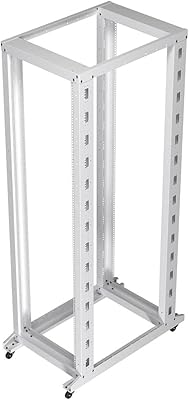
The Rosewill RSR-4P12U001 12U Open Frame Server Rack sits in a practical middle ground — not quite enterprise-grade, but a solid step above bargain-bin options that flex under load. Built around a 4-post adjustable frame, it ships flat-packed and relies on you to assemble it, which sets expectations right away. The 12U capacity handles a modest but meaningful amount of equipment, and the depth adjustability — ranging from 22″ to 40″ — is genuinely useful when your gear doesn't all come from the same manufacturer. That 3.3-star average is worth paying attention to; it tells a story of real-world mixed results that deserve an honest look.

Features & Benefits

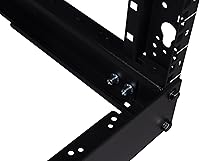
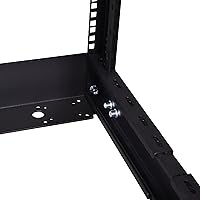
The adjustable depth rails are the standout feature here — being able to slide between 22″ and 40″ means you're not locked into equipment from a single vendor, which matters when you're mixing older servers with newer switches. Twelve rack units of usable space isn't enormous, but it's enough for a router, a few switches, a patch panel, and a 1U server without crowding. The posts include clear U markings and depth scales that make positioning equipment straightforward, even for first-timers. The integrated cable hook system is basic but functional, and the alloy steel frame feels sturdy enough once fully assembled and properly tightened down.

Best For

This open-frame rack makes the most sense for home lab builders who need flexible mounting options without spending enterprise money. If you're running a handful of network devices — switches, a NAS, maybe a small server — and want them organized vertically rather than stacked on a shelf, this server rack delivers that. Small business IT staff managing a closet-sized server room will appreciate the depth range, since real-world equipment rarely comes in uniform sizes. One thing to note: the open-frame design means no physical security or dust protection, so if either of those matter in your environment, a fully enclosed cabinet is the better path.

User Feedback

Buyers who appreciate the Rosewill 12U rack tend to praise its depth flexibility and the value it delivers for a non-enterprise budget. That said, the assembly experience draws consistent criticism — instructions are reportedly sparse, hardware bags aren't always complete, and getting the frame square takes patience. A few users have noted noticeable wobble when heavier equipment is loaded, particularly if the rack isn't anchored to a floor or wall. The cable management hooks get a mixed response: handy for light tidying, but not robust enough for complex wiring. Satisfied buyers are typically those with realistic expectations — they knew going in they were getting a budget-conscious option, not a precision-engineered data center rack.

Pros

  • Rail depth adjusts from 22″ to 40″, handling mixed-vendor equipment without adapters or workarounds.
  • 12U of usable space covers a full home lab stack — switches, patch panel, NAS, and a server — without crowding.
  • Open-frame design allows natural heat dissipation, reducing thermal management headaches in small spaces.
  • Clearly stamped U markings on all four posts make equipment planning and repositioning quick and accurate.
  • Alloy steel construction holds up well under typical home lab or small office loads when properly assembled.
  • Flat-pack shipping keeps delivery manageable and avoids the logistics complexity of pre-assembled cabinet freight.
  • RoHS-compliant materials signal responsible sourcing, which matters for environmentally conscious buyers.
  • At its price tier, this open-frame rack undercuts many 12U 4-post competitors while covering the core use case.
  • The 1200 lb weight rating means rack capacity will never be the limiting factor for any realistic home or small office load.
  • Standard 19-inch EIA spacing ensures broad compatibility with virtually any branded rackmount equipment.

Cons

  • Assembly instructions are widely criticized as vague, poorly illustrated, and insufficient for first-time rack builders.
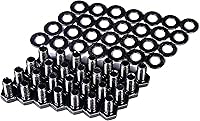
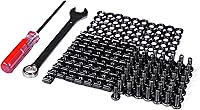
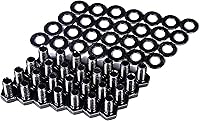
  • Missing hardware in the box is a recurring complaint, not an isolated incident — have a spare M6 hardware kit ready.
  • Freestanding stability under heavier loads is genuinely poor; anchoring is effectively required, not optional.
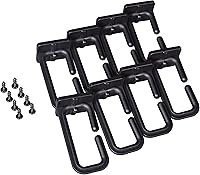
  • Cable management hooks are too basic for anything beyond light-duty tidying of a small number of connections.
  • Edge finishing on cut metal components can be rough, with burrs that catch cables and skin during installation.
  • Packaging organization is disorganized, making the initial parts sort-out tedious before assembly even begins.
  • Rail adjustment mechanism can be stiff out of the box, requiring extra effort before smooth depth changes are possible.
  • Finish consistency varies across units, with some buyers receiving minor cosmetic blemishes or uneven powder coating.
  • No side panels, doors, or locks mean this server rack is unsuitable wherever dust control or physical security matters.
  • At this price point, build precision and hardware quality fall noticeably short of what established rack brands deliver.

Ratings

The Rosewill RSR-4P12U001 12U Open Frame Server Rack earns a nuanced scorecard — not a clean win, not a clear miss. The ratings below are generated by AI after analyzing verified buyer reviews from multiple global marketplaces, with spam, incentivized, and bot-flagged submissions actively filtered out. Both what works and what frustrates real users are reflected honestly here.
Depth Adjustability
83%
The ability to slide rails between 22″ and 40″ is the single most praised feature in user feedback. Home lab builders with mixed-vintage equipment — say, a 2U server from one brand alongside a shallower switch from another — consistently report this flexibility saved them from buying a second rack.
A handful of users found the adjustment mechanism stiff out of the box, requiring extra effort to slide rails smoothly before first use. A few noted that the rail locking mechanism doesn't feel as positive or confidence-inspiring as on pricier competing frames.
Assembly Experience
44%
56%
Users who approached assembly methodically and had prior rack-building experience generally got the frame square and stable in under an hour. Those who laid out all parts first and cross-referenced community forum photos reported a more manageable process than the included instructions alone would suggest.
The included instruction sheet is widely criticized as vague and poorly illustrated, leaving many buyers to figure out orientation and hardware placement by trial and error. Missing screws and incomplete hardware bags show up repeatedly in reviews, which is a frustrating discovery mid-build when your equipment is already waiting to be racked.
Structural Stability
57%
43%
When assembled correctly on a flat surface and loaded with lighter network gear — switches, patch panels, a NAS — the frame holds steady without noticeable flex. Users who bolted the feet to a concrete floor or secured the top to a wall reported a noticeably more rigid result.
Unanchored and loaded with heavier 2U or 4U servers, wobble becomes a real concern that multiple reviewers flagged. The open-frame design inherently sacrifices some rigidity compared to enclosed cabinets, and this rack sits closer to the wobbly end of that spectrum without additional anchoring.
Value for Money
71%
29%
At its price point, this open-frame rack undercuts many comparable 12U 4-post options while still delivering the core functionality — adjustable depth, decent weight capacity, and a full 12U of usable space. For a home lab on a budget, the math works out reasonably well if you go in with calibrated expectations.
Buyers who compare it directly to StarTech or Tripp Lite alternatives in a similar range sometimes feel the finishing quality and hardware precision don't quite match up. If you factor in the time cost of a difficult assembly or a return for missing hardware, the value proposition erodes somewhat.
Cable Management
53%
47%
The integrated hook system is genuinely useful for a first pass at cable organization — looping patch cables and keeping power cords from dangling freely. For a small setup with a handful of connections, it does the job without requiring add-on accessories.
Anyone running a more complex cabling environment will find the hooks underwhelming fast. They're not designed to handle high-density wiring, and there's no dedicated horizontal or vertical cable manager included, which means a busier rack quickly looks messy despite the hooks.
Build Quality & Materials
62%
38%
The alloy steel posts feel solid in hand and the black finish is clean and professional-looking when first unboxed. For stationary use in a home office or small server closet, the material holds up well under normal conditions.
Edge finishing on some units has been reported as rough, with sharp burrs on cut metal that can catch skin or snag cables during installation. The overall fit and finish doesn't match what you'd see from rack hardware at twice the price, which is worth knowing before you commit.
Weight Capacity
78%
22%
A 1200 lb rated capacity is a number that far exceeds what any home lab or small office will realistically need, which means users loading it with typical rackmount gear have no genuine concerns about the frame giving way under weight alone.
The rated capacity and the real-world stability experience don't always align — the wobble issues under heavier loads suggest the frame's rigidity is the limiting factor before the weight limit ever becomes relevant. Treat the spec as a floor load rating, not a handling comfort rating.
Rail Markings & Usability
74%
26%
The U markings on the posts are clearly stamped and easy to read, which makes planning equipment placement and counting rack units genuinely straightforward. This is a small detail that saves real time during installation and when re-organizing a rack months later.
Some users noted that the depth adjustment markings, while present, are less prominent than the U markings and can be easy to misread in low-light server closet conditions. A minor complaint, but it adds friction to an already fiddly adjustment process.
Open-Frame Airflow
81%
19%
With no side panels, doors, or top cover, heat from stacked equipment dissipates freely — a genuine advantage for densely loaded setups where airflow matters. Home lab users running multiple active devices reported no heat-related issues attributable to the rack itself.
That same openness means dust accumulates on equipment faster than it would inside an enclosed cabinet, which is a maintenance consideration in dusty environments. There's also no physical access control, so this design is only appropriate where security isn't a concern.
Footprint & Space Efficiency
76%
24%
The 12U form factor hits a useful sweet spot for compact server rooms or home office corners — enough vertical space to consolidate a meaningful amount of gear without dominating the room. The flat-pack shipping also means it arrives without the logistics headache of a pre-assembled cabinet.
The footprint once assembled is wider than some buyers anticipate, and the open-frame style means the visual footprint feels larger than an equivalent enclosed unit. If space is genuinely tight, measuring twice before ordering is strongly advised.
Compatibility with Rackmount Gear
77%
23%
The adjustable depth handles a wide variety of rackmount chassis, and the standard EIA 19-inch rack spacing means virtually any branded rackmount gear drops in without compatibility concerns. This is a rack that plays well with mixed hardware environments.
Users with particularly deep server chassis pushing toward the 40″ outer limit occasionally found the adjustment process less smooth than expected. Compatibility is broadly good, but edge-case hardware sometimes requires fiddling that a sturdier adjustable system would avoid.
Packaging & Unboxing
49%
51%
The flat-pack format keeps shipping costs down and makes delivery manageable without requiring a freight appointment. The core metal components generally arrive without shipping damage.
Hardware organization inside the box is frequently criticized — loose bags, unlabeled components, and parts scattered without clear grouping make the initial sort-out unnecessarily tedious. Combined with vague instructions, unboxing this rack is one of the more frustrating entry points in the setup process.
Aesthetics & Finish
66%
34%
The matte black finish looks clean and professional in a home lab or small business server closet. It photographs well and doesn't look out of place next to branded network equipment.
Finish consistency across units is uneven — some buyers received racks with minor cosmetic blemishes or slightly inconsistent powder coating. Nothing that affects function, but for buyers who care about presentation, it's a roll of the dice.

Suitable for:

The Rosewill RSR-4P12U001 12U Open Frame Server Rack is a practical fit for home lab enthusiasts who are consolidating their first or second rack setup and don't need enterprise-grade rigidity. If you're running a mix of network switches, a patch panel, a NAS, and maybe a 1U server, the 12U capacity covers that load comfortably without overbuilding. The adjustable depth range is particularly useful for buyers who've accumulated gear from different manufacturers over the years — not everything ships at the same depth, and this rack handles that reality better than fixed-rail alternatives at a similar price. Small business IT staff managing a compact server closet on a tight budget will also find it workable, especially if they're willing to anchor the frame to a floor or wall for added stability. Anyone who prioritizes natural airflow over physical security will appreciate the open-frame design, which lets heat escape freely without requiring active cooling management at the rack level.
Not suitable for:

Buyers expecting a straightforward, confidence-inspiring assembly experience should approach this server rack with caution — the instructions are sparse, hardware labeling is inconsistent, and missing screws from the hardware bag are a documented pattern, not a rare exception. If you're loading the rack with heavy 2U or 4U servers and leaving it freestanding, the wobble reported by multiple users becomes a real concern rather than a minor annoyance. The open-frame design also makes this a poor choice for environments where dust accumulation, physical security, or equipment access control are genuine requirements — an enclosed cabinet solves all three. IT professionals building out a production environment or a client-facing server room will likely find the fit, finish, and structural predictability fall short of what those contexts demand. Those who've used mid-to-high-tier racks from brands like StarTech or Tripp Lite may find the overall precision and hardware quality here a noticeable step down.

Specifications

  • Form Factor: Open-frame, 4-post design with no side panels, doors, or top cover, allowing unrestricted airflow and front-to-back equipment access.
  • Rack Capacity: Supports 12 rack units (12U) of standard 19″ EIA-compatible rackmount equipment.
  • Adjustable Depth: Horizontal rail depth adjusts from 22.3″ to 40.3″, accommodating a wide range of server chassis and network hardware depths.
  • Weight Capacity: Rated to support up to 1200 lbs of static load under normal conditions.
  • Material: Posts and rails are constructed from alloy steel for structural rigidity across typical home lab and small office loads.
  • Finish: Matte black powder-coat finish applied to all steel components.
  • Compliance: RoHS compliant, indicating restricted use of hazardous substances in materials and manufacturing.
  • Cable Management: Integrated hook-style cable managers are built into the frame to help route and retain patch cables and power cords.
  • Post Markings: All four posts feature clearly stamped rack unit (U) designations and depth adjustment scale markings for accurate equipment placement.
  • Assembly: Ships flat-packed and requires self-assembly; no pre-assembled configuration is available for this model.
  • Item Weight: The assembled rack weighs 26.5 lbs, making solo repositioning manageable for most users.
  • Shipping Dimensions: The flat-pack box measures 25.59 x 7.09 x 4.33 inches, suitable for standard parcel delivery without freight scheduling.
  • Compatible Equipment: Designed for standard 19″ rackmount servers, network switches, routers, patch panels, and similar rackmount chassis.
  • Post Frame Type: 4-post frame configuration provides independent front and rear mounting points for full chassis rail support.
  • Manufacturer: Designed and sold by Rosewill, a brand under Newegg Commerce with a broad catalog of PC components and accessories.

Related Reviews

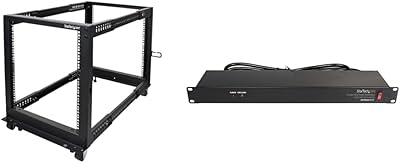
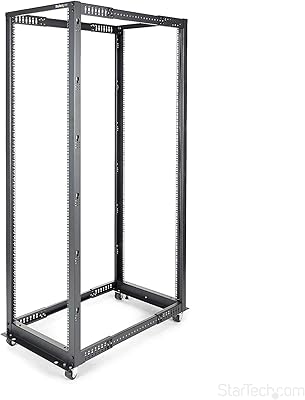
StarTech.com 12U Open Frame Server Rack & 8 Outlet Rack Mount PDU
86%
92%
Build Quality
89%
Ease of Assembly
88%
Power Distribution
90%
Surge Protection
84%
Adjustable Depth
More
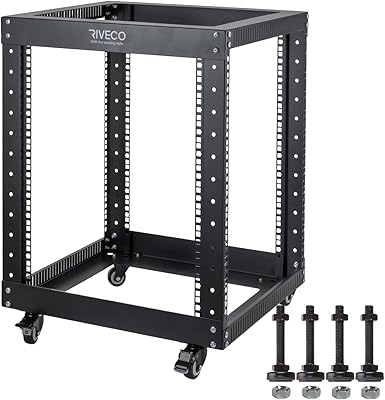
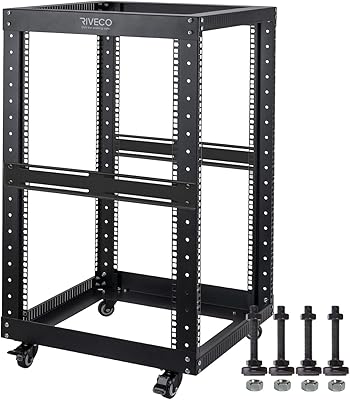
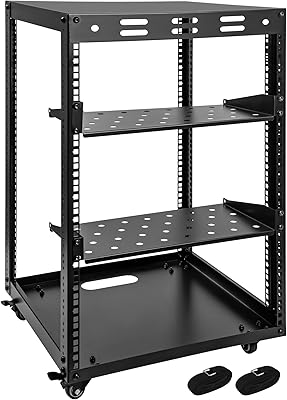
RIVECO 12U Server Rack Open Frame with Casters
85%
89%
Build Quality
93%
Ease of Assembly
85%
Weight Capacity
88%
Mobility with Casters
82%
Durability of Finish
More
Eastrexon 15U Open Frame Server Rack
75%
76%
Build Quality
68%
Assembly Experience
82%
Rack Compatibility
71%
Caster & Mobility
88%
Value for Money
More
RackPath 25U Open Frame Server Rack
86%
89%
Build Quality
93%
Weight Capacity
85%
Ease of Assembly
88%
Mobility and Casters
91%
Cable Management
More
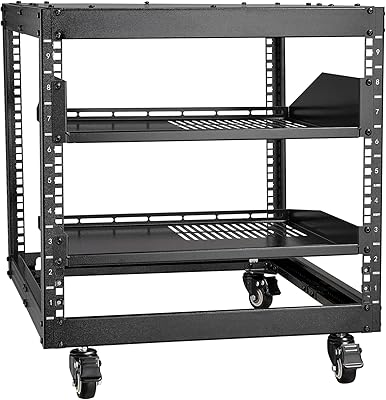
VEVOR 9U Open Frame Server Rack
83%
91%
Build Quality & Durability
89%
Assembly Ease
88%
Weight Capacity
87%
Flexibility & Versatility
85%
Portability & Mobility
More
RIVECO 18U Open Frame Server Rack
84%
89%
Build Quality
91%
Ease of Assembly
87%
Durability
88%
Mobility and Stability
84%
Versatility for Different Equipment
More
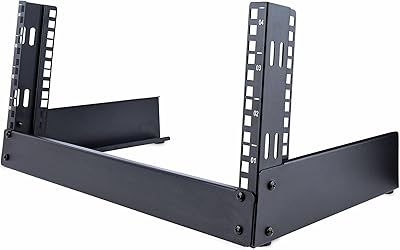
StarTech RK4OD 4U 2-Post Desktop Server Rack
79%
83%
Build Quality
91%
Ease of Assembly
61%
Capacity & Scalability
88%
Value for Money
86%
Footprint & Space Efficiency
More
NavePoint 45U 2-Post Open Frame Server Rack
75%
83%
Build Quality
88%
Assembly Experience
91%
Airflow & Thermal Performance
74%
Weight Capacity & Load Handling
89%
Footprint & Space Efficiency
More
NavePoint 42U 4-Post Open Frame Server Rack
86%
90%
Build Quality
85%
Ease of Setup
93%
Weight Capacity
88%
Durability
91%
Adjustability
More
StarTech 4POSTRACK42 42U Mobile Open Frame Server Rack
87%
92%
Build Quality
85%
Ease of Assembly
91%
Weight Capacity
89%
Mobility & Flexibility
88%
Durability
More

FAQ

Honest answer: it's manageable, but not beginner-friendly. The included instruction sheet is minimal and the diagrams aren't great, so first-timers often find themselves referencing YouTube videos or forum threads for guidance. Budget around 60 to 90 minutes, lay all the hardware out before you start, and have a spare M6 cage nut and screw kit on hand in case the included hardware bag comes up short — that's a common enough complaint to plan for.

Freestanding, yes — wobble under heavier loads is one of the most consistent complaints from buyers. The open-frame design and the weight of real server hardware can make the rack noticeably unstable if it's just sitting on the floor with nothing securing it. Anchoring the base to the floor or tying the top to a wall stud makes a significant difference, and it's really something you should plan for from the start rather than as an afterthought.

The rail depth adjusts up to 40.3″, which covers most 1U and 2U rack servers from major vendors including Dell, HP, and Supermicro. That said, some very deep chassis pushing the outer limit of that range can make rail adjustment a little fiddly. For anything shallower — switches, patch panels, NAS units — it works without issue.

It does ship with hardware included, but the quantity and organization of that hardware is inconsistent across units — enough buyers have reported missing screws or cage nuts to make it worth having a backup kit ready. A standard M6 rack hardware assortment pack is inexpensive and will save you a trip to the hardware store mid-assembly.

It's best treated as a home lab and small office solution. The Rosewill RSR-4P12U001 12U Open Frame Server Rack doesn't carry the build precision, stability guarantees, or vendor certifications that production environments typically require. If you're racking equipment for a client site or a business-critical application, the wobble and assembly inconsistency issues documented by buyers would be a legitimate concern.

Yes, the frame uses standard EIA 19-inch rack spacing, so any equipment labeled as 19-inch rackmount will drop in without compatibility issues. This is a universal standard and the open-frame rack follows it correctly.

Not with any official Rosewill accessories designed for this frame. This is a purpose-built open-frame rack and there are no manufacturer-supported enclosure add-ons. Third-party universal rack panels exist but fitment isn't guaranteed, and retrofitting an enclosure onto an open-frame rack is generally more trouble than it's worth — if you know you'll want a door, starting with a proper enclosed cabinet is the better path.

They're functional for light-duty cable management — looping a few patch cables or keeping a power strip cord from dragging on the floor. For a small home lab setup with a modest number of connections, they do the job. Once you start running higher-density cabling, they become insufficient pretty quickly, and most users in that situation end up adding a dedicated 1U horizontal cable manager in one of the rack units.

You can set it up freestanding, and plenty of users do — but freestanding stability under load is a known weak point. For light network gear on all 12U, it's generally fine. For anything heavier, or in an environment where someone might bump into it, anchoring it is genuinely advisable rather than optional.

Rosewill has been producing server and networking accessories for over a decade and operates under the Newegg umbrella, so it's not a fly-by-night brand. Their rack lineup covers a range of sizes and configurations and is reasonably well-known in the home lab community. That said, their quality control and support experience are inconsistent enough that the product earns cautious rather than enthusiastic trust — good for the price tier, but not a brand you'd lean on for mission-critical infrastructure.