Overview

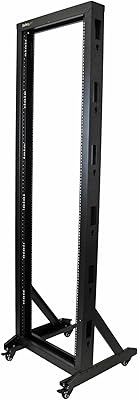
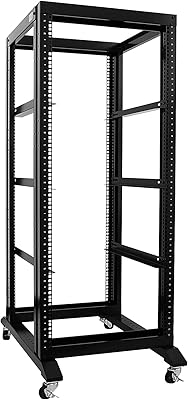
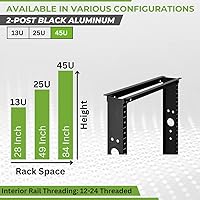
The NavePoint 45U 2-Post Open Frame Server Rack is a floor-standing, open-frame solution built for IT professionals and small business server rooms that need serious rack space without committing to a full enclosed cabinet. At 45U, it accommodates a substantial amount of 19-inch standard equipment — switches, patch panels, 1U servers, and more. Before buying, understand the format: a 2-post design means two vertical uprights supporting gear at front and rear mounting points, not a four-post enclosed cabinet with side panels and a door. That distinction shapes the entire use case. The aluminum frame with a black powder-coated finish isn't purely cosmetic — it keeps the structure lightweight yet rigid, and holds up well in active working environments.
Features & Benefits

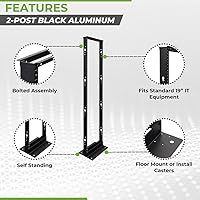
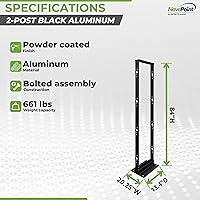
The open-frame structure is the defining practical advantage here. Without side panels or a top enclosure, heat has nowhere to accumulate — air moves freely around every mounted device, which matters when stacking several units in a tight space. The stated weight capacity is substantial, though keep in mind that 2-post designs distribute load differently than 4-post frames; deeper, heavier enterprise servers may need additional rear support. The compact footprint — 13.4 by 20.25 inches at the base — fits neatly in server closets where floor space is tight. Assembly is flat-pack: hardware arrives pre-labeled, the bolted design is logical, and most users report getting it standing solo without specialized tools. Standard 19-inch rail compatibility means virtually any rack-mount device will fit without adapters.

Best For

This 2-post server rack is a natural fit for small to mid-size businesses building out a dedicated networking or server closet without overspending on full enclosed cabinet infrastructure. Home lab users who want 45U of usable space but can't justify the footprint of a traditional four-post cabinet will find the proportions genuinely practical. Network engineers consolidating patch panels, switches, and a handful of 1U or 2U servers into one organized structure will appreciate the straightforward front-and-rear access. The key condition: your environment should already handle ambient cooling. This open-frame rack has no dust filters, no locking door, and no physical security — if those are requirements, a closed cabinet is the smarter path.

User Feedback

Owners of the NavePoint 45U rack generally report a positive experience, with easy assembly being a consistent highlight — the labeled hardware and logical bolt pattern mean most people can get it upright without calling in help. Once standing, the structure feels notably solid for an open-frame unit, which surprises buyers who expected flex or wobble. On the less positive side, a recurring complaint is that shipping packaging doesn't always prevent cosmetic dings in transit, so inspect carefully on arrival. A few users also note that 2-post mounting isn't ideal for very deep or particularly heavy gear without extra bracing. Overall, buyer satisfaction skews high among those who understood the open-frame format before purchasing.

Pros

  • 45U of usable rack height fits a substantial amount of networking gear in a surprisingly small floor footprint.
  • Open-frame structure allows unrestricted airflow, keeping equipment cooler in dense configurations.
  • Solo assembly is genuinely straightforward — pre-labeled hardware and a logical bolt design mean most buyers are done in under an hour.
  • Standard 19-inch rail compatibility means virtually any rackmount device installs without adapters or modifications.
  • The aluminum frame feels solid and stable once assembled, with minimal flex under normal networking loads.
  • Front and rear access without panels or doors makes cable management and equipment swaps noticeably faster.
  • The black powder-coated finish holds up well over time with no reported peeling or significant surface wear indoors.
  • At its price point, this 2-post server rack competes strongly against budget imports while offering a more refined build.

Cons

  • Shipping packaging is inconsistent — cosmetic damage on arrival is a recurring complaint worth inspecting for before signing delivery.
  • No cable management accessories are included; horizontal managers and vertical wire guides must be purchased separately.
  • Deep enterprise servers extending beyond the post depth require rear support brackets that are not included in the box.
  • Top-heavy loading creates noticeable instability — heavier gear must be placed low or the rack needs wall anchoring.
  • Repeated cage nut swaps over time can gradually widen the square holes in the uprights, reducing hardware bite in high-turnover setups.
  • No dust filtration or enclosure means equipment in less-controlled spaces requires more frequent cleaning.
  • The slim base footprint, while space-efficient, can cause the rack to shift on smooth flooring during active cable work.
  • Weight capacity figures can mislead buyers — 2-post load distribution is fundamentally different from a 4-post frame and not suited to all heavy gear.

Ratings

The NavePoint 45U 2-Post Open Frame Server Rack has been evaluated by our AI system after analyzing verified buyer reviews from multiple global markets, with spam, incentivized, and bot-generated feedback actively filtered out. The scores below reflect an honest synthesis of real-world installation experiences, long-term use observations, and recurring complaints — not a polished marketing summary. Both the strengths that make this rack a popular choice and the friction points that cause hesitation are represented transparently.
Build Quality
83%
Once assembled, the aluminum frame surprises most buyers with how rigid it feels for an open-frame unit at this price point. IT admins setting it up in small server closets consistently note there is very little flex even when rails are loaded with multiple 1U devices and patch panels.
The aluminum extrusions are noticeably thinner than what you would find on enterprise-grade competitors. A handful of users reported minor deformation at rail mounting points after loading heavier equipment over extended periods, suggesting the frame is well-suited for lighter networking gear rather than dense server stacks.
Assembly Experience
88%
The flat-pack design with pre-labeled hardware bags is one of the most consistently praised aspects across all buyer feedback. Solo installers regularly report getting the rack fully upright and ready to use in under an hour without needing a second person or any tools beyond a basic screwdriver.
A small number of buyers found the included instructions vague during the final rail-alignment step, requiring some trial and error. The bolted design is straightforward overall, but users who have assembled higher-end racks note the hardware tolerances feel slightly loose before final tightening.
Airflow & Thermal Performance
91%
The open-frame format genuinely delivers on ventilation. Network engineers running dense switch stacks and compact servers report measurably cooler ambient temperatures around mounted gear compared to their previous enclosed cabinets, particularly in smaller rooms with limited dedicated cooling infrastructure.
The same openness that aids airflow means dust accumulates on equipment faster than in an enclosed cabinet. Users in workshops or less-controlled environments mention having to clean mounted devices more frequently, which adds a minor but real ongoing maintenance consideration.
Weight Capacity & Load Handling
74%
26%
The stated capacity covers most small business and home lab scenarios comfortably. Buyers mounting a mix of managed switches, patch panels, and lightweight 1U servers report no stability concerns, and the floor footprint stays planted without the need for additional anchoring in most installations.
The 2-post configuration distributes weight very differently from a 4-post frame, and this is where the capacity figure becomes misleading for some buyers. Deeper rackmount servers that extend well beyond the post depth can cause the structure to lean forward noticeably, requiring rear support brackets that are sold separately.
Footprint & Space Efficiency
89%
At 13.4 by 20.25 inches at the base, this 2-post server rack fits into server closets and utility rooms where a full 4-post cabinet simply would not. Home lab users with limited dedicated space consistently highlight this as the deciding factor in their purchase, getting 45U of usable rack height without sacrificing floor area.
The slim footprint does reduce lateral stability somewhat. On smooth flooring like tile or polished concrete, a few users noted the rack shifted slightly during cable management work, suggesting rubber feet or floor anchors would be a worthwhile addition for busy installations.
Cable Management
81%
19%
Open rear access is a genuine operational advantage for anyone managing a growing network. Technicians can reach behind mounted gear, reroute cables, and add equipment without detaching side panels or working around a cabinet door, which makes routine changes noticeably faster.
The rack itself ships with no built-in cable management accessories — no horizontal cable managers, no velcro channels, and no vertical wire guides. Buyers planning a clean installation will need to budget separately for these accessories, which adds to the overall cost.
Device Compatibility
86%
Standard 19-inch rail spacing means virtually any rackmount device — from consumer-grade network switches to enterprise patch panels — installs without adapters. Users coming from multiple equipment brands report no compatibility surprises, which is especially valuable in mixed-vendor environments.
Very deep chassis equipment, particularly servers extending beyond 30 inches, becomes problematic in a 2-post configuration without supplementary rear rails. This is a format limitation rather than a manufacturing flaw, but buyers shopping for server consolidation specifically should verify their equipment depth before purchasing.
Structural Stability
77%
23%
With equipment evenly distributed across multiple rack units, the assembled structure feels solid and does not wobble noticeably during normal cable insertion or equipment swaps. The bolted uprights hold their alignment well over time when the initial assembly is done carefully.
Top-heavy loading — concentrating heavier gear in the upper rack units — creates a perceptible instability that several users flagged as a concern. Without wall-anchoring or a ballast strategy of placing heavier equipment lower, the tall 84-inch height makes this a real consideration for safety in busier server rooms.
Finish & Aesthetics
79%
21%
The black powder-coated finish looks clean and professional in a server room or home lab setting. Most buyers find the appearance appropriately understated for an IT rack, and the finish has held up well for long-term owners who report no peeling or significant surface wear under normal indoor conditions.
Shipping-related cosmetic damage is a recurring complaint — scratches and small dents on the uprights arrive on a meaningful percentage of orders due to packaging that buyers describe as adequate but not robust. The damage is rarely structural, but it is frustrating for buyers who care about presentation in a client-facing environment.
Shipping & Packaging
62%
38%
The flat-pack format keeps the shipping box manageable in size and weight, making it easier to transport from a delivery point to the installation location without freight handling. Most hardware arrives correctly and completely, with very few reports of missing components.
The packaging itself is the weakest link in the purchase experience. A consistent pattern of minor cosmetic damage on arrival — scratched uprights, dented extrusion ends — suggests the inner protection is insufficient for the transit conditions this product regularly encounters. Buyers are advised to inspect on delivery before signing.
Value for Money
84%
In the open-frame 2-post rack segment, this unit occupies a practical middle ground — more refined than the cheapest imports and significantly more affordable than branded data-center options. For small businesses and home lab builders who need reliable 45U capacity without enterprise pricing, the cost-to-usability ratio is genuinely strong.
The value calculus shifts if you factor in the accessories you will likely need — rear support brackets for heavy servers, cable management panels, and potentially anti-tip hardware. Those additions can push the real-world total noticeably above the base unit price, which is worth accounting for in any pre-purchase budget.
Security & Physical Protection
41%
59%
For environments where physical access is already controlled — a locked server room, a dedicated network closet with restricted entry — the lack of a cabinet enclosure is a non-issue. In those contexts, the open frame actually benefits daily operations by eliminating the step of unlocking and opening a cabinet door.
This 2-post server rack offers zero physical security features — no door, no side panels, no lock provisions whatsoever. In any environment with mixed or uncontrolled foot traffic, mounted equipment is fully exposed. Buyers with compliance requirements around physical server access should look at enclosed cabinet alternatives instead.
Dust & Environmental Protection
44%
56%
In clean server room environments with filtered air handling, the absence of enclosure panels rarely causes problems in practice. Long-term owners in climate-controlled data closets report no unusual dust accumulation issues beyond normal equipment cleaning intervals.
Outside of controlled environments, the fully open structure provides no barrier against dust, debris, or accidental liquid contact. Facilities that share space with manufacturing, woodworking, or similar activities will find equipment fouling accelerates significantly compared to an enclosed alternative, with real consequences for hardware longevity.
Long-Term Durability
76%
24%
Buyers who have owned the NavePoint 45U rack for two or more years generally report that the frame holds its shape and that rack-unit markings remain legible. The aluminum construction resists corrosion well in typical indoor server room humidity conditions.
Extended observations from long-term owners suggest that repeated torquing of cage nuts — particularly during frequent equipment swaps — can gradually widen the square holes in the uprights, slightly reducing the bite of new cage nuts over time. This is a gradual issue rather than an acute failure, but worth noting for high-turnover rack environments.

Suitable for:

The NavePoint 45U 2-Post Open Frame Server Rack is an excellent fit for small to mid-size businesses and IT professionals who need a full-height, high-capacity rack in a space-constrained server closet or dedicated network room. Home lab enthusiasts who have outgrown smaller shelving solutions will find 45U of usable rack height without sacrificing significant floor space — the narrow base footprint is a real advantage in tight rooms. Network engineers consolidating switches, patch panels, and lightweight 1U or 2U servers into a single organized structure will appreciate how quickly front and rear access enables cable changes and equipment swaps. This 2-post server rack is also well-matched to environments where ambient cooling is already handled — climate-controlled closets, purpose-built server rooms, or spaces with dedicated cooling units — because the open frame lets that existing airflow do its job without restriction. Buyers who prioritize hands-on accessibility over physical security enclosure will find the format genuinely practical for day-to-day IT operations.
Not suitable for:

The NavePoint 45U 2-Post Open Frame Server Rack is a poor match for any environment where physical security of mounted equipment is a requirement — it has no door, no side panels, and no locking mechanism, making it unsuitable for spaces with mixed or uncontrolled foot traffic. Organizations that need to house deep enterprise-grade servers should think carefully before committing to a 2-post configuration, since chassis that extend well beyond the post depth require supplementary rear support brackets and can create stability issues without them. Buyers in dusty, high-particulate, or workshop-adjacent environments will find that open-frame racks accumulate debris on mounted hardware far faster than enclosed cabinets, which creates real maintenance and hardware longevity concerns. If your compliance requirements include physical access controls for mounted servers — common in regulated industries — this open-frame rack simply does not meet those standards regardless of the room it sits in. Finally, anyone planning to load predominantly heavy, deep rackmount servers rather than networking gear should evaluate a 4-post enclosed or open-frame alternative instead, where load distribution is fundamentally better suited to that kind of equipment.
Specifications

  • Form Factor: 2-post open frame, floor-standing design with no side panels, doors, or top enclosure.
  • Rack Capacity: Supports 45 rack units (45U) of standard 19-inch rackmount equipment.
  • Dimensions: Overall assembled dimensions measure 13.4″ length x 20.25″ width x 84″ height.
  • Weight Capacity: Rated to support up to 881 lbs of mounted equipment under normal loading conditions.
  • Product Weight: The rack itself weighs 32.8 lbs, making it manageable to reposition during installation.
  • Frame Material: Constructed from aluminum extrusions for a combination of structural rigidity and reduced overall unit weight.
  • Finish: Black powder-coated surface finish applied to all frame components for durability and a clean professional appearance.
  • Rail Compatibility: Compatible with all standard 19-inch rackmount equipment following EIA-310 spacing conventions.
  • Mounting Style: Floor-standing installation with a fixed base; no wall-mount or ceiling-mount capability.
  • Assembly Method: Ships flat-packed with all necessary hardware included; components are pre-labeled for straightforward bolted assembly.
  • Ventilation: Fully open-frame structure on all sides allows unrestricted natural and forced airflow around all mounted devices.
  • Security Features: No locking mechanism, door, or side panel enclosure; physical equipment access is entirely unrestricted.
  • Model Number: Manufacturer model number is 400432012, sold under the NavePoint brand.
  • Brand: Manufactured and sold by NavePoint, a brand focused on IT infrastructure mounting solutions.
  • Market Rank: Holds a Best Sellers Rank of #366 in the Computer Racks and Cabinets category on Amazon.
  • Availability: First made available for purchase in June 2017, indicating an established product with a multi-year track record.
  • Post Configuration: Two-post design supports equipment at front and rear mounting points without enclosing side rails.
  • Cage Nut Standard: Uses standard square-hole cage nut mounting positions compatible with common M6 cage nut and screw hardware.

Related Reviews

NavePoint 42U 4-Post Open Frame Server Rack
86%
90%
Build Quality
85%
Ease of Setup
93%
Weight Capacity
88%
Durability
91%
Adjustability
More
StarTech 2POSTRACK42 42U 2-Post Mobile Server Rack
78%
83%
Build Quality
88%
Mobility & Casters
79%
Weight Capacity
91%
Ease of Assembly
86%
Equipment Compatibility
More
StarTech 4-Post 8U Mobile Open Frame Server Rack
86%
89%
Build Quality
91%
Ease of Assembly
94%
Weight Capacity
85%
Adjustability
88%
Mobility (Casters & Feet)
More
Tripp Lite SR4POST 45U 4-Post Open Frame Rack
84%
94%
Build Quality & Durability
89%
Ease of Assembly
92%
Weight Capacity
90%
Airflow & Heat Dissipation
85%
Adjustability of Depth
More
Raising Electronics 27U Open Frame Server Rack 24″ Depth
76%
74%
Build Quality
82%
Assembly Experience
88%
Structural Load Capacity
67%
Depth Compatibility
83%
Mobility & Casters
More
StarTech.com 12U Open Frame Server Rack & 8 Outlet Rack Mount PDU
86%
92%
Build Quality
89%
Ease of Assembly
88%
Power Distribution
90%
Surge Protection
84%
Adjustable Depth
More
VEVOR 9U Open Frame Server Rack
83%
91%
Build Quality & Durability
89%
Assembly Ease
88%
Weight Capacity
87%
Flexibility & Versatility
85%
Portability & Mobility
More
NavePoint 25U 4-Post Server Rack
84%
88%
Setup Ease
91%
Weight Capacity
90%
Build Quality
85%
Adjustable Depth
70%
Stability Under Load
More
RackPath 25U Open Frame Server Rack
86%
89%
Build Quality
93%
Weight Capacity
85%
Ease of Assembly
88%
Mobility and Casters
91%
Cable Management
More
Eastrexon 15U Open Frame Server Rack
75%
76%
Build Quality
68%
Assembly Experience
82%
Rack Compatibility
71%
Caster & Mobility
88%
Value for Money
More

FAQ

It depends on the server depth. The NavePoint 45U 2-Post Open Frame Server Rack uses a 2-post configuration, which means equipment is supported at two mounting points rather than four. Shallow networking gear and 1U servers with short chassis handle this fine, but full-depth enterprise servers — typically 28 to 36 inches deep — will cantilever forward and create instability without supplementary rear support brackets. If you are planning to mount deep servers, budget for those additional accessories before purchasing.
Most buyers report completing assembly solo in 45 minutes to an hour. The hardware bags are pre-labeled by step, and the bolted design is logical enough that you do not need prior rack-building experience. Having a second person to hold uprights steady during the initial frame alignment helps, but it is not strictly necessary — plenty of single-person installations are documented in buyer reviews.

For typical networking loads — switches, patch panels, lightweight servers — the assembled rack stands stably without anchoring on most flooring types. The main caveat is top-heavy loading: if you concentrate heavier gear in the upper rack units, the tall 84-inch frame can develop a noticeable lean risk, especially on smooth tile or polished concrete. In those situations, a wall anchor or anti-tip foot kit is a sensible precaution.

A standard Phillips screwdriver and an adjustable wrench or socket set for the included bolts are all that is required. No drilling, no cutting, and no specialty rack tools are needed. A cage nut insertion tool is helpful for installing cage nuts later, but that is an accessory purchase rather than an assembly requirement.

The rack ships with the hardware needed for frame assembly, but cage nuts and rack screws for mounting your actual equipment are typically not included. You will want to pick up a bag of M6 cage nuts and screws separately — they are inexpensive and widely available, and you will need them before you can mount anything.

Technically it will work anywhere, but an open-frame rack in a shared workspace comes with real trade-offs. There is no door, no panels, and no lock — anyone walking by can touch or disconnect mounted equipment. There is also no dust filtration, so equipment picks up more particulates in open office environments. If your space has controlled access and you are not concerned about curious hands, it is fine. Otherwise, a lockable enclosed cabinet is a better fit.

Unfortunately, yes — it comes up regularly in buyer feedback. The flat-pack packaging protects the structural components adequately, but the cosmetic surfaces of the aluminum uprights can pick up scratches and minor dings during transit. The damage is almost always surface-level and does not affect function or structural integrity. If the marks bother you, inspect everything before signing the delivery receipt and contact the seller for a partial resolution if needed.

The short version: 2-post racks are lighter, cheaper, and easier to access, while 4-post racks are more stable and better suited to heavy or deep equipment. A 2-post design like this one works well for networking gear, patch panels, and short-chassis servers. A 4-post open or enclosed rack makes more sense if you are mounting full-depth servers, UPS units, or anything over about 20 inches deep. Think of the 2-post format as purpose-built for networking and light compute, not dense server infrastructure.

Not directly — this open-frame rack is not designed to accept aftermarket enclosure panels or door accessories. If physical security or dust protection becomes a requirement down the line, you would need to replace it with an enclosed cabinet rather than retrofit this one. That is a meaningful long-term consideration if your needs might evolve.

The 881 lb figure is a stated maximum, but real-world usable capacity on a 2-post rack depends heavily on equipment type and placement. Evenly distributed, short-chassis gear can approach that limit without issues. However, 2-post frames are more sensitive to uneven loading and to the depth of mounted equipment than 4-post alternatives — the number does not tell the full story. For networking-focused installations, capacity is rarely the limiting factor. For server-dense builds, treat the figure with healthy skepticism and verify with the manufacturer for your specific equipment configuration.