Overview

The Rockville REQ20 Dual 10-Band Graphic Equalizer is a rack-mount unit built for home studio owners, car audio enthusiasts, and small venue operators who want hands-on tone control without breaking the bank. It runs a dual-channel design, giving you independent left and right channel adjustment across 20 total bands — a genuine advantage when you need to address channel-specific frequency issues. The 19-inch chassis slides into any standard equipment rack cleanly, keeping your signal chain organized. Build quality sits right where you would expect for an entry-level unit: functional and reasonably sturdy, not professional broadcast hardware. Go in with realistic expectations and this rack-mount equalizer is a solid, practical choice.

Features & Benefits

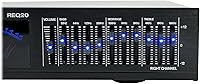
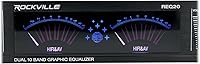
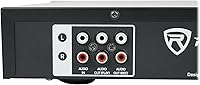
Each channel on the REQ20 gets its own set of 10 sliders spanning the full 20Hz to 20kHz audio range, so you have precise, independent control over both sides of your stereo signal. The blue LED-backlit sliders are a practical touch — they stay visible in dark rack closets or dimly lit DJ booths without any fuss. Dual VU meters sit front and center, letting you watch output levels in real time and catch clipping before it becomes a problem. Connectivity is straightforward: stereo RCA inputs, two stereo RCA line outputs, plus a dedicated record output for easy signal routing. The analog design is refreshingly simple, with fewer components to fail compared to digitally managed processors.

Best For

This dual-channel EQ earns its place in a few specific scenarios. Home theater owners who want to tweak bass response or tame bright highs without digging through DSP menus will find the physical sliders a genuine relief. It is also well-suited to car audio custom builds — particularly trunk or hatch installs where a rack-friendly form factor matters. Small DJ setups and karaoke rigs running through RCA gear can benefit from basic frequency correction without investing in more complex outboard equipment. And if you are newer to audio and want to understand how graphic EQ works by touching real sliders, this rack-mount equalizer is a practical learning tool with no steep software curve.

User Feedback

Across nearly 180 ratings the REQ20 holds a 4-star average, which tells a fairly consistent story: buyers who know what they are getting tend to walk away satisfied. The most common praise centers on easy RCA integration and the real-world visibility of the VU meters and LED sliders during use. On the flip side, some users report a noticeable noise floor when pushing gain levels high — worth knowing if you are running sensitive speakers or a quiet listening room. Build quality draws mixed opinions; the chassis feels functional rather than rugged, and a handful of reviewers raise questions about long-term durability. Those with grounded expectations generally find it a worthwhile buy.

Pros

  • Twenty total EQ bands across two channels give genuinely useful stereo frequency control.
  • Blue LED-backlit sliders remain visible in dark rack bays or dimly lit DJ booths.
  • Dual VU meters help catch output clipping before it damages speakers or amplifiers.
  • The dedicated record output adds flexible signal routing that many competing units skip.
  • Standard 19-inch rack-mount form factor drops into existing setups without custom hardware.
  • Analog passive design means fewer electronic components that can fail over time.
  • RCA connectivity makes integration with consumer home theater and car audio gear straightforward.
  • Holds a 4-star average across nearly 180 buyer ratings, reflecting broadly positive real-world satisfaction.
  • A practical entry point for beginners wanting to learn graphic EQ on physical hardware.

Cons

  • Noise floor rises noticeably at high gain settings, which can be an issue with sensitive speakers.
  • Strictly unbalanced RCA connections exclude users with professional balanced signal chains.
  • Build materials feel functional rather than durable, raising questions about long-term reliability.
  • No parametric or semi-parametric control limits precision frequency targeting compared to pricier units.
  • Some buyers report slider action feels loose or inconsistent across the fader bank.
  • No digital preset memory means EQ curves must be manually reset after any adjustment.
  • The unit's depth of 12 inches may not fit shallower rack enclosures in compact car audio builds.
  • No XLR connectivity rules it out for stage or live sound applications entirely.
  • A handful of reviewers cite concerns about long-term durability under regular, repeated use.

Ratings

The scores below reflect our AI-driven analysis of verified global buyer reviews for the Rockville REQ20 Dual 10-Band Graphic Equalizer, with spam, bot-generated, and incentivized feedback actively filtered out before scoring. Each category is rated on real-world performance reported by actual users across home theater, car audio, and small venue applications. Both the strengths that keep buyers satisfied and the friction points that prompt complaints are represented transparently in every score.

Value for Money
83%
Buyers consistently point out that getting independent stereo EQ control with VU metering and LED sliders at this price tier is genuinely hard to match. For home theater owners or car audio builders working within a tight budget, the feature-to-cost ratio lands well above expectations.
A segment of buyers who pushed the unit harder — particularly in demanding DJ or live sound environments — felt the performance ceiling arrived too quickly to justify even the modest investment. The value proposition weakens noticeably for anyone expecting near-professional results.
Build Quality
58%
42%
The chassis is sturdy enough for fixed rack installations where it will not be regularly transported or handled roughly. Users who mounted the REQ20 in a permanent home theater or car audio rack report no issues with structural integrity over moderate use periods.
Reviewers frequently describe the overall construction feel as plasticky and lightweight — fine for a shelf installation, but not reassuring for anyone planning repeated handling or road use. A handful of longer-term owners have flagged durability concerns after extended daily use, which pulls this score down meaningfully.
Signal Clarity
62%
38%
At conservative gain settings the REQ20 passes a clean enough signal for home theater and casual listening applications, where the subtle coloration introduced by the analog circuit is unlikely to bother the average user. For non-critical environments it handles the job without obvious distortion.
The noise floor becomes a real issue when gain is pushed higher than optimal — several users with sensitive speakers or in quiet listening rooms reported audible hiss that was not present before adding this unit to the chain. This is the most consistently cited technical complaint across verified reviews.
Ease of Setup
87%
The straightforward RCA in-and-out design means most buyers had this unit integrated into their existing setup within minutes, with no manual required. Car audio installers and home theater owners alike appreciated that there is no configuration menu, firmware, or software to deal with — just plug in and adjust sliders.
Users with balanced XLR or TRS signal chains hit a hard wall immediately, as there is no adapter path that fully resolves the unbalanced-to-balanced mismatch without introducing other complications. Setup simplicity is real, but only within the narrow universe of RCA-based equipment.
Slider Feel & Precision
66%
34%
Most buyers found the physical sliders responsive and easy to position by feel, which matters when adjusting levels in a dark DJ booth or dimly lit rack bay. The tactile interaction is one of the features buyers specifically cite as a reason they chose a hardware EQ over a software plug-in.
A recurring complaint across reviews is inconsistent slider tension — some units arrive with noticeably looser faders than others, which makes precise positioning less reliable. A few buyers reported that certain sliders did not hold their set position firmly over time, which is frustrating when returning to a dialed-in EQ curve.
VU Meter Usefulness
78%
22%
The dual VU meters drew genuine praise from buyers who wanted a visual reference for output levels without adding a separate metering unit to their rack. For preventing clipping in car audio builds or small DJ setups, having that front-panel feedback proved practically useful during real sessions.
Seasoned audio engineers noted that the VU meter response is fairly basic and lacks the precision of dedicated metering units, making it a useful sanity check rather than a reliable mixing tool. For more demanding level-matching work, the meters provide directional guidance at best.
LED Visibility
81%
19%
The blue LED backlighting on every individual slider was consistently praised by buyers who operate in low-light environments — DJ booths, home theater closets, and car trunk builds were the most commonly mentioned scenarios. The lighting is bright enough to be useful without being distractingly harsh.
A small number of buyers found the blue LED color less readable at certain angles compared to warmer amber lighting used on some competing units. This is a minor ergonomic preference rather than a functional flaw, but it came up enough in reviews to note.
Rack Integration
89%
The standard 19″ chassis fit cleanly into every rack enclosure buyers tested it against, with no modifications or adapter plates needed. Car audio builders particularly valued this, as it allowed the REQ20 to slot into custom-fabricated trunk rack enclosures without any special hardware.
At 12 inches deep, the unit occupies more front-to-back depth than some compact rack enclosures allow, which was a surprise for a handful of buyers working with shallow cases. Measuring your rack depth before purchasing is genuinely advisable.
Connectivity Options
54%
46%
For buyers operating entirely within an RCA-based ecosystem — which covers the majority of home theater receivers, car head units, and consumer audio gear — the connectivity is complete and practical. The addition of a dedicated record output gives useful signal routing flexibility that buyers did not always expect at this tier.
The absence of any balanced connection type is a hard limitation that eliminates this dual-channel EQ from consideration for professional or semi-professional applications entirely. Users who later upgraded other parts of their signal chain to XLR-based gear found themselves needing to replace this unit sooner than anticipated.
Noise Performance
55%
45%
When operated within its intended gain range and paired with reasonably tolerant speakers, the background noise level is acceptable for casual home and car audio use where ambient noise provides a natural masking floor. Many buyers in these contexts reported no meaningful hiss in everyday listening.
This is the category with the most polarized buyer feedback — users with efficient or high-sensitivity speakers in quiet rooms frequently cited hiss as a dealbreaker, while others in noisier environments never noticed it. The noise floor variability across units suggests some production inconsistency as well.
Long-Term Durability
57%
43%
Buyers who used the REQ20 in stable, fixed installations with minimal physical interaction reported no hardware failures over periods of one to two years. For a stationary home theater rack unit that is rarely touched after initial setup, longevity appears acceptable.
Buyers who handled the unit more frequently — DJs packing and unpacking gear, or car audio enthusiasts who periodically reconfigure their setups — reported wear on sliders and connectors sooner than expected. Long-term reliability remains one of the weakest areas in the overall review profile.
Frequency Coverage
84%
Spanning 20Hz to 20kHz across 10 bands per channel means the REQ20 covers the entire range a human ear can perceive, giving users meaningful control over bass, midrange, and treble characteristics without gaps in the frequency spectrum. Home theater buyers appreciated being able to address both low-end room modes and high-frequency harshness with one unit.
With only 10 bands per channel, the frequency resolution between adjustment points is fairly wide, meaning very precise surgical corrections — like addressing a narrow resonant peak — are not realistically achievable. Buyers needing that level of precision would require a parametric EQ instead.
User Documentation
61%
39%
The basic setup process is intuitive enough that most experienced audio users did not need documentation at all, and the included materials covered the fundamentals adequately for straightforward installations. Beginners learning graphic EQ for the first time generally found enough guidance to get started.
Several buyers noted that the documentation provided minimal help for less obvious use cases — like integrating with specific receiver types or troubleshooting noise issues — leaving them to rely on online communities for answers. More detailed guidance on gain staging in particular would reduce a common frustration point.

Suitable for:

The Rockville REQ20 Dual 10-Band Graphic Equalizer is a solid fit for buyers who want physical, hands-on frequency control without the complexity or cost of digital signal processors. Home theater enthusiasts who find their receiver's built-in tone controls too limited will appreciate having 10 dedicated sliders per channel to dial in their listening room's acoustics. Car audio builders — particularly those designing custom trunk or hatch installs — benefit from the standard 19-inch rack chassis, which integrates cleanly into fabricated enclosures. Small DJ rigs and karaoke setups running through RCA-based gear can use the REQ20 for basic room correction without a significant equipment investment. It also works well as a learning tool for beginners who want to understand how graphic equalization shapes sound in a real signal chain, using tactile sliders rather than abstract software interfaces.
Not suitable for:

Buyers expecting professional or audiophile-grade performance should look elsewhere — the Rockville REQ20 Dual 10-Band Graphic Equalizer is an entry-level unit, and its noise floor can become noticeable when gain is pushed hard, which rules it out for quiet critical-listening environments or high-sensitivity speaker systems. Recording engineers and broadcast technicians who need clean, transparent signal paths will find the analog noise characteristics a meaningful limitation. Users running balanced XLR signal chains are out of luck entirely, as this dual-channel EQ is strictly an unbalanced RCA device. Those prioritizing long-term build durability — particularly for heavy touring or daily professional use — should be cautious, as buyer feedback suggests the construction quality is functional rather than road-ready. If your setup demands precise parametric control or digital recall of EQ settings, a graphic slider unit at this tier simply will not meet those needs.

Specifications

  • Brand & Model: Manufactured by Rockville under the model designation REQ20.
  • EQ Channels: Dual-channel (stereo) configuration with fully independent left and right channel control.
  • Bands Per Channel: Each channel features 10 graphic EQ bands, totaling 20 adjustable bands across both channels.
  • Frequency Response: Covers the full audible spectrum from 20Hz to 20kHz.
  • Rack Format: Standard 19″ rack-mount chassis compatible with universal equipment racks.
  • Dimensions: Unit measures 19″ wide by 12″ deep by 5″ tall.
  • Weight: Unit weighs 5.45 pounds, making it manageable for single-person rack installation.
  • Input Connectivity: Accepts stereo signal via unbalanced RCA line-level inputs.
  • Output Connectivity: Provides two stereo RCA line outputs, including a dedicated record output for signal splitting.
  • Connector Type: All connections use standard RCA plugs; no XLR or TRS balanced connections are present.
  • Level Metering: Dual VU meters mounted on the front panel display real-time output levels for both channels.
  • Slider Lighting: Each individual EQ slider is backlit with a blue LED for visibility in low-light environments.
  • Signal Design: Analog passive signal path with no digital processing or onboard DSP.
  • Preset Memory: No digital preset or recall function; all EQ settings are set manually via physical sliders.
  • Amazon Rating: Holds a 4.0 out of 5-star rating based on approximately 179 verified buyer ratings.

Related Reviews
Rockville REQ42-B Dual 21-Band Graphic Equalizer
74%
91%
Value for Money
83%
Build Quality
88%
Ease of Installation
67%
Audio Performance
61%
Connectivity
More
NVX XEQ7 7-Band Graphic Equalizer
86%
87%
Sound Performance
92%
Ease of Installation
90%
Bass Control
83%
Build Quality
88%
Connectivity Options
More
Audiotek At-eq500 5-Band Graphic Equalizer
84%
88%
Audio Performance
91%
Ease of Use
89%
Bass Control
60%
Build Quality
87%
Sound Clarity
More
DS18 EQX7 7-Band Graphic Equalizer
85%
88%
Sound Quality
90%
Bass Performance
82%
Ease of Installation
85%
Build Quality
87%
Frequency Range
More
Gravity GR-EQ9 7-Band Graphic Equalizer
82%
89%
Sound Quality
85%
Ease of Installation
90%
Bass Control
80%
Build Quality
82%
User Interface
More
Audiopipe EQ-909X 9-Band Car Graphic Equalizer
80%
91%
Ease of Installation
88%
Signal Clarity
74%
Build Quality
93%
Value for Money
86%
Subwoofer Control
More
Rockville RV1010P Dual 10″ Subwoofer Enclosure
71%
78%
Bass Performance
83%
Ease of Installation
74%
Build Quality
81%
Value for Money
69%
LED Lighting System
More
Pyle PLE550BS 5-Band Bluetooth Car Equalizer
74%
88%
Value for Money
83%
Sound Quality Improvement
79%
Bluetooth Performance
86%
Subwoofer Integration
54%
Build Quality
More
Rockville RDSM10 Dual 10″ Sealed Subwoofer Enclosure
76%
83%
Build Quality
79%
Fitment Accuracy
86%
Enclosure Sealing
91%
Shallow Depth Advantage
71%
Bass Performance
More
Blaupunkt CEBP871 7-Band Car Audio Graphic Equalizer
86%
89%
Sound Quality
91%
Ease of Installation
85%
Customization Options
87%
Input Versatility
82%
Build Quality
More

FAQ

Yes, as long as your receiver has RCA preamp outputs and inputs — commonly labeled as pre-out and main-in or processor loop. You run the receiver's preamp output into the REQ20's RCA inputs, then connect its outputs back to the receiver's main-in. Not all receivers have this loop, so check your manual before buying.

It can, provided your head unit has RCA preamp outputs, which most aftermarket head units do. The rack-mount form factor makes it a popular choice for custom trunk or hatch builds where a dedicated enclosure holds the equipment in a standard rack frame. Just make sure you have a clean 12V power source and proper grounding in the vehicle.

At normal operating gain levels the noise floor is acceptable for most home and car audio applications. However, several buyers have noted that pushing the output gain higher than needed — especially with sensitive speakers — can introduce audible hiss. Keeping your gain staging conservative and matching levels between your source and the EQ helps keep noise in check.

No, it does not. This unit is strictly unbalanced RCA — there are no XLR or quarter-inch TRS connections available. If your signal chain relies on balanced connections for noise rejection over longer cable runs, you will need a different unit designed for professional balanced operation.

The chassis is 5 inches tall, which corresponds to roughly 3U of rack space in a standard rack enclosure. Make sure to account for that when planning your rack layout, especially in compact car audio rack builds where space is limited.

Yes — the unit includes a dedicated stereo RCA record output specifically for that purpose. You can run the equalized signal from that output to a recording device, external DAC, or secondary amplifier simultaneously with the main line output, which is a handy routing option for the price.

For light to moderate use in a fixed or semi-permanent DJ setup, most buyers find it adequate. That said, this rack-mount equalizer is not built to touring road-case standards — the construction is functional rather than rugged, and a number of reviewers mention that the overall feel reflects its entry-level positioning. For heavy recurring gig use where gear takes regular physical stress, investing in a more robust unit would be wise.

Generally yes, the sliders hold their set positions under normal conditions. A minority of buyers have reported that some sliders feel slightly loose compared to others across the fader bank, though this appears to be a quality-consistency issue rather than a universal defect. It is worth checking all sliders after initial setup to confirm they are holding their positions accurately.

Absolutely. Since each channel operates independently, you can simply use one side for a mono application and leave the other unused or bypass it entirely. This makes the dual-channel EQ a practical option even for simpler single-channel signal paths.

Yes, it requires AC mains power via a standard power cable, which is included with the unit. The front panel powers on the LED and VU meter displays along with the active circuitry. There is no battery or phantom power option — it needs a standard wall outlet or a power strip inside your rack.

Where to Buy