Overview

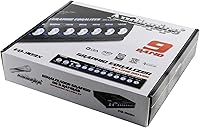
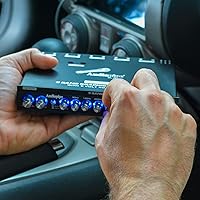
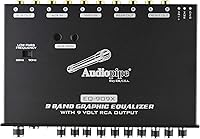
The Audiopipe EQ-909X 9-Band Car Graphic Equalizer sits in that practical middle ground between a basic head unit and a full DSP processor — it gives you real, hands-on frequency control without requiring a professional-grade budget. Built around a half-DIN chassis, it drops into most standard dash openings with minimal fuss, which matters when you are working in a cramped interior. The nine-band layout covers enough of the frequency spectrum to make a genuine difference in how your system sounds, and the onboard 9V line driver helps push a stronger signal to your amplifiers. Just keep expectations grounded — this is a tuning tool for enthusiasts, not an audiophile-grade component.
Features & Benefits

One of the more useful aspects of the EQ-909X is how thoughtfully the signal routing is laid out. You get three stereo RCA outputs — one each for front, rear, and subwoofer — so you can run separate amplifiers off a single unit without any signal splitters. The subwoofer crossover switches between 60Hz and 90Hz, giving you just enough flexibility to match different driver sizes. Gold-plated connectors on both ends keep interference low, while the independent sensitivity controls for left and right aux inputs let you balance sources cleanly. The nickel-plated locking knobs feel solid and stay put once you have dialed in your settings, a small but practical detail you will appreciate on bumpy roads.

Best For

This car equalizer makes the most sense for DIY car audio installers who already run — or plan to run — multiple amplifiers and want centralized frequency management in a permanently mounted unit. If your head unit has weak or no built-in EQ, this fills that gap efficiently. It also works well for anyone adding a subwoofer to an existing setup, since the selectable crossover handles that transition cleanly. Anyone chasing the absolute last word in audio accuracy should look at dedicated DSP units, but for someone who wants real tuning control at a sensible price without tearing into complex software configurations, this in-dash EQ unit hits the mark reliably.

User Feedback

With a 4.6-star average across more than 800 ratings, this car equalizer has earned a notably positive reputation. Buyers regularly mention how straightforward the installation is, even for first-timers, and many note a clear improvement in sound definition after wiring it in. On the other side, a handful of long-term users have flagged that the knobs can feel less firm over extended use, and a few noted fitment issues in vehicles with tighter or non-standard dash cutouts. Compared to similarly priced alternatives, most buyers feel the signal routing flexibility and overall build quality tip the scales in its favor — though those wanting deeper control will eventually want to step up.

Pros

  • Three independent RCA output pairs make running separate front, rear, and subwoofer amps genuinely straightforward.
  • The 9V line driver delivers a stronger signal than many head units can manage on their own.
  • Switchable 60Hz and 90Hz subwoofer crossover gives useful flexibility depending on your driver size.
  • Gold-plated RCA connectors on both ends help keep noise and signal loss to a minimum.
  • Half-DIN form factor fits most standard dash openings with little to no modification needed.
  • Independent left and right aux sensitivity controls let you balance input sources cleanly.
  • Over 800 verified buyers give this car equalizer a 4.6-star rating, reflecting consistent real-world satisfaction.
  • Installation is straightforward enough for confident DIYers without professional help.
  • Subwoofer output level is independently adjustable, so bass tuning does not affect your main mix.
  • Nickel-plated locking knobs stay in position once set, which matters on rough roads.

Cons

  • Knob durability over extended daily use has drawn complaints from a share of long-term owners.
  • Nine fixed bands cannot match the precision of a parametric or fully digital EQ system.
  • No time alignment or advanced crossover slope options, which limits serious acoustic tuning.
  • Fitment can be awkward in vehicles with non-standard or oversized DIN openings.
  • No built-in display or visual frequency curve feedback makes precise tuning harder to verify.
  • Buyers without an existing multi-amp setup may not fully use the three separate output channels.
  • The unit ships with only the equalizer itself — no wiring harness or mounting hardware included.
  • Not ideal if your primary goal is reducing road noise rather than shaping tonal balance.

Ratings

The scores below reflect AI-driven analysis of verified buyer reviews for the Audiopipe EQ-909X 9-Band Car Graphic Equalizer, collected from real-world users across multiple global markets — with spam, incentivized posts, and bot activity actively filtered out. Each category score weighs both the enthusiastic praise and the honest frustrations that real installers and audio hobbyists reported after living with this unit. Nothing is glossed over: where buyers consistently flagged a weakness, the score reflects it.

Ease of Installation
91%
Buyers across skill levels — from first-time DIYers to seasoned installers — consistently describe the wiring process as intuitive and well-organized. The half-DIN form factor drops into most standard openings without adapters, and the clearly labeled RCA inputs and outputs make signal routing quick to figure out even without a manual.
A noticeable subset of buyers in vehicles with non-standard or double-DIN-only dash configurations reported needing additional brackets or trim adapters. Without included mounting hardware, those edge-case installs require a separate trip to an auto parts store.
Signal Clarity
88%
Most users noticed a clean, low-noise signal output after installation, particularly when the unit was properly grounded. The gold-plated RCA connectors play a real role here — several buyers mentioned that switching from cheaper connectors to this unit reduced the background hiss they had been chasing for months.
A small but consistent group of reviewers reported picking up minor interference noise, almost always traced back to grounding issues rather than a fault in the unit itself. Users running very long RCA cable runs also noted slightly more susceptibility to EMI compared to higher-shielded alternatives.
Build Quality
74%
26%
The overall chassis feels solid for a unit in this price bracket, and the nickel-plated locking knobs give a satisfying, tactile resistance when first installed. Buyers who use the unit daily on smooth to moderately rough roads report no rattling or structural issues after extended periods.
Longer-term owners — those past the one-year mark — are the most likely to flag knob tension as a gradual concern, with some reporting that the locking feel softens over time. The overall housing, while acceptable, does not carry the weight or rigidity of more premium in-dash units.
Value for Money
93%
At its price point, the combination of a 9V line driver, three independent stereo RCA output pairs, and a selectable crossover is genuinely hard to match without spending significantly more. Buyers regularly note that competing units offering similar output routing capability cost noticeably more, making this car equalizer a standout for budget-conscious multi-amp builds.
Those who eventually outgrow the unit — moving toward parametric EQ or full DSP processing — occasionally reflect that the money might have been better invested upfront. For a permanent system build, the EQ-909X can feel like a stepping stone rather than a final solution.
Subwoofer Control
86%
The dedicated subwoofer output level and the 60Hz or 90Hz crossover toggle give users practical, immediate control over bass behavior without touching the main mix. Buyers adding a subwoofer for the first time found this crossover feature particularly helpful, describing the integration as noticeably cleaner than using their head unit alone.
The two-position crossover switch is functional but limited — users with larger or higher-performance subwoofer setups often want a more precise crossover point than either 60Hz or 90Hz provides. There is no variable crossover adjustment, which is a real gap compared to even some modestly priced DSP alternatives.
Frequency Band Control
79%
21%
Having nine physical band sliders gives users a genuinely hands-on tuning experience that most head unit EQs simply cannot replicate. Commuters who switch between spoken-word podcasts and bass-heavy music found that memorizing a few slider positions allowed for quick manual adjustments on the road.
Nine fixed bands cover the basics well but fall short for anyone trying to target a very specific problem frequency — room resonances in a hatchback, for instance, often sit between two adjacent bands. Users coming from parametric EQ experience tend to feel constrained by the fixed center frequencies.
Multi-Amp Compatibility
94%
The three-channel output design is the standout functional feature for anyone running a multi-amplifier system. Buyers who previously used Y-splitters to distribute signal reported a noticeably cleaner and more organized setup after switching to this in-dash EQ unit, with each amp receiving a dedicated, properly leveled signal.
Users with only a single-amplifier setup will find two of the three output channels sitting idle, which is a mild waste of capability. There is also no channel mixing or mono summing option, which limits some more creative routing configurations without external adapters.
Aux Input Flexibility
77%
23%
The independent left and right sensitivity controls for the auxiliary input are a practical feature that most competing units at this price omit entirely. Buyers connecting smartphones, media players, or secondary head units appreciated being able to balance the input level without affecting the main EQ settings.
The aux input does not support high-level speaker inputs natively, meaning users with head units lacking RCA preamp outputs must still use a separate line output converter. There is no auto-sensing or priority switching between inputs, which requires manual management when swapping sources.
Long-Term Durability
63%
37%
For buyers who install the unit and leave it largely untouched — just powering on and off — the hardware holds up reasonably well through years of daily use. The chassis shows minimal cosmetic wear even in high-humidity or high-temperature environments typical of car interiors in warmer climates.
The locking knob mechanism is the most commonly cited durability concern, with multiple long-term users describing gradual loosening that eventually allows vibration-induced drift. There are also scattered reports of intermittent RCA contact issues after several years, suggesting the connectors may degrade faster than the gold plating implies.
Noise Floor Performance
81%
19%
When installed with a solid chassis ground and quality RCA cables, the EQ-909X performs well above its price bracket in terms of background noise. Users upgrading from no-name equalizers or passive line drivers consistently mentioned a darker, quieter background in their audio.
The unit does have a measurable noise floor that becomes audible in very high-sensitivity tweeter setups with the gain turned up significantly. In systems with extremely efficient speakers or tweeters crossed over at high frequencies, a faint hiss at idle is detectable in quiet listening environments.
Knob Usability
72%
28%
The physical knob interface is genuinely faster and more intuitive than any app or touchscreen-based EQ for making quick adjustments while parked. Buyers with larger hands still found the spacing between bands workable, and the tactile resistance gives clear feedback that a setting has been changed intentionally.
The knobs are relatively small and tightly spaced, making fine adjustments while driving inadvisable and somewhat awkward even when parked. Users who frequently retune for different passengers or listening scenarios noted that the lack of preset memory means resetting everything from scratch each time.
Compatibility Range
83%
The standard RCA input and output format means this in-dash EQ unit works with virtually any aftermarket head unit or amplifier brand on the market. Buyers pairing it with everything from entry-level Pioneer receivers to higher-end Alpine and Kenwood head units reported no compatibility issues whatsoever.
Factory head units without RCA preamp outputs — which covers many OEM systems in budget vehicles — require an additional line output converter to connect properly. Buyers who did not account for this in their planning ended up with an unplanned extra purchase before the unit was usable.
Packaging & Unboxing
58%
42%
The unit arrives securely packaged with adequate protective foam, and most buyers report receiving it in undamaged, functional condition. The physical construction shows no assembly defects out of the box for the vast majority of purchases.
The box includes only the equalizer unit itself — no wiring harness, RCA cables, or mounting screws are provided. For a first-time installer expecting a complete kit, this omission requires a separate accessories purchase before the installation can even begin.

Suitable for:

The Audiopipe EQ-909X 9-Band Car Graphic Equalizer is a strong fit for car audio enthusiasts who want hands-on frequency control without committing to a complex DSP setup. It works particularly well for anyone running a multi-amplifier system, since the three independent RCA output pairs let you send clean, separate signals to front, rear, and subwoofer amps from a single mounted unit. Drivers who feel limited by the bare-bones EQ options in their factory or budget head unit will notice a real difference once this is wired in. DIY installers tend to appreciate the half-DIN chassis, as it slides into most standard dash cutouts without requiring custom brackets or significant modification. It is also a practical choice for anyone adding an aftermarket subwoofer for the first time, since the switchable 60Hz or 90Hz crossover takes care of bass management cleanly and without extra hardware.
Not suitable for:

Buyers chasing studio-grade audio accuracy or looking to replace a full digital signal processor should look elsewhere — the Audiopipe EQ-909X 9-Band Car Graphic Equalizer is not designed to compete at that level. The nine bands, while useful for broad tonal shaping, do not offer the granular control that a dedicated DSP with parametric EQ provides. Listeners who primarily want precise time alignment, advanced crossover slopes, or per-speaker tuning will find this unit limiting. There is also a practical concern for vehicles with non-standard or oversized dash openings, where fitment may require additional adapters. Long-term durability of the knobs has been questioned by a portion of users, so buyers who prefer zero-maintenance components may find that a mild frustration over time.

Specifications

  • Brand: Manufactured by Audiopipe, a brand focused on car audio amplification and signal processing components.
  • Model: The model number is EQ-909X, sometimes referenced as EQ909X in installation documentation.
  • Form Factor: Uses a half-DIN chassis design, which fits into most standard single-DIN or half-DIN dash openings in passenger vehicles.
  • EQ Bands: Features 9 graphic equalizer bands for shaping frequency response across the audible spectrum.
  • Line Driver: Includes a built-in 9V line driver to boost output signal strength beyond what most factory head units provide.
  • Subwoofer Crossover: Offers a selectable subwoofer crossover frequency of either 60Hz or 90Hz to match different subwoofer driver sizes.
  • RCA Outputs: Provides three stereo RCA output pairs routed independently to front, rear, and subwoofer amplifier channels.
  • RCA Connectors: Both input and output RCA connectors are gold-plated to reduce oxidation and maintain low-resistance signal transfer.
  • Knob Material: Adjustment knobs are nickel-plated and locking, designed to hold their set position under vibration.
  • Aux Sensitivity: Left and right auxiliary input sensitivity levels are independently adjustable for balanced source input control.
  • Sub Level Control: Subwoofer output volume is independently controllable without affecting the front or rear channel output levels.
  • Dimensions: The unit measures 9 x 7.6 x 1.9 inches, making it compatible with standard half-DIN dash mounting locations.
  • Weight: The equalizer weighs 1.81 pounds, which is typical for a half-DIN in-dash signal processor of this type.
  • Color: Available in black, which blends with the interior dash panels found in most production vehicles.
  • In the Box: The package includes the Audiopipe 9-band equalizer unit; no wiring harness or mounting hardware is listed as included.
  • First Available: This model was first made available for purchase in June 2017 and has remained in production since.

Related Reviews

Blaupunkt CEBP871 7-Band Car Audio Graphic Equalizer
86%
89%
Sound Quality
91%
Ease of Installation
85%
Customization Options
87%
Input Versatility
82%
Build Quality
More
Audiotek At-eq500 5-Band Graphic Equalizer
84%
88%
Audio Performance
91%
Ease of Use
89%
Bass Control
60%
Build Quality
87%
Sound Clarity
More
DS18 EQX7 7-Band Graphic Equalizer
85%
88%
Sound Quality
90%
Bass Performance
82%
Ease of Installation
85%
Build Quality
87%
Frequency Range
More
NVX XEQ7 7-Band Graphic Equalizer
86%
87%
Sound Performance
92%
Ease of Installation
90%
Bass Control
83%
Build Quality
88%
Connectivity Options
More
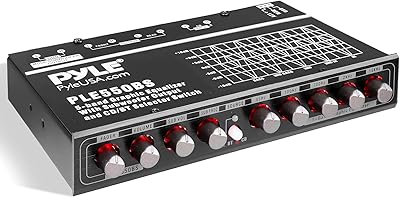
Pyle PLE550BS 5-Band Graphic Equalizer with Bluetooth
83%
87%
Sound Customization
91%
Bluetooth Connectivity
85%
Ease of Use
63%
Subwoofer Control
88%
Integration with Devices
More
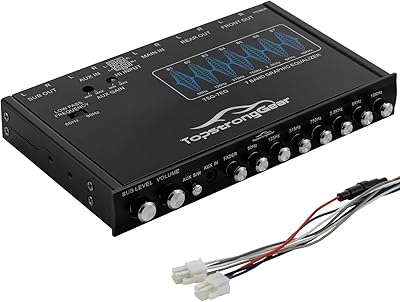
TOPSTRONGGEAR TSG7EQ 7-Band Car Audio Equalizer
83%
87%
Sound Quality
91%
Ease of Installation
84%
Bass Control
80%
Build Quality
85%
Connectivity Options
More
Audiotek AT-EQ700 7 Band Car Audio Equalizer
85%
91%
Bass Control
84%
Ease of Installation
87%
Sound Quality
85%
Compatibility with Audio Devices
92%
Customizability (Frequency Bands)
More
Rockville REQ20 Dual 10-Band Graphic Equalizer
85%
91%
Sound Control Precision
88%
Build Quality
85%
Ease of Use
92%
VU Meters Clarity
89%
Visual Appeal (LED Lights)
More
Stetsom EQX764 7-Band Car Audio Equalizer
85%
91%
Sound Quality Enhancement
89%
Ease of Installation
93%
Bass Control
85%
Frequency Band Flexibility
88%
Output Channels
More
Clarion EQS755 7-Band Car Audio Equalizer
85%
89%
Sound Quality
85%
Connectivity Options
92%
Ease of Installation
87%
Build Quality
90%
Subwoofer Control
More

FAQ

In most cases, yes — the half-DIN chassis is a standard size that slots into the majority of single or double-DIN dash openings using a half-DIN slot. That said, some vehicles have non-standard or unusually shaped openings, so it is worth checking your specific dash dimensions before ordering. A small number of buyers have noted fitment challenges in certain makes, so a quick measurement goes a long way.

This in-dash EQ unit is a signal processor, not an amplifier, so it does not drive speakers on its own. It sits between your head unit and your amplifiers, conditioning the signal before it reaches them. If you do not already have external amplifiers in your system, you would need to add them to make use of this unit.

Yes, you can, as long as your factory head unit has RCA preamp outputs. If your head unit only has speaker-level outputs and no RCA jacks, you would need a line output converter first to step down the signal before feeding it into the EQ. Many installers pair this unit with a simple LOC for exactly that reason.

These two options determine the frequency point at which the subwoofer channel rolls off the higher frequencies. A 60Hz setting works well for larger subwoofers in bigger enclosures that can handle lower frequencies cleanly, while 90Hz is better for smaller drivers or sealed boxes that perform better when crossed over a bit higher. It is a practical toggle rather than a fully adjustable crossover, so just pick the one that sounds tighter in your setup.

Many buyers with basic wiring knowledge install the Audiopipe EQ-909X 9-Band Car Graphic Equalizer without professional help. The connections are standard RCA in and out, plus a power and ground wire, so if you are comfortable with basic car audio wiring you should be fine. Reading through a wiring diagram for your specific head unit beforehand helps avoid any confusion.

The locking knobs are specifically designed to resist that kind of vibration-induced movement. In general, users find that once the knobs are set, they stay put through normal driving conditions. A minority of long-term users have mentioned that the locking feel can loosen slightly over time, but for most people this is not a day-to-day issue.

The EQ-909X provides three stereo RCA output pairs — one for front channels, one for rear channels, and one dedicated to a subwoofer amplifier. So you can drive up to three separate amplifiers simultaneously from a single unit, which is one of the more useful aspects of its design for multi-amp builds.

When properly grounded and installed, most users report a clean signal with no significant noise floor issues. Gold-plated connectors on both input and output sides help reduce interference at the connection points. If you do hear hiss, the most common culprit is a grounding problem rather than the unit itself — a solid chassis ground usually resolves it.

Yes, that is one of the more practical design choices on this car equalizer. The subwoofer output level has its own independent control, so you can dial in your bass level without touching the front or rear channel output. This makes it easy to adjust for different music genres or listening preferences on the fly.

Most factory and budget aftermarket head units offer limited EQ options — typically a basic bass, mid, and treble adjustment or a simplified preset-based system. This in-dash EQ unit gives you nine separate frequency bands with physical sliders you can adjust individually, plus the added benefit of a 9V line driver boosting your output. For anyone who wants real control over how their system sounds, the difference is noticeable and worth the extra step in the signal chain.

Where to Buy