Overview

The Rockville Home Matrix 4 sits in an interesting middle ground — it's not a consumer AV receiver, and it's not a full commercial distributed audio system, but it borrows meaningfully from both worlds. Rack-mountable at a standard 19-inch width and just 3.5U tall, it's built for semi-permanent installation in a closet, equipment rack, or utility room. The target buyer wants centralized control over multiple rooms without commissioning a custom install. Brands like Sonos, Dayton Audio, and Russound compete in this space, but this multi-room amp undercuts many of them on price while offering a feature set that punches well above its tier.
Features & Benefits

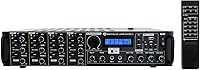
At the core of the Home Matrix 4 is an 8-channel amplifier divided into 4 stereo zones, with each zone drawing from its own independently assigned source — meaning one room streams Bluetooth while another plays FM radio simultaneously, no conflicts. The input roster is genuinely broad: Optical, Coaxial, RCA, USB, and two dedicated mic inputs round out the options beyond wireless. Each zone also carries an RCA line output, so adding a subwoofer or a secondary amp for a larger room is straightforward. The mic priority ducking feature automatically pulls music volume down when someone speaks into a connected mic, which makes it a real differentiator for anyone running a small venue or retail environment.

Best For

This whole-home amplifier makes the most sense for buyers who already own passive speakers and want a single unit to drive them across several rooms — think ceiling speakers in the kitchen, living room, back porch, and master bedroom, all managed from one rack-mounted box. It's also a strong fit for small commercial environments: a coffee shop or fitness studio needing background music plus occasional announcements will find the feature set surprisingly complete. Where it's less ideal is if you only need one or two zones, or if a fully app-controlled smart audio ecosystem is a priority. The 4-to-8-ohm speaker compatibility adds useful flexibility when mixing brands across zones.

User Feedback

Across roughly 65 ratings, this multi-room amp holds a 4.0 average — reflecting genuine satisfaction rather than inflated scores. Installers and DIYers frequently highlight how approachable the setup process is, and zone separation earns consistent praise for performing exactly as described. On the critical side, a handful of buyers were caught off guard by how audible the internal fan can be in quieter rooms — not a dealbreaker for most installations, but worth factoring in. Some also found the included manual thin on configuration detail, so expect to spend time experimenting. Power output handles typical room sizes comfortably, though buyers chasing high-headroom performance may want to temper expectations. The overall value proposition is where most reviewers land favorably.

Pros

  • Four fully independent zones let different rooms play different sources at the same time, with no compromises.
  • The input roster — Bluetooth, Optical, Coaxial, RCA, USB, FM, and dual mic — covers virtually every source scenario in one unit.
  • Mic priority ducking automatically lowers music during announcements, a genuinely useful feature for cafes and retail spaces.
  • Standard 19-inch rack-mount form factor drops cleanly into existing AV racks or equipment closets without adapters.
  • RCA line outputs per zone make adding a subwoofer or secondary amplifier to any zone straightforward.
  • Supports 4-to-8-ohm speakers, giving real flexibility when mixing different speaker brands across zones.
  • Installation is approachable enough for a confident DIYer to complete a 4-zone setup without professional help.
  • The value-to-feature ratio is hard to match at this price point compared to buying separate single-zone amplifiers.

Cons

  • The included manual is too thin to support anything beyond a basic 4-zone wiring configuration.
  • Bluetooth range suffers noticeably when the unit is installed inside a closed rack or equipment cabinet.
  • Fan noise is audible enough in quiet, open-room environments to be a recurring frustration for some buyers.
  • No app control, remote zone management, or smart-home integration of any kind is available.
  • Power headroom felt tighter than expected to buyers trying to drive larger rooms or higher-demand speaker loads.
  • Rear panel terminal quality is inconsistent, with some binding posts requiring extra effort to seat connectors properly.
  • Long-term reliability data is limited given the relatively small review pool, leaving durability questions partially open.
  • Mic EQ and echo adjustments are coarse and lack the precision needed for a clean, professional announcement sound.

Ratings

Our scores for the Rockville Home Matrix 4 are generated by AI after systematically analyzing verified purchaser reviews from global markets, with spam, bot-submitted, and incentivized feedback actively filtered out. The result is a balanced picture that reflects what real installers, home AV enthusiasts, and small business owners actually experienced — both the strengths that earned repeat praise and the friction points that showed up consistently across buyer segments.
Value for Money
88%
Buyers repeatedly cite this as one of the strongest arguments for choosing the Home Matrix 4 over the competition. Getting 4 independent zones with broad input support at this price point is genuinely difficult to match without stepping up to dedicated commercial distribution systems that cost significantly more.
A small segment of buyers felt the value calculus shifts if you factor in potential reliability concerns over time. If the unit requires servicing outside warranty, the savings versus a premium brand narrow considerably.
Zone Independence & Source Assignment
91%
This is where the multi-room amp consistently earns its keep. Users running Bluetooth in the kitchen while a separate zone handles FM radio in the garage reported that the source isolation worked exactly as expected, with no crosstalk or bleed between zones.
A few technically inclined users noted that zone management controls on the front panel feel limited for complex setups. There is no app or remote zone control, so adjusting sources means walking to the unit or wiring in a separate wall controller.
Amplifier Power & Headroom
67%
33%
For background music in average-sized rooms — a kitchen, small retail floor, or home office — the per-channel output is more than sufficient. Most buyers using it with 8-ohm ceiling speakers or bookshelf speakers reported comfortable listening levels with room to spare.
Buyers who pushed the unit toward louder, more dynamic listening — home theater supplemental zones or larger open-plan spaces — found the headroom tighter than the spec sheet implied. A handful specifically noted that the power felt constrained at higher volumes compared to dedicated stereo amplifiers in a similar class.
Input Variety & Connectivity
93%
Few units at this price offer Optical, Coaxial, RCA, USB, FM, Bluetooth, and dual mic inputs under one roof. Installers praised how this eliminated the need for external switchers or input expanders in mixed-source environments like retail stores or multi-use home spaces.
Bluetooth connectivity drew some mixed reactions specifically around range and stability. Users with the unit installed inside a closed rack or equipment closet reported occasional dropouts, which is a real consideration when placement options are limited.
Mic Input & Announcement Features
86%
The mic ducking feature — which automatically pulls down background music when someone speaks — proved to be a genuine differentiator for commercial buyers. Cafe and fitness studio owners highlighted this as the deciding factor, noting it worked reliably without requiring manual intervention.
The mic EQ and echo controls, while present, lack precision. Users trying to dial in a clean, professional-sounding announcement voice found the adjustments coarse and somewhat unpredictable, which matters more in a business context than a home one.
Build Quality & Hardware
74%
26%
The steel chassis feels appropriately solid for a rack-mount unit, and the front panel controls have a tactile quality that installers found reassuring during setup. At 27.2 lbs, it sits firmly in a rack without feeling flimsy or plasticky in the way some budget-tier units do.
Some buyers noted that the rear terminal quality felt inconsistent — a few reported speaker binding posts that required extra force to seat connectors securely. Nothing catastrophic, but a reminder that fit and finish tolerances are not at the level of professional-grade gear.
Ease of Installation
82%
18%
The rack-mount form factor and clearly labeled rear panel made physical installation straightforward for anyone with basic AV wiring experience. Multiple buyers with no professional background reported completing a 4-zone setup in an afternoon without needing outside help.
The included documentation is thin. Users attempting more nuanced configurations — like combining subwoofer outputs with zone amps or managing impedance across mixed speaker loads — had to rely on trial and error or community forums rather than the manual.
Fan Noise
58%
42%
Under moderate load in typical installations, the fan operates quietly enough that it goes unnoticed when the unit is behind a closed rack door or in a utility closet. In those contexts, the active cooling is a net positive that helps protect the amp during extended use.
In quieter environments — a home office, bedroom zone, or any space where the amp sits in the open — the fan noise was a recurring complaint. Several reviewers specifically said it was the one thing they wished they had known before purchasing.
Front Panel Usability
71%
29%
All primary controls are accessible from the front panel, and the layout is logical enough that most users can navigate basic zone and volume adjustments without referencing the manual. The physical knobs are a practical choice for installations where quick manual adjustments are needed.
The display readability received criticism from buyers working in dim equipment rooms or at a distance. Label fonts are small, and the panel can feel cluttered when you are trying to quickly identify which control corresponds to which zone.
Bluetooth Performance
63%
37%
For open-area installs where the source device stays within a reasonable distance of the unit, Bluetooth pairing is quick and connections hold reliably. Buyers using it in retail environments with a dedicated tablet or phone as the source reported consistent day-to-day performance.
Enclosed rack installations and longer distances degraded the experience noticeably. Unlike dedicated wireless audio systems with external antennas, the Home Matrix 4 offers no easy way to extend Bluetooth reception, which became a frustration in several reported setups.
Speaker Compatibility & Impedance Flexibility
84%
The 4-to-8-ohm support window gives installers genuine flexibility when sourcing speakers across zones. Buyers mixing 6-ohm bookshelf units in one zone with 8-ohm ceiling speakers in another reported no instability or protection-mode triggering during normal use.
Running lower-impedance loads across all four zones simultaneously appeared to stress the unit more than some buyers anticipated. A small number reported thermal shutdowns under sustained high-load conditions, suggesting the impedance flexibility has practical limits in real-world multi-zone scenarios.
Documentation & Support
51%
49%
Rockville does maintain online resources and a product support channel that some buyers found responsive. For straightforward installs, the basic manual covers enough ground to get the unit operational without too much friction.
For anything beyond a basic setup, the documentation falls short. Advanced configuration questions — wiring topologies, subwoofer integration, zone controller compatibility — were frequently left unanswered, pushing buyers toward third-party forums for guidance.
Form Factor & Rack Integration
89%
The standard 19-inch rack width and compact 3.5U height make it a clean fit in home AV racks, IT closets, or behind-the-bar equipment panels. Buyers with existing rack infrastructure appreciated not needing custom shelving or adapters.
At 27.2 lbs, the unit is heavier than it looks, and buyers mounting it in overhead racks or shallow-depth panels noted that cable management at the rear becomes tight. The depth of just over 10 inches also requires careful planning in shallower rack enclosures.
Long-Term Reliability
66%
34%
The majority of buyers who had owned the unit for six months or more reported no operational issues, and those running it in commercial environments noted consistent uptime during daily business hours. For the price tier, that track record is reasonable.
A subset of reviews — not a majority, but enough to flag — mentioned unit failures or degraded performance after extended use. Whether this reflects a quality control variance or isolated cases is hard to determine from available data, but it tempers confidence in long-term durability.

Suitable for:

The Rockville Home Matrix 4 is built for buyers who want centralized, multi-room audio without commissioning a custom install or paying commercial-system prices. It fits best in homes where passive speakers are already wired or being newly run through walls and ceilings — a kitchen, living area, outdoor patio, and bedroom all driven from one rack-mounted unit is exactly the scenario this whole-home amplifier was designed around. DIY-minded AV enthusiasts will appreciate that the setup process is approachable enough to complete in a single afternoon without a contractor. Small commercial environments are another strong match: a cafe, yoga studio, or boutique retail shop that needs background music across a couple of zones plus the occasional mic announcement will find the feature set surprisingly complete for the price. If independent source selection per zone is a hard requirement — not just shared volume control — this multi-room amp is one of the few options at this tier that genuinely delivers on that promise.
Not suitable for:

Buyers expecting app-based control, voice assistant integration, or the kind of polished smart-home ecosystem that Sonos provides should look elsewhere — the Rockville Home Matrix 4 is a fundamentally hands-on, hardware-first product with no networking features beyond Bluetooth. If the amp will live in an open room rather than a closed rack or equipment closet, the fan noise may become an ongoing annoyance, particularly in quiet environments like a home office or bedroom. Anyone planning to run high-impedance loads across all four zones simultaneously at sustained volumes should factor in thermal performance before committing. The documentation is thin enough that buyers without prior AV wiring experience may hit real friction during anything beyond a basic setup. And if long-term reliability with minimal intervention is the top priority — the kind of set-and-forget durability you might expect from a Russound or similar professional-grade distributor — this whole-home amplifier carries enough uncertainty in that department to warrant caution.
Specifications

  • Total Power: The amplifier delivers 600W RMS across all 8 channels combined, providing sufficient headroom for multi-room background and moderate-listening-level applications.
  • Per Channel: Each of the 8 channels outputs 75W RMS, which is adequate for driving a standard ceiling or bookshelf speaker in a typical residential or small commercial room.
  • Channels & Zones: 8 amplified channels are organized into 4 stereo zones, with each zone independently assignable to a separate audio source and volume level.
  • Speaker Impedance: Compatible with passive speakers rated between 4 and 8 ohms, accommodating a wide range of ceiling, in-wall, and bookshelf speaker models.
  • Audio Inputs: Accepts audio from Bluetooth, USB, Optical (Toslink), Coaxial (S/PDIF), stereo RCA, FM radio antenna, and two dedicated microphone inputs.
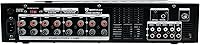
  • Audio Outputs: Each zone provides speaker binding post terminals plus a dedicated RCA line output for connecting a subwoofer or a secondary zone amplifier.
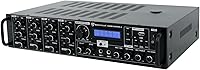
  • Mic Controls: Microphone inputs include independent volume, EQ, echo, and delay adjustments, along with a priority ducking feature that automatically reduces music volume when the mic is active.
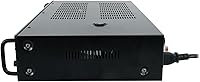
  • Form Factor: Designed for standard 19-inch equipment rack installation at 3.5U height, fitting cleanly into home AV racks, IT closets, or behind-the-bar enclosures.
  • Dimensions: The unit measures 19″ wide, 10.4″ deep, and 3.5″ tall, requiring a rack depth of at least 11 inches when rear cable clearance is factored in.
  • Weight: The unit weighs 27.2 lbs, which is on the heavier side for a 3.5U chassis and should be accounted for when planning rack load capacity.
  • Bluetooth: Bluetooth connectivity allows wireless audio streaming from smartphones, tablets, or computers to any assigned zone without a physical cable connection.
  • FM Tuner: A built-in FM tuner is included as a native input source, assignable to any zone independently of other active inputs.
  • Color Options: Available in two finish options — White and Silver — to suit different rack aesthetics or open-installation environments.
  • Cooling: Active cooling is provided by an internal fan that engages during operation to manage heat, particularly relevant during sustained multi-zone use.
  • Brand & Model: Manufactured by Rockville under the model designation HOME MATRIX 4, with ASIN B0BCVX66XV on Amazon and a first availability date of June 2022.

Related Reviews

Rockville MS40W 4″ Marine Boat Speakers
83%
85%
Sound Quality
60%
Bass Performance
92%
Waterproof Durability
90%
Ease of Installation
88%
Build Quality
More
Rockville RGHR45 4-Zone Marine Receiver
83%
88%
Audio Performance
91%
Durability and Build Quality
75%
Bluetooth Connectivity
82%
Ease of Installation
94%
Waterproofing
More
Rockville RHPA4 4-Channel Headphone Amplifier
87%
88%
Audio Performance
85%
Build Quality
91%
Ease of Use
87%
Portability
89%
Volume Control Flexibility
More
Rockville RVF-2 4-Channel Car Amplifier
84%
88%
Audio Quality
91%
Power Output
85%
Build Quality
72%
Thermals (Heat Management)
80%
Installation Ease
More
Rockville DBM45 2000W 4-Channel Marine Amplifier
86%
88%
Sound Quality
91%
Build Quality
94%
Waterproof Performance
89%
Power Output
85%
Ease of Installation
More
Rockville RXA-F1 1600W 4-Channel Car Amplifier
82%
88%
Sound Quality
93%
Power Output
84%
Ease of Installation
92%
Value for Money
79%
Durability
More
Rockville RV4.3A 4″ 3-Way Car Speakers
83%
85%
Sound Quality
88%
Ease of Installation
82%
Bass Performance
87%
Build Quality
80%
Treble Clarity
More
Rockville KRYPTON F2 3200W 4-Channel Car Amplifier
84%
94%
Power Output
89%
Sound Clarity
76%
Ease of Installation
88%
Build Quality
90%
Efficiency (Power Handling)
More
Rockville RXD-F30 2400W 4-Channel Car Amplifier
88%
89%
Performance
87%
Sound Quality
92%
Ease of Installation
90%
Build Quality
85%
Durability
More
Rockville ATOM P30 2400W 4-Channel Marine Amplifier
84%
94%
Power Output
90%
Build Quality
88%
Waterproof Performance
80%
Ease of Installation
85%
Sound Quality
More

FAQ

Yes, that is one of the core functions of this unit. Zone 1 can stream from a phone over Bluetooth while Zone 2 plays FM radio and Zone 3 is running audio from an optical input — all simultaneously and independently. That source independence is what separates a true multi-zone amp from a basic multi-room volume distributor.

Most likely yes, as long as your speakers are rated between 4 and 8 ohms, which covers the vast majority of residential ceiling and in-wall speakers on the market. If you are unsure, check the impedance rating printed on the speaker label or in the original documentation before connecting.

For background music or moderate listening in a standard bedroom, kitchen, or small retail floor, the per-channel output is genuinely sufficient. Where it starts to feel constrained is in larger open-plan spaces or if you want high-volume, dynamic listening — in those scenarios, some buyers found it fell short of expectations.

This is a known limitation worth planning around. Enclosed metal racks significantly reduce Bluetooth range and can cause intermittent dropouts. If your source device will be more than a few feet away from a closed rack, consider routing a dedicated wired input instead, or leaving the rack door open in the area facing the room.

No, the Rockville Home Matrix 4 does not have an app, network connectivity, or a bundled remote control. All source and volume adjustments happen at the front panel directly. If remote zone control matters to you, you would need to wire in compatible third-party wall-plate controllers, which is a common addition in professional distributed audio installs.
Noticeable enough to matter in some environments. If the unit is installed in a closed rack room or utility closet, you will not hear it at all. But if it sits on an open shelf in a living space or home office, several buyers found the fan hum distracting — particularly during quiet passages in music or in a room that is otherwise silent.

Yes, each zone includes a dedicated RCA line output that you can run directly to a powered subwoofer or to the input of a separate subwoofer amplifier. This is one of the more practical features of this whole-home amplifier, since it means you are not locked into a stereo-only system if you want more bass presence in a specific room.

It is a solid fit for that use case, particularly because of the mic priority ducking feature, which automatically lowers background music when staff speak into a connected microphone — useful for announcements without requiring anyone to manually lower a volume knob. For a single-floor venue with two to four speaker zones, the feature set covers most practical needs.

The physical wiring is straightforward if you have basic familiarity with speaker wire and audio connections. Labeling is clear, and the front panel layout is intuitive enough to figure out zone assignments without too much trial and error. Where people hit friction is in more advanced configurations — mixing impedance loads, setting up subwoofer outputs, or troubleshooting source priority — because the included manual does not go into much depth on those scenarios.

Dayton Audio and Russound both offer multi-zone distribution products, but they typically either lack the same breadth of inputs or carry a noticeably higher price for equivalent zone count. The trade-off with this multi-room amp is that those brands, particularly Russound, have a longer commercial track record and more robust long-term reliability data. If budget is the deciding factor and you are comfortable with some DIY problem-solving, this unit competes well; if you need guaranteed longevity with professional support, the premium alternatives are worth considering.