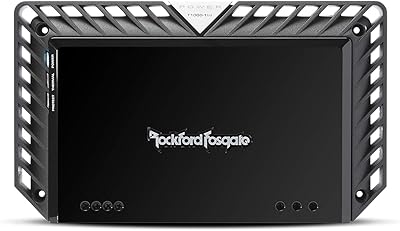
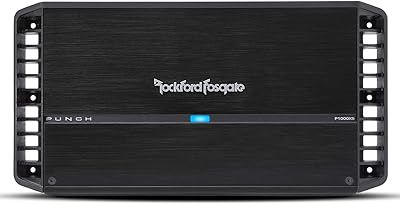
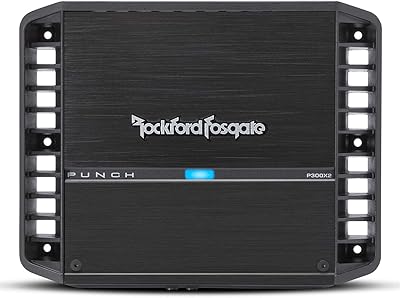
Overview

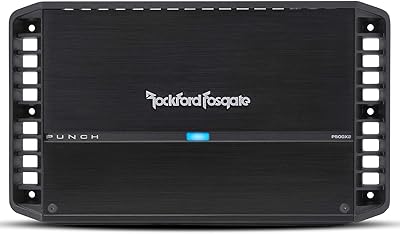
The Rockford Fosgate Punch P500X1BD Mono Amplifier occupies a well-earned spot in the car audio market as a dedicated, subwoofer-only unit built for buyers who want real performance without overengineering. Unlike traditional Class-A/B designs that run hot and lose efficiency under load, this Punch mono amp uses Class-BD technology to produce cleaner bass with less heat buildup. At its price tier, buyers rightly expect more than raw numbers — they want something that installs confidently and holds up over time. The compact full chassis, just over 11 inches deep, makes it a practical choice for trunk builds where every inch counts. It competes squarely against offerings from Alpine, JL Audio, and Kenwood in the same segment.
Features & Benefits

What separates this Rockford subwoofer amplifier from cheaper alternatives starts with its Class-BD circuit, a hybrid topology that blends the efficiency of Class-D with the audio character of Class-B — the result is tighter, more controlled bass that runs cooler during sustained use. Power scales with your wiring: most single-subwoofer builds running a 2-ohm load will land at 300 watts, a practical sweet spot. The Hi and Lo-level RCA inputs let you connect directly to a factory head unit without needing an add-on converter. The onboard Punch EQ adds up to 18dB of boost centered at 45Hz, and the variable Butterworth crossover keeps the sub focused. The C.L.E.A.N. system takes the guesswork out of setting gain correctly, which matters more than most beginners realize.

Best For

The P500X1BD is a natural match for anyone building a focused single-subwoofer system who wants honest, consistent output rather than inflated peak numbers. Buyers stepping up from an entry-level amp will notice the difference in precision and build quality immediately with this Punch mono amp. It works especially well in installs where a factory head unit is staying put, since the Hi-level inputs solve a common wiring challenge without extra hardware. Physically, it tucks into tighter enclosures than many rivals in the same power class. And for buyers who factor brand reliability into the decision, Rockford's track record for long-term durability and a real warranty program add genuine peace of mind that budget alternatives simply cannot offer.

User Feedback

Across a wide spread of owner reviews, the P500X1BD draws consistent praise for stable low-impedance performance and a chassis that feels built to last rather than assembled to a price point. Long-term owners frequently mention the amp running reliably after years of daily driving, which is meaningful. That said, the picture is not entirely without caveats. A recurring concern among less experienced installers is that the gain structure can be difficult to set accurately by ear alone — a multimeter or oscilloscope is genuinely recommended. A smaller number of buyers have reported sensitivity to chassis ground quality and intermittent RCA noise in specific vehicle setups. These are manageable issues, but worth flagging, particularly for first-time builders working without professional guidance.

Pros

  • Class-BD topology runs noticeably cooler than traditional Class-A/B amps under sustained bass loads.
  • Hi and Lo-level inputs make connecting to a factory head unit genuinely straightforward.
  • The onboard Punch EQ adds real low-end weight without needing a separate processor.
  • Long-term owners consistently report this Punch mono amp holding up after years of daily use.
  • The C.L.E.A.N. gain setup system removes a lot of the guesswork for intermediate installers.
  • Compact dimensions fit into tighter trunk builds where many comparable amps simply will not.
  • The variable Butterworth crossover keeps the subwoofer operating in its ideal frequency range.
  • RCA pass-through outputs make daisy-chaining additional amplifiers clean and simple.
  • Build quality feels noticeably more substantial than budget-tier alternatives in the same power class.
  • A manufacturer warranty backed by a reputable brand adds real purchase confidence.

Cons

  • Setting gain accurately without a multimeter or oscilloscope is genuinely difficult and risks clipping.
  • Chassis ground sensitivity can introduce RCA noise in certain vehicles, requiring extra troubleshooting.
  • Full 500-watt output is only achievable at a 1-ohm load, which limits real-world power for many buyers.
  • The P500X1BD is strictly a subwoofer amp — no flexibility for running full-range or component speakers.
  • Convection cooling means airflow around the amp must be planned carefully in sealed enclosure installs.
  • No wireless remote level control is included, which some competitors offer at a similar price point.
  • At 9 pounds, this Rockford subwoofer amplifier is heavier than some ultracompact rivals, complicating certain mounting scenarios.
  • The 1-year warranty is shorter than what a few competing brands offer in the same segment.

Ratings

The scores below reflect an AI-driven analysis of verified owner reviews collected globally for the Rockford Fosgate Punch P500X1BD Mono Amplifier, with spam, bot activity, and incentivized feedback actively filtered out to ensure the results represent genuine buyer experiences. Ratings cover the full spectrum from standout strengths to recurring frustrations, so you get an honest picture before committing. Both enthusiastic long-term owners and critical voices informed every score shown here.

Build Quality
91%
Owners consistently describe the chassis as feeling substantial and well-finished compared to similarly priced competitors. Many report the unit still performing flawlessly after two to four years of daily driving, heat cycles, and road vibration — which is the kind of durability that actually matters in a car audio context.
A small number of buyers noted minor cosmetic inconsistencies on the terminal covers and labeling, though nothing that affected function. At this price tier, some expected an even more premium-feeling exterior finish closer to Rockford's higher-end Power Series.
Power Output Accuracy
83%
Bench-tested buyers and experienced installers confirm the amp tracks its rated RMS figures honestly, particularly at the 2-ohm load most real-world builds use. That kind of honesty is rare in a category where inflated peak wattage claims are the norm among cheaper alternatives.
The 500-watt ceiling requires a 1-ohm load that many subwoofer and wiring configurations simply do not support without additional planning. Buyers expecting full output from a single 4-ohm subwoofer will be working with 150 watts, which can feel like a letdown if the spec sheet was the main selling point.
Thermal Management
78%
22%
The Class-BD topology runs meaningfully cooler than traditional Class-A/B designs at equivalent output levels, which owners in hotter climates particularly appreciated. In builds with reasonable airflow around the chassis, the amp maintains stable output without throttling even during extended sessions.
Passive convection cooling puts the burden of thermal management entirely on the installer — there is no fan to compensate for poor placement. Buyers who mounted the amp in sealed enclosures with limited airflow reported occasional warmth-related shutdowns, which required repositioning to resolve.
Ease of Installation
86%
The Hi-level input option is a genuine time-saver for anyone keeping a factory head unit, eliminating the need to source and wire a separate line output converter. Experienced installers praised the clearly labeled terminals and logical layout, noting that the physical footprint makes routing wires straightforward in most trunk configurations.
The wiring diagram included with the unit is serviceable but not particularly detailed for first-time installers working through impedance decisions. A handful of buyers also found the RCA input connectors slightly stiff, making it awkward to seat cables fully in tight spaces.
Gain Setup & C.L.E.A.N. System
72%
28%
For intermediate installers, the C.L.E.A.N. LED indicator takes a process that normally requires expensive equipment and makes it approachable with basic tools. Buyers who followed the system carefully reported clean, distortion-free output that protected their subwoofers over the long run.
Complete beginners found the gain-setting process confusing without additional guidance beyond what the manual provides, and a few admitted to leaving the gain set too high for weeks before noticing distortion artifacts. The system is genuinely helpful but works best when paired with at least a multimeter rather than used in isolation.
Onboard EQ & Crossover
84%
The Punch EQ boost centered at 45Hz adds genuine low-end impact that many owners said they did not expect from a built-in control — it reduced or eliminated the need for a separate DSP in straightforward single-sub setups. The variable Butterworth crossover gave experienced users enough precision to integrate the subwoofer cleanly with their existing speakers.
The EQ boost is fixed at 45Hz, which works well for typical ported enclosures but is less ideal for sealed boxes tuned to a higher frequency. Users wanting a fully adjustable parametric EQ will still need an external processor despite the onboard options.
Value for Money
79%
21%
Against budget amps with similar wattage claims, the P500X1BD justifies its mid-tier price with honest power figures, better thermal performance, and a brand that stands behind the product. Buyers who had previously burned through cheaper amplifiers viewed this Punch mono amp as a cost-effective long-term investment rather than a premium splurge.
Compared to a few competing brands at a similar price point, the one-year warranty feels conservative and the absence of a remote level control starts to sting. Buyers on a strict budget may find the price hard to reconcile when some alternatives offer more flexibility, even if they sacrifice build quality.
Signal Noise & RCA Quality
69%
31%
In clean, well-grounded installs, the P500X1BD is quiet and the RCA inputs handle both factory and aftermarket signals without audible hiss or interference. Buyers who took the time to run a proper chassis ground to bare metal were largely satisfied with the noise floor.
A recurring complaint from a subset of owners involved ground loop hum and RCA noise in vehicles with less straightforward grounding, particularly older platforms and European cars. While the issue is typically installation-related rather than a product defect, it appears often enough in feedback to flag as a real risk for less experienced installers.
Compatibility & Flexibility
74%
26%
The dual Hi/Lo input configuration makes this Rockford subwoofer amplifier compatible with a wider range of source units than many mono amps at this price, which is a practical advantage for buyers upgrading incrementally. RCA pass-through outputs also add flexibility for multi-amp configurations without signal loss.
Being a mono subwoofer-only unit, it offers no path to powering door speakers or tweeters — buyers who want a simpler single-amp setup will need to look elsewhere. The lack of a bridgeable configuration also limits future system expansion options compared to some competing two-channel amps.
Footprint & Mounting
88%
The relatively compact chassis — just over 11 inches deep — fits comfortably in trunk corners and under rear cargo floors where larger amps simply will not go. Owners building compact enclosures specifically called out the physical dimensions as a deciding factor, and the mounting feet are sturdy enough to handle road vibration without play.
At 9 pounds, it is heavier than some ultracompact digital competitors at similar output levels, which matters when mounting on thin panel surfaces or inside custom fiberglass enclosures. The footprint, while compact for its class, is still too large for true under-seat installs in most passenger vehicles.
Long-Term Reliability
89%
Multi-year ownership accounts are disproportionately positive for this Punch mono amp, with many buyers specifically returning to leave updated reviews after two or three years of trouble-free daily use. The Rockford brand reputation for durability is not just marketing — it shows up consistently in the long-tail feedback from real drivers.
The one-year manufacturer warranty does not reflect the apparent lifespan of the product and leaves buyers exposed if something fails in year two or three. A small number of owners reported protection circuit triggers after extended high-volume sessions, though these were typically resolved by improving airflow or reducing the load.
Documentation & Support
63%
37%
Rockford Fosgate maintains reasonably accessible online support resources, and the inclusion of the C.L.E.A.N. setup documentation is a step above what most competitors provide at this level. Buyers who reached out to Rockford directly for technical guidance generally reported helpful, knowledgeable responses.
The printed manual bundled with the unit is brief and does not walk users through impedance calculations or common troubleshooting scenarios in enough depth for newer installers. Several buyers said they relied more on third-party YouTube tutorials than on the official documentation to complete their installs confidently.

Suitable for:

The Rockford Fosgate Punch P500X1BD Mono Amplifier is purpose-built for the buyer who wants a clean, focused single-subwoofer setup without throwing money at more power than their system can actually use. It suits enthusiasts who are stepping up from a generic budget amp and want something with real engineering behind it — not just bigger numbers on the box. Installers working with factory head units will appreciate the Hi-level inputs, which remove the need for an additional line output converter and keep the wiring clean. If your build is tight on space, the compact chassis works in your favor without sacrificing thermal performance. Long-term reliability matters to this buyer too, and the Rockford brand consistently delivers on that front with years of proven durability in daily-driven vehicles.

Not suitable for:

The Rockford Fosgate Punch P500X1BD Mono Amplifier is the wrong choice if you are chasing raw wattage for a multi-subwoofer setup or need a two-channel amp to run both a sub and door speakers from a single unit. Buyers expecting 500 watts in a typical real-world install will likely be disappointed — that output only happens at a 1-ohm load, and not every subwoofer or wiring configuration supports that safely. Complete beginners who have never set amplifier gain before may find the process frustrating without proper tools like a multimeter or oscilloscope; setting it by ear risks clipping and long-term driver damage. Those with grounding issues in older vehicles may encounter noise problems that require additional troubleshooting beyond a straightforward plug-and-play install. If your priority is absolute maximum output on a tight budget, rival options in a lower price tier may feel more immediately gratifying, even if they sacrifice some refinement.
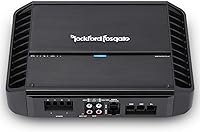
Specifications

  • Circuit Topology: This amp uses a Class-BD design, a hybrid approach that combines the efficiency of Class-D with the sonic character of Class-B for cleaner, cooler bass output.
  • RMS Power (1-Ohm): At a 1-ohm load, the amp delivers 500 watts RMS, which is the peak output scenario requiring a compatible single-voice-coil or dual-voice-coil wiring configuration.
  • RMS Power (2-Ohm): Running a standard 2-ohm load — the most common real-world setup — the amp outputs 300 watts RMS, a solid and practical figure for most single-subwoofer builds.
  • RMS Power (4-Ohm): At a 4-ohm load, output is rated at 150 watts RMS, suitable for higher-impedance subwoofers or builds where headroom and temperature management are prioritized.
  • Channels: This is a single-channel mono amplifier designed exclusively for subwoofer applications and is not suitable for driving full-range or component speakers.
  • Dimensions: The full chassis measures 2.38″ high by 7.76″ wide by 11.03″ deep, making it a compact option that fits well in tight trunk or under-seat installations.
  • Weight: The unit weighs 9 pounds, which is worth accounting for when planning mounting points, especially in custom enclosure builds.
  • Input Types: Both Hi-level (speaker-level) and Lo-level (RCA) inputs are supported, allowing direct connection to factory head units without a separate line output converter.
  • RCA Outputs: Pass-through RCA outputs are included, enabling a clean signal chain when adding a second amplifier downstream without signal degradation.
  • Onboard EQ: The Punch EQ provides up to +18dB of boost centered at 45Hz, adding impactful low-end presence without requiring an external equalizer or processor.
  • Crossover: A variable 12 dB per octave Butterworth low-pass crossover is built in, allowing precise frequency roll-off tuning to keep the subwoofer operating in its optimal range.
  • Gain Setup: The C.L.E.A.N. (Clipping Level Evaluation Achieved Noticeably) system provides a visual aid for setting input gain accurately and avoiding clipping-related distortion.
  • Cooling Method: The amplifier relies on passive convection cooling rather than an active fan, so adequate airflow around the chassis must be maintained during installation planning.
  • Recommended Fuse: An 80-amp external fuse is recommended to protect the power circuit; this fuse is not included with the unit and must be purchased separately.
  • Warranty: Rockford Fosgate covers this amplifier with a 1-year manufacturer warranty, which is standard for the mid-tier car audio segment.
  • Wireless Remote: No wireless remote level control is included or supported with this model, unlike some competing amplifiers at a similar price point.
  • Discontinued Status: As of the available product data, this model has not been discontinued by the manufacturer and remains an active part of the Punch amplifier lineup.
  • Application: This amplifier is designed strictly for mono subwoofer use and should not be used to power tweeters, midrange drivers, or any full-range speaker configuration.

Related Reviews

Rockford Fosgate P1000X1BD Mono Car Amplifier
85%
93%
Power Accuracy
91%
Bass Sound Quality
89%
Build Quality
87%
Thermal Management
84%
Onboard Tuning Controls
More
Rockford Fosgate P300X1 Punch 300 Watt Mono Amplifier
85%
88%
Sound Quality
91%
Build Quality
90%
Power Output at 2-Ohm
85%
Ease of Setup
86%
Size & Portability
More
Rockford Fosgate P300-8P 8-inch Amplified Subwoofer
80%
88%
Ease of Installation
74%
Bass Output & Impact
86%
Build Quality
79%
Sound Clarity & Bass Definition
91%
Enclosure Size & Fitment
More
Rockford Fosgate T1000-1bdCP Mono Amplifier
75%
93%
Power Delivery Accuracy
91%
Build Quality
74%
Thermal Management
89%
Constant Power Technology
86%
Onboard Signal Processing
More
Rockford Fosgate PBR300X4 4-Channel Car Amplifier
79%
84%
Sound Quality
93%
Form Factor and Size
87%
Installation Ease
76%
Power Delivery
82%
Value for Money
More
Rockford Fosgate P400X4 Punch 4-Channel Amplifier
83%
88%
Sound Quality
91%
Value for Money
83%
Ease of Installation
86%
Build Quality
67%
Thermal Management
More
Rockford Fosgate P300-10T 10-Inch Amplified Subwoofer
79%
88%
Installation Experience
83%
Bass Quality
67%
Output Volume Ceiling
71%
Fitment & Cab Compatibility
86%
Build Quality
More
Rockford Fosgate P1000X5 5-Channel Car Amplifier
82%
91%
Sound Quality
88%
Bass Performance
93%
Build Quality
86%
Power Output Accuracy
67%
Installation Experience
More
Rockford Fosgate Punch P1000X2 1000-Watt 2-Channel Amplifier
86%
93%
Sound Performance
91%
Power Output
88%
Installation Ease
72%
Thermal Management
89%
Durability and Build Quality
More
Rockford Fosgate Punch P600X4 4-Channel Amplifier
87%
93%
Sound Clarity
91%
Build Quality
88%
Power Output
89%
Installation Experience
71%
Value for Money
More

FAQ

Yes, and this is actually one of the more practical things about the P500X1BD. The Hi-level inputs accept speaker-level signal directly from your factory head unit, so you can skip the line output converter entirely. Just tap into the rear speaker wires and you are good to go.

Honestly, most buyers will not see 500 watts in a typical setup. That figure requires a 1-ohm load, which means wiring a dual-voice-coil subwoofer in parallel or using two subs in parallel. A single 2-ohm subwoofer, which is far more common, will pull 300 watts — still a strong, usable number for most builds.

It is manageable, but it is not something you should do entirely by feel. The C.L.E.A.N. system on the Rockford Fosgate Punch P500X1BD Mono Amplifier gives you a visual LED indicator to guide the process, which helps a lot. That said, using a multimeter or a basic oscilloscope will give you a more precise result and protect your subwoofer from clipping damage over time.
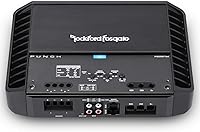
It uses convection cooling, so there is no fan — heat dissipation depends entirely on airflow around the chassis. In a sealed trunk with the amp mounted flat and no ventilation, you could run into thermal issues at higher volumes. Mounting it where air can circulate freely, or at least leaving clearance on all sides, is the right move.

It works at 4 ohms, but output drops to 150 watts at that impedance. For a single 4-ohm sub, that is workable depending on the driver's sensitivity and your volume expectations, but you will get noticeably more output by wiring to 2 ohms if your subwoofer supports it.

Not necessarily. The built-in Punch EQ provides a boost centered around 45Hz, which covers the deep bass frequencies most subwoofer builds are targeting. For a straightforward single-sub setup, the onboard controls are enough. If you are running a more complex system or want full parametric control, an external processor would add more flexibility.

At just over 11 inches deep and under 8 inches wide, this Punch mono amp is on the smaller side for a 500-watt class unit. Whether it fits under a specific seat depends on the vehicle, but it is a realistic option for many compact SUVs and trucks with raised rear seats. Measure your clearance first, and remember it needs airflow around it.

A small number of buyers have reported RCA noise or a ground loop hum in specific vehicles. This is usually traced back to a poor chassis ground connection rather than a fault with the amp itself. Running a solid ground wire to bare metal — not a screw or painted surface — resolves the issue in most cases.

You can, but the impedance math matters. If you wire two 4-ohm subs in parallel, you get a 2-ohm load and 300 watts split between them. If each sub is a 2-ohm driver wired in parallel, you are down to a 1-ohm load for the full 500 watts. Just make sure your subwoofers can handle the power split and that the amp stays within its rated impedance range.

The difference shows up most in build quality, thermal management, and long-term reliability rather than peak wattage claims. Budget amps often inflate power ratings and cut corners on internal components. This Rockford subwoofer amplifier is built to a measurable standard, runs cooler by design, and has a track record from owners who have used it for years without failure — that is not something you get at the bottom of the market.

Where to Buy