Overview

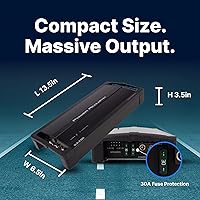
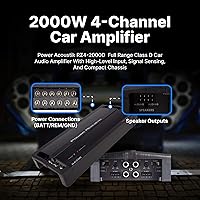
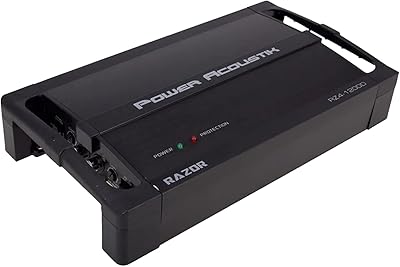
The Power Acoustik RZ4-2000D 4-Channel Car Amplifier has been quietly holding its own in the budget car audio market since 2012 — a surprisingly long run for an entry-level amp. Made by Epsilon Electronics under the Power Acoustik brand, this 4-channel amp sits comfortably in the affordable tier of the multichannel amplifier space, competing directly with similarly priced rivals. Its compact surface-mount chassis measures just 13.5 x 6.5 x 3.5 inches, meaning it tucks away in tight spots without drama. If you are building your first real car audio system or upgrading a tired stock setup on a budget, it is worth a close look.

Features & Benefits

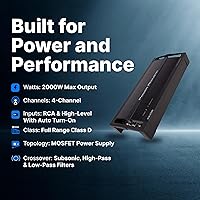
Running on Class D topology, the RZ4-2000D draws less current and generates less heat than older Class AB designs — a practical advantage for installs where airflow is limited. The MOSFET PWM power supply keeps voltage delivery stable even when the amp is working hard. Output flexibility is one of the stronger selling points: you can run 160W per channel at 4-ohm, push to 250W per channel at 2-ohm, or bridge two channels for 500W into a subwoofer. Full-range operation means no external crossover is required to split frequencies between speakers and a sub, which keeps the install tidy and the parts list short.

Best For

This Power Acoustik amplifier really shines for DIY car audio builds where the goal is squeezing solid performance out of a tight budget. If you want to power all four speakers in your car and still have a bridged channel left for a subwoofer, the 4-channel layout covers that without needing a second amp. The low-profile chassis is a genuine plus for installs under seats or in compact trunk spaces where a bulkier unit simply will not fit. It also makes sense as a first step up for anyone moving away from a factory head unit — you get noticeably more headroom than OEM outputs can deliver, without a steep investment.

User Feedback

Across 144 ratings, the RZ4-2000D holds a 3.9 out of 5 — decent, but not without caveats. The most consistent praise centers on value for money; buyers generally feel they are getting solid output for the spend. The honest recurring gripe is that real-world power delivery falls short of the headline 2000W max figure, though that gap between peak and actual RMS is standard across budget amps and should not catch an informed buyer off guard. Heat during extended use comes up occasionally, making planned ventilation worth considering. Long-term reliability is the bigger uncertainty — some owners report years of trouble-free use, while others hit early failures, which is the accepted trade-off at this price tier.

Pros

  • Covers all four speaker channels plus a bridged subwoofer output from a single unit.
  • Class D design runs cooler and draws less current than older amp topologies.
  • Compact chassis fits easily under seats or in tight trunk installs.
  • Flexible ohm configurations let you tailor output to different speaker setups.
  • Full-range operation eliminates the need for a separate external crossover.
  • Wiring and gain controls are straightforward enough for first-time installers.
  • Has maintained a broadly positive reception over a long product lifespan since 2012.
  • Offers a meaningful power upgrade over any factory or OEM head unit output.
  • MOSFET PWM power supply keeps current delivery stable under normal listening loads.

Cons

  • Real-world continuous power falls well short of the advertised 2000W maximum rating.
  • Durability is inconsistent — some units fail early while others last for years with no pattern.
  • No warranty terms are clearly stated, leaving buyers with little recourse if issues arise.
  • Heat buildup during extended use can be a problem if ventilation is not planned carefully.
  • No wireless remote is included, limiting convenience for adjusting settings after install.
  • Budget-tier build quality means it is unlikely to withstand rough handling or demanding daily use long-term.
  • The 3.9 out of 5 rating across 144 reviews reflects a divided buyer experience, not widespread satisfaction.
  • Not a strong match for higher-impedance or high-efficiency speakers that need precise, clean power delivery.

Ratings

Our AI-generated scores for the Power Acoustik RZ4-2000D 4-Channel Car Amplifier were produced by analyzing verified global buyer reviews, with spam, bot-generated, and incentivized feedback actively filtered out before scoring. Each category reflects the honest balance of praise and frustration real owners have shared — nothing is glossed over. Where this 4-channel amp earns strong marks, you will see why; where it falls short, the scores say so plainly.
Value for Money
83%
The RZ4-2000D consistently earns its strongest praise here. Buyers doing their first car audio build regularly note that getting four driven channels plus bridging capability at this price is difficult to beat among direct competitors. For someone upgrading from a stock head unit on a tight budget, the perceived bang-for-buck is genuinely high.
The value equation starts to wobble if the unit fails within the first year, which a meaningful minority of buyers have experienced. When you factor in potential replacement costs, the initial savings can disappear quickly, making the long-term value less certain than the upfront price suggests.
Power Accuracy
54%
46%
The amp does produce usable, noticeable power — drivers coming from factory audio report a clear and immediate improvement in volume and headroom. Running at 2-ohm per channel squeezes more output from the unit and some buyers who set up their systems this way have been satisfied with the result.
The gap between the advertised 2000W maximum and real-world continuous RMS output is substantial, and informed buyers consistently flag this. The peak rating is a burst figure achieved under near-ideal lab conditions, not something you will sustain during a long highway drive with the system working hard.
Build Quality
57%
43%
The chassis feels reasonably solid for the price tier, and the terminal connections are sturdy enough to hold standard gauge wiring without issues. Several long-term owners who have treated their installs carefully report the unit holding up well over multiple years of regular use.
Component quality is clearly budget-grade, and early failures reported by a notable portion of buyers suggest inconsistent quality control at the factory level. The casing can feel thin compared to mid-range rivals, and a few users have noted that the unit does not inspire confidence when handled before install.
Thermal Management
61%
39%
The Class D design does run meaningfully cooler than equivalent Class AB amplifiers, which is a real benefit for installs tucked under seats or in partially enclosed spaces. Buyers who planned their ventilation properly and kept airflow around the unit have reported no significant overheating during normal daily use.
Extended listening at higher volumes brings heat complaints out of a consistent subset of buyers, particularly in summer months or enclosed trunk installs. Unlike higher-end amps, there is no built-in fan or advanced thermal protection that reliably prevents shutdowns, so poor placement decisions will be punished.
Installation Ease
78%
22%
The surface-mount footprint and clearly laid-out terminal block make this a straightforward install for anyone with basic car audio knowledge. A notable share of first-time installers reported getting the amp wired and operational without needing professional help, which is a genuine plus for the DIY crowd this product targets.
The owner documentation included with the unit is thin, and first-timers relying solely on the included manual may find the gain and crossover setup instructions lacking. Without supplementary guides or forum help, setting gains correctly by ear can lead to distortion or underpowered output.
Channel Flexibility
79%
21%
The ability to run four independent speaker channels or reconfigure two of them into a bridged mono subwoofer output gives this amp real versatility for a single-unit install. Buyers building a full front, rear, and sub setup from one amplifier have found the configuration options well-suited to common DIY system layouts.
Bridging is limited to 4-ohm loads, which restricts compatibility with popular 2-ohm subwoofers and forces buyers to plan their speaker selection carefully upfront. Those who did not account for this discovered the limitation after purchase, leading to frustration and return requests.
Signal Clarity
66%
34%
At moderate listening volumes, the RZ4-2000D delivers acceptably clean audio that represents a clear step up from unamplified factory output. Buyers using it to drive full-range speakers in the front stage have found mid and high-frequency reproduction to be reasonably detailed for a budget Class D unit.
At higher gain settings or when pushed toward its power ceiling, some buyers detect audible distortion and noise floor issues that would not be acceptable on a more expensive amp. Signal-to-noise performance is functional rather than impressive, and audiophile-leaning buyers will notice the limitations quickly.
Compatibility
74%
26%
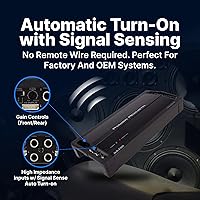
The amp accepts both high-level speaker inputs and low-level RCA inputs, making it compatible with factory head units as well as aftermarket decks — a flexibility that broadens its appeal for mixed-system builds. The supply voltage range of 6V to 24V also covers non-standard automotive applications beyond typical 12V vehicles.
The lack of explicit impedance protection below 4-ohm on bridged channels creates compatibility issues with common single-voice-coil subwoofers wired to 2-ohm. Buyers who did not check this spec before purchasing were occasionally left with an unusable bridged configuration.
Long-Term Durability
51%
49%
A solid contingent of buyers — particularly those who installed the amp with proper ventilation and correctly set gains from the start — report years of trouble-free operation. When treated well, the unit can clearly outlast the skepticism that its price point invites.
The durability feedback is too split to ignore. Early failures within the first few months are reported at a rate that is above average for the category, and with no clear warranty terms provided, buyers who experience issues have limited formal recourse. This is the single biggest risk factor in the purchase decision.
Compact Form Factor
81%
19%
At 13.5 x 6.5 x 3.5 inches and only 4 pounds, the RZ4-2000D fits into spaces that would reject a larger amp without hesitation. Hatchback and small sedan owners frequently highlight the low-profile chassis as the reason they chose this unit over bulkier alternatives in the same price range.
The compact size does limit internal component space, which likely contributes to the thermal and durability concerns raised elsewhere. Buyers expecting the same internal build density found in larger, pricier amps will be disappointed when they open the chassis.
Gain & Crossover Controls
71%
29%
The onboard gain and crossover adjustments are accessible and functional, letting installers tune the system without external processors for a basic setup. Buyers who took the time to set gains with a multimeter or by ear reported satisfactory results across a range of speaker combinations.
The controls lack the precision and range of higher-end amps, and the crossover slopes are relatively gentle. For buyers trying to fine-tune a more demanding system with specific crossover points, the onboard options feel limiting compared to what a dedicated processor would provide.
Brand Reputation
63%
37%
Power Acoustik has been a recognizable name in budget car audio for well over a decade, and the RZ4-2000D itself has been on the market since 2012 — a track record that gives it more credibility than fly-by-night newcomers. Buyers familiar with the brand generally have calibrated expectations and tend to rate their experience more favorably as a result.
Epsilon Electronics, the parent manufacturer, does not carry the same brand equity as established audio specialists, and customer support infrastructure appears minimal. Buyers who run into post-purchase issues report difficulty getting timely or helpful responses through official channels.
Packaging & Accessories
59%
41%
The unit arrives protected adequately for standard shipping conditions, and most buyers report receiving the amp without cosmetic damage. The box configuration is straightforward, and the included hardware covers the basic mounting requirements for a standard surface install.
Accessories included in the box are minimal — no RCA cables, no wiring kit, and no detailed setup guide. First-time installers will need to budget separately for all supporting materials, and the sparse documentation means there is little guidance for buyers who are not already familiar with amplifier installation.

Suitable for:

The Power Acoustik RZ4-2000D 4-Channel Car Amplifier is a solid pick for budget-conscious car audio builders who want real amplification without spending a lot. If you are replacing a weak factory head unit and want noticeably louder, cleaner output across all four speakers, this 4-channel amp delivers that without requiring a second unit for your subwoofer — bridge two channels and you have a complete front, rear, and sub setup in one box. Its compact surface-mount chassis makes it particularly well-suited for smaller vehicles, hatchbacks, or builds where trunk real estate is limited. First-time installers will also appreciate the accessible gain and crossover controls, which take some of the guesswork out of tuning. For anyone stepping into car audio on a practical budget, the RZ4-2000D represents a reasonable and capable entry point.
Not suitable for:

The Power Acoustik RZ4-2000D 4-Channel Car Amplifier is not the right choice for buyers chasing serious, high-fidelity sound quality or those who need reliable peak power for demanding speaker loads. The advertised 2000W max figure is a peak rating, and real-world continuous output is considerably lower — experienced audio enthusiasts who know what true RMS numbers look like will find the spec sheet optimistic. This Power Acoustik amplifier also carries some uncertainty around long-term durability, which makes it a poor fit for anyone building a system they expect to last many years without maintenance or replacement. If you are running high-efficiency component speakers or competition-grade subwoofers that need stable, accurate power, you will quickly outgrow what the RZ4-2000D can reliably provide. Buyers who prioritize warranty support or direct manufacturer service should also look elsewhere, as warranty coverage requires contacting the manufacturer with no guaranteed terms listed.
Specifications

  • Max Power Output: The amplifier is rated at a maximum peak output of 2000W across all channels combined.
  • RMS Output (4-ohm): Each of the four channels delivers 160W RMS when driving a 4-ohm load in stereo mode.
  • RMS Output (2-ohm): Each channel steps up to 250W RMS when the load is reduced to 2-ohm per channel in stereo mode.
  • Bridged Output: When bridged, the amp delivers 500W RMS per pair into a 4-ohm load, suitable for powering a subwoofer.
  • Amplifier Class: Class D topology is used, offering improved power efficiency and lower heat generation compared to Class AB designs.
  • Power Supply: A MOSFET PWM power supply ensures stable and consistent current delivery even under sustained load conditions.
  • Number of Channels: The unit features four independent channels, configurable for full-range stereo or bridged mono subwoofer operation.
  • Dimensions: The chassis measures 13.5 x 6.5 x 3.5 inches, providing a compact footprint suitable for tight vehicle installs.
  • Weight: The amplifier weighs approximately 4 pounds, making it easy to handle and position during installation.
  • Mounting Type: Designed for surface mounting, the unit can be secured to flat surfaces in a trunk, cargo area, or under a seat.
  • Supply Voltage Range: The amp operates within a supply voltage range of 6V minimum to 24V maximum, compatible with standard 12V automotive electrical systems.
  • Frequency Response: Full-range capability allows the amp to handle both high-frequency speaker signals and low-frequency subwoofer signals without requiring an external crossover.
  • Wireless Remote: No wireless remote control is included or supported with this amplifier.
  • Manufacturer: The RZ4-2000D is manufactured by Epsilon Electronics Inc. and sold under the Power Acoustik brand.
  • Model Number: The official model designation is RZ4-2000D, which identifies this specific 4-channel variant in the Power Acoustik lineup.
  • Compliance: The product meets California Proposition 65 requirements, as noted in its official product documentation.
  • First Available: This amplifier was first made available for purchase in January 2012, giving it over a decade of market presence.
  • Warranty: Warranty terms are not explicitly stated in product documentation; buyers are directed to contact the manufacturer directly for coverage details.

Related Reviews
Power Acoustik RZ4-1200D 4-Channel Car Audio Amplifier
82%
88%
Sound Quality
91%
Power Output
84%
Build Quality
75%
Installation Ease
90%
Efficiency (Class D Technology)
More
Power Acoustik RE4-2000D 2000 Watt 4-Channel Car Stereo Amplifier
86%
89%
Sound Quality
92%
Power Output
84%
Thermal Protection
88%
Ease of Installation
80%
Durability
More
Power Acoustik VA4-1800D Vertigo Series 4-Channel Car Amplifier
85%
88%
Performance
85%
Sound Quality
80%
Heat Management
90%
Build Quality
82%
Ease of Installation
More
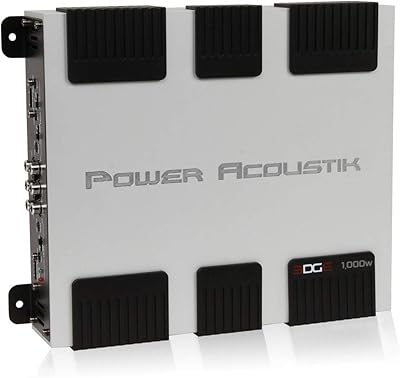
Power Acoustik EG4-1000 Edge Series 4-Channel Amplifier
85%
91%
Power Output
87%
Sound Quality
90%
Ease of Installation
82%
Durability
89%
Compact Design
More
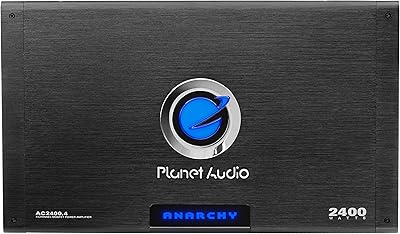
Planet Audio AC2400.4 4-Channel Car Amplifier
84%
95%
Power Output
89%
Sound Clarity
87%
Bass Performance
82%
Ease of Installation
65%
Thermals/Heat Management
More
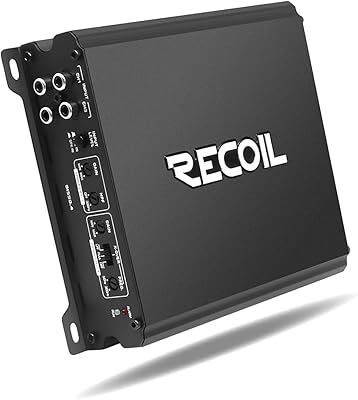
Recoil REA600.4 4-Channel Car Audio Amplifier
84%
89%
Audio Performance
91%
Ease of Installation
85%
Sound Quality at High Volumes
62%
Heat Management
90%
Power Output
More
Recoil DI800.4 4-Channel Car Audio Amplifier
83%
88%
Sound Quality
92%
Power Output
65%
Thermal Management
84%
Build Quality
91%
Ease of Installation
More
Planet Audio PL1600.4 4-Channel Car Amplifier
72%
88%
Value for Money
84%
Ease of Installation
74%
Sound Quality
58%
Power Output (Real-World)
61%
Build Quality
More
Recoil DI550.4 4-Channel Car Audio Amplifier
74%
91%
Value for Money
78%
Power Output
86%
Ease of Installation
74%
Sound Quality
67%
Build Quality
More
Planet Audio AC1200.4 4-Channel Car Amplifier
73%
88%
Value for Money
67%
Power Output
83%
Installation Ease
74%
Sound Quality
61%
Build Quality
More

FAQ

Not quite. The 2000W figure is a peak or maximum rating, which represents the absolute best-case burst output under ideal conditions. The continuous RMS figures — 160W per channel at 4-ohm, or 250W per channel at 2-ohm — are what you will actually work with day to day. For a budget amp at this price point, that is a reasonable and honest expectation.

Yes, that is one of the more practical aspects of the 4-channel layout. You can use two channels to drive your front speakers, two channels for the rears, and then bridge one of those pairs to feed a subwoofer. Just keep in mind that bridging reduces your available speaker channels to two plus a mono sub output, so plan your setup accordingly.

No. This amp is full-range capable, meaning it can handle both high-frequency and low-frequency signals natively. There are onboard crossover controls you can adjust to direct the right frequencies to the right speakers, which keeps the install simpler and reduces the number of extra components you need to buy.

Some buyers have mentioned noticeable heat buildup during extended listening sessions, which is worth taking seriously when planning your install. Class D runs cooler than older designs, but the amp still needs breathing room. Avoid mounting it in an enclosed space with no airflow — under a seat with some clearance or in an open trunk area works better than a sealed box.

In most cases, yes. The RZ4-2000D accepts both high-level and low-level inputs, so it can take signal from a factory head unit that only has speaker-level outputs. You will want to double-check the input sensitivity range and set your gains carefully to avoid distortion when using high-level inputs.

It is manageable for a careful first-timer. The terminal layout and gain controls are reasonably well-labeled, and several buyers with no prior experience have reported getting it up and running without too much trouble. That said, you will want to follow a proper wiring guide — correct fusing on the power wire and a solid ground connection are the two things most beginner installs get wrong.

For an amp in this power range, 4-gauge wire for both the power and ground runs is generally the right call. Make sure the ground wire goes directly to bare metal on the chassis — not a painted surface — and keep the run as short as possible. A proper inline fuse near the battery on the power wire is not optional; it is a safety requirement.

No. The bridged output is rated for 4-ohm loads only. Running a bridged channel into a 2-ohm subwoofer can overheat or damage the amplifier. If you plan to use a 2-ohm sub, either run it unbridged on a single channel or use a sub with a 4-ohm voice coil when bridging.

The honest answer is mixed. Some owners have been running the RZ4-2000D for several years without a problem, while others have reported early failures. At this price tier, that kind of variance is not unusual — you are not paying for premium components or rigorous quality control. If longevity is a top priority, budgeting up for a more established brand might be worth considering.

It is actually one of the better-suited options in its class for compact installs. The chassis is only 13.5 x 6.5 x 3.5 inches and uses a surface-mount design, so it sits flat against a panel without needing a dedicated enclosure. Many hatchback and small sedan owners have found it fits neatly behind a rear seat panel or along a trunk sidewall without sacrificing much storage.

Where to Buy