Overview

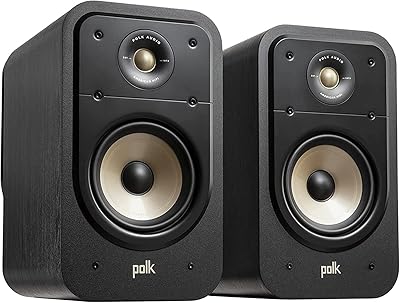
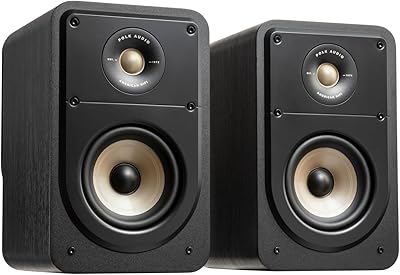
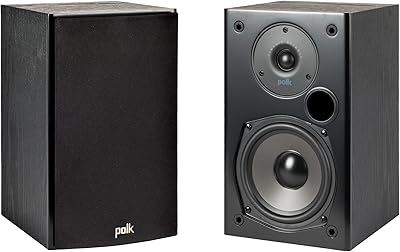
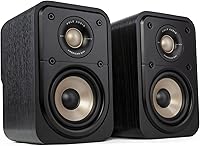
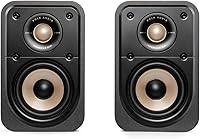
The Polk Audio Signature Elite ES10 Surround Speakers are purpose-built surround channels — designed to fill the side, rear, or elevation positions in a Dolby Atmos or DTS:X home theater, not to serve as your primary stereo pair. That distinction matters. If you're buying these expecting full-range bookshelf performance, you'll be disappointed. But slot them into a 5.1 or 7.1 layout as part of a broader system, and they earn their place quickly. The cabinet is compact and clean — rounded edges, a matte black finish — the kind of speaker that disappears on a wall bracket or shelf without clashing with your room. They're also flexible enough to pair with a wide range of AV receivers thanks to 4- and 8-ohm compatibility.
Features & Benefits

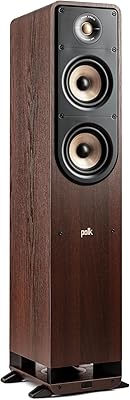
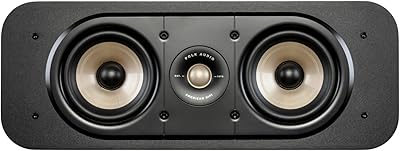
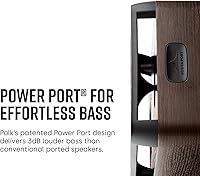
Polk's Power Port Technology is the headline feature here, and it genuinely makes a difference you can hear. Unlike a standard ported design, the rear-firing port is engineered to smooth out airflow turbulence, which translates to bass that hits cleaner and slightly louder without the chuffing you sometimes get from cheaper ported cabinets. The 1-inch Terylene tweeter handles high-frequency detail well — dialogue stays crisp, and action sequences don't turn harsh at moderate volumes. The Hi-Res Audio certification means they can resolve lossless audio streams without compression artifacts muddying the signal. And because these share timbre matching with the broader Signature Elite lineup, blending them with an ES60 tower or ES35 center channel produces a cohesive, consistent soundstage across every seat.

Best For

These Polk surround speakers are an easy recommendation if you're expanding an existing home theater into Dolby Atmos territory and want surrounds that match your front stage tonally. They suit mid-size rooms well — think a 15-by-18-foot living room — where their compact size and wall-mount flexibility actually work in your favor. Gamers chasing positional audio and movie lovers who want overhead or side-channel immersion will get real value here. What they're not ideal for is pure stereo music listening or very large open-plan spaces where you'd need more acoustic output. If you're already running other Signature Elite speakers, adding the ES10 pair as surrounds is one of the more logical extensions you can make.

User Feedback

The Signature Elite ES10s get consistent praise for their clean treble response and the way they integrate naturally with mid-tier AVRs without requiring excessive amplifier power. Build quality earns compliments too — the finish looks more expensive than you'd expect at this price point. That said, real buyers are candid about the limits. Bass extension without a subwoofer is noticeably thin; these are not designed to go deep on their own, and nobody should expect otherwise. A few buyers also flag that the binding posts feel less substantial than what you'd find on higher-end competitors. In larger rooms, some users report that overall volume output falls short at more demanding listening levels.

Pros

  • Tonal consistency with the Signature Elite family makes channel blending in Atmos setups noticeably natural.
  • The Power Port bass design delivers cleaner, tighter low-end than most ported cabinets at this size.
  • Hi-Res Audio certification means these Polk surround speakers resolve lossless audio without compression artifacts.
  • Works reliably with a wide range of mid-tier AV receivers without demanding extra amplifier power.
  • Wall-mount installation is straightforward — keyhole slots and screw inserts are genuinely DIY-friendly.
  • The matte black finish looks polished and understated in furnished living rooms and dedicated media spaces.
  • Flexible placement as side surrounds, rear channels, or elevation speakers suits evolving room configurations.
  • Dialogue clarity during loud action sequences is a consistent real-world strength buyers repeatedly highlight.
  • Compact cabinet size makes installation practical in rooms where larger surround speakers would be awkward.
  • Dual 4- and 8-ohm compatibility gives buyers genuine flexibility across different receiver brands and models.

Cons

  • Deep bass extension is noticeably weak without a subwoofer — do not buy these expecting standalone low-end.
  • Binding posts feel flimsy compared to competitors at a similar price, and banana plugs can sit loosely.
  • Volume output in rooms larger than roughly 300 square feet starts to feel inadequate at higher listening levels.
  • Wall-mount hardware is not included in the box, which adds cost and a trip to the hardware store.
  • The timbre-matching benefit is meaningless if you are mixing these with speakers from other brands or series.
  • A single color option limits compatibility with lighter or wood-toned interior decor schemes.
  • The grille cloth attracts dust visibly and requires regular cleaning to maintain the speakers' appearance.
  • Ceiling-bounce Atmos performance can be uneven in rooms with lower ceilings or non-standard geometry.
  • Upper treble can harden slightly at high volumes, particularly with heavily compressed movie audio tracks.
  • No built-in cable management makes wall-mounted installations look untidy unless wires are run through the wall.

Ratings

The scores below reflect an AI-driven analysis of verified global buyer reviews for the Polk Audio Signature Elite ES10 Surround Speakers, with spam, incentivized, and bot-generated feedback actively filtered out before scoring. Ratings are built from real-world usage patterns across home theater installations, gaming setups, and apartment listening rooms. Both the standout strengths and the honest frustrations buyers reported are factored into every number you see here.

Surround Sound Performance
88%
In a properly calibrated Dolby Atmos or DTS:X setup, these Polk surround speakers throw a convincing, spacious soundfield that keeps action sequences and atmospheric soundtracks anchored to their correct positions. Users consistently describe helicopter flyovers and environmental effects as noticeably more directional compared to lower-tier surrounds.
Performance is heavily dependent on a capable AV receiver doing the processing work. Buyers running entry-level AVRs reported that the spatial advantage narrows considerably, and the speakers alone cannot compensate for weak room correction or poor speaker placement.
Bass Output
62%
38%
The Power Port design does produce tighter, cleaner low-end than you typically get from a similarly sized ported cabinet. For surround-channel use — where bass duties are shared with a dedicated subwoofer — the ES10 pair handles its portion of the low-mid range without sounding hollow or strained.
Run these without a subwoofer and the bass limitation becomes hard to ignore. Deep cinematic rumble simply does not materialize from a 4-inch driver, and users who tried them as standalone bookshelf speakers in music-focused setups were consistently let down by the thin low-end response below 60 Hz.
Treble Clarity
86%
The Terylene tweeter handles high-frequency detail with real refinement for this price tier. Dialogue clarity is a specific strength buyers call out repeatedly — voices stay intelligible during loud action scenes, and cymbal work in music content avoids the brittle edge common in cheaper tweeters.
At higher volumes in larger rooms, a small number of users detected a slight hardness creeping into the upper treble during compressed movie audio tracks. It is not a dealbreaker, but listeners sensitive to brightness may want to apply a subtle treble trim in their AVR EQ settings.
Midrange Detail
79%
21%
For a compact surround speaker, the midrange holds together surprisingly well during dense, layered soundtracks. Instrument separation in musical passages is clear, and the crossover transition between the tweeter and woofer does not produce the muddy handoff you notice in budget competing models.
The midrange does compress noticeably when the speakers are pushed hard. Users watching high-dynamic-range content at reference listening levels reported that busy mid-frequency passages — crowds, orchestras, complex game audio — lose some texture and start to blur together.
Build Quality
77%
23%
The cabinet feels solid and the matte black finish looks genuinely premium on a wall bracket or shelf. Multiple buyers noted that the ES10 pair looks more expensive than its actual price suggests, and the rounded-edge design holds up well against light knocks and routine handling during installation.
The binding posts are the weakest point in the physical build. Several users flagged them as feeling noticeably less robust than what competitors at a similar price offer, with one common complaint being that banana plugs sit slightly loose rather than locking in with confidence.
Value for Money
83%
As dedicated surround or elevation channels in a mid-range home theater system, the ES10 pair competes confidently against alternatives in the same price bracket from Klipsch and Yamaha. Buyers who purchased them as part of a full Signature Elite build consistently felt the timbre matching alone justified the cost.
The value proposition weakens if you are buying these outside of the Signature Elite ecosystem or trying to use them as general-purpose bookshelf speakers. In those contexts, similarly priced competitors offer better full-range performance per dollar.
Ease of Installation
91%
The keyhole slots and screw inserts make wall mounting genuinely straightforward — most buyers reported completing the installation without professional help or specialized tools. The lightweight cabinet makes single-person mounting to drywall anchors manageable.
The wall-mount hardware is not included in the box, which caught some buyers off guard. A few users also noted that the keyhole slot spacing requires careful measurement before drilling, and minor misalignments are difficult to correct without re-patching the wall.
AVR Compatibility
93%
The dual 4- and 8-ohm compatibility is a practical advantage that plays out well in real setups. Buyers running Denon, Yamaha, Marantz, and Sony mid-tier receivers all reported clean, stable integration without any impedance warnings or clipping behavior during extended listening sessions.
While AVR compatibility is broad, the speakers do benefit meaningfully from receivers with automatic room correction like Audyssey or YPAO. Without that calibration step, channel balance can feel uneven, particularly when the ES10 pair is used as elevation channels above the primary listening height.
Hi-Res Audio Performance
74%
26%
Users streaming lossless FLAC or Dolby TrueHD content through a capable receiver noticed that the ES10s resolve fine detail without smearing it — a real difference compared to speakers lacking Hi-Res certification. For movie watching with a quality Blu-ray or streaming source, the certification is more than a marketing badge.
The practical benefit of Hi-Res certification is constrained by the driver size. In a surround role the advantage is real, but dedicated music listeners hoping to hear the full resolution of high-bitrate audio through a 4-inch woofer will inevitably feel the physical limits of the cabinet.
Volume Output
66%
34%
In rooms up to roughly 250 square feet, the Signature Elite ES10s deliver adequate volume levels for immersive surround use without the AVR straining. For apartment living rooms and dedicated media rooms of standard size, most buyers found them plenty loud at typical evening listening levels.
In larger or open-plan spaces, the output ceiling becomes a genuine limitation. Multiple users with rooms above 350 square feet reported needing to push their AVR gains higher than comfortable, and a handful noted that at those levels the speakers began to sound congested rather than simply louder.
Placement Versatility
87%
The ability to use these as side surrounds, rear surrounds, or overhead elevation channels in a single speaker model is a practical advantage buyers appreciate when planning a flexible room layout. The compact footprint means they work on narrow shelves and small speaker stands without awkward overhang.
Directional firing via wall mounting works best within a fairly specific angle range. A few buyers found that ceiling-bounced Atmos placement produced uneven results in rooms with lower ceilings, and the speaker lacks the wide dispersion some dedicated Atmos elevation modules are designed to provide.
Aesthetic Design
84%
The clean lines and matte black finish consistently earn compliments from buyers who care about how their home theater gear looks in a furnished living room. The rounded cabinet edges avoid the industrial appearance of older speaker designs and blend naturally with modern furniture.
The single color option limits flexibility for buyers with lighter-toned interiors or those who prefer wood-finish cabinetry. A few users noted that the grille cloth attracts dust more visibly than expected, requiring regular maintenance to keep the speakers looking as clean as they do out of the box.
Timbre Matching
92%
For buyers running a full Signature Elite system, the tonal consistency from the front stage through to the surrounds is the ES10 pair's most underappreciated quality. Panning effects and moving audio objects in Atmos content track naturally across all channels without obvious tonal shifts.
The timbre-matching benefit only applies within the Signature Elite family. Users pairing the ES10s with speakers from different Polk series — or from other brands entirely — reported noticeable tonal discontinuity that required significant EQ work to partially address.
Cable Management
58%
42%
The wired binding posts allow use of standard bare wire, banana plugs, or spade connectors, which gives buyers reasonable flexibility in how they run their speaker cables during installation.
There is no built-in cable management channel or rear-routing solution, which means wall-mounted installations often show visible cable runs unless the buyer routes wires through the wall independently. In a tidy living room setup, this can require extra effort and cost to address cleanly.

Suitable for:

The Polk Audio Signature Elite ES10 Surround Speakers are built for a specific kind of buyer, and that buyer will get real satisfaction from them: someone actively constructing or expanding a dedicated home theater around Dolby Atmos or DTS:X, who needs surround or elevation channels that tonally match their front stage. If you are already running Signature Elite towers or a center channel up front, adding the ES10 pair as side, rear, or height speakers is one of the most coherent moves you can make — the tonal consistency across the whole system is immediately noticeable. They also suit apartment dwellers and mid-size room setups particularly well, where the compact footprint and wall-mount flexibility are practical advantages rather than compromises. Gamers chasing positional audio and cinephiles who watch a lot of object-based surround content will find that these speakers hold their own against similarly priced competition from Klipsch and Yamaha in the surround channel role. If your AVR supports room correction like Audyssey or YPAO, these speakers respond well to calibration and punch above their weight once dialed in properly.
Not suitable for:

If your goal is a capable pair of stereo bookshelf speakers for dedicated music listening, the Polk Audio Signature Elite ES10 Surround Speakers are not the right tool — and this is probably the most common mismatch buyers make with this model. Without a subwoofer handling the deep low end, the bass foundation simply is not there for music that depends on weight and extension below 60 Hz. Buyers in larger open-plan rooms should also temper expectations: at high volumes in a spacious environment, these speakers can start to sound strained before they reach the kind of output level the room demands. If you are pairing them with speakers from a different brand or a different Polk series, the timbre-matching advantage disappears entirely and you may end up doing significant EQ work to get the tonal balance right across channels. Finally, anyone expecting premium hardware finishing throughout — particularly at the binding posts — may find the build quality feels a step behind what similarly priced rivals offer in that specific detail.
Specifications

  • Driver Config: Each speaker uses a 1-inch Terylene dome tweeter paired with a 4-inch dynamic woofer for handling high-frequency clarity and midrange detail.
  • Power Handling: The ES10 pair is rated to handle up to 200 watts of input power, giving them headroom across a wide range of AV receiver output levels.
  • Impedance: Nominal impedance is 8 ohms, with 4-ohm compatibility confirmed, making these speakers usable with the majority of consumer AV receivers on the market.
  • Frequency Response: Frequency response extends down to 40 Hz, though real-world bass performance below 80 Hz benefits substantially from pairing with a dedicated subwoofer.
  • Dimensions: Each cabinet measures 6.1″ deep, 5.4″ wide, and 8.4″ tall — a compact footprint that fits comfortably on shelves, stands, or wall brackets.
  • Weight: The pair weighs approximately 6 pounds total, making single-person wall-mount installation manageable without additional support equipment.
  • Bass Technology: Polk's patented Power Port rear-firing port is engineered to reduce airflow turbulence, producing tighter and measurably louder bass output compared to conventional ported cabinet designs.
  • Surround Config: Designed for use as surround, rear, or elevation channels in 5.1, 7.1, and Dolby Atmos multi-channel configurations.
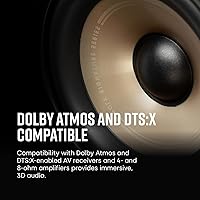
  • Format Support: The ES10s are compatible with Dolby Atmos and DTS:X object-based surround sound formats when paired with a capable AV receiver.
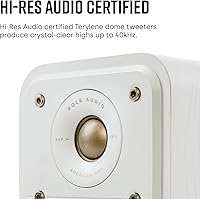
  • Certification: Both speakers carry official Hi-Res Audio certification, confirming their ability to reproduce audio content at resolutions beyond standard CD quality.
  • Mounting Options: Built-in keyhole slots and threaded screw inserts on the rear cabinet allow wall mounting for directional firing without requiring a separate adapter bracket.
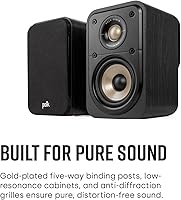
  • Connectivity: Connection is via wired binding posts that accept bare wire, banana plugs, or spade connectors in standard gauges.
  • Series Compatibility: The ES10 pair is timbre-matched within the Polk Signature Elite family, ensuring tonal consistency when combined with ES60 towers, the ES35 center channel, or other ES-series speakers.
  • Cabinet Material: The cabinet is constructed using a combination of metal and plastic components, with a matte black finish and rounded edges on the exterior.
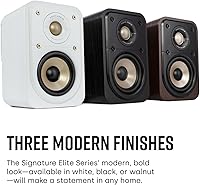
  • Color Option: Available in a single Stunning Black finish; no additional color variants are currently offered for this model.
  • Unit Count: Each purchase includes two speakers sold as a matched pair, intended for symmetrical left-right channel placement in a surround layout.
  • Tweeter Diameter: The dome tweeter measures 50 millimeters (approximately 2 inches) in diameter across its face.
  • Woofer Diameter: The woofer cone measures 300 millimeters (approximately 4 inches) in diameter, handling bass and lower midrange frequencies.
  • Warranty: Polk Audio covers these speakers with a limited manufacturer warranty; buyers should confirm current warranty terms and duration directly with Polk or their authorized retailer.
  • Power Source: These are passive speakers powered entirely via a wired connection to an external amplifier or AV receiver — no internal amplification or power supply is included.

Related Reviews

Polk Signature Elite ES20 Bookshelf Speaker
86%
91%
Sound Quality
89%
Bass Performance
88%
Clarity and Detail
85%
Build Quality
87%
Ease of Setup
More
Polk Signature Elite ES15 Bookshelf Speaker
87%
91%
Audio Quality
88%
Bass Performance
85%
Build Quality
89%
Sound Clarity
90%
Design & Aesthetics
More
Polk Signature Elite ES50 Tower Speaker
87%
91%
Sound Quality
88%
Bass Performance
85%
Ease of Setup
93%
Design and Build Quality
89%
Compatibility with AV Systems
More
Polk Audio Signature Elite ES30 Center Speaker
84%
94%
Dialogue Clarity
78%
Bass Performance
91%
Build Quality
86%
Value for Money
83%
Dolby Atmos & DTS:X Integration
More
Polk Audio 80 F/X RT In-Ceiling Speakers
81%
88%
Sound Quality
74%
Bass Extension
91%
Surround Imaging
93%
RTi Tonal Matching
61%
Installation Experience
More
Polk Audio T15
Polk Audio T15
82%
88%
Sound Clarity
61%
Bass Response
79%
Build Quality
93%
Value for Money
91%
Ease of Setup
More
Polk Audio 265-RT In-Wall Speaker
82%
91%
Sound Quality
88%
Installation Experience
86%
Build Quality
93%
Grille & Aesthetics
71%
Bass Performance
More
Polk Audio OWM3
Polk Audio OWM3
83%
88%
Sound Clarity
63%
Bass Performance
94%
Versatile Placement
76%
Build Quality
86%
Value for Money
More
Polk Audio Reserve R200 Bookshelf Speaker
87%
94%
Sound Quality
89%
Bass Performance
90%
Build Quality
85%
Ease of Setup
92%
Value for Money
More
Polk Audio Atrium 4 Outdoor Speakers
88%
89%
Sound Quality
91%
Ease of Installation
93%
Build Quality & Durability
87%
Value for Money
83%
Bass Performance
More

FAQ

You can technically use the Polk Audio Signature Elite ES10 Surround Speakers for music, but they are genuinely optimized for the surround channel role in a home theater setup. Without a subwoofer filling in the low end, music that relies on bass depth will sound noticeably thin. For dedicated stereo music listening, a speaker with a larger driver and full-range tuning would serve you better.
For home theater use, yes — a subwoofer is strongly recommended. The ES10 pair handles its surround channel frequencies well, but deep cinematic bass below around 80 Hz is simply beyond what a 4-inch driver can realistically produce. In a properly configured AV receiver setup, you would set these to the small speaker profile and let the subwoofer handle the low-frequency effects channel anyway.

Almost certainly yes. The dual 4- and 8-ohm impedance compatibility means these Polk surround speakers play nicely with the vast majority of popular AV receivers, including Denon, Yamaha, Marantz, Sony, and Onkyo mid-tier models. Just make sure your receiver has enough channels to support the placement you are planning, whether that is 5.1, 7.1, or a full Atmos configuration.

Yes, but with some nuance. The ES10 pair can function as elevation channels in an Atmos layout when wall-mounted at the appropriate height and angled toward the listening position. They are not dedicated up-firing Atmos modules, so if your room has lower ceilings or an unusual layout, the spatial effect may be less precise than with purpose-built height speakers. In a standard room with proper placement, most users find the Atmos performance satisfying.

It is reasonably DIY-friendly. The built-in keyhole slots and screw inserts mean you do not need any specialty mounting hardware beyond standard wall anchors and screws, which are not included in the box. Most buyers with basic tools report completing the installation without professional help. Just measure the slot spacing carefully before drilling — small misalignments are harder to fix once the holes are in the wall.

No. The package includes only the two speakers themselves. Wall anchors, screws, speaker wire, banana plugs, and speaker stands are all sold separately. Budget for these extras when planning your purchase, particularly if you are wall mounting or running new speaker cable through your room.

Extremely well, which is the main reason to buy these if you are already running other Signature Elite speakers. The timbre matching across the ES family means the tonal character stays consistent from your front left and right channels through to the surrounds, so panning effects and audio objects in Atmos content track naturally without sounding like they are moving between different speakers. It is one of the more audible advantages in this price range.

In mid-size rooms up to roughly 250 to 300 square feet, they perform comfortably at typical listening volumes. In larger open-plan spaces, some users find the output ceiling limiting, particularly during demanding action sequences. If your room is on the bigger side, make sure your AV receiver has enough power headroom to drive them harder, and set up room correction properly to optimize their output.

They accept banana plugs, bare wire, and spade connectors through the binding posts. That said, several buyers have noted the binding posts feel slightly less robust than what you find on higher-end speakers, and banana plugs in particular can sit with a bit of looseness rather than locking in firmly. It is not a functional problem, but worth knowing if you prefer a very secure connection.

It is meaningful in context. Hi-Res Audio certification confirms that these Polk surround speakers can resolve audio content recorded at resolutions above standard CD quality, which matters if you are streaming lossless formats like FLAC, Dolby TrueHD, or DTS-HD Master Audio through a capable receiver. In the surround channel role they are designed for, that resolution comes through noticeably compared to non-certified speakers at the same price. As standalone stereo music speakers, however, the physical limits of the driver size still apply regardless of the certification.

Where to Buy