Overview

The Polk Audio 255C-RT In-Wall Center Speaker has been a reliable fixture in home theater builds since its 2011 debut, and that longevity means something. It sits squarely in the mid-range of the in-wall speaker market, aimed at buyers who want real dialogue clarity without a cabinet eating up floor space. It works across 3.1 through 7.1 configurations and beyond, handles up to 150 watts, and connects via standard wired hookup at 8 ohms. The paintable grille is a genuine selling point for design-conscious homeowners. Proven over a decade, this is not a product that needs to oversell itself.
Features & Benefits

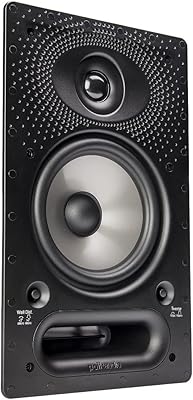
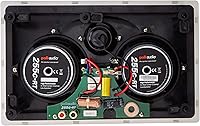
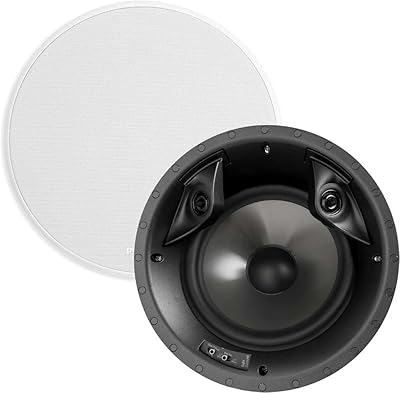
The Polk 255C-RT pairs two 5.25-inch mid/woofer drivers with a 1-inch silk dome tweeter that swivels, which matters when your speaker is fixed into a wall at a set angle. Polk's Dynamic Balance technology reduces the coloration that wall cavities can introduce — a real concern that cheaper in-wall options tend to ignore. The Power Port extends low-end output beyond what drivers this size would normally manage, so lighter theater setups feel less thin in the lower frequencies. A rotating cam mount locks the unit firmly into drywall, and a Distance Toggle lets you tune the frequency response based on your actual seating position relative to the wall.

Best For

This in-wall center channel makes the most sense for homeowners doing a full theater build or renovation where hiding the audio hardware is part of the plan. If you already have a 5.1 or 7.1 receiver and need a strong center channel anchor, this fits that role well. It also suits anyone whose room layout makes a freestanding center speaker awkward — low TV consoles, built-in cabinetry, or rooms with strict aesthetic demands. That said, it rewards buyers who are comfortable cutting drywall themselves or willing to work with an AV installer. Rushing the wall cut is the single biggest risk with any in-wall speaker.

User Feedback

Owners consistently praise dialogue reproduction — voices come through cleanly even in complex action sequences, which is the core job of any center channel. Installation feedback is mostly positive; users find the cam-lock system reliable once the wall opening is cut correctly, though some note the importance of double-checking measurements before committing. The paintable grille earns genuine appreciation from people who care about interior aesthetics. On the downside, buyers stepping up from a larger freestanding center may notice limited bass depth at higher volumes. Long-term durability, however, rarely draws complaints — units purchased years back still appear in positive reviews, which says a lot.

Pros

  • Dialogue clarity is genuinely strong — voices stay distinct and natural even during busy, effects-heavy scenes.
  • The cam-lock mounting system holds firmly in drywall without rattling, even at higher volume levels.
  • Polk's Power Port technology squeezes more low-end out of compact drivers than you would reasonably expect.
  • The paintable grille is thin enough that once painted, most guests simply do not notice it is there.
  • Compatible with a wide range of surround configurations, making it easy to integrate into existing or future setups.
  • The swivel-mount tweeter lets you angle the high-frequency output toward your listening position, which matters when placement is fixed.
  • Distance Toggle provides real tuning flexibility based on how far your seating is from the front wall.
  • Over a decade on the market with consistent positive long-term feedback suggests solid build quality and durability.
  • Included mounting template takes much of the guesswork out of cutting the wall opening accurately.

Cons

  • Bass output thins out noticeably at high volumes without a capable subwoofer backing it up.
  • Installation requires a precise, permanent drywall cut — a mistake here is costly and stressful to correct.
  • The in-wall form factor means repositioning it later is not a realistic option without patching and repainting.
  • Some buyers report the installation template could be more precise, requiring careful double-checking before cutting.
  • At roughly 6.6 pounds, the unit needs secure backing material in the wall cavity for reliable long-term support.
  • No wireless connectivity whatsoever — running speaker wire through walls adds complexity to the installation process.
  • The design prioritizes mid-range and dialogue over full-spectrum performance, so it is not a standalone audio solution.

Ratings

The scores below reflect our AI-powered analysis of verified global user reviews for the Polk Audio 255C-RT In-Wall Center Speaker, with spam, bot activity, and incentivized feedback actively filtered out before any scoring was applied. The results capture both what buyers genuinely love about this in-wall center channel and the recurring frustrations that show up across real-world installations. Nothing has been softened — the numbers reflect the full picture.

Dialogue Clarity
91%
This is where the Polk 255C-RT earns its reputation. Buyers consistently report that voices stay clean, natural, and easy to follow even during dense action sequences with competing sound effects. In dedicated theater rooms, the improvement over budget center channels is immediately obvious.
A small number of users in very large rooms note that at the upper limits of volume, some edge comes into the high-mids that can make certain vocal frequencies sound slightly forward. This is uncommon but worth noting for buyers planning very high-output setups.
Bass Performance
61%
39%
Polk's Power Port technology does meaningful work here — the low-end output is noticeably fuller than you would expect from dual 5.25-inch drivers operating inside a wall cavity. For dialogue-heavy content and moderate listening levels, it holds up well without a subwoofer carrying the entire load.
Buyers stepping down from a large freestanding center channel will feel the difference almost immediately on bass-heavy film soundtracks. The wall cavity limits cone excursion, and without a capable subwoofer in the system, the overall sound can feel thin during action-heavy or music-driven content.
Installation Experience
78%
22%
The rotating cam system is a genuine differentiator — once the wall opening is cut correctly, the speaker locks in solidly without rattling or shifting over time. Buyers with basic DIY experience report completing the installation in under an hour, especially with the included mounting template.
The template accuracy has drawn mixed feedback; some users found it slightly off, requiring careful verification before committing to the cut. For first-timers, the fear of making an irreversible mistake in drywall is real, and the instructions could do more to address that anxiety step by step.
Aesthetic Integration
88%
The paintable sheer grille is a standout feature in practice, not just on paper. Users who took their time applying thin coats of latex paint report that the speaker essentially disappears into the wall — guests frequently do not realize it is there until someone points it out.
Getting the grille paint job right takes patience; a heavy single coat can partially clog the mesh and affect high-frequency transparency. A few buyers also noted the grille feels slightly less premium to the touch than expected at this price point, though it performs its acoustic and visual job well.
Build Quality
83%
Units purchased years — in some cases nearly a decade — ago still appear in positive long-term reviews, which speaks to the durability of the driver materials and overall construction. The polypropylene and silk polymer composite cones show no sign of degradation in normal residential conditions.
The grille hardware feels less substantial than the speaker body itself, and a few buyers reported minor fitting inconsistencies between the grille frame and the wall opening. These are cosmetic rather than functional issues, but they are noticeable for buyers who care about a perfectly finished look.
Value for Money
74%
26%
At its price point, this in-wall center channel competes favorably with alternatives from Klipsch and Monoprice when total cost of ownership is considered — there is no cabinet to buy, no stand, and no visible cable management required. For a full room renovation, those hidden savings add up.
Buyers comparing it purely on audio specs against freestanding competitors at the same price will find the value proposition less convincing. The premium here is partly for the invisible form factor, and shoppers who do not need that specific benefit may feel they are paying for a feature they do not fully use.
Surround System Compatibility
89%
The 8-ohm impedance and broad power handling range mean it drops into virtually any modern AV receiver without configuration headaches. Buyers running everything from entry-level Denon units to higher-end Marantz and Yamaha receivers report clean, stable integration with no impedance warnings or clipping issues.
There is no wireless option at all, which is increasingly noticeable as wireless home theater systems become more common. For buyers trying to minimize wire runs in a finished space, routing speaker cable through walls adds a layer of complexity that not everyone is prepared for.
Tweeter Performance
86%
The 1-inch silk dome tweeter handles sibilance and high-frequency detail gracefully — speech consonants and musical overtones come through without that brittle, piercing quality you get from cheaper polymer dome tweeters. The swivel mount is a practical touch that lets you angle the dispersion toward your seating position.
The swivel adjustment range, while useful, is limited, and buyers in rooms with unconventional seating layouts may find the optimal angle just beyond what the mount can achieve. A wider range of angular adjustment would have made this feature significantly more useful in real-world installations.
Mid-Range Reproduction
87%
Instruments, ambient effects, and layered soundtrack elements all retain their texture and separation, which matters most during scenes that blend music with dialogue. The Dynamic Balance design does real work here — in-wall speakers often suffer from resonance coloration, and this one largely avoids that problem.
At the extreme low end of the mid-range — around the 80 to 150 Hz zone — the hand-off to a subwoofer can feel slightly abrupt if your receiver crossover is not carefully calibrated. This is partly an integration issue rather than a driver flaw, but it does require more attention during AV receiver setup than a freestanding speaker would.
Long-Term Durability
84%
A speaker design that has been commercially available since 2011 and continues to generate positive long-term reviews has clearly passed real-world endurance testing. Users in humid basement theater rooms and air-conditioned media spaces both report consistent performance over years of regular use.
Because it is a permanent wall installation, any component failure down the road requires extraction and potential wall repair — a much more disruptive process than swapping out a freestanding speaker. While failures appear rare, the consequence of one in this form factor is significantly higher than for conventional speakers.
Frequency Tuning Flexibility
72%
28%
The Distance Toggle is a feature that comparable in-wall speakers often skip entirely, and buyers who actually use it notice a meaningful improvement in tonal balance depending on their room dimensions. It is a small switch with a real audible effect, especially in rooms where the front wall is closer to the seating than ideal.
The adjustment is binary rather than continuously variable, which limits how precisely you can dial in the response for unusual room configurations. Buyers with acoustically complex spaces — irregular shapes, heavy soft furnishings, exposed concrete — may find even the toggled adjustment insufficient without additional room correction from their AV receiver.
Packaging & Included Accessories
76%
24%
Polk includes a mounting template, painting instructions for the grille, an owner's manual, and a product brochure — a reasonably complete kit that gets most buyers through installation without needing to source additional information. The template in particular saves time during the wall-marking phase.
The template has drawn enough complaints about minor dimensional inaccuracies that buyers should treat it as a starting guide rather than a definitive stencil. A physical wire connector or terminal block for easier hookup would also have been a welcome addition that competitors at this price sometimes include.

Suitable for:

The Polk Audio 255C-RT In-Wall Center Speaker is built for homeowners who are serious about their home theater setup and equally serious about keeping their living space looking clean. If you are in the middle of a renovation, finishing a basement theater room, or simply tired of a center channel speaker sitting awkwardly on a TV console, this is the kind of solution that makes real sense. It pairs well with 5.1 through 7.1 receivers and holds its own as the anchor of a surround sound system where dialogue intelligibility is the priority. Buyers who are comfortable with basic drywall work — or who plan to hire an AV installer — will find the installation process straightforward thanks to the included template and cam-lock system. It also suits design-forward households where a paintable, nearly invisible grille is not a luxury but a genuine requirement.
Not suitable for:

The Polk Audio 255C-RT In-Wall Center Speaker is not the right call for renters, frequent movers, or anyone who is not ready to commit to cutting a permanent hole in their wall. Once it is in, it is in — that is the fundamental trade-off of any flush-mount speaker. Buyers expecting the same low-frequency weight they would get from a large freestanding center channel will likely be disappointed; the dual 5.25-inch drivers do a respectable job, but physics still applies, and deep bass extension is not this speaker's strong suit without a dedicated subwoofer. Casual listeners assembling a basic 2.1 or soundbar-style setup have no real use for it either. And if you are a dedicated audiophile chasing the absolute highest fidelity regardless of aesthetics, there are freestanding center channels at a similar price point that will outperform it on a pure sound-quality basis.
Specifications

  • Driver Configuration: Each unit houses two 5.25-inch mid/woofer drivers and a 1-inch swivel-mount silk dome tweeter in a 2-way center channel arrangement.
  • Power Handling: The speaker is rated for a maximum power input of 150 watts, making it compatible with most mid-to-high-output home theater receivers.
  • Impedance: Nominal impedance is 8 ohms, which is standard for wired home theater systems and compatible with the vast majority of AV receivers on the market.
  • Frequency Response: The speaker covers a frequency range extending up to 27,000 Hz, ensuring detailed high-frequency reproduction from the silk dome tweeter.
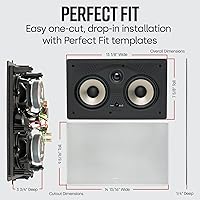
  • Dimensions: The unit measures 9.8″ in depth, 14.81″ in width, and 9.31″ in height, requiring adequate wall cavity clearance during installation.
  • Weight: The speaker weighs approximately 6.6 pounds, meaning the surrounding wall structure should offer solid backing material to support it long-term.
  • Mounting System: Installation uses a rotating cam system with a precision flange that grips drywall securely without requiring additional mounting hardware in most standard builds.
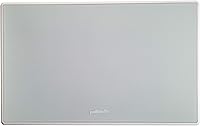
  • Grille Type: The included sheer grille is ultra-thin and designed to be painted with standard interior latex paint so it blends with any wall color.
  • Driver Materials: The mid/woofer cones are constructed from polypropylene and silk polymer composite materials, chosen for their stiffness-to-weight ratio and resistance to moisture-induced warping.
  • Connectivity: This is a purely wired speaker with no wireless capability; it connects via standard speaker wire terminated at the installer's preference.
  • Surround Compatibility: The speaker is designed to function as a center channel in 3.1, 5.1, 6.1, 7.1, and higher surround configurations.
  • Special Technologies: Polk's Power Port, Dynamic Balance driver design, and Distance Toggle are all incorporated to optimize output, reduce wall-cavity distortion, and allow basic frequency tuning.
  • Color Options: Grilles are available in black or white to suit different wall finishes before painting.
  • Series: This speaker belongs to Polk Audio's Vanishing RT Series, a line specifically engineered for flush in-wall and in-ceiling home theater applications.
  • Warranty: Polk Audio covers this speaker under a limited warranty; buyers should confirm current terms directly with Polk or their authorized retailer at time of purchase.
  • Included Contents: The package includes the speaker unit, a white metal grille, a mounting template, an owner's manual, sheer-grille painting instructions, and a registration card.
  • Market Availability: The speaker has been commercially available since January 2011, representing over a decade of continuous production and iterative customer validation.

Related Reviews
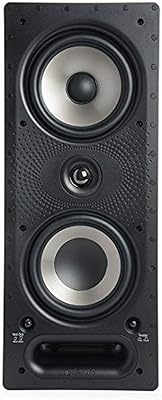
Polk Audio 65-RT 6.5-inch In-Wall Speaker
80%
88%
Sound Quality
83%
Bass Performance
71%
Installation Experience
79%
Value for Money
81%
Build Quality
More
Polk Audio 265-RT In-Wall Speaker
82%
91%
Sound Quality
88%
Installation Experience
86%
Build Quality
93%
Grille & Aesthetics
71%
Bass Performance
More
Polk Audio 255c-LS In-Wall Center Channel Speaker
83%
93%
Dialogue Clarity
88%
Sound Quality Overall
71%
Bass Performance
86%
Installation Ease
89%
Build Quality
More
Polk Audio TL1 Center Channel Speaker
78%
88%
Dialogue Clarity
52%
Bass & Low-End Response
83%
Value for Money
79%
Build Quality & Finish
91%
AV Receiver Compatibility
More
Polk Audio OWM3
Polk Audio OWM3
83%
88%
Sound Clarity
63%
Bass Performance
94%
Versatile Placement
76%
Build Quality
86%
Value for Money
More
Polk Audio 80 F/X RT In-Ceiling Speakers
81%
88%
Sound Quality
74%
Bass Extension
91%
Surround Imaging
93%
RTi Tonal Matching
61%
Installation Experience
More
Polk Audio CS1 Series II Center Speaker
82%
91%
Dialogue Clarity
88%
Value for Money
83%
Build Quality
61%
Bass Performance
84%
Placement Flexibility
More
Polk Audio T30 Center Channel Speaker
79%
88%
Dialogue Clarity
91%
Value for Money
61%
Bass Performance
78%
Build Quality
94%
Setup & Installation
More
Polk Audio T15
Polk Audio T15
82%
88%
Sound Clarity
61%
Bass Response
79%
Build Quality
93%
Value for Money
91%
Ease of Setup
More
Polk Audio DB6502 Component Speaker System
86%
93%
Sound Quality
90%
Bass Performance
88%
Waterproof Durability
85%
Ease of Installation
84%
Mounting Flexibility
More

FAQ

Any AV receiver with an 8-ohm compatible center channel output will work fine. Most home theater receivers sold in the last 15 years support 8-ohm speakers natively, so unless you have an unusual or very old unit, compatibility should not be an issue. Just make sure your receiver can deliver enough clean power — somewhere in the 20 to 150 watt range per channel is the sweet spot.

It is manageable for a careful first-timer, but it does require patience and accuracy. The included mounting template takes the guesswork out of marking your cut, and the rotating cam system makes securing the speaker straightforward once the opening is ready. The part that trips people up is making that first cut — measure twice, and ideally use an oscillating tool or drywall saw rather than rushing it with a utility knife. If you are not confident, hiring an AV installer for a couple of hours is genuinely worth it.

It works perfectly well in a 3.1 or 5.1 system — that is actually the most common configuration buyers use it in. The center channel handles dialogue and front-stage audio regardless of how many surround channels you have, so even a modest system benefits from a strong center anchor like this one.

Standard 16-gauge or 14-gauge in-wall rated speaker wire is what most installers use. You will need to run it from your receiver through the wall cavity to the speaker location, which is easier during construction or renovation when walls are open. If your walls are already closed, a fish tape or wire-fishing kit makes the job doable, though it takes more effort in finished spaces.

Painting it yourself is exactly what Polk designed it for. The included instructions walk you through the process — you use standard interior latex paint and apply it carefully so the fine mesh stays acoustically transparent. Light coats work better than one heavy application. Once done correctly, the grille nearly disappears against the wall, which is the whole point.

It is sold as a single unit. For a center channel position in a home theater setup, one speaker is all you need. If you are also looking to fill the front left and right positions with matching in-wall speakers, Polk makes companion models in the Vanishing RT Series that pair well with it.

That is exactly what the Distance Toggle is there to help with. It lets you adjust the frequency response based on how close your primary listening position is to the speaker, compensating for the acoustic changes that happen when you are sitting near a reflective surface. It is a small but genuinely useful feature that not all in-wall speakers offer.

A freestanding center at the same price will usually offer more cabinet volume and potentially deeper bass extension, simply because it is not constrained by a wall cavity. What this Vanishing Series speaker gives you in return is a completely invisible installation, no cable clutter, and a look that a freestanding speaker cannot match. The trade-off is real — if maximum low-end output from the center channel is your priority and aesthetics are secondary, a freestanding unit may suit you better.

Yes, Polk sells replacement grilles for the Vanishing RT Series. It is worth confirming part availability directly with Polk Audio or an authorized dealer at the time you need one, since parts availability can vary over time. The white metal grille included in the box is the standard option, and it accepts paint well if you want to recolor it after a replacement.

The age actually works in its favor more than against it. A speaker design that has been on the market this long without being discontinued has had years of real-world validation, and Polk has clearly kept it in production because it continues to sell and satisfy buyers. The underlying acoustic engineering has not become obsolete — driver materials, impedance ratings, and surround compatibility standards have not changed fundamentally. You are getting a mature, well-understood product rather than a first-generation design still working out its kinks.

Where to Buy