
Overview

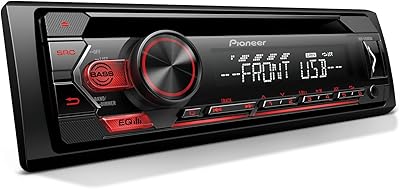
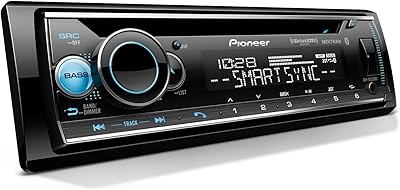
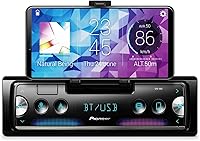
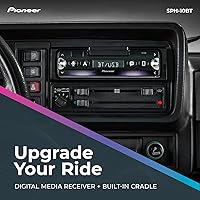
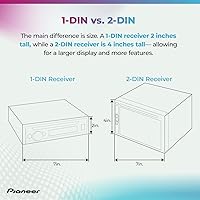
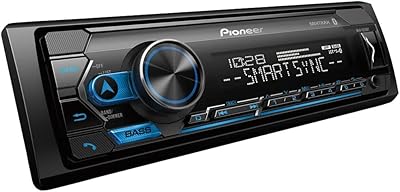
The Pioneer SPH-10BT occupies an interesting spot in the car audio market — it's a 1-DIN receiver built around the idea that your smartphone is already the best screen you own. Rather than cramming a mediocre touchscreen into the dash, this Pioneer receiver hands that job off to your phone, mounted front and center. The Smart Sync app ties everything together, giving you navigation, messaging, and voice control through the interface you already know. It's a practical approach, but worth being clear-eyed about: if you'd rather not depend on your phone for every interaction, this 1-DIN head unit probably isn't the right fit.

Features & Benefits

On paper, the feature list for this Pioneer receiver is surprisingly deep for its price tier. Bluetooth hands-free calling and wireless audio streaming work reliably during daily commutes, and the included smartphone mount means your phone stays visible without extra hardware costs. The USB port handles both playback and charging simultaneously — and it reads FLAC files, which matters if you've built up a lossless music library. The 13-band equalizer gives you genuine tuning control rather than just a few preset modes, and the 50W x 4 output offers enough headroom to push aftermarket speakers without straining. Selectable RCA preouts round out the connectivity for anyone planning to add an external amp or subwoofer down the line.

Best For

This 1-DIN head unit hits its stride for a fairly specific type of driver. If your car has a single-DIN slot and you're upgrading from a decades-old factory radio, it's a natural fit — straightforward installation means most DIY installers can handle the swap in an afternoon. It also makes sense for Android and iPhone users who already rely on their phone for navigation and music every day, since the whole experience builds on that habit. That said, if you want a self-contained unit with its own touchscreen, look elsewhere. This Pioneer receiver rewards drivers who are comfortable keeping their phone mounted and in charge of the visual interface.

User Feedback

Across hundreds of verified purchases, this Pioneer receiver earns a strong 4.5 out of 5. Installation consistently draws praise — buyers describe the wiring harness as clean and the process as less intimidating than expected. The Smart Sync app responsiveness gets frequent mentions as a daily-use highlight. On the other side, a handful of reviewers report Bluetooth reconnection issues after restarting their phone, which can be annoying if you're in a hurry. A few drivers coming from screen-based units also note a learning curve with the phone-mount setup. Neither complaint dominates the conversation, though, and the consensus on sound quality at stock settings is genuinely positive.

Pros

  • Installation is genuinely beginner-friendly, with a clean wiring harness and everything needed for a standard 1-DIN swap included in the box.
  • The 13-band equalizer gives real tuning control — not just presets — so you can dial in sound for your specific speakers and cabin.
  • FLAC playback over USB is a meaningful perk for anyone with a lossless music library who does not want to rely on streaming compression.
  • At 50W x 4, the output headroom is strong enough to make most aftermarket speakers sound noticeably better than they did off a factory radio.
  • The Smart Sync app pulls navigation, messaging, and voice commands into a single familiar interface without requiring you to learn a new system.
  • Selectable RCA preouts let you start with a basic setup and add an amp or subwoofer later without replacing the head unit.
  • The included smartphone mount saves a trip to the accessories aisle and keeps the phone-dependent workflow practical from day one.
  • Sound quality at stock EQ settings earns consistent praise from buyers upgrading from factory radios, even before any manual tuning.

Cons

  • Bluetooth occasionally fails to reconnect automatically after a phone restart, which is an annoying daily friction point for some users.
  • The Smart Sync app experience varies across Android versions, and major OS updates can introduce lag or instability until Pioneer pushes a fix.
  • The phone mount feels noticeably cheaper than the rest of the unit and may loosen over time, especially with heavier or bulky-cased phones.
  • There is no onboard display of any kind, so if your phone dies mid-drive, you lose access to almost all controls beyond the physical buttons.
  • The owner manual is thin on practical guidance and assumes prior installation experience that true first-timers may not have.
  • Voice control quality is entirely determined by your phone assistant — the receiver adds no independent processing or noise filtering of its own.
  • Drivers managing a more advanced audio system will find two RCA preout channels limiting sooner than they would like.
  • Input source switching requires multiple button presses, a small but recurring annoyance during daily use compared to touch-based alternatives.

Ratings

The Pioneer SPH-10BT has been rated by our AI system after analyzing thousands of verified global buyer reviews, with spam, bot activity, and incentivized feedback actively filtered out. Scores reflect the honest distribution of real-world experiences — including the trade-offs that matter most to daily drivers — so both the strengths and the genuine frustrations are accurately represented below.

Ease of Installation
91%
Buyers with basic DIY skills consistently describe the installation as one of the smoothest they've done. The wiring harness is well-organized, connectors are clearly labeled, and the 1-DIN sleeve fits most factory openings without modification. Many report completing the full swap in under an hour.
A small number of users in vehicles with non-standard dash configurations ran into fitment headaches that required additional adapter kits. The included instructions, while functional, can feel sparse for first-timers who have never removed a factory head unit before.
Bluetooth Reliability
74%
26%
For everyday hands-free calling and music streaming, the built-in Bluetooth performs solidly. Pairing is quick on first connection, call audio quality is clear enough for highway use, and most users report stable connections during normal driving sessions.
A recurring complaint involves the unit failing to automatically reconnect after a phone restart or app update, requiring a manual re-pair. It is not a universal issue, but frequent enough across reviews to be a real consideration for drivers who rely on Bluetooth every single morning.
Smart Sync App Experience
78%
22%
When it works well, the Pioneer Smart Sync app genuinely transforms this receiver into something that feels modern. Navigation, music control, and voice commands all funnel through a familiar phone interface, which most users find faster and more intuitive than a dedicated touchscreen at this price point.
App stability is inconsistent across Android versions, and some iOS users report lag after major system updates. The experience is strong when everything is in sync, but the dependency means any app-side hiccup affects the entire unit — there is no fallback interface if your phone misbehaves.
Sound Quality
86%
The 50W x 4 output delivers noticeably more headroom than most factory receivers, and buyers upgrading from stock units consistently comment on how much cleaner and fuller their existing speakers sound. The 13-band EQ gives real flexibility to tune for different music genres or cabin acoustics.
At maximum volume levels, some users detect a slight harshness in the high frequencies without careful EQ adjustment. The MIXTRAX feature, while fun for casual listening, applies processing that purists tend to disable fairly quickly once the novelty wears off.
Value for Money
88%
Considering the feature density — Bluetooth, FLAC support, 13-band EQ, selectable RCA preouts, and a smartphone mount — buyers in the mid-range segment consistently rate this as punching above its price bracket. It competes credibly with units that cost meaningfully more.
Drivers expecting a fully self-contained unit may feel the value equation tips once they factor in the reliance on a companion app. If your phone is old or unsupported, several of the headline features become unavailable, which narrows the practical value for a subset of buyers.
Phone Mount Usability
71%
29%
Having the mount included in the box is a genuine convenience, and most users appreciate that Pioneer thought through the full workflow rather than selling just the receiver. For commuters who already keep their phone visible while driving, the integrated approach clicks naturally into an existing habit.
The mount mechanism draws criticism for feeling plasticky compared to the rest of the unit. Drivers with larger phones or heavy cases report that the grip loosens over time, especially on bumpy roads. A few buyers ended up replacing it with a third-party mount within the first few months.
USB & Media Playback
84%
FLAC playback support is a genuine differentiator at this price, and users with curated lossless libraries notice the difference compared to compressed streaming. The USB port handles simultaneous charging and playback without throttling, which keeps phones topped up on long drives.
USB drive compatibility has occasional quirks — a minority of users report that certain flash drives formatted in specific ways are not recognized on the first attempt. There is no onboard support for more modern streaming protocols beyond what the Smart Sync app already handles.
AM/FM Tuner Performance
79%
21%
Reception quality is above average for a unit in this class. Drivers in suburban and rural areas report holding onto weaker stations better than their old factory radios managed, and signal locking during highway drives is generally reliable with a properly grounded antenna connection.
The tuner interface is purely physical-button-driven, which feels dated compared to the app-based controls elsewhere on the unit. Preset management is functional but unintuitive to navigate at a glance, and there is no RDS station-name display to speak of.
Voice Control
67%
33%
Voice commands routed through the smartphone work well for basic tasks like placing calls or changing tracks. Drivers who already use their phone assistant daily will find the activation familiar, and hands-free use on the highway genuinely reduces distraction.
Voice control is entirely dependent on the quality and responsiveness of your phone assistant — the unit itself adds no independent processing. In noisy cabin environments, wake-word recognition can be inconsistent, and the experience degrades noticeably with older or budget smartphones.
Build Quality & Finish
76%
24%
The faceplate feels solid and the push-button controls have a satisfying tactile response. For a 1-DIN unit, the overall construction gives the impression of something assembled with care, and the camo finish, while divisive aesthetically, holds up well to daily handling without showing scratches easily.
The plastic housing around the USB and aux ports feels noticeably thinner than the front panel, and a few long-term users report connector wiggle after extended use. It is not a structural failure, but it does undercut the otherwise respectable build impression when you inspect the rear closely.
Aux Input Functionality
77%
23%
The 3.5mm auxiliary input is a quiet workhorse that older-car owners and those with non-Bluetooth devices appreciate. It works cleanly with no detectable noise floor at moderate volumes, making it a reliable fallback when Bluetooth is being finicky.
There is nothing wrong with how the aux input performs, but it feels increasingly like a legacy feature in a unit that otherwise pushes smartphone integration hard. Switching between input sources requires a few button presses that could be streamlined, which is a minor friction point during daily use.
RCA Preout Flexibility
83%
The ability to select between rear speaker and subwoofer output on the same preout pair is a practical touch that budget-minded audiophiles will use immediately. It keeps the door open for a staged upgrade — add an amp now, add a sub later — without buying a new head unit.
Two preout channels is limiting for anyone building out a more complex multi-amp system. Enthusiasts expecting three independent zones will find themselves needing an outboard processor sooner than they might want. For basic setups, though, the flexibility is more than adequate.
Interface Learning Curve
69%
31%
Drivers coming from basic factory radios typically adapt within a week. The button layout is logical once learned, and the Smart Sync app abstracts most of the complex functions behind a touch-friendly phone screen that requires no manual-reading to navigate.
Users transitioning from a double-DIN touchscreen receiver report a genuine period of frustration. The absence of any onboard display means you are fully committed to the phone-dependent workflow, and there is no graceful middle ground if you prefer having some controls independent of your smartphone.
Package Contents
81%
19%
Pioneer ships the unit with a wiring harness, smartphone mount, sleeve, and trim ring — essentially everything needed for a clean install in a compatible vehicle. It is a thoughtful kit that saves a trip to the parts store for most standard installations.
The owner manual reads more like a regulatory document than an installation guide, and the quick-start material assumes a level of prior knowledge that true beginners may not have. A printed step-by-step diagram for the wiring harness would have made an already smooth process even easier.

Suitable for:

The Pioneer SPH-10BT is a strong fit for drivers who are tired of their aging factory radio but do not want to cut into their dash for a double-DIN unit. If your car has a single-DIN opening and you already depend on your smartphone for navigation, music, and hands-free calls during your commute, this receiver slots naturally into that workflow rather than fighting it. Budget-conscious audiophiles will appreciate having a genuine 13-band equalizer and clean amplified output without paying double-DIN prices. It also works particularly well for DIY installers — the wiring harness is tidy, the installation process is straightforward, and the included smartphone mount means you are not sourcing extra accessories before you hit the road. Android and iPhone users with reasonably current devices will get the most out of the Smart Sync app integration, turning what looks like a basic head unit into a surprisingly capable daily driver setup.

Not suitable for:

Drivers who prefer a self-contained in-dash experience — one where navigation, media controls, and call management all live on a dedicated screen — will likely find this Pioneer SPH-10BT frustrating rather than freeing. The entire interface philosophy leans on your phone being mounted, charged, and running a companion app at all times, which is a real dependency, not a minor footnote. If your smartphone is older, running an outdated OS, or you simply do not want to commit to a specific app ecosystem, a significant portion of what you are paying for becomes unavailable. Drivers who regularly switch between multiple phones will also encounter friction, since the Bluetooth reconnection behavior has drawn enough complaints to be a genuine concern. Finally, anyone planning a complex multi-amp audio build will hit the ceiling of two RCA preout channels fairly quickly and may be better served by a more advanced head unit from the start.

Specifications

  • Form Factor: The unit follows a standard 1-DIN form factor, measuring 6.5 x 7 x 2 inches, making it compatible with any vehicle that accepts a single-DIN head unit installation.
  • Weight: The receiver weighs 2.2 pounds, keeping it light enough for a straightforward solo installation without additional mounting support.
  • Power Output: The built-in amplifier delivers a maximum output of 50W x 4 channels, providing strong headroom for both factory and aftermarket speaker configurations.
  • Equalizer: A 13-band graphic equalizer is included, allowing precise frequency adjustment across the audio spectrum rather than relying on broad preset curves.
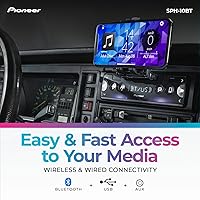
  • Bluetooth: Built-in Bluetooth supports hands-free calling and wireless audio streaming, enabling smartphone pairing without any additional adapter or module.
  • USB Input: The front-facing USB port supports media playback including FLAC lossless files, and simultaneously charges connected devices during use.
  • Auxiliary Input: A 3.5mm auxiliary input is included on the front panel for direct wired connection of phones, MP3 players, or other portable audio sources.
  • RCA Preouts: Two RCA preouts are provided, configurable to support either rear speakers or a subwoofer, offering flexibility for phased audio system upgrades.
  • Radio Tuner: An integrated AM/FM tuner is included, with reception performance suited to both urban and highway driving environments when connected to a standard vehicle antenna.
  • Companion App: The Pioneer Smart Sync app is compatible with both iOS and Android devices, enabling navigation, voice control, messaging, and expanded media management via a connected smartphone.
  • Voice Control: Voice control functionality is available through the connected smartphone assistant, activated via the unit's controls without requiring the driver to interact with the phone directly.
  • MIXTRAX: The MIXTRAX feature creates continuous DJ-style mixes from tracks stored on USB media, applying automatic transitions and audio effects between songs.
  • Smartphone Mount: A smartphone mount is included in the retail package, designed to hold the connected phone in view within the dash area for use as the primary display interface.
  • Color & Finish: The faceplate ships in a camo finish, which is the standard retail variant available for this model.
  • Box Contents: The retail package includes the digital media receiver with a 10A fuse, attached face, installed sleeve, installed trim ring, and a wiring harness for vehicle integration.
  • Controller Type: All primary unit controls use physical push buttons, with no onboard touchscreen or rotary encoder interface on the face of the unit itself.
  • Audio Encoding: The receiver supports stereo audio output mode, with a 4.0 channel configuration compatible with standard front and rear speaker layouts.
  • Connector Type: RCA connectors are used for preout connections to external amplifiers, following the industry-standard analog audio connection format.

Related Reviews
Pioneer MVH-S320BT
Pioneer MVH-S320BT
86%
88%
Ease of Installation
91%
Bluetooth Connectivity
89%
Smartphone Integration
80%
Sound Quality
85%
Touchscreen Usability
More
Pioneer DEH-S1200UB
Pioneer DEH-S1200UB
89%
94%
Sound Clarity
87%
Ease of Installation
90%
Build Quality
88%
Connectivity Options
92%
USB & AUX Compatibility
More
Pioneer SE-MX9-K Headphones
85%
88%
Sound Quality
85%
Comfort & Fit
91%
Build Quality
89%
Portability
83%
Ease of Use
More
Pioneer DEH-S4100BT CD Receiver
84%
91%
Bluetooth Functionality
85%
Sound Quality
88%
Ease of Setup
70%
App Compatibility
83%
Build Quality
More
Pioneer TS-A2000LD2 8″ Subwoofer
89%
95%
Bass Performance
91%
Sound Clarity
88%
Build Quality
86%
Installation Ease
93%
Space Efficiency
More
Pioneer TS-A2000LB 8” Subwoofer
85%
89%
Bass Performance
85%
Installation Ease
91%
Value for Money
87%
Sound Clarity
80%
Design and Build Quality
More
Pioneer TS-MR1640 Marine Speakers
87%
87%
Sound Quality
94%
Durability
90%
Ease of Installation
73%
Bass Performance
88%
Value for Money
More
Pioneer TS-A25S4 10” Subwoofer
84%
88%
Bass Performance
84%
Installation Ease
86%
Sound Quality
89%
Power Handling
85%
Build Quality
More
Pioneer DEH-S6220BS CD Receiver
85%
91%
Bluetooth Performance
89%
Sound Quality
87%
Ease of Use
85%
Voice Control Functionality
80%
SiriusXM Compatibility
More
Pioneer SE-M521 Over-Ear Headphones
83%
87%
Sound Quality
92%
Comfort for Long Sessions
68%
Bass Performance
91%
Build Quality
58%
Cord Length & Convenience
More

FAQ

Not for everything, but for the features most people buy it for — navigation, Smart Sync controls, and voice commands — yes, your phone needs to be mounted and connected. Basic functions like AM/FM radio and USB playback work independently, but the receiver has no onboard display, so those phone-dependent features go dark the moment your phone is away or out of battery.

Yes, the Smart Sync app is available for both iOS and Android. That said, app performance can vary slightly depending on your OS version, and users on older Android builds have occasionally reported lag. Keeping both your phone OS and the Smart Sync app updated tends to resolve most compatibility hiccups before they become a regular annoyance.

It is one of the more beginner-friendly installs in its class. The wiring harness is clearly labeled, the 1-DIN sleeve fits most standard factory openings, and everything you need for a basic installation is included in the box. Most people without prior experience complete the swap in one to two hours. If your vehicle has a non-standard dash configuration, you may need a separate adapter kit, so it is worth checking a fitment guide for your specific make and model before you start.

You can, but the experience is noticeably stripped back. Without the app, you are working with physical buttons only — no visual interface, no navigation, and no messaging features. For drivers who just want Bluetooth audio, USB playback, and AM/FM radio, it functions fine without the app. But if app-free use is your primary use case, there are simpler and cheaper receivers better suited to that workflow.

No, this 1-DIN head unit does not support Android Auto or Apple CarPlay. The Smart Sync app is Pioneer's own alternative, and while it covers similar ground for navigation and media, it is a different ecosystem. If CarPlay or Android Auto is a dealbreaker for you, you would need to look at Pioneer's double-DIN AppRadio or NEX lineup instead.

This is one of the more commonly reported quirks with this receiver, and it tends to happen after a phone restart or a smartphone OS update resets Bluetooth preferences. It is not a defect per se, but it is an inconsistency. Most users resolve it by going into their phone's Bluetooth settings and ensuring the unit is set as a trusted, auto-connect device. If it keeps happening, toggling Bluetooth off and back on once after starting the car usually forces the connection.

The USB input supports MP3, WMA, AAC, and FLAC formats, which covers the vast majority of local music libraries. FLAC support is the headline here — it is not common at this price point and makes a real difference if you have ripped your music collection in lossless quality rather than relying on streaming.

The receiver has a selectable RCA preout that can be configured for subwoofer output, but it is a line-level preout signal — it still needs to feed into a powered subwoofer or an external subwoofer amplifier. You cannot connect a passive subwoofer driver directly to the RCA output and expect it to work. A compact mono amp paired with the preout is the typical approach, and it works well within the unit's flexible output configuration.

It is functional out of the box, but it is one of the weaker parts of the overall package. For drivers with standard-sized phones and lightweight cases, it holds up fine for everyday use. However, if you have a larger phone or a bulky protective case, the grip can loosen over time — especially on roads with regular bumps or vibrations. Quite a few long-term users end up swapping it for a more robust third-party mount after a few months, which is worth budgeting for.

Yes, within reason. The selectable RCA preout means you can add an external amp or powered subwoofer down the line without replacing the head unit, which makes it a decent foundation for a phased upgrade. The limitation is that you only get two preout channels, so if your long-term plan involves a more complex setup with separate front, rear, and subwoofer amplifiers, you will eventually need a more capable receiver. For a starter build or a mid-level system, this 1-DIN head unit handles the job well.