Overview

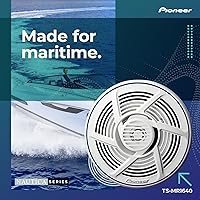
The Pioneer TS-MR1640 6.5-Inch Marine Speakers are a solid mid-range option from a brand that has earned genuine credibility in marine audio over decades. These marine speakers are built as a direct drop-in replacement for any standard 6.5-inch cutout — no rewiring, no custom fabrication required. The kit arrives complete with grilles, a mounting template, and stainless steel hardware, so you have everything you need straight out of the box. The dual-cone, 2-way coaxial design keeps the setup simple without sacrificing full-range coverage, which is exactly what most weekend boaters are actually looking for.

Features & Benefits

Power ratings on marine speakers can mislead, so it is worth being straight: 30W RMS is the number that matters for real listening, not the 160W peak figure. That said, 30W pairs well with most factory and aftermarket head units. The dual-cone waveguide design handles vocals and mids genuinely well — conversations over background music stay clear, which counts when you are out on the water with a group. The 4-ohm impedance keeps compatibility broad, and the included stainless steel mounting hardware is a practical bonus, since marine environments eat through inferior fasteners faster than most buyers expect.

Best For

This Pioneer speaker pair suits pontoon and recreational boat owners who want a straightforward audio upgrade without a complicated installation. If your factory speakers have worn out after a few seasons, these drop right in without cutting new holes or rerouting wires. They hold up well under spray and humidity in freshwater and mild saltwater conditions — though they are water-resistant, not waterproof, so do not expect them to survive submersion. Anyone chasing deep, thumping bass should look at dedicated subwoofer setups instead; this is a pair built for clear, balanced sound at a practical, no-fuss price.

User Feedback

Buyers who have run these marine speakers through full boating seasons consistently praise two things: how straightforward the installation is, and how useful the included stainless clips are — a small touch that saves a separate hardware run. On the downside, bass depth draws fair criticism from listeners expecting more low end, which is an honest limitation of dual-cone coaxial designs rather than a defect. A handful of reviewers also mention that the grilles feel lighter than the speakers themselves. Overall, satisfaction skews noticeably positive among casual weekend boaters running stock head units, and noticeably less so among those with higher-powered audio systems.

Pros

  • Drop-in installation into any standard 6.5-inch marine cutout — no cutting or rewiring needed.
  • The kit includes stainless steel clips and screws, saving you a separate hardware run.
  • UV-resistant housing holds up well against sun fading across multiple boating seasons.
  • Vocal and midrange clarity is noticeably better than most aging factory marine speakers.
  • 4-ohm impedance works with virtually any factory or aftermarket marine head unit out of the box.
  • Comes with grilles and a mounting template — genuinely everything you need in one box.
  • Lightweight build at under 4.5 pounds makes solo installation easy on overhead or angled mounts.
  • The Pioneer name carries real warranty support and parts availability, unlike obscure off-brand options.
  • Water-resistant construction handles rain and spray reliably in freshwater and mild coastal conditions.

Cons

  • Bass output is modest — listeners who want real low-end punch will need to add a subwoofer separately.
  • 30W RMS is the honest working power; the 160W peak figure on the box can create unrealistic expectations.
  • Grille construction feels noticeably lighter than the speaker bodies, which some buyers find underwhelming.
  • Not rated for submersion, so placement in areas prone to standing water or heavy splash is a risk.
  • White color is the only option, which may not suit every boat interior or deck aesthetic.
  • Performance improvement is limited when paired with a very low-powered factory head unit.
  • No built-in tweeter means high-frequency detail, while decent, does not match a true 3-way setup.
  • Long-term durability in heavy saltwater exposure has shown some inconsistency in multi-season user reports.

Ratings

The scores below for the Pioneer TS-MR1640 6.5-Inch Marine Speakers were generated by our AI system after processing verified buyer reviews from multiple global markets, with spam, bot submissions, and incentivized feedback actively filtered out. Each category reflects the honest distribution of real user experiences — not just the highlights — so both the genuine strengths and the recurring frustrations are transparently represented. Where scores dip, the explanations tell you exactly why.

Ease of Installation
93%
Buyers consistently call this one of the most straightforward marine speaker installs they have done. The included mounting template takes the guesswork out of alignment, and the stainless speed clips make securing the grilles fast even for first-timers working alone on a tight deck cutout.
A small number of users with non-standard or shallow mounting cavities hit clearance issues with the 2.25-inch depth. Those replacing speakers on older boats with corroded original hardware occasionally note that the prep work, not the install itself, adds unexpected time.
Sound Clarity
84%
Vocal reproduction is the clear standout, with the waveguide design making conversations over background music noticeably cleaner than typical factory marine speakers. Buyers running the Pioneer TS-MR1640 with a stock radio frequently comment that dialogue in podcasts and call audio feels sharper than they expected at this price tier.
Clarity has its ceiling, and at higher volumes — particularly on open water with wind noise — some listeners find the high-frequency detail gets a bit thin. A dedicated tweeter setup would outperform this dual-cone design in critical listening scenarios.
Bass Performance
54%
46%
For casual background music on a slow afternoon cruise, the low end is adequate and the overall frequency balance is inoffensive. Users who primarily play softer genres like country, acoustic, or classic rock report that bass feels appropriately present rather than absent.
Bass-heavy listeners are the most consistent source of low ratings for these speakers. Hip-hop, EDM, and heavy rock fans frequently note that the low end feels hollow, and without a subwoofer to fill in the gaps, these speakers struggle to satisfy anyone who expects real thump from their marine audio.
Durability & Weather Resistance
78%
22%
Most buyers who have run these through full boating seasons — including rainy days and regular saltwater spray on coastal boats — report that the housing holds up without cracking, yellowing, or losing structural integrity. The UV-resistant plastic is a genuine differentiator over generic off-brand marine speakers in the same price range.
A subset of long-term reviewers, particularly those boating in harsh saltwater environments year-round, note some surface degradation after two or more seasons. The speakers are water-resistant, not waterproof, and a few buyers who had them exposed to persistent pooling water reported premature deterioration.
Hardware Quality
91%
The stainless steel mounting clips and screws draw consistent and specific praise — buyers who have dealt with rusted speaker hardware on previous installs know exactly how valuable corrosion-resistant fasteners are. Getting a full set of quality marine-grade hardware in the box rather than generic screws is a detail that experienced boaters genuinely notice and appreciate.
The grilles, while functional, feel noticeably lighter and less substantial than the speaker bodies themselves. A handful of reviewers mention that the grille clips feel looser than expected, which is a minor but noticeable quality gap given how solid the speaker housings feel.
Volume & Loudness
67%
33%
Paired with a factory head unit in the 15W to 30W RMS range, these marine speakers produce volume that works well for conversational background listening on a pontoon at moderate speeds. The 90 dB signal-to-noise ratio keeps output clean and hiss-free at those comfortable listening levels.
Users who expected the 160W peak figure to translate into serious loudness frequently come away disappointed. The real-world ceiling is set by the 30W RMS rating, and on larger boats or in open-air environments with significant ambient noise, maximum volume can feel underwhelming without an external amplifier.
Value for Money
82%
18%
For a named brand with a proven track record in marine audio, these speakers hit a reasonable balance between cost and capability for a weekend recreational boater. The complete kit — speakers, grilles, hardware, and template — removes the need for any supplementary purchases for a basic install.
Buyers who prioritize bass output or who boat in extreme conditions may find that this price point does not fully deliver on those specific needs, and end up spending more on a subwoofer or a weather-tougher alternative anyway. For that narrower group, the value calculation does not hold up as well.
Build & Fit Finish
71%
29%
The speaker bodies themselves feel solid and well-molded, and the white finish looks clean against typical marine deck surfaces. Buyers who place these in visible positions on a pontoon report that they look presentable and appropriately matched to standard white marine trim.
The grilles are the weak link aesthetically — they have a noticeably more plastic, lightweight feel compared to the speaker housing, which can look mismatched up close. Buyers who care about deck aesthetics sometimes replace the grilles with aftermarket options after installation.
Compatibility
89%
The standard 6.5-inch sizing and 4-ohm impedance make these a near-universal drop-in for boats, pontoons, and even some larger watercraft with existing 6.5-inch cutouts. Almost no buyers report wiring incompatibility issues when replacing comparable-era factory marine speakers.
The 2.25-inch mounting depth occasionally causes problems on boats with especially shallow speaker cavities, particularly in older fiberglass hulls where space behind panels is limited. Buyers should measure mounting depth before purchasing rather than assuming fit.
Midrange Presence
81%
19%
The waveguide design does its job well in the midrange, where instruments like acoustic guitar and piano come through with decent body and presence. For spoken content — radio, podcasts, navigation prompts — midrange clarity is clearly the design's strongest suit.
At higher listening volumes the midrange can compress slightly, losing some of its definition. Buyers comparing directly to a proper component speaker setup will notice the dual-cone design has limits in reproducing complex layered mixes with full midrange separation.
Packaging & Unboxing
76%
24%
Everything is organized and protected in standard retail packaging, and the inclusion of a specifications and template sheet on the box itself is a practical touch that makes planning the install easier before you even open the box fully.
The packaging is functional rather than premium, which may matter to buyers purchasing these as a gift or expecting a more polished unboxing experience at this price point. No installation guide beyond the template is included, which some first-time installers find limiting.
Long-Term Reliability
73%
27%
Many buyers who have owned the Pioneer TS-MR1640 for two or more boating seasons report that it continues to perform without notable audio degradation, provided it is installed in a reasonably protected location and rinsed after saltwater exposure.
The sample of very long-term user reviews — three seasons or more in active saltwater use — shows a meaningful drop in satisfaction, with cone and surround integrity being the most commonly cited issues. Longevity is decent but not exceptional for demanding marine environments.
Grille Fit & Security
63%
37%
For calm-water and freshwater boating, the grilles stay in place reliably under normal conditions and do an adequate job protecting the speaker cones from spray and debris. Most buyers do not report grille loss under typical use.
On rougher water or boats with heavy vibration, some buyers report that the grilles work loose over time. The clip-on mechanism, while convenient during installation, does not inspire the same confidence as a screw-down grille design for high-vibration applications.

Suitable for:

The Pioneer TS-MR1640 6.5-Inch Marine Speakers are a smart pick for recreational boaters who want a reliable audio upgrade without the hassle of a complicated install. If your factory speakers have started sounding thin, distorted, or have simply given up after years of sun and spray, this Pioneer speaker pair drops straight into any standard 6.5-inch cutout and gets you back to good sound in an afternoon. Weekend pontoon owners, freshwater lake boaters, and coastal cruisers who deal with occasional saltwater spray will find the UV-resistant housing and corrosion-resistant hardware genuinely useful over multiple seasons. DIY-friendly buyers will appreciate that the kit includes everything needed — grilles, mounting template, and stainless steel fasteners — so there are no last-minute hardware store runs. Anyone running a stock or modestly upgraded head unit will also find that the 4-ohm impedance and 30W RMS rating pair naturally with what is already on the boat.

Not suitable for:

Buyers chasing deep, room-filling bass should look elsewhere before committing to these marine speakers, as the dual-cone coaxial design is optimized for clarity and vocal presence rather than low-end punch. If you are building out a serious marine audio system with a dedicated amplifier pushing high wattage, the 30W RMS ceiling of the Pioneer TS-MR1640 6.5-Inch Marine Speakers will likely feel like a bottleneck. Boaters who spend extended time in genuinely harsh saltwater environments — offshore fishing, open-ocean cruising — may also want to consider speakers with a higher IP rating, since these are water-resistant rather than waterproof. Those who care a great deal about aesthetics should know that the grilles are functional rather than premium in feel, which can stand out on a nicely finished deck. Finally, if your existing speaker cutouts are non-standard in size or depth, the standard 6.5-inch form factor will not save you from custom fabrication work.

Specifications

  • Speaker Size: Each driver measures 6.5 inches in diameter, fitting any standard marine or automotive cutout designed for that size.
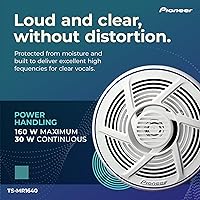
  • Peak Power: The speakers are rated at 160W peak power, which represents the maximum short-term power they can handle without damage.
  • RMS Power: Continuous (RMS) power handling is 30W per speaker, which is the practical figure to match against your head unit output.
  • Impedance: Both speakers are 4-ohm, making them compatible with the vast majority of factory and aftermarket marine receivers without additional wiring changes.
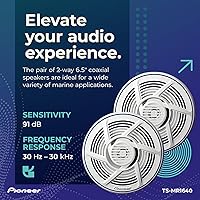
  • Frequency Response: The drivers cover a frequency range up to 30,000 Hz, handling the full spectrum from bass through upper treble.
  • Signal-to-Noise Ratio: A 90 dB signal-to-noise ratio means background hiss stays well controlled at normal listening volumes on the water.
  • Speaker Type: These are 2-way coaxial, dual-cone speakers, integrating woofer and tweeter functions into a single driver with a waveguide for improved vocal clarity.
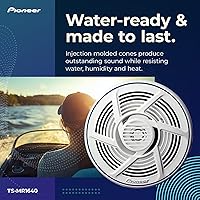
  • Water Resistance: The speakers are rated water-resistant and built to withstand spray, humidity, and saltwater exposure, but they are not designed for submersion.
  • UV Resistance: The plastic housing is UV-treated to resist fading, yellowing, and surface degradation from prolonged sun exposure on open decks.
  • Mounting Type: Surface mount installation is used, with the speaker fitting flush against the mounting surface and secured with the included hardware.
  • Housing Material: Speaker bodies are constructed from UV-resistant plastic engineered to tolerate marine environmental conditions over multiple seasons.
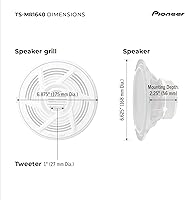
  • Dimensions: Each speaker measures 6.5″ in diameter and 2.25″ in depth, which determines the minimum cavity depth required behind the mounting surface.
  • Weight: The complete pair weighs 4.23 pounds total, keeping the load light for overhead or angled deck installations.
  • Color: Both speakers and their grilles are finished in white, which is the only available color option for this model.
  • Included Hardware: Each package contains two speakers, two grilles, eight stainless steel speed clips, eight 1-1/8″ stainless steel screws, and a mounting template.
  • Audio Output: The pair operates in stereo mode, with each speaker handling one channel of a standard two-channel audio source.
  • Unit Count: One package contains two speakers, making it a complete stereo pair replacement for a single listening zone on a boat.
  • Warranty: Pioneer includes a limited warranty with these speakers; buyers should register the product and retain proof of purchase for any claims.

Related Reviews
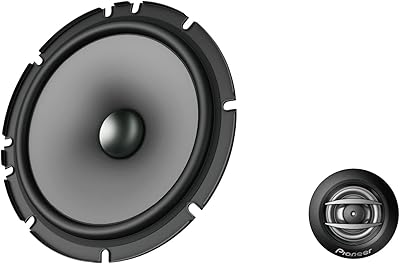
Pioneer TS-A652C 6.5″ 2-Way Component Car Speakers
78%
88%
Sound Clarity & Midrange Quality
67%
Bass Response
79%
Tweeter Performance
83%
Installation Ease
74%
Vehicle Compatibility
More
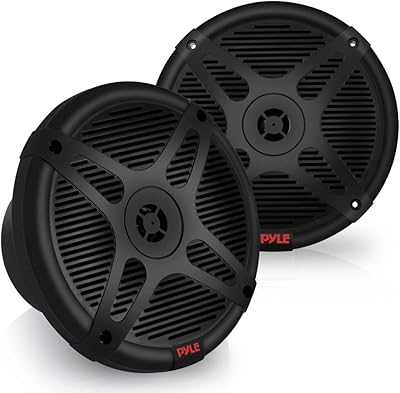
Pyle PLMRF65SB 6.5-inch Marine Speakers
67%
78%
Waterproof & Weather Resistance
63%
Sound Quality
74%
Build Quality & Durability
51%
Wireless RF Performance
86%
Installation & Fitment
More
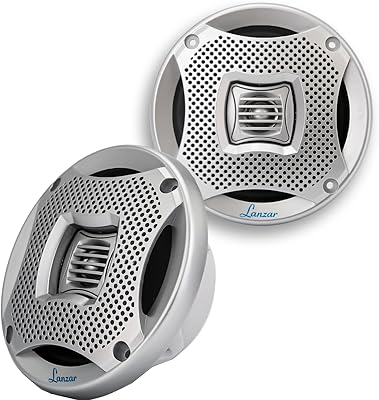
Pyle Lanzar AQ6CXS 6.5-inch Marine Speakers
73%
88%
Value for Money
91%
Ease of Installation
72%
Water Resistance
74%
Sound Quality
51%
Bass Response
More
Pioneer TS-MR2040 Marine Speakers (Pair) 8-inch
86%
88%
Sound Quality
94%
Durability Against Weather
85%
Installation Ease
72%
Bass Performance
90%
Build Quality
More
Sony XS-MP1621 6.5-Inch Marine Coaxial Speaker
72%
88%
Water & Weather Resistance
61%
Sound Quality
79%
Build Quality
91%
Ease of Installation
67%
Volume & Power Output
More
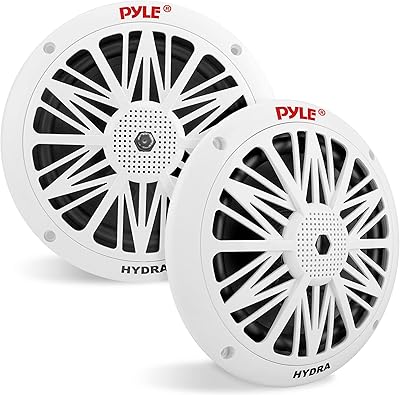
Pyle PLMR62 6.5-inch Marine Speakers
75%
88%
Waterproofing & Weather Resistance
67%
Sound Quality
73%
Build Quality & Materials
91%
Ease of Installation
86%
Value for Money
More
Kenwood KFC-1633MRW 6.5-Inch Marine Speakers
73%
83%
Value for Money
76%
Sound Quality
71%
Durability
67%
Water Resistance
89%
Ease of Installation
More
Herdio HMS-6005 6.5-Inch Marine Bluetooth Speakers
74%
83%
Value for Money
88%
Ease of Installation
76%
Sound Clarity
57%
Bass Response
84%
Bluetooth Connectivity
More
Blaupunkt GTM652W 6.5-Inch 200W Waterproof Marine Speakers
83%
88%
Sound Quality
94%
Waterproof Performance
83%
Ease of Installation
91%
Build Quality & Durability
86%
Volume & Clarity at High Levels
More
Rockville RKL65MBW 6.5″ Marine Speakers
77%
91%
Weather Resistance
68%
Sound Quality
54%
Bass Performance
88%
Installation Ease
82%
LED Feature
More

FAQ

If your current speakers are 6.5-inch, yes — the Pioneer TS-MR1640 6.5-Inch Marine Speakers are designed as a direct drop-in replacement. A mounting template is included in the box to help you line everything up correctly. No cutting or custom fabrication is needed for a standard 6.5-inch opening.

Anything in the 15W to 30W RMS range per channel is the sweet spot for these speakers. The 160W figure on the packaging is peak handling capacity, not the continuous power draw. Most factory marine radios and entry-level aftermarket head units sit in exactly that range, so you should be fine without an external amplifier.

They are water-resistant, which means they handle rain, spray, and humidity without issue. However, they are not rated for submersion or prolonged standing water contact. For most recreational boating scenarios — pontoons, freshwater lakes, mild coastal use — that level of protection is more than adequate.

No extra hardware is necessary. The kit ships with eight stainless steel speed clips and screws, which is everything you need to mount both speakers securely. A basic Phillips screwdriver is all the tooling required for a standard installation.

In most cases you can use your existing wiring without any changes. These are 4-ohm speakers, which matches the output impedance of nearly all factory and aftermarket marine receivers. As long as your current wiring is in reasonable condition, just disconnect the old connectors and attach the new ones.

These marine speakers do a solid job with midrange and vocal clarity, but they are not bass-heavy by design. The dual-cone coaxial configuration prioritizes balanced, full-range sound over deep low-end output. If thumping bass is your priority, you would need to add a separate subwoofer to the system.

They hold up well in light saltwater environments — spray, humid salt air, and occasional splashing are not a problem. For boats that spend serious time offshore or in consistently harsh saltwater conditions, a speaker with a higher IP rating might offer better long-term protection. For weekend coastal or inshore use, these perform reliably.

The grilles clip on using the included stainless steel speed clips rather than screwing down separately. They are designed for a reasonably secure fit, though some buyers note they feel lighter than expected. They do their job for weather protection and aesthetics without adding installation complexity.

Each speaker is 2.25 inches deep from the mounting face to the back of the magnet assembly. That is the minimum cavity depth you need behind your mounting surface. It is worth measuring your available depth before purchasing, especially on boats with shallow mounting locations like thin fiberglass panels.

A rinse with fresh water after saltwater exposure is the best routine maintenance you can do. For the grilles and housing, a mild soap and soft cloth work well for removing grime or oxidation. Avoid high-pressure washing directly at the speaker cone, and make sure water drains away from the mounting area rather than pooling against the housing.