Overview

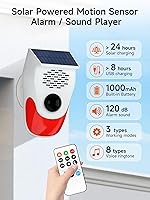
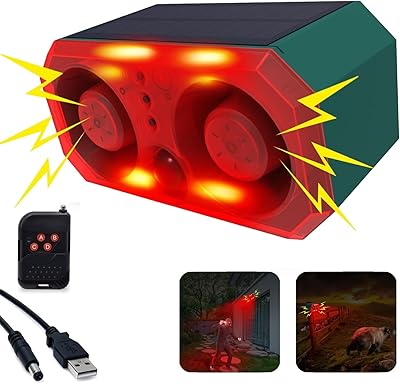
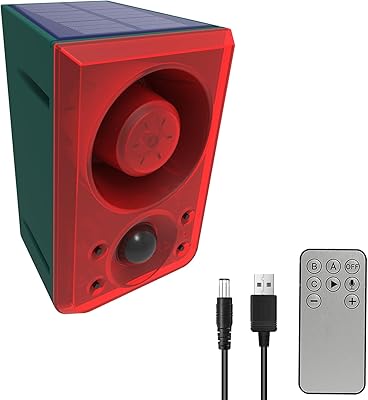
The PILSAMAS CT90Y Solar Motion Sensor Alarm stands out in a crowded category by letting you replace its factory sounds with your own recorded voice clips — something almost no competitor at this price point offers. Whether you need to warn deer away from a vegetable garden or alert pool guests to slippery surfaces, this solar alarm adapts to situations most generic deterrents cannot. It runs on a built-in lithium-ion battery kept charged by its solar panel or a USB cable, and its IP65 weatherproofing keeps it functional through rain and frost. Just keep expectations realistic: this is a deterrent device, not a monitored security system.
Features & Benefits

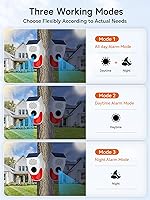
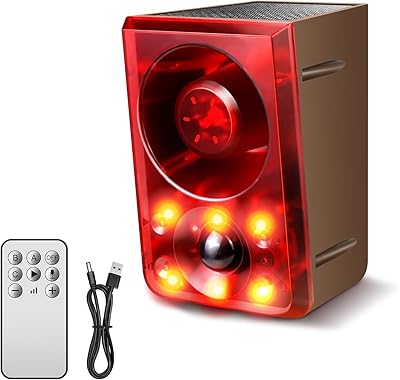
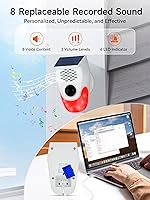
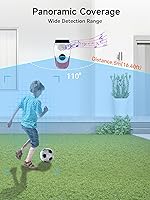
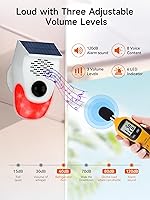
The custom voice upload capability is where this outdoor alarm device earns its keep. Plug in a USB drive loaded with up to 8 MP3 or WAV recordings — a gunshot, a barking dog, or a recorded safety message — and the alarm plays them instead of a generic beep. Motion is detected across a 110-degree arc out to 20 feet, which is adequate for most entry points and garden perimeters. When triggered, the 120dB output combined with six flashing LEDs makes it hard to ignore. Three scheduling modes let you silence it during the day or run it around the clock, depending on your situation.

Best For

This solar alarm is a natural fit for rural property owners who deal with deer, bears, or raccoons around gardens, chicken coops, or outbuildings. It is equally useful as a pool safety alert — record a voice warning about deep water or a slippery deck, and the alarm broadcasts it automatically whenever someone approaches. Because it charges off the sun and requires no wiring, it works well in locations where running power is not practical: a detached shed, a remote gate, a lakeside dock. If you want a low-maintenance deterrent with no subscription fees, this motion-triggered deterrent covers a lot of ground for the price.

User Feedback

Buyers consistently appreciate how quick and painless setup is — most report mounting and connecting the device in under 10 minutes. The custom voice feature tends to get enthusiastic reactions, especially from users who recorded personalized pool warnings or animal deterrent sounds. On the downside, a recurring concern involves solar charging performance: in overcast climates or during short winter days, some users find the battery drains faster than the panel can replenish it. A few buyers also noted that real-world detection range fell slightly short of the advertised 20 feet, particularly in dense foliage. The remote control, however, generally met expectations for range and reliability.

Pros

  • Custom voice upload lets you record personalized audio warnings rather than relying on a fixed, generic alarm tone.
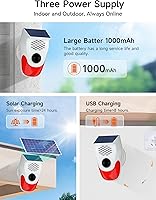
  • Solar charging combined with USB backup means this solar alarm stays powered even in off-grid locations.
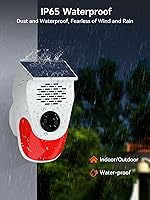
  • IP65 waterproofing holds up reliably through rain, frost, and high summer heat without special maintenance.
  • The 120dB output is genuinely loud and gets attention in outdoor environments where ambient noise is a factor.
  • Three scheduling modes let you avoid nuisance alerts during hours when motion is expected and harmless.
  • Setup takes under 15 minutes for most users — no electrician, no drilling complexity, no tools required.
  • Rotating through multiple custom sounds helps prevent animals from habituating to a single repeated noise.
  • Six flashing LEDs add a visual deterrent layer that works even when sound alone might not be enough.
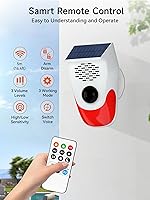
  • The included remote control lets you arm or disarm the motion-triggered deterrent without walking to the unit.
  • At its price point, the feature set — especially custom audio — is difficult to match among comparable devices.

Cons

  • Solar charging performance drops noticeably in overcast climates or during short winter days, requiring frequent USB top-ups.
  • Real-world detection range often falls short of the stated 20 feet, especially through vegetation or at oblique angles.
  • There is no app, Wi-Fi, or smartphone alert capability, so you will not know the alarm triggered unless you hear it.
  • The PIR sensor cannot distinguish between a deer, a dog, or a child, which can lead to frequent false activations.
  • Audio clip file size is capped under 1.3MB, which limits recording length and may frustrate users wanting longer messages.
  • The device has no tamper protection — a determined intruder or curious animal could simply knock it off the wall.
  • No memory of trigger events means there is no log to review if something activated the alarm while you were away.
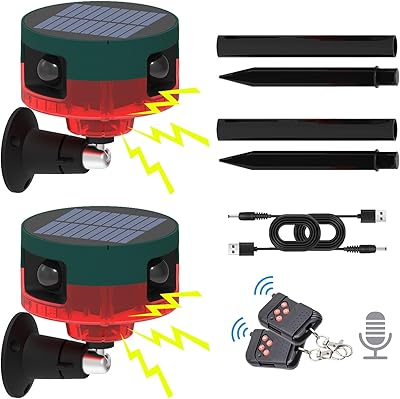
  • Mounting hardware and placement flexibility are limited to wall surfaces, which may not suit every outdoor scenario.

Ratings

Our AI rating engine analyzed verified global buyer reviews for the PILSAMAS CT90Y Solar Motion Sensor Alarm, actively filtering out incentivized, bot-generated, and repeat-submission feedback to surface what real users actually experienced. Scores reflect the honest spread of opinion — where buyers agreed overwhelmingly, scores climb; where frustrations were consistent and legitimate, they drop accordingly. Both the standout strengths and the recurring pain points are transparently baked into every number you see below.

Custom Audio Feature
88%
The ability to upload personal voice recordings is the single feature buyers mention most enthusiastically. Users who recorded pool safety warnings, predator sounds, or even personalized trespassing messages found it genuinely useful and far more effective than a fixed beep at keeping animals or visitors alert.
The 1.3MB file size cap per clip frustrates users who want longer or higher-quality recordings. A few buyers also found the USB loading process slightly fiddly on first attempt, particularly when file naming conventions caused the unit to skip clips silently.
Ease of Installation
91%
This is one of the most consistently praised aspects across all buyer segments. Most users report having the unit mounted, charged, and operational in under 15 minutes without any special tools or electrical knowledge, which is a genuine advantage for rural or off-grid placements.
The wall-mount-only design limits placement flexibility, and a small number of buyers found the included mounting hardware inadequate for masonry surfaces without supplementary anchors. Users wanting a freestanding or stake-mounted option will need a workaround.
Solar Charging Performance
58%
42%
In sunny climates with reliable daily exposure, the solar panel keeps the battery adequately topped up and allows the unit to run entirely off-grid for weeks without any USB intervention. For summer use in high-sun regions, the self-sufficiency is a real convenience.
Winter performance and overcast-climate reliability are where this solar alarm draws the most complaints. Multiple buyers in northern states and cloudy regions report the panel barely maintaining charge during short days, forcing frequent USB top-ups and undermining the off-grid pitch significantly.
Detection Reliability
67%
33%
Under ideal conditions — clear sightlines, moderate temperatures, warm-bodied targets — the PIR sensor performs consistently and triggers promptly. Buyers monitoring a single gate, coop door, or pool entry point generally report satisfactory detection with few missed events.
Real-world range frequently falls short of the stated 20 feet, particularly through foliage, at extreme angles, or in cold weather when animal body heat is less distinct from ambient temperature. False negatives at range and false positives from wind-blown vegetation are both noted in buyer feedback.
Alarm Volume
83%
The 120dB output is genuinely startling in person, and buyers consistently confirm it is loud enough to be heard clearly from inside a home or across a typical backyard. For wildlife deterrence, the sudden volume spike alone is often enough to send deer or raccoons retreating.
In urban or suburban settings, the volume draws unwanted neighbor attention and has reportedly triggered noise complaints. A small number of buyers also felt the 120dB rating was slightly optimistic compared to what they measured with a phone app, suggesting some unit-to-unit variance.
Weather Resistance
84%
The IP65 housing holds up well against rain, morning dew, garden hose splash, and temperature swings. Buyers in rainy climates and those who left units mounted through full winters generally report no water ingress, corrosion, or casing degradation after months of outdoor exposure.
A handful of long-term users noted that the solar panel surface showed minor clouding or UV discoloration after an extended outdoor season, which may gradually affect charging efficiency over time. The unit itself remains functional, but panel longevity at the multi-year mark is still an open question.
Remote Control
74%
26%
For most users, the included remote works as expected — they can arm or disarm the motion-triggered deterrent from a deck, a bedroom window, or a nearby vehicle without walking to the unit. The one-click operation is straightforward and requires no pairing process.
Effective range is modest, and thick walls or distance beyond roughly 40 feet reduce responsiveness noticeably. A few buyers reported intermittent lag or the occasional missed command, which is inconvenient when you need to silence an alarm quickly before it disturbs the household.
Build Quality
71%
29%
The compact casing feels reasonably solid for its weight class, and the unit does not rattle or creak when handled. Most buyers describe it as adequately constructed for a budget-tier outdoor device and not something that feels like it will fall apart after one season.
The plastic housing does not inspire confidence in the way a premium security device might, and some users noted the mounting bracket felt slightly flimsy under firm pressure. For a unit left permanently outdoors, the construction is acceptable but not reassuring over a multi-year horizon.
LED Strobe Effectiveness
69%
31%
The six flashing LEDs add a useful secondary deterrent layer, particularly at night when the visual flash can startle wildlife or signal to a human intruder that they have been detected. Buyers using this outdoor alarm device around pools appreciated the added nighttime visibility.
In bright daylight, the LED flash is largely invisible and adds little deterrent value. The lights are also fixed-position, so their coverage angle is limited to whatever direction the unit faces — there is no way to widen or redirect the visual alert independently of the sensor.
Scheduling Modes
81%
19%
Having three distinct time modes — always-on, daytime, and nighttime — is genuinely practical and keeps the alarm from becoming an annoyance. Buyers who live near busy pathways or have active pets especially appreciate being able to limit triggers to specific hours without manual arming each day.
The mode switching requires physical access to the unit rather than remote or app control, which is inconvenient if the alarm is mounted high or in a hard-to-reach spot. There is also no programmable schedule — you cannot set specific hours, only choose from the three fixed presets.
Value for Money
82%
18%
At its price point, the combination of custom audio, solar charging, IP65 weatherproofing, and a remote control is genuinely difficult to match in a competing product. Buyers who found a use case that fits the device's strengths consistently describe it as a smart and cost-effective purchase.
Buyers who expected professional-grade detection accuracy or robust build quality at this price were occasionally disappointed. For users whose primary use case turned out to need longer range or stronger solar performance, the value proposition weakens considerably relative to alternatives.
Animal Deterrence Effectiveness
73%
27%
Rotating custom sounds — particularly recordings of predator calls, gunshots, or barking dogs — genuinely disrupts animal habituation in ways that single-tone alarms cannot. Chicken coop and garden users report meaningful reductions in wildlife incursions when sounds are varied regularly.
No audio deterrent is foolproof, and persistent or bold animals — particularly bears or habituated urban deer — may require only a few exposures before they stop responding. The 20-foot detection limit also means a large garden may need multiple units to achieve consistent coverage.
Setup Flexibility
62%
38%
The triple-power system and wireless remote mean you are not locked into a specific location near an outlet, which opens up genuinely remote placements like fence posts, barn walls, or dock pilings. USB charging as a fallback gives users a safety net when solar underperforms.
The unit is strictly wall-mount and ships with basic hardware that does not accommodate all surface types. Users wanting to mount it on a post, stake it into soil, or angle it downward at a steep pitch will find the bracket design limiting without purchasing additional mounting accessories separately.

Suitable for:

The PILSAMAS CT90Y Solar Motion Sensor Alarm was clearly designed with practical, outdoor-focused users in mind, and it delivers best when matched to the right situation. Homesteaders and rural property owners will find real value here — particularly anyone dealing with persistent deer, bears, or raccoons raiding a garden or threatening a chicken coop. The ability to upload custom audio, like a predator call or a gunshot sound, gives it a meaningful edge over fixed-tone alarms that animals quickly learn to ignore. Pool owners and parents looking for a hands-free safety alert around water hazards will also appreciate being able to record a plain-spoken voice warning that triggers automatically when someone approaches. Because it charges via solar panel and requires no wiring whatsoever, it is an excellent fit for remote locations like a detached garage, a lakeside shed, or a rural fence line where running electricity is not practical.
Not suitable for:

Buyers expecting professional-grade perimeter security should look elsewhere, because the PILSAMAS CT90Y Solar Motion Sensor Alarm is a deterrent tool, not a surveillance or monitored alarm system — it has no camera, no connectivity, and no way to send alerts to your phone. The 20-foot detection range, while fine for a single entry point or garden bed, is simply too limited for large properties or wide-open areas where threats can approach from multiple directions. If you live in a region with extended overcast winters or heavy shade, the solar charging may not keep pace with regular use, meaning you will need to rely on USB top-ups more often than the solar pitch implies. Those who need the alarm to distinguish between a human intruder and a passing cat will be disappointed — PIR sensors at this price tier are not that selective. And if you are hoping to integrate this into a broader smart home or security ecosystem, the lack of any wireless connectivity makes that impossible.
Specifications

  • Brand: Manufactured by PILSAMAS, under the parent company LORA.
  • Model: The unit carries the model designation CT90Y, also referenced as the Round-Eye style variant.
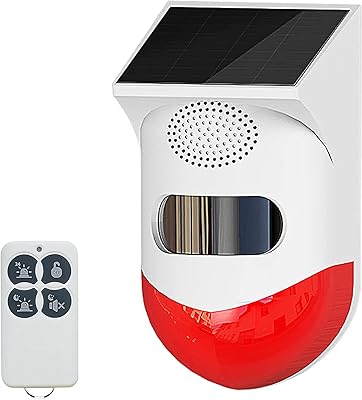
  • Dimensions: The housing measures 2.8″ deep, 3″ wide, and 5.3″ tall, making it compact enough to mount unobtrusively on most exterior walls.
  • Weight: The complete unit weighs 8.4 ounces, light enough to be supported by standard wall anchors without reinforcement.
  • Detection Range: The PIR sensor detects motion at distances of up to 20 feet under optimal line-of-sight conditions.
  • Detection Angle: The sensor covers a 110-degree horizontal field, suitable for monitoring a single entry point, gate, or garden perimeter.
  • Alarm Output: The speaker produces a maximum volume of 120dB, which is comparable to a chainsaw at close range and audible across a wide outdoor area.
  • LED Lights: Six built-in LEDs flash simultaneously when the alarm is triggered, providing a visible deterrent alongside the audio output.
  • Power Source: The device runs on a built-in lithium-ion battery that can be recharged via the integrated solar panel or a standard USB cable.
  • Battery Type: One lithium-ion battery is built into the unit and is included; no separate battery purchase is required.
  • Weather Rating: IP65 certification means the unit is fully dust-tight and protected against low-pressure water jets from any direction.
  • Temp Range: The alarm is rated to operate reliably in temperatures ranging from -20°C to 50°C, covering most outdoor climates.
  • Custom Audio: Users can upload up to 8 audio clips in MP3 or WAV format via USB, with each file required to be under 1.3MB in size.
  • Work Modes: Three scheduling modes are available — 24/7 continuous, daytime-only, and nighttime-only — switchable with a single button press.
  • Mounting Type: The device is designed for wall mounting and ships with the necessary hardware for a straightforward exterior installation.
  • Remote Control: A wireless remote control is included in the package, allowing the user to arm, disarm, or adjust the alarm without approaching the unit.
  • Availability Date: The product was first listed for sale on July 20, 2024.
  • Package Contents: Each package contains one alarm unit, one solar panel, one remote control, and mounting hardware; no additional accessories are required to begin use.

Related Reviews

COTINSE N911N Solar Motion Sensor Alarm
71%
88%
Ease of Setup
71%
Deterrence Effectiveness
91%
Alarm Volume
83%
Sound Variety
44%
Remote Control Usability
More
Anizoowu An-911S-02 Solar Motion Sensor Alarm
73%
88%
Sound & Siren Volume
74%
Motion Detection Coverage
63%
Solar Charging Reliability
81%
Custom Recording Feature
91%
Ease of Installation
More
ChunHee SL07 Solar Strobe Alarm Siren
76%
88%
Ease of Installation
61%
Solar Charging Performance
83%
Siren Volume & Deterrent Effect
72%
PIR Motion Sensor Accuracy
67%
Remote Control Reliability
More
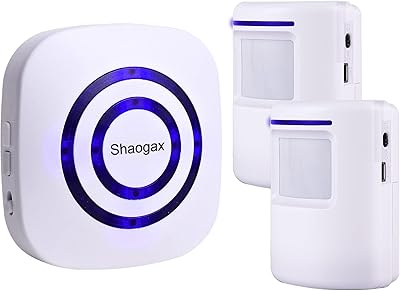
Shaogax Wireless Motion Sensor Driveway Alarm System
71%
91%
Ease of Setup
83%
Wireless Range
88%
Alert Customization
58%
False Alert Rate
61%
Build Quality
More
GREENCYCLE M-SF20R Wireless Driveway Alarm
78%
91%
Ease of Setup
78%
Detection Reliability
62%
Wireless Range
88%
Chime & Alert Volume
61%
Battery Life
More
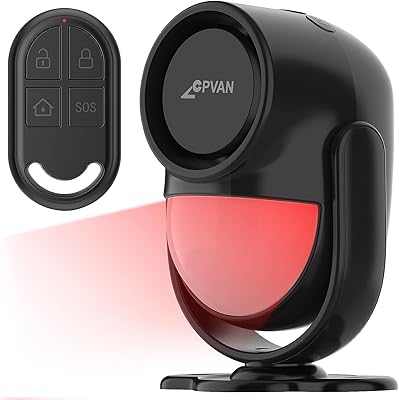
CPVAN CP2 Pro Motion Sensor Alarm
76%
93%
Ease of Setup
91%
Alarm Volume
67%
PIR Detection Accuracy
84%
Remote Control Range
61%
Battery Life
More
ROYELLE Solar Outdoor Motion Detector Alarm
82%
88%
Value for Money
91%
Ease of Installation
85%
Sound Effectiveness
78%
Battery Life in Sunlight
62%
Battery Life in Low Sunlight
More
Smart Caregiver TL-2700 Motion Sensor Alarm
63%
93%
Ease of Setup
78%
Alert Reliability
81%
Detection Range
62%
False Alarm Rate
59%
Build Quality
More
Qualirey Driveway Alarm Wireless Motion Sensor System
86%
92%
Value for Money
94%
Ease of Installation
89%
Range of Detection
88%
Weather Resistance
85%
Alert Customization
More
1byone Wireless Driveway Motion Sensor Alarm
71%
91%
Ease of Setup
67%
Wireless Range
63%
Detection Accuracy
88%
Alert Volume & Clarity
71%
Build Quality
More

FAQ

You save your audio files — MP3 or WAV format, each under 1.3MB — onto a USB drive, then plug that drive into the alarm unit. The device reads the files and replaces its default sounds with your recordings. Just keep the filenames simple and make sure the files are not tucked inside subfolders on the drive.

In regions with strong, consistent sunlight, the solar panel generally keeps pace with regular use. However, in cloudy climates or during short winter days, the panel alone may not fully replenish the battery, especially if the alarm triggers frequently. Keeping a USB cable nearby for occasional top-ups during low-light seasons is a smart habit.

No — the PILSAMAS CT90Y Solar Motion Sensor Alarm has no Wi-Fi, Bluetooth, or app connectivity of any kind. When motion triggers it, the alarm sounds and the LEDs flash locally, but you will only know it fired if you are within earshot. It is purely a physical deterrent, not a remote monitoring tool.
The PIR sensor is reasonably sensitive and will detect most warm-bodied movement within its 110-degree arc, including pets, wildlife, and people. If your dog roams the monitored area regularly, expect frequent triggers. Positioning the sensor at a height or angle that catches human-height motion while avoiding ground-level pet traffic can help reduce false activations.

The IP65 rating means it is fully protected against dust and against water jets from any direction, so rain and garden hose splashes are not a concern. It is not submersible, but for typical outdoor wall-mount use in any climate, the weatherproofing is solid and well-suited to year-round exposure.

120dB is very loud — roughly equivalent to a rock concert or a chainsaw at arm's length. In a quiet rural setting, it will carry a significant distance. In a suburban backyard, yes, your neighbors will likely hear it if it triggers. You may want to use the daytime or nighttime scheduling mode to limit activations to hours when it matters most.

Technically it will function indoors, but the solar charging panel is only useful if placed near a window with direct sunlight. For purely indoor use, you would rely on USB charging. The IP65 casing and outdoor-optimized design make it better suited to exterior applications, but there is nothing preventing indoor use in a garage or barn.

The manufacturer does not publish a specific remote range, but based on typical RF remotes included with products in this category, expect reliable operation within roughly 30 to 50 feet in open conditions. Walls and obstructions will reduce that range. Most users find it adequate for arming or disarming the unit from a deck, driveway, or nearby window.

Yes, animal habituation is a real concern with any fixed-sound deterrent. This outdoor alarm device actually addresses that problem directly — because you can load up to 8 different recordings and rotate them, you can vary what the animals hear over time, which makes it significantly harder for them to habituate compared to a single-tone alarm.

Your uploaded audio files are stored on the USB drive itself, not in the alarm's internal memory, so you do not lose them if the battery dies. Once you recharge the unit via USB or allow the solar panel to replenish it, you simply plug the drive back in if needed. No reprogramming from scratch is required.