
Overview

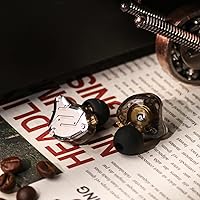
The KZ ZS10 Pro Hybrid IEM Earphones represent a genuine refinement over the original ZS10 — not a simple rebadge, but a thoughtful rethink of driver tuning and frequency extension. At this price point, multi-driver technology typically means audible compromises, yet these hybrid IEMs arrive with a stainless steel faceplate and a build quality that punches noticeably above its category. KZ swapped in new balanced armature configurations and tightened the overall presentation, producing something that sounds more coherent and articulate than the model it replaced. Whether you need a microphone or not, the flexible option set makes the ZS10 Pro easy to recommend across a surprisingly wide range of listeners.

Features & Benefits

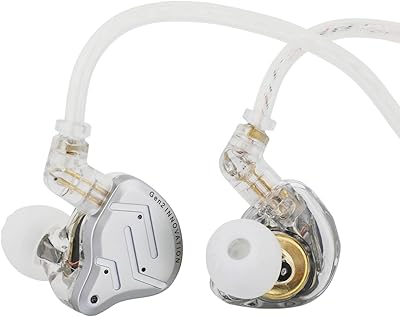
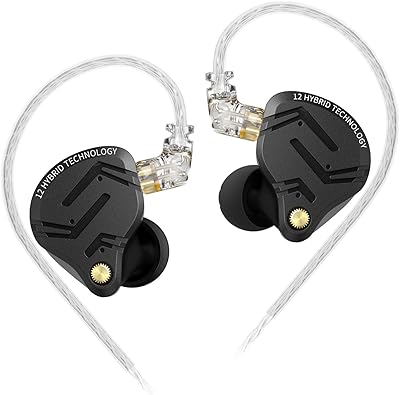
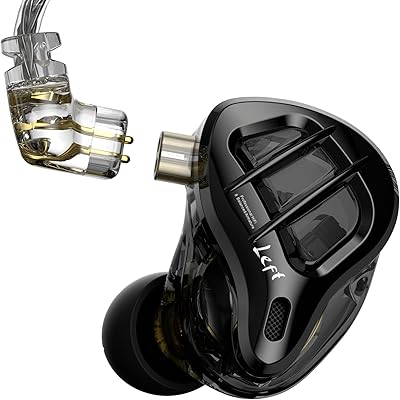
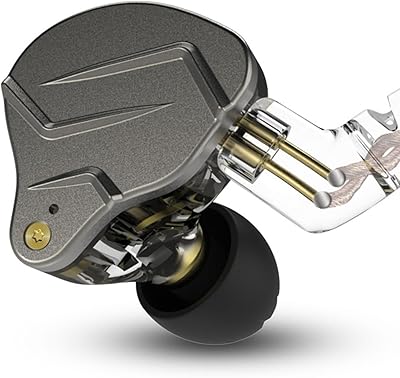
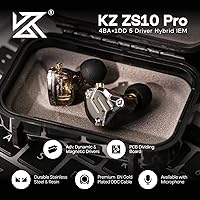
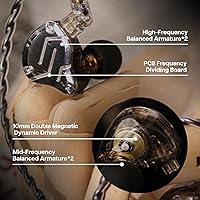
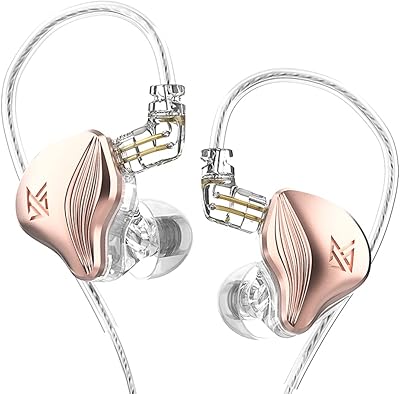
Five drivers packed into a compact shell sounds impressive on paper, but what actually matters is how they work together. The ZS10 Pro uses a 4BA plus 1DD layout — two balanced armatures for highs, two more handling mids, and a second-generation Tesla double-magnetic dynamic driver managing the low end. A PCB crossover board coordinates all of them internally, which is largely why the sound feels cohesive rather than disjointed. The shell is molded from cochlear scan data, giving it a secure fit even during movement, and passive isolation reaches around 26dB. The recessed 2-pin detachable cable with gold-plated OFC conductors means future upgrades are straightforward and affordable.

Best For

If you are just entering the IEM hobby, the ZS10 Pro is a natural starting point — it shows you what a well-executed multi-driver setup sounds like without a serious financial commitment. Gamers will appreciate the bright, detailed tuning that helps with positional audio in competitive titles, along with a fit that stays put through long sessions. Musicians on a tight budget will find it serviceable for practice or low-stakes stage use. That said, these hybrid IEMs lean analytical and forward in the highs. Listeners who live in bass-heavy genres like hip-hop or EDM may find the low-end presentation leaner than expected compared to consumer-tuned alternatives.

User Feedback

Among the large pool of verified buyers, praise centers consistently on mid and upper frequency clarity — many listeners mention catching details in familiar tracks that previous earphones had buried. The counterpoint, raised just as consistently, is that bass-heavy listeners find the low end thinner than what mainstream earphones deliver. Fit varies more than the ergonomic claims suggest; tip rolling is a near-universal recommendation in community discussions before drawing any conclusions about comfort. The stock cable is the other common friction point, with a notable share of buyers swapping it out immediately for an aftermarket option. The recessed 2-pin socket design does earn genuine credit for connector durability, and that detail surfaces repeatedly in longer-term ownership reviews.

Pros

  • Five-driver hybrid setup delivers clear mid and high-frequency detail that is rare at this price point.
  • The stainless steel faceplate gives the ZS10 Pro a build quality that looks and feels more expensive than it is.
  • Detachable 2-pin cable means a damaged cable is an easy fix, not a reason to replace the whole unit.
  • Passive noise isolation of around 26dB handles noisy commutes and open offices without any active circuitry.
  • The ergonomic resin shell fits securely enough for exercise and extended listening sessions without fatigue.
  • A PCB crossover board helps the five drivers work together coherently rather than sounding disjointed.
  • Available with or without a microphone, making it practical for calls and voice chats as well as pure listening.
  • Long-term connector durability is better than earlier KZ models thanks to the recessed 2-pin socket design.
  • Compatible with any device that has a standard 3.5mm jack, requiring no dongles or adapters on most setups.

Cons

  • Bass response will disappoint listeners accustomed to the boosted low-end of consumer-tuned earphones.
  • The stock cable feels below par and many buyers replace it almost immediately after unboxing.
  • No water or sweat resistance means outdoor workouts in rain or high-humidity conditions are a real risk.
  • Default ear tips do not work well for all ear canal sizes, and finding the right fit may require a separate tip purchase.
  • The bright high-frequency tuning can cause listening fatigue during very long sessions, particularly with poorly mastered recordings.
  • Wired-only connectivity is a deliberate design choice, but it is still a friction point for users in wireless-first environments.
  • The shell is bulkier than ultra-compact single-driver IEMs, which some users with smaller ears may notice during extended wear.
  • Cable color and style are shipped at random, so buyers cannot count on receiving a specific aesthetic variant.

Ratings

The scores below for the KZ ZS10 Pro Hybrid IEM Earphones were generated by our AI rating engine after systematically analyzing thousands of verified global buyer reviews, actively filtering out incentivized, bot-generated, and single-use account feedback to ensure the data reflects genuine ownership experiences. Both the strengths that make these hybrid IEMs a recurring recommendation in budget audiophile communities and the real pain points that frustrated a meaningful share of buyers are transparently reflected in every score.

Sound Clarity
88%
The mid and upper frequency performance is where the ZS10 Pro consistently earns its strongest praise. Listeners describe picking out background instrument layers in familiar tracks that cheaper single-driver earphones had always masked, making it a genuinely revelatory experience for buyers stepping up from stock earphones.
A handful of reviewers with more reference-grade experience find the treble slightly forward and fatiguing during very long listening sessions, particularly with older recordings that already have a bright master. It is a tuning choice rather than a defect, but it does divide opinion among critical listeners.
Bass Performance
63%
37%
The dynamic driver handles transient bass response with reasonable punch for rock, acoustic, and gaming audio, where tight and controlled low-end matters more than raw volume. Buyers who listen to jazz, classical, or cinematic soundtracks tend to find the bass presentation well-balanced and non-intrusive.
For hip-hop, EDM, and bass-heavy pop listeners, the low end consistently disappoints relative to consumer-tuned competitors at a similar price. Multiple reviewers specifically note that switching back from mainstream earphones makes the sub-bass feel noticeably thin, which is the single biggest recurring complaint in user feedback.
Soundstage & Imaging
82%
18%
Gamers and musicians repeatedly mention the sense of spatial separation the five-driver setup produces, making it easier to place sounds directionally during gameplay or pick out individual instruments during practice monitoring. For an IEM at this price tier, the width and depth of the soundstage genuinely surprised a large share of first-time buyers.
Against dedicated single-dynamic-driver IEMs known for their natural soundstage, the ZS10 Pro can feel slightly processed in its imaging. Some critical listeners describe the stage as wide but not particularly deep, which matters less in casual listening but becomes noticeable during focused critical listening sessions.
Build Quality
86%
The 304 stainless steel faceplate is a genuine differentiator that buyers regularly photograph and comment on, because it simply looks and feels more expensive than competing earphones in the same price bracket. The resin shell has held up well for the majority of long-term owners, with very few reports of cracking or deformation over time.
Some buyers report visible seam inconsistencies between the steel faceplate and resin body on certain units, suggesting quality control is not perfectly uniform across production batches. It is cosmetic rather than functional, but for buyers who care about flawless finish, it is worth inspecting on arrival.
Cable Quality
54%
46%
The detachable design itself is universally appreciated, since a worn cable becomes a simple and inexpensive fix rather than a reason to discard the entire earphone. The recessed 2-pin connector with limit-slot protection is a genuine engineering improvement over earlier KZ models and earns consistent positive mentions in longer-term reviews.
The actual stock cable included in the box draws consistent criticism for feeling stiff, prone to tangling, and below the standard the rest of the earphone sets visually. A notable proportion of buyers report ordering an aftermarket replacement within days of receiving the unit, which effectively adds an unplanned cost to the purchase.
Comfort & Fit
71%
29%
For buyers whose ear canal dimensions align well with the ergonomic resin shell, the over-ear fit is described as genuinely secure even during exercise, with many reporting hours of comfortable wear without needing to readjust. The lightweight build at around 2.11 ounces contributes meaningfully to long-session wearability.
Fit is arguably the most polarizing aspect of the ownership experience, with a significant minority of buyers reporting that the shell sits awkwardly or applies pressure at specific points in their ear. Tip rolling is recommended almost universally in community discussions, which means the out-of-box experience for some buyers requires additional time and potentially extra spending on third-party ear tips.
Noise Isolation
79%
21%
The sealed resin cavity delivers passive isolation that buyers describe as genuinely useful during commutes, library sessions, and open-plan office work, where ambient noise reduction matters without the complexity of active electronics. Reviewers report that moderate ambient noise, including conversations and keyboard noise, becomes easy to tune out at normal listening volumes.
Low-frequency noise like underground train rumble or airplane cabin drone passes through more than buyers sometimes expect from a 26 dB passive isolation rating. Those coming from active noise-cancelling earphones should temper expectations, as the isolation here is solid for a passive design but not a substitute for ANC in high-noise environments.
Microphone Quality
61%
39%
For casual voice calls and basic gaming voice chat, the inline microphone on the mic variant performs adequately and is consistently described as intelligible by call recipients in quiet indoor environments. Buyers who primarily use it for quick phone calls while commuting tend to find it perfectly serviceable.
In any environment with background noise, the microphone struggles to isolate the speaker's voice cleanly, and several reviewers note that call recipients frequently report hearing ambient noise bleeding in. It is not a microphone suited to content creation, remote work calls with clients, or any situation where audio quality on the other end matters.
Value for Money
93%
Across the entirety of user feedback, value is the category that generates the most enthusiastic and consistent praise, with buyers repeatedly expressing surprise that a five-driver hybrid IEM with a metal faceplate and detachable cable is available at this price point. Many reviewers describe it as the earphone they recommend first to friends looking to explore the IEM hobby without a serious financial commitment.
The stock cable weakness slightly undermines the headline value proposition, since buyers who feel compelled to upgrade it immediately are effectively paying more than the listed price for a satisfying out-of-box experience. For buyers on a strict budget who want a complete package with no follow-up purchases, this is worth factoring in upfront.
Driver Coherence
78%
22%
The PCB crossover board does a creditable job of integrating five drivers into a presentation that most listeners perceive as a unified, coherent sound rather than a patchwork of disparate frequency ranges. For the price, the transition between the balanced armatures and the dynamic driver is smoother than many competitors manage.
Experienced IEM listeners who have spent time with well-tuned single dynamic driver earphones sometimes describe a subtle lack of organic cohesion between the dynamic driver bass and the balanced armature midrange. It is not something casual listeners typically identify, but it does surface in detailed critical listening comparisons.
Gaming Performance
83%
The bright tuning and multi-driver detail retrieval work in the ZS10 Pro's favor specifically for competitive gaming, where picking up footsteps, directional cues, and environmental audio cues matters more than low-end impact. Gamers describe it as a meaningful improvement over their previous headsets in terms of positional awareness.
The lack of any virtual surround sound processing and the absence of a boom microphone mean it is not a drop-in replacement for a dedicated gaming headset in team-based multiplayer environments. The inline mic variant helps for voice chat, but overall microphone performance trails purpose-built gaming peripherals noticeably.
Detachability & Upgradability
87%
The recessed 2-pin detachable system opens up a wide ecosystem of compatible aftermarket cables at varying price points, giving owners genuine long-term flexibility to tune both the aesthetics and, to a lesser degree, the sound of the earphone over time. The improved connector protection design reduces the pin damage risk that affected earlier KZ models.
The random cable color and style shipped with each unit, as noted in the product listing, means buyers cannot reliably predict the aesthetic they will receive, which is a minor but recurring frustration for those who care about the visual presentation of their setup.
Packaging & Accessories
58%
42%
The included silicone ear tips come in multiple sizes, which gives buyers a reasonable starting point for finding a functional fit without any additional purchase. The user manual, while basic, covers the essentials for first-time IEM users unfamiliar with over-ear cable routing.
Beyond ear tips and the cable, the package includes no carrying case, no cable management solution, and no additional accessories of note, which feels sparse compared to some competitors at a similar price point. Buyers planning to travel with the ZS10 Pro will need to source a case separately to protect the earphones in a bag.
Long-Term Durability
74%
26%
The stainless steel faceplate shows very little visible wear even after months of daily use according to long-term owners, and the resin shell has proven resistant to the minor drops and bag-jostling that earphones inevitably experience in daily carry. The connector protection design has meaningfully reduced the pin damage issues that plagued the original ZS10.
A small but consistent subset of longer-term reviews mention that the stock cable begins to show wear at the connector junction and the 3.5mm jack end within several months of regular use, reinforcing the case for an aftermarket cable replacement as a proactive rather than reactive decision.

Suitable for:

The KZ ZS10 Pro Hybrid IEM Earphones are an excellent match for anyone taking their first serious step into the world of multi-driver in-ear monitors without committing to a premium price tag. Hobbyist audiophiles who want to hear what a properly tuned hybrid setup actually sounds like — with real driver separation and extended high-frequency detail — will find a lot to appreciate here. Gamers who favor wired connections for their lower latency and who rely on precise positional audio cues in competitive play will benefit from the bright, articulate sound signature these hybrid IEMs deliver. Musicians on a working budget, whether rehearsing at home or monitoring on a small stage, get a functional and durable in-ear option with the added practicality of a swappable cable. Commuters who want meaningful passive isolation and a secure fit that survives a busy subway or a morning run will also find the ergonomic shell design holds up well in real-world daily use.

Not suitable for:

The KZ ZS10 Pro Hybrid IEM Earphones are a harder sell for listeners whose music taste lives primarily in bass-forward genres like hip-hop, trap, or electronic dance music, as the tuning leans bright and analytical rather than warm and thumping. Anyone expecting the deep, pillowy low-end response of mainstream consumer earphones in this price range will likely feel the bass presentation is underwhelming by comparison. The stock cable, while functional, is not a strong point, and buyers who dislike the idea of factoring in an aftermarket cable purchase should weigh that extra consideration upfront. People with smaller ear canals may also struggle with the default ear tips, and while tip rolling solves the problem for most, it does add friction to the out-of-box experience. Finally, those who need water or sweat resistance for intense workouts should look elsewhere entirely, as these wired in-ear monitors offer no rated protection against moisture.

Specifications

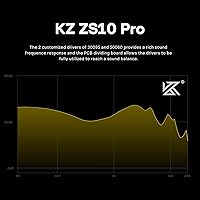
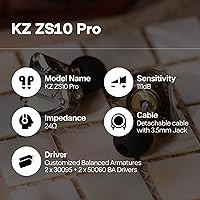
  • Driver Config: Five drivers total: two 30095 balanced armatures for highs, two 50060 balanced armatures for mids, and one second-generation Tesla double-magnetic dynamic driver for bass.
  • Impedance: Impedance is rated at 24 Ohm, making the ZS10 Pro easy to drive directly from a smartphone or laptop without a dedicated amplifier.
  • Sensitivity: Sensitivity is rated at 111 dB, meaning these hybrid IEMs will reach listening volume comfortably even from low-power source devices.
  • Frequency Response: Frequency response extends up to 40 kHz, covering the full audible range and reaching into the ultrasonic region.
  • Noise Isolation: Passive noise isolation is rated at up to 26 dB, achieved through the sealed resin cavity design rather than any active circuitry.
  • Cable Connector: The earphones use a recessed 2-pin detachable connector with a limit-slot protection design to reduce stress and wear on the interface.
  • Cable Termination: The included cable terminates in a standard 3.5mm audio jack, compatible with most smartphones, laptops, desktops, and portable audio players.
  • Cable Material: The stock cable uses gold-plated OFC (oxygen-free copper) conductors intended to minimize signal loss and resist oxidation over time.
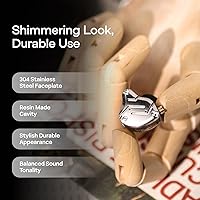
  • Faceplate Material: The outer faceplate is constructed from 304 stainless steel, providing scratch resistance and a polished aesthetic without adding significant weight.
  • Cavity Material: The inner shell cavity is molded from imported resin, shaped using cochlear data to approximate a custom-fit profile for a broad range of ear canals.
  • Item Weight: Total weight is approximately 2.11 ounces (around 60 grams), keeping the earphones light enough for extended daily wear.
  • Microphone: A microphone variant is available at purchase, with the mic integrated into the cable for hands-free calling and voice communication.
  • Water Resistance: These earphones carry no official water or sweat resistance rating and should not be used in rain or during high-intensity sweating activities.
  • Crossover Board: An internal PCB dividing board manages signal routing between all five drivers, aiming to reduce phase issues and improve driver coherence.
  • Compatibility: The 3.5mm wired connection is compatible with smartphones, tablets, desktops, laptops, and any standard audio source with a headphone output.
  • Wireless Support: Bluetooth and wireless connectivity are not supported; this is a fully wired in-ear monitor intended for direct wired use only.
  • Included Items: Each unit ships with the earphones, a detachable cable, a set of silicone ear tips in multiple sizes, and a basic user manual.
  • Earpiece Shape: The earpiece shell is circular in profile with an over-ear cable routing design for a secure, stable fit during movement.

Related Reviews
Linsoul KZ ZSN PRO 2 IEM
87%
91%
Sound Quality
88%
Comfort & Fit
84%
Bass Response
89%
Build Quality
92%
Value for Money
More
Westone Audio Pro X30 IEM Earphones
84%
92%
Sound Quality
88%
Comfort and Fit
90%
Sound Isolation
85%
Build Quality
80%
Ease of Use
More
MEE audio MX2 PRO Dual-Driver Hybrid IEM
85%
91%
Sound Quality
94%
Bass Performance
86%
Fit and Comfort
89%
Build Quality
88%
Noise Isolation
More
Linsoul KZ ZSX 5BA+1DD Hybrid In-Ear Earphones
85%
92%
Sound Quality
88%
Comfort & Fit
89%
Build Quality
90%
Noise Isolation
85%
Cable Durability & Customization
More
NICEHCK DB2 IEM Earphones
86%
89%
Sound Quality
91%
Bass Response
87%
Comfort & Fit
83%
Durability
85%
Build Quality
More
KZ ZEX Hybrid Earbuds
82%
91%
Sound Quality
88%
Comfort & Ergonomics
92%
Value for Money
87%
Build Quality & Durability
85%
Ease of Use
More
KZ ZS12 PRO X
KZ ZS12 PRO X
89%
95%
Sound Clarity
91%
Bass Response
93%
Treble Detail
90%
Midrange Accuracy
88%
Noise Isolation
More
KZ ZAR Hybrid In-Ear Monitors
86%
92%
Sound Quality
89%
Comfort & Fit
90%
Noise Isolation
84%
Build Quality & Durability
72%
Cable Durability
More
KZ ZSN Pro in Ear Monitors
85%
91%
Sound Quality
85%
Comfort & Fit
88%
Build Quality
89%
Noise Isolation
82%
Durability
More
DEWALT Jobsite Pro DXMA1902091
85%
93%
Chassis Durability
91%
Battery Longevity
88%
Gloved Operation
86%
Water & Dust Resistance
74%
Passive Sound Isolation
More

FAQ

Not at all. With a 24 Ohm impedance and 111 dB sensitivity, the ZS10 Pro will get plenty loud directly from a phone, tablet, or laptop. A dedicated amplifier is not required, though one may refine the sound if you already own one.

This is one of the most common early complaints, and tip rolling almost always fixes it. Try the included silicone tips in a smaller size first, and if none of them work well for your ear shape, aftermarket foam or wide-bore silicone tips from brands like Spinfit or Comply are popular community recommendations.

The stock cable is functional and will not degrade sound quality in any obvious way, but it is a common point of frustration for buyers who want something more flexible or visually refined. Plenty of users replace it with an aftermarket option within the first week. If the cable works for your use case, there is no urgent reason to swap it, but the 2-pin connector makes upgrading straightforward and affordable.

The tuning here is noticeably brighter and more detail-forward than what most stock or budget consumer earphones deliver. Highs are more extended and present, mids are cleaner, and the bass, while present, is tighter and less exaggerated than what you might be used to. For pop, rock, classical, or gaming audio, this works really well. For hip-hop or heavy EDM where you want strong sub-bass, the ZS10 Pro may feel lean.

Yes, these work well for gaming. The bright tuning and five-driver setup give you good positional clarity for competitive titles. They connect via 3.5mm, so any controller or PC headphone port will work. If you pick up the microphone variant, you get a basic inline mic for voice chat as well.

They will stay in place reasonably well during moderate exercise thanks to the over-ear cable routing and ergonomic shell, but they carry no sweat or water resistance rating at all. Light gym use is probably fine for most people, but if you sweat heavily or plan to use them in rain, a water-resistant pair would be a smarter choice.

Passive isolation rated at 26 dB is genuinely useful for blocking out ambient noise in commuting or office environments, but it is a physical seal, not electronic cancellation. It will not eliminate low-frequency rumble the way active noise cancellation does, but for blocking out voices, keyboard noise, or light traffic, it does a solid job.

You can absolutely replace just the cable. These use a standard recessed 2-pin connector, and replacement cables from KZ, Tripowin, and other compatible brands are widely available and inexpensive. This is one of the practical advantages of choosing a detachable-cable IEM over a fixed-cable design.

For the ear tips, remove them and rinse them with warm water, then let them dry fully before reattaching. For the shell and nozzle, a dry soft-bristle brush or a toothpick wrapped in a small piece of tissue works well to clear earwax buildup without pushing debris further in. Avoid any liquid near the driver housing or connector pins.

No, the driver configuration and tuning are identical between both variants. The only difference is the presence of a microphone and remote inline on the cable. If you never plan to use the mic for calls or voice chat, the no-mic version is a perfectly fine choice.