Overview

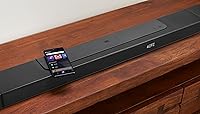
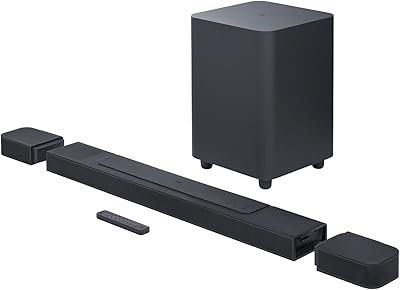
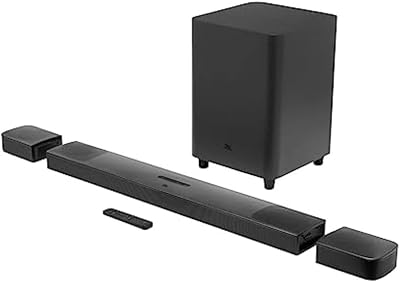
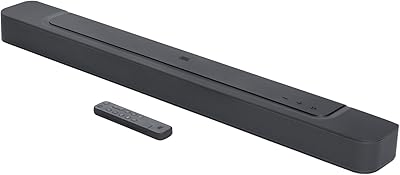
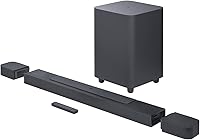
The JBL Bar 700 5.1-Channel Soundbar is one of the more thoughtfully designed home theater systems available for anyone tired of stereo audio pretending to be surround sound. What sets this JBL soundbar system apart isn't just the spec sheet — it's the fact that the surround speakers physically detach from the main bar and run on battery power, placing them behind you without a single cable in sight. That's a genuine structural difference from nearly every competing soundbar at this tier. Pair that with a wireless subwoofer and the whole setup works cohesively right out of the box. Realistically, the Bar 700 is sized for larger spaces — rooms from roughly 128 to 453 square feet and TVs 55 inches or bigger.
Features & Benefits

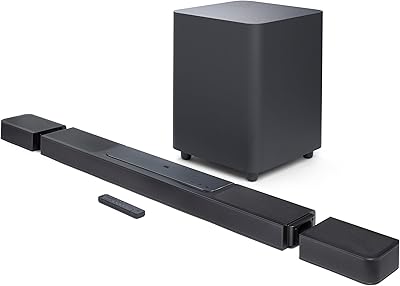
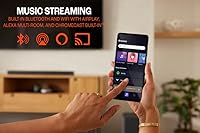
The detachable surround speakers are the most compelling part of this surround sound setup. Charge them up, place them on stands or shelves behind your seating position, and they pair wirelessly — no outlets needed nearby. For Dolby Atmos content, the spatial effect is noticeably more convincing than what upward-firing drivers in a single bar can produce. The 10-inch wireless subwoofer delivers bass you feel in your chest during action sequences without sounding muddy on music. Connectivity is broad: AirPlay 2, Chromecast, and Alexa Multi-Room Music cover virtually every streaming ecosystem, and the companion app gives real control over EQ and sound modes rather than burying everything in a remote.

Best For

This JBL soundbar system makes the most sense for people who want true 5.1 surround sound but have no interest in running cables across their living room. If you have been stuck with a basic 2.1 soundbar and keep noticing that effects feel flat during action films or gaming, the Bar 700 is a meaningful jump up. It also rewards streaming-heavy households — anyone deep in the Apple, Google, or Amazon ecosystem will appreciate how naturally it integrates. One thing to be honest about: the price is premium, and it is justified mainly if you have the room to take advantage of it. Compact apartments or bedrooms with smaller TVs will not get the full return on that investment.

User Feedback

Buyers are broadly positive about the Bar 700, and the 4.5-star average across nearly 300 ratings reflects that. The wireless surround speakers draw the most consistent praise — owners frequently note the setup feels cleaner than a traditional receiver system without sacrificing much in terms of actual surround positioning. Bass output from the subwoofer gets similar marks, holding up equally well for music and movies. On the downside, a few users ran into initial connectivity hiccups with the app that required a restart to resolve. There is also a practical concern worth noting: the soundbar's low profile can sometimes block TV IR sensors on certain stand configurations, which disrupts remote functionality until repositioned.

Pros

  • Detachable surround speakers deliver genuine positional audio without a single cable leaving the main unit.
  • The wireless subwoofer produces deep, controlled bass that holds up equally well for music and film.
  • Dolby Atmos support adds a convincing spatial layer when watching properly encoded content.
  • AirPlay 2, Chromecast, and Alexa MRM in one system covers virtually every major streaming ecosystem.
  • The full system arrives ready to use — no receiver, no separate amplifier, no additional purchases required.
  • App-based EQ and speaker level controls give more tuning flexibility than most soundbars in this category.
  • The surround speakers charge directly on the main bar, keeping the whole system self-contained when not in use.
  • Dialogue clarity is a clear improvement over built-in TV speakers, even at moderate listening volumes.
  • The 46.2-inch wide bar scales visually and acoustically to large-format TVs without looking out of proportion.

Cons

  • Surround speaker battery life can fall short during extended viewing sessions, and there is no on-unit charge indicator.
  • First-time app setup frequently requires multiple pairing attempts before Wi-Fi connectivity stabilizes.
  • The bar's low height profile can physically block the IR sensor on certain TV stand configurations.
  • Bluetooth playback introduces noticeable latency, making it a poor choice for video content from a phone.
  • Advanced controls like per-speaker level adjustment are locked behind the app — the remote alone is insufficient.
  • Default sound processing modes artificially widen stereo music in ways that will bother critical listeners.
  • The surround speaker housings feel considerably lighter and less premium than the main bar in hand.
  • Room geometry significantly affects surround staging — irregular layouts or low ceilings reduce the spatial effect.
  • Buyers in dense wireless environments may experience occasional subwoofer dropouts that require repositioning to resolve.

Ratings

The JBL Bar 700 5.1-Channel Soundbar scores were generated by an AI system trained to analyze verified global buyer reviews, actively filtering out incentivized, duplicate, and bot-driven submissions to surface what real owners actually experience. Across every category below, both the highlights and the friction points are reflected honestly — this is not a promotional summary. The Bar 700 earns strong marks in several areas, but like any premium system, it has trade-offs worth knowing before you commit.
Surround Sound Immersion
91%
The detachable, battery-powered surround speakers produce a convincing sense of audio placement that most soundbar systems simply cannot replicate. Buyers watching action films or playing first-person games consistently describe directional cues — footsteps, ambient effects, overhead audio — feeling genuinely spatial rather than simulated.
The surround effect depends heavily on speaker placement height and distance from the listening position. Users in rooms with irregular layouts or low ceilings report the Dolby Atmos overhead effect is less pronounced than expected, which can feel underwhelming given the system's price tier.
Bass Performance
88%
The 10-inch wireless subwoofer delivers low-end impact that owners describe as physical — felt in the chest during explosions and deep bass lines. Music listeners in particular note that the bass stays controlled and does not bleed into the midrange, which is a common complaint with cheaper subwoofers in this form factor.
A handful of reviewers in smaller rooms found the default bass tuning too aggressive out of the box, requiring app-based EQ adjustments to dial it back. The subwoofer's wireless connection very occasionally drops during heavy signal interference, though this appears to be an edge case rather than a widespread issue.
Detachable Speaker Design
93%
The concept of charging the surround speakers on the main bar and then placing them anywhere in the room is genuinely practical. Buyers in apartments or rentals where drilling and cable routing are not options consistently call this the single biggest reason they chose the Bar 700 over a traditional receiver setup.
Battery life on the surround speakers is a real consideration that the product marketing underplays. Several owners report needing to recharge them after extended movie marathon sessions, and there is no visible battery indicator on the speakers themselves — you typically discover they are low when audio cuts out.
App & Setup Experience
67%
33%
Once the JBL One app is properly configured, it offers genuine control — EQ presets, individual speaker levels, sound mode switching, and firmware updates all happen through a reasonably clean interface. Users who got through the initial setup without issues rate the app experience positively.
First-time setup is the most cited frustration across reviews. Bluetooth and Wi-Fi handshakes during initial pairing can fail silently, leaving buyers unsure whether to restart the bar, the router, or the app. Multiple reviewers needed two or three attempts before everything connected stably, which is a poor first impression for a premium product.
Dolby Atmos Performance
82%
18%
With properly encoded Atmos content — Netflix originals, 4K Blu-ray, compatible games — the height and overhead audio layers add a layer of realism that a standard stereo soundbar cannot approach. The effect is most impressive in large open rooms where sound has space to develop and reflect naturally.
The Bar 700 does not include dedicated upward-firing drivers in the surround speakers, so the height channel information is handled primarily by the main bar. In rooms where the main bar sits low relative to the listening height, the overhead imaging feels flatter than buyers accustomed to ceiling-speaker Atmos setups might expect.
Streaming & Connectivity
89%
Support for AirPlay 2, Chromecast, and Alexa Multi-Room Music in a single system is genuinely rare at this form factor. Buyers embedded in Apple or Google households appreciate that switching between devices requires no physical input switching — the bar just responds to wherever audio is being cast from.
Bluetooth connectivity, while functional at up to 10 meters, is the weakest of the wireless options — latency is noticeable when using it for video playback from a phone. Wi-Fi-based streaming is significantly more reliable, but buyers who primarily use Bluetooth out of habit may not immediately realize this until they troubleshoot on their own.
Build Quality & Materials
78%
22%
The main soundbar has a solid, premium feel with a metal grille and clean rectangular profile that sits naturally below most large-format TVs. At nearly 40 pounds for the full system, the subwoofer in particular has the heft that signals serious internal components rather than hollow plastic construction.
The surround speakers feel noticeably lighter and more plasticky compared to the main bar, which creates a slight mismatch in perceived quality when you handle them. Some buyers noted minor scuffs appearing on the surround speaker housing after routine handling, suggesting the finish is not particularly scratch-resistant.
Sound Quality for Music
84%
Stereo music playback through the Bar 700 is more satisfying than many buyers expect from a surround-focused system. The midrange clarity is strong enough that vocals in jazz or acoustic tracks come through without the honky coloration that can plague soundbars with compressed driver arrays.
The system defaults to its surround processing modes, which can artificially widen stereo music in a way that sounds unnatural for purists. Switching to a dedicated stereo mode via the app corrects this, but it is not an obvious step for buyers who expect correct defaults out of the box.
Dialogue Clarity
79%
21%
Center channel dialogue reproduction is clear enough for everyday TV watching, including fast-paced drama and news content where speech intelligibility matters most. Most users transitioning from a basic TV speaker report an immediate and noticeable improvement in how clearly they can follow conversation at moderate volumes.
At very high volumes, dialogue can feel slightly recessed compared to the expansive bass and surround effects, which some users describe as characters sounding distant during loud action sequences. A dedicated dialogue enhancement mode exists in the app, though its effectiveness is inconsistent across different content types.
TV Compatibility & IR Passthrough
62%
38%
In most standard TV stand configurations, the Bar 700 connects via HDMI eARC and works reliably with TV remotes for volume control through CEC. The HDMI implementation is stable and does not require manual configuration on most modern Samsung, LG, or Sony TVs.
The soundbar's low 2.2-inch height is a double-edged concern — it fits under slim TVs cleanly, but on certain stands where the TV IR sensor sits low, the bar physically blocks the signal path from the remote. This is not a universal problem, but it comes up frequently enough in reviews that buyers should check their TV stand geometry before purchasing.
Value for Money
74%
26%
For buyers who want genuine surround sound without a full receiver-and-speaker system, the all-in-one nature of this setup represents real value. The combination of wireless surround placement, a capable subwoofer, and broad streaming support in a single package would cost considerably more when assembled from separate components.
At its price point, buyers will find competing soundbars from Sony and Samsung that offer Atmos support and strong audio performance, even if they lack the detachable speaker trick. If the wireless surround concept is not a priority for your room, the price premium is harder to justify purely on sound quality alone.
Remote Control Usability
71%
29%
The included remote covers the core functions — volume, input switching, sound mode cycling, and subwoofer level — without requiring the app for day-to-day use. The button layout is logical and readable in low-light environments, which matters for a device primarily used during movie watching.
The remote lacks backlighting, which becomes a genuine inconvenience in dark home theater setups. More critically, advanced functions like EQ adjustment and individual surround speaker level control are app-only, which means users who prefer a traditional remote workflow will feel the interface is incomplete.
Subwoofer Wireless Stability
81%
19%
The wireless subwoofer connects automatically during startup and maintains its connection through normal use without requiring manual pairing steps. Buyers consistently report that the bass integration feels tight and synchronized — there is no audible lag between the bar and the subwoofer during fast transient sounds like drum hits or on-screen impacts.
A small percentage of reviewers report occasional dropouts when the subwoofer is placed on the far side of a wall or in rooms with dense wireless environments. The subwoofer lacks any signal strength indicator, so diagnosing placement-related connectivity issues requires trial and error rather than a clear diagnostic tool.
Physical Footprint & Placement
83%
At 46.2 inches wide, the soundbar scales appropriately under a 65-inch or larger TV without looking undersized. The wireless design of both the subwoofer and surround speakers gives buyers real flexibility in furniture arrangement — the subwoofer in particular can be tucked to the side or behind furniture without penalty.
The full system has a meaningful physical footprint once all components are in place. Users in tighter living rooms sometimes find that placing the surround speakers far enough behind the seating position for ideal audio staging conflicts with their furniture layout, limiting the practical surround effect.

Suitable for:

The JBL Bar 700 5.1-Channel Soundbar is built for people who want a real surround sound experience but are not willing — or able — to route speaker cables across their living room. If you have a large TV, a proper lounge or dedicated media room, and you watch a lot of content where audio placement actually matters — action films, immersive gaming, concert footage — this setup delivers in a way that a standard two-channel or even 3.1 soundbar simply cannot. It makes particular sense for renters or apartment dwellers who cannot permanently mount speakers, since the detachable surround units just need a shelf or speaker stand rather than any installation. Streaming-heavy households embedded in Apple, Google, or Amazon ecosystems will also find the connectivity side of this system unusually complete — switching between AirPlay, Chromecast, and Alexa playback requires no input juggling. Buyers upgrading from an entry-level soundbar who are ready to invest in something that punches closer to a separates system will find the Bar 700 a compelling and coherent step forward.
Not suitable for:

The JBL Bar 700 5.1-Channel Soundbar is genuinely hard to recommend for smaller rooms, compact apartments, or anyone pairing it with a TV under 55 inches — the system is physically and acoustically sized for larger spaces, and in a tight room the subwoofer output alone can feel overwhelming before you even push the volume. Buyers who expect a plug-and-play experience with zero app involvement may find the initial setup frustrating, as first-time Wi-Fi pairing can require patience and sometimes multiple attempts. If your primary use case is background music or casual TV watching rather than dedicated home theater sessions, the price premium of this surround sound setup is difficult to justify against simpler alternatives. Those who rely heavily on their TV remote for all audio control should also take note: the Bar 700's low profile can obstruct the IR sensor on some TV stands, which forces workarounds. And if you routinely run four-hour movie marathons back to back, the battery-powered surround speakers will need a recharge mid-session, which disrupts the wireless convenience that makes this system appealing in the first place.
Specifications

  • Channel Configuration: The system operates as a true 5.1-channel surround setup, with a dedicated center channel, left and right drivers in the main bar, two detachable wireless surround speakers, and a standalone wireless subwoofer.
  • Total Output Power: The full system delivers 620W of combined output power across all channels and the subwoofer.
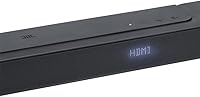
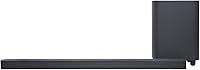
  • Soundbar Dimensions: The main soundbar measures 46.2″ wide, 4.7″ deep, and 2.2″ tall, designed to sit flush under large-format televisions without obstructing the screen.
  • Subwoofer Driver: The wireless subwoofer houses a 10″ dynamic driver tuned for deep low-frequency extension down to 20 Hz.
  • Tweeter Diameter: The main soundbar incorporates 0.75″ tweeters to handle high-frequency audio reproduction within the front soundstage.
  • Wireless Connectivity: Built-in Wi-Fi supports AirPlay 2, Chromecast built-in, and Alexa Multi-Room Music for network-based audio streaming without Bluetooth dependency.
  • Bluetooth: Bluetooth is supported with a stated range of up to 10 meters, suitable for casual audio casting from nearby mobile devices.
  • Surround Speakers: The two detachable surround speakers are battery-powered with a 3283 mAh cell each, connecting to the system wirelessly without requiring power outlets at their placement location.
  • Audio Formats: The system supports Dolby Atmos decoding, enabling three-dimensional spatial audio reproduction when the source content is encoded in Atmos format.
  • Recommended Room Size: JBL rates the Bar 700 for rooms ranging from approximately 128 to 453 square feet, making it suitable for mid-size to large living rooms.
  • TV Size Compatibility: The system is designed and acoustically optimized for use with televisions 55 inches or larger.
  • System Weight: The complete system, including the soundbar, subwoofer, and surround speakers, totals approximately 39.6 pounds.
  • Control Method: Primary control is handled through the JBL One companion app, which provides access to EQ adjustment, sound modes, and individual speaker level settings; a physical remote is also included for core functions.
  • Audio Driver Type: All drivers in the system use a dynamic driver design, which is standard for home audio applications requiring controlled excursion and efficient power handling.
  • HDMI Connectivity: The soundbar connects to compatible televisions via HDMI eARC for lossless audio passthrough and CEC-based volume control through the TV remote.
  • Power Source: The main soundbar and subwoofer are AC-powered, while the detachable surround speakers run on their internal rechargeable batteries and charge via contact points on the main soundbar.
  • Input Voltage: The system is rated for 100V input, so buyers in regions with different mains voltages should verify compatibility or use an appropriate voltage converter.
  • Streaming Services: Through AirPlay 2, Chromecast, and Alexa MRM, the system can access over 300 online music streaming services and internet radio platforms without a separate streaming device.
  • Warranty: The Bar 700 is covered by a limited manufacturer warranty from JBL; buyers should confirm duration and regional terms directly with JBL or the retailer at point of purchase.
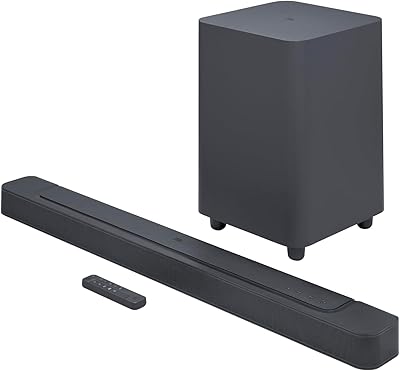
  • Included Components: The package includes the main soundbar unit, two detachable wireless surround speakers, one wireless subwoofer, and a remote control.

Related Reviews

JBL Bar 500
JBL Bar 500
81%
88%
Sound Quality
91%
Bass Performance
86%
Dialogue Clarity
93%
Streaming & Connectivity
89%
Setup & Installation
More
JBL Bar 1000 7.1.4 Soundbar
81%
91%
Surround Sound Immersion
88%
Detachable Speaker Convenience
89%
Bass Performance
87%
Dolby Atmos & DTS:X Decoding
71%
Value for Money
More
JBL Bar 1300X 11.1.4-Channel Soundbar
80%
91%
Surround Sound Immersion
88%
Detachable Surround Speaker Design
93%
Bass Performance
67%
Value for Money
74%
Setup & Installation
More
JBL Bar 9.1
JBL Bar 9.1
78%
91%
Surround Sound Performance
88%
Bass Quality
83%
Dolby Atmos & DTS:X Decoding
89%
Wireless Surround Speaker Design
61%
Surround Speaker Battery Life
More
TCL Q75H 5.1.2 Channel Soundbar
85%
91%
Sound Quality
88%
Ease of Setup
92%
Bass Performance
89%
Dialogue Clarity
84%
Build Quality
More
TCL Q65H 5.1 Channel Sound Bar with Dolby Atmos
84%
88%
Sound Quality
92%
Ease of Setup
91%
Value for Money
75%
Bass Performance
87%
Connectivity Options
More
Polk Audio MagniFi Max AX Sound Bar
78%
91%
Audio Performance
83%
Dolby Atmos & Height Channel Effect
93%
Dialogue Clarity & VoiceAdjust
89%
Subwoofer Performance
78%
Wireless Connectivity & Streaming
More
LG S95TR Soundbar
LG S95TR Soundbar
81%
93%
Surround Sound Immersion
89%
Dialogue Clarity
88%
Wireless Setup & Cable Management
91%
LG Ecosystem Integration
76%
Subwoofer Performance
More
LG S70TY 3.1.1-Channel QNED TV Matching Soundbar
88%
91%
Sound Quality
93%
Ease of Setup
96%
Compatibility with LG QNED TVs
88%
Dialogue Clarity
84%
Bass Performance
More
JBL Bar 300 5.0-Channel Soundbar
78%
83%
Sound Quality
66%
Bass Performance
89%
Dialogue Clarity
91%
Connectivity & Ecosystem
84%
Setup & Installation
More

FAQ

JBL does not publish a specific battery life figure prominently, which is itself worth noting. Based on owner reports, expect roughly 10 hours of use under normal listening volumes before the surround speakers need to be docked back on the main bar to recharge. If you regularly watch two or three films in a single evening, you are unlikely to run into issues, but marathon sessions over four or five hours straight can occasionally push the limits depending on volume level.

The JBL Bar 700 5.1-Channel Soundbar does decode Dolby Atmos natively — it is not a simulation or upmixing trick. The height and overhead audio information in Atmos-encoded content is processed and reproduced through the speaker array. That said, the system does not include dedicated upward-firing drivers in the surround speakers, so the height effect is primarily generated by the main bar. In a large room with properly placed speakers, the effect is convincing; in smaller or acoustically irregular spaces it is more subtle.
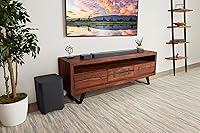
This is a genuine concern that comes up in real owner feedback and is worth checking before you buy. The bar stands only 2.2 inches tall, which is low enough that on certain TV stand configurations the bar sits directly in front of the TV's IR receiver window. Whether this affects you depends entirely on the height of your TV's IR sensor relative to your stand. If the sensor is centered low on the TV bezel, you may need to reposition the bar slightly or use HDMI CEC control instead, which routes volume commands through the HDMI connection and bypasses IR entirely.

No — the detachable surround speakers are designed exclusively to work as part of the Bar 700 system. They do not have standalone Bluetooth pairing capability or their own audio input. They charge on the main bar and communicate with the system wirelessly, but they only function within the context of this surround sound setup.

Through the combination of AirPlay 2, Chromecast built-in, and Alexa Multi-Room Music, you can stream from virtually every major platform — Spotify, Apple Music, Tidal, Amazon Music, YouTube Music, Deezer, and hundreds of internet radio services among them. The key point is that streaming happens directly to the bar over Wi-Fi, so your phone is just a controller, not the audio source. That matters for playback quality and connection stability compared to standard Bluetooth streaming.

You can handle basic day-to-day use — volume, input switching, and sound mode cycling — with the included remote alone. However, anything beyond that, including EQ adjustments, individual speaker level control, and firmware updates, requires the JBL One app. If you are someone who sets their sound preferences once and leaves them, the remote is probably sufficient after initial configuration. If you like to tune regularly or switch between profiles, the app becomes part of your routine.

Honestly, first-time setup is the roughest part of owning the Bar 700, based on consistent feedback from real buyers. The JBL One app walks you through the process, but the initial Wi-Fi and Bluetooth handshakes can occasionally fail or time out without clear error messaging. Having your phone on the same network as you intend to connect the bar to, and keeping the app open throughout, helps. Most people who had issues resolved them within a second or third attempt — it is a frustrating first impression but not a permanent problem.

Yes — the Bar 700 is listed as compatible with projectors, and the connection method would typically depend on what outputs your projector supports. If the projector has HDMI ARC or eARC, that is the cleanest option. Otherwise, optical audio input can serve as a fallback for audio routing from the projector. The wireless streaming options via AirPlay or Chromecast also let you send audio directly from a source device without routing through the projector at all.

JBL does not publish a hard maximum range for the surround speaker wireless link, but the system is designed for typical living room distances — generally up to around 30 feet in open space. Walls, dense furniture, and interference from other 2.4 GHz or 5 GHz devices can reduce effective range. In practice, placing them 6 to 10 feet behind your seating position — the ideal listening position anyway — keeps them well within reliable operating range.

The wireless subwoofer connects to the main bar over a dedicated wireless link and does not need to be adjacent to it. Low-frequency bass is largely non-directional, so placement is flexible — behind a sofa, beside a media cabinet, or in a corner all work acoustically. The main practical constraint is that it still needs to be plugged into a power outlet, so placement is limited by cable reach. Keeping it within the same room and away from dense wireless interference is all that is required for stable operation.

Where to Buy